- Updated:
- Published:
How to measure and maximize influencer impact in iGaming (2026 Guide)

Why 2026 is the year hype finally meets measurement
For much of the past decade, influencer marketing in iGaming followed a familiar arc.
First came curiosity. Then enthusiasm. Then, inevitably, excess.
By 2024 and 2025, streamers and content creators were everywhere — promoting casinos, crash games, sportsbooks, and crypto platforms to millions of viewers across Twitch, YouTube, and Telegram. The assumption was simple: attention equals acquisition.
By 2026, that assumption no longer holds.
Across operators, affiliates, platforms, and regulators, the industry has reached a quieter, more sober conclusion: influencers can still drive growth, but only when their impact is measured at the market level, not at the level of views, clicks, or screenshots.
“After 2025, the winners are those who don’t just collect data, but extract market signals from it — and act faster than the competition.”
Max Tesla CEO and co-founder of Blask
In other words, the era of influencer hype is giving way to something more demanding: proof.
From vanity metrics to market signals
The problem with influencer marketing was never reach.
It was attribution.
A streamer could attract tens of thousands of viewers and still fail to move the needle in any meaningful way. Operators paid for exposure, affiliates argued over conversion rates, and neither side could say with confidence whether a campaign had actually increased demand — or simply recycled the same audience.
By 2026, this uncertainty has become unacceptable. Acquisition costs have risen. Regulation has tightened. Retention, not reach, now defines success.
The industry is no longer asking whether influencers work in theory — but whether a specific creator moved real demand in a specific market at a specific time.
📌 Read more: How do iGaming affiliates use Blask?
Creators are no longer affiliates, they are distribution channels
Another quiet shift is underway. Influencers are no longer treated as interchangeable traffic sources. Increasingly, they are evaluated as media channels in their own right — sometimes even as co-creators.
Streaming-first launches, creator-led communities, and “show-before-product” strategies are becoming more common, especially among younger audiences. As CEO & founder TrueLab Dan Andrianov noted, “Influencers are evolving from promoters into co-creators. Distribution now often begins with the show, not the product.”
This evolution raises the stakes. If creators are channels, then they must be measured like channels — with benchmarks, baselines, and comparable signals.
Measuring what actually changes: Blask Index
This is where market-level indicators have entered the conversation.
Rather than tracking clicks or promo-code usage, some operators and affiliates now monitor shifts in branded interest itself: how often players search for a brand, how that interest changes over time, and whether it rises in direct response to a campaign.
One such tool is the Blask Index, which functions less like an analytics dashboard and more like a demand barometer.
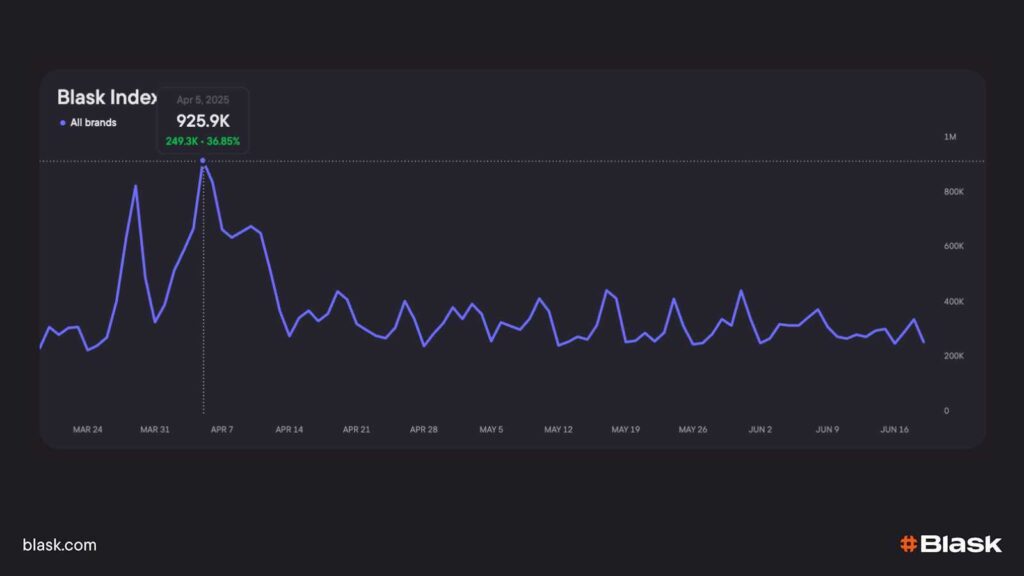
Blask index measures total player interest in a country and how that interest is distributed between brands. It is built on the long-observed relationship between branded search and market share — typically an 80–90 percent correlation — with the added advantage that search behavior often precedes actual revenue shifts.
Crucially, the index does not attempt to measure traffic, rankings, or SEO performance. Instead, it tracks relative demand — normalized, localized, and updated at an hourly cadence. The question it answers is not “how many users clicked,” but “did the market react?”
For influencer campaigns, that distinction matters.
🚀 Read more: What is Blask Index.
How to use it for streams
| Step | Action in Blask | Outcome |
|---|---|---|
| 1. Pre-stream baseline | Pin the brand’s Blask Index widget one week before a creator goes live. | Establish “normal” demand curve. |
| 2. Go-live watch | Keep the dashboard open during the stream; set a smart-alert for ≥ +10% vs 24 h average. | Instant Slack/e-mail ping when interest spikes. |
| 3. Post-stream read | Compare peak minus baseline. A clean, geo-specific uplift proves the influencer moved search behaviour rather than just churning the same viewers. | Use lift-to-FTD ratio (see APS below) to forecast actual sign-ups. |
Example:
Affiliate actively works with streamers in a target market. A creator goes live on April 15. During and immediately after the stream, the brand’s Blask Index rises by 15% in that country. Based on past correlations between demand spikes and first-time depositors, the uplift suggests roughly 250 new FTDs. “Blask lets us separate performers from hype machines — and it saves tens of thousands in test budgets.”
Timing matters more than ever
Another lesson of 2026 is that when an influencer campaign runs can matter as much as who runs it.
Seasonality analysis now allows teams to identify the most responsive months, days, and even hours for a given market.
A creator who underperforms on a Tuesday afternoon may convert efficiently on a Sunday evening — not because the content changed, but because demand conditions did.
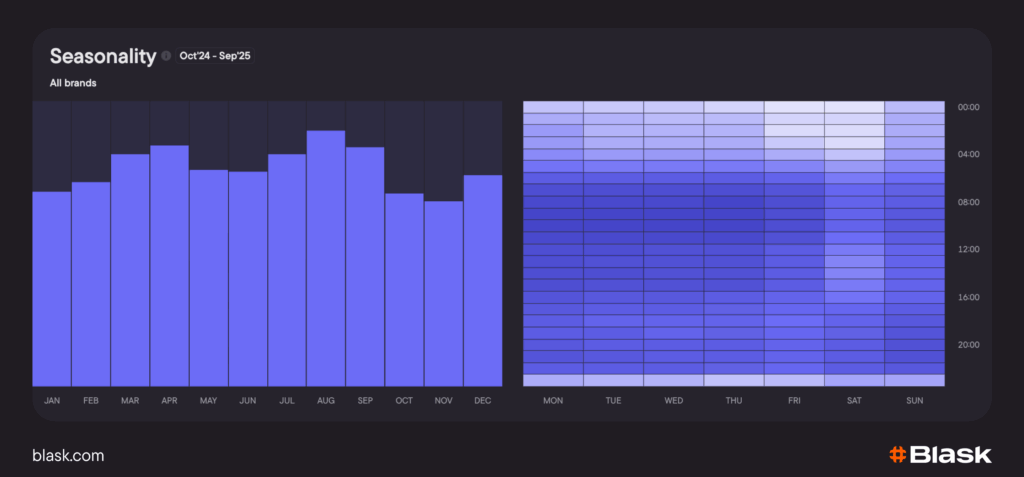
Influencer marketing, once driven by availability and negotiation, is increasingly scheduled like media buying.
Dial-in your influencer’s audience fit with Customer Profile
Blask’s Customer Profile dashboard distils millions of open-source signals into a country-specific, multi-tab snapshot of who actually gambles and why. Before you brief a creator, open the profile for your target GEO and line their following up against these four data blocks:
| Customer Profile tab | What you learn | How to use it for influencer selection |
|---|---|---|
| Socio-demographics – age, gender split, income bands, education level, top employment sectors | Confirms whether the streamer’s fan-base skews 18-24 gig-economy or 35-44 white-collar – and if they can afford your minimum stake. | Pick creators whose core demo ≥60% overlaps the highest-value bracket to maximise ARPU. |
| Motivations & Triggers – main reasons people bet (thrill, social proof, celebrity fandom, big jackpots) and the promo hooks that convert them | Shows whether “big win” highlights or “community challenges” drive sign-ups in that market. | Script the sponsorship CTA around the #1 trigger; brief the influencer to emphasise that hook on-stream. |
| Preferred verticals & game types – sports vs. casino, slots vs. crash, live-dealer appetite | Tells you if the country is cricket-first, slot-heavy, or instant-game crazy. | Pair slot-heavy markets with casino streamers; push sports tips only where sportsbook interest > 60 %. |
| Device & payment mix – desktop vs. mobile share, card vs. e-wallet vs. crypto usage | Flags UX or KYC friction that could tank conversions post-stream. | Ensure the landing page mirrors the dominant device; highlight local wallets the profile lists as “top adoption”. |
📚 Want the full walk-through? See “What is Blask Customer Profile”
APS = acquisition baseline to monetise that lift
What APS measures
Acquisition Power Score is Blask’s AI forecast of how many new customers a brand should convert in the current month, given its visibility. The score is published around the 10-th as a three-band corridor:
- Worse · Average · Better
Sponsorship / creator workflow
- Record last month’s APS before the campaign — that’s your business-as-usual range.
- Run the influencer push.
- When the new APS drops:
- Above “Better” → campaign unlocked extra head-room → replicate / scale.
- Inside band → creative OK but not yet breakout → tweak hooks, try a bigger co-stream.
- Below “Worse” → the lift you saw in Blask Index never converted → audit KYC flow, landing page, payment FX.
Operator quick win
Benchmark your corridor against rival brands who used the same streamer — if their APS leaps higher, dissect their promo code, odds-boost or on-screen CTA and adjust before the next slot marathon.
🚀 Read more: Ushering in APS & CEB for a new era of brand performance
Closing the loop with CEB & GGR
- CEB (Competitive Earning Baseline) converts the new-customer expectation into revenue potential for the month.
- GGR is your actual “bets − wins” ledger.
| Scenario | Interpretation | Next move |
|---|---|---|
| APS ↑ , CEB ↑ , GGR ≥ Average | Streamer drove sign-ups and they monetised on-par. | Renew creator; negotiate better rev-share. |
| APS ↑ , CEB ↑ , GGR < Worse | Users arrived but didn’t stick/spend. | Improve onboarding, bonus structure, VIP. |
| APS flat, Blask Index spike only | Hype with no conversion. | Cut the streamer; test micro-creators or alternative platforms. |
Games, not just brands
The same logic now applies at the product level.
By analyzing which games are gaining traction in a country — and which are losing momentum — operators can align creators with titles that already resonate with local players. A streamer promoting a declining game may look successful on camera, yet fail to move demand. One aligned with a rising title can amplify an existing wave.
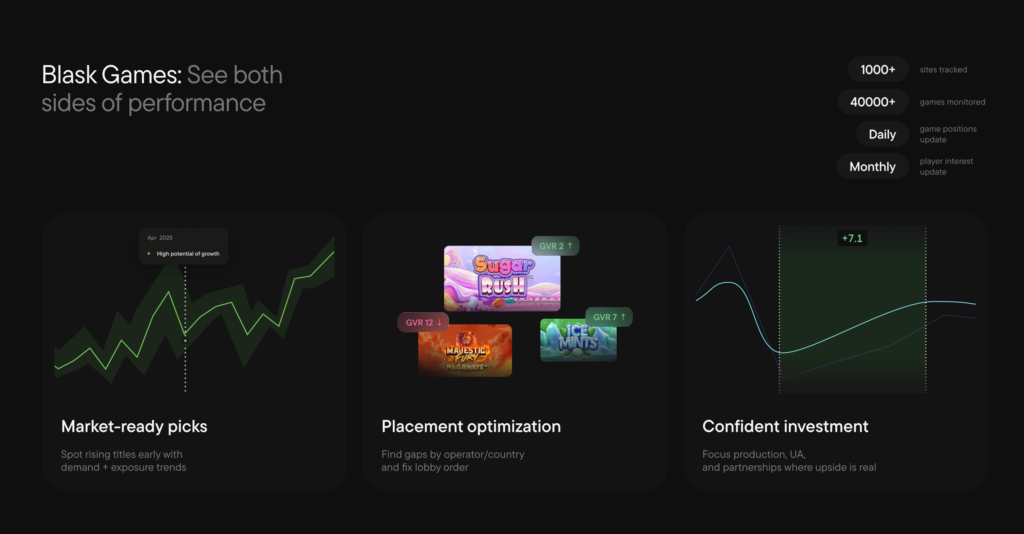
📚 Quick tour: See exactly how to surface rising games inside the Game View – “The Game View in Blask Games”
Learning from competitors, openly
Some of the most pragmatic users of market-level data are operators themselves.
Rather than experimenting blindly, they track brands that are growing rapidly within a market, examine when that growth began, and identify the campaigns and creators involved.
Smaller local brands, often dismissed as marginal players, frequently become the most valuable teachers.
A quieter, more serious future for influencers
By 2026, influencer marketing in iGaming has not disappeared, it has grown up.
The industry has moved past the idea that creators alone can “unlock” growth. Instead, they are judged by the same standard as every other channel: their ability to change behavior, not just attract attention.
As regulation tightens, budgets concentrate, and competition intensifies, one truth has become difficult to ignore:
Influencers still matter — but only when their impact is visible at the level that actually counts: the market itself. Everything else is just noise.