
- Updated:
- Published:
How does Blask AI power Customer Profile?

What if you could read your players’ minds — before they even land on your site?
Blask Customer Profile doesn’t just guess who’s behind the screen — it knows. With AI‑powered inference grounded in a one‑time, large‑scale survey foundation, you get a full breakdown of who your audience is, what drives them, and how to reach them before your competitors do.
Because in iGaming, knowing your players first is how you win.
What is Blask Customer Profile?
Imagine you’re an iGaming operator gearing up to enter a new market. You know understanding your audience is the key to success — but the idea of doing traditional research? “Harold, feel the pain.”
Expensive. Time-consuming. Outdated before it’s even published.

That’s why we built Blask Customer Profile.
It replaces guesswork with a trained AI model and a clear picture of who your players are.
This AI-powered tool gives you a detailed, country-specific breakdown of your iGaming audience: age, income, motivations, playing habits — everything that helps you market smarter and build better.
Currently in beta and getting sharper by the day, Customer Profile will soon include RAG (Retrieval-Augmented Generation) tech for even deeper, more dynamic insights.
📌 What makes Blask different?
Most platforms show you what your current users do.
Blask shows you who’s out there, even if they haven’t found you yet.
You’ll understand entire markets — not just your database. And that opens the door to confident, strategic growth.
Blask’s journey to develop the Customer Profile feature.
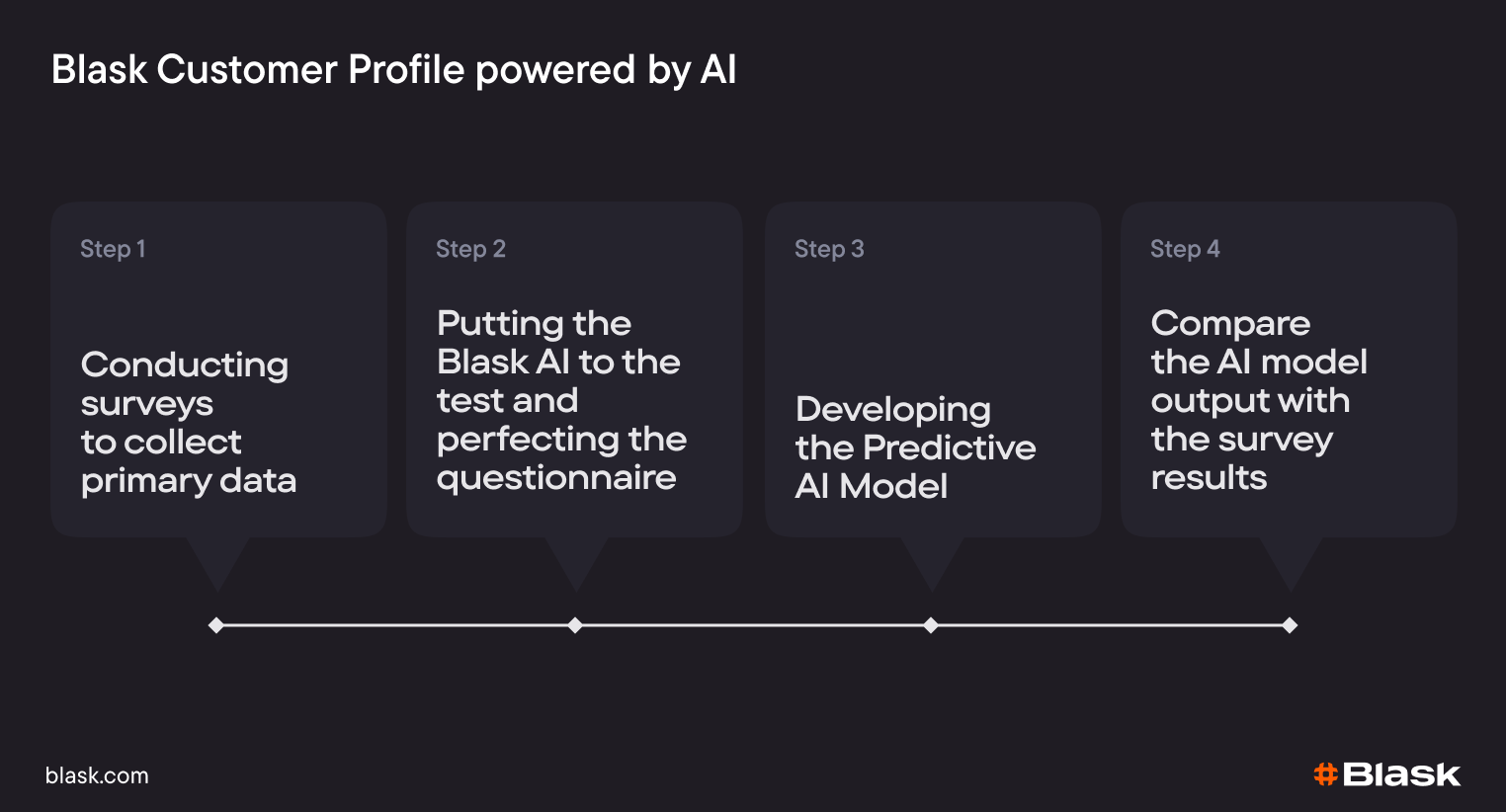
Step 1: 80,000 surveys and counting.
To build something smart, you need smart data.
That’s why the first version of Blask Customer Profile started with old-school, boots-on-the-ground research — over 80,000 surveys conducted manually across multiple continents during Q3 and Q4 of 2023.
No shortcuts. No recycled reports. Just real input from real players.
We surveyed adults (18+) who had engaged in iGaming over the past six months — from online slots and casino games to esports betting, fantasy leagues, and local favorites like Rummy in India.
Each country was approached holistically, not just major urban hubs. Our goal: a 4% error margin and 95% confidence level for a realistic view of the national player landscape.
To ensure authenticity, we ran the surveys through mobile games and apps — verifying devices, locations, and responses. Every answer mattered. Whether it was free text, single-choice, or multi-choice, each one helped shape the foundation of Customer Profile.
This wasn’t about vanity metrics. It was about building a profile tool that understands your players better than they understand themselves.
Step 2: Training the AI — and perfecting the questions.
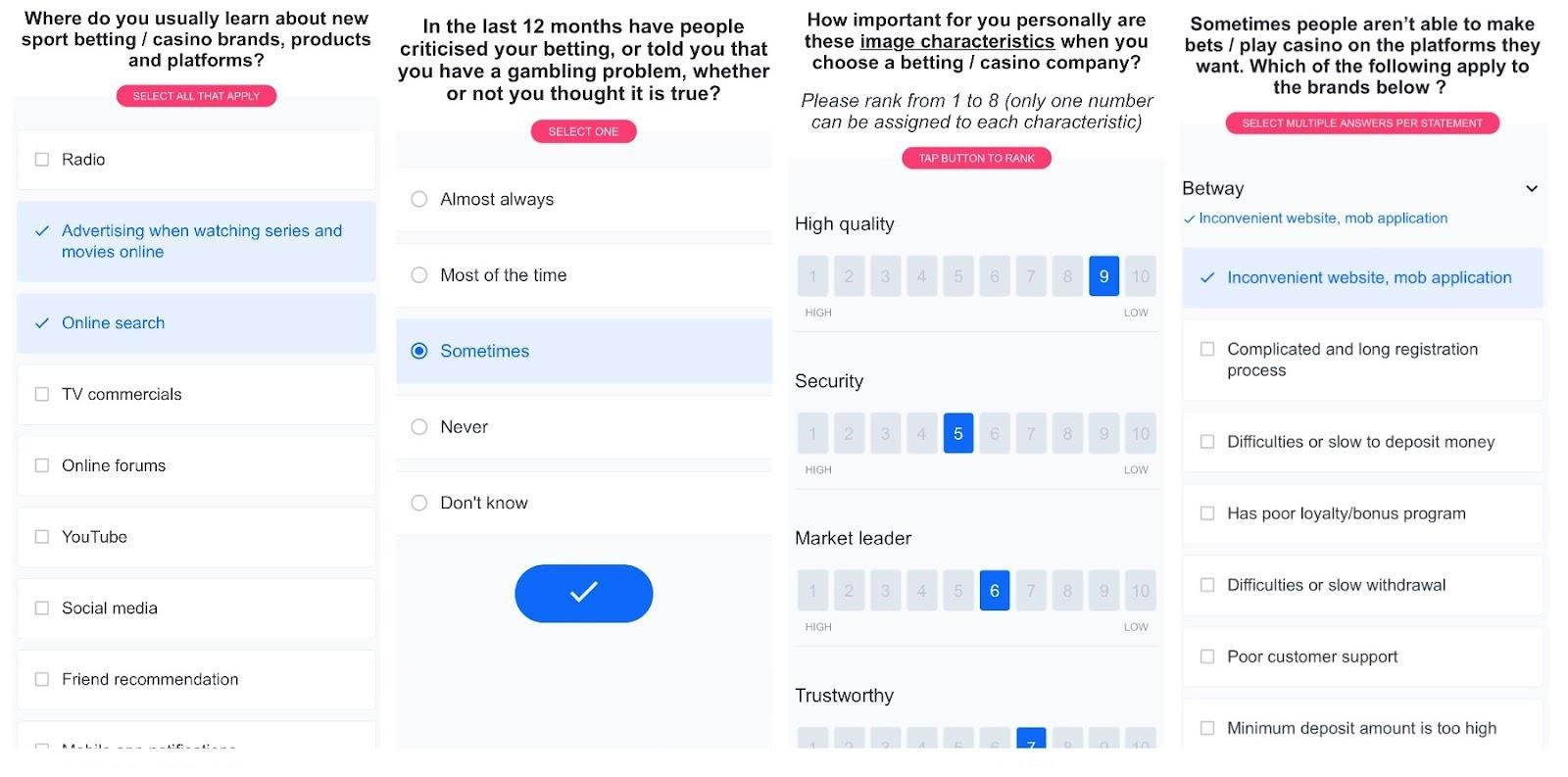
At this point, you’re probably thinking: “Cool, 80,000 surveys — but where’s the AI?”. Hold tight. We’re getting there.
Before handing the wheel to machine learning, we needed to test our model against real-world data. Every survey we ran had two missions:
- Challenge the AI — compare its predictions with human responses.
- Refine the questionnaire — figure out which questions deliver the richest insights.
By aligning the AI’s answers with actual player responses, we could see where it nailed the prediction — and where it needed to go back to class. This wasn’t just for accuracy. It helped us reshape the entire survey flow to make it smarter, sharper, and more useful for operators like you.
Take this example:
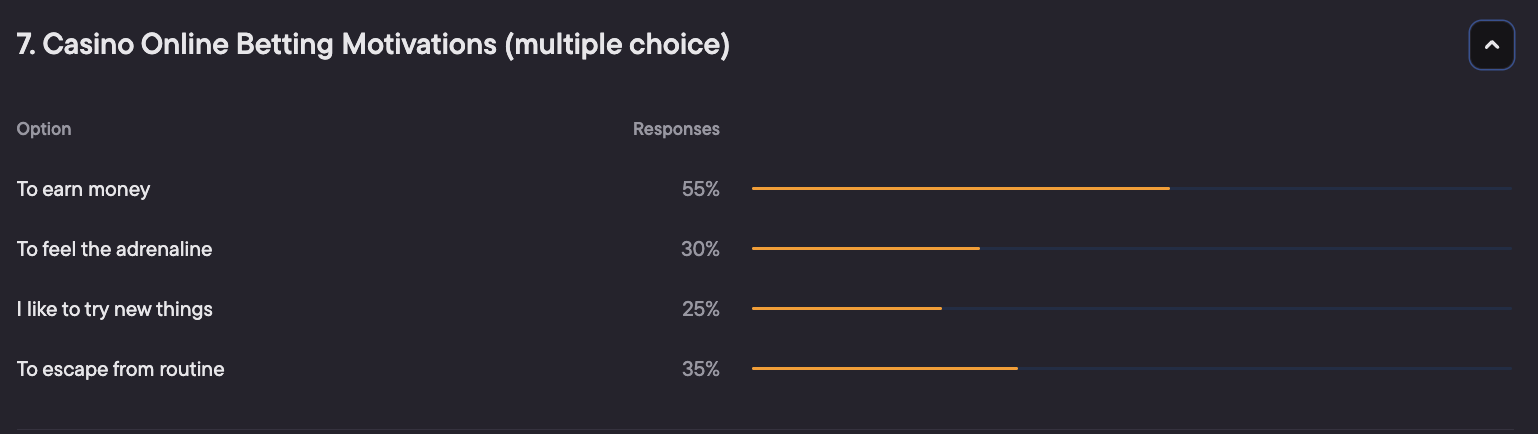
In Bangladesh, the survey on Casino Online Betting Motivations offered just 4 answer options. In India? 15.
Bangladesh (4 options):
India (15 options):
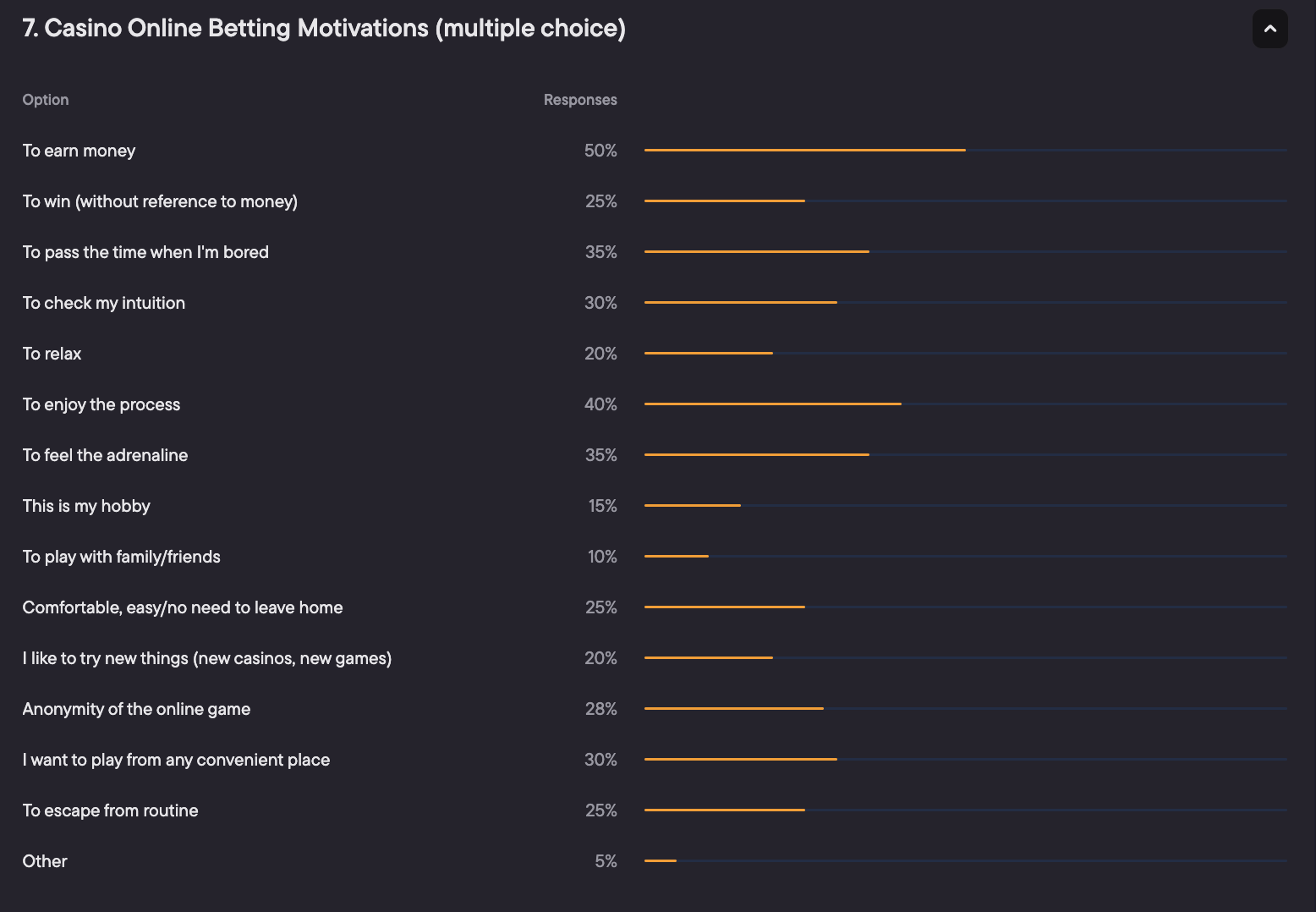
Why the difference? Player behavior varies, and so should the questions. More options meant deeper insights — revealing nuanced motivations across different cultures and regions.
This process gave us two wins:
✔️ A smarter AI.
✔️ A laser-focused question set for every market.
Next up? Teaching the AI to scale that knowledge across the globe. Let’s dive in.
Step 3: Building the predictive AI model.
Once we had tens of thousands of survey responses in hand, it was time to train the model that powers Customer Profile.
At the core of Blask’s AI is a simple goal: predict how the average player behaves — even before you enter the market.
To make that happen, we built the model on three key data layers:
- Survey data
This was our training ground. Real answers from real players gave the model a solid foundation of behavior, preferences, and motivations. - External sources
Think: market research reports, public data, social trends, user behavior analytics — anything that paints a broader picture of iGaming players worldwide. - Blask’s proprietary database
This is where things get powerful. We fed the model exclusive, anonymized behavioral data collected across the Blask platform — from market dynamics and brand growth to product usage and competition.
The result?
A predictive AI that doesn’t just crunch numbers — it understands the iGaming industry.
It knows how regulations influence behavior.
It recognizes what changes when a country legalizes sports betting.
It tracks the ripple effect of events like the World Cup or IPL.
It knows how the new market works. Even without the surveys.
It’s trained on player psychology, game theory, content trends — and yes, 64 GB worth of documents, reports, and behavioral studies.
📊 So when you open a country’s Customer Profile in Blask, you’re seeing an AI‑powered interpretation fed by open data and market signals — not an ongoing survey feed.
Step 4: Validating the model against reality.
Once the predictive AI model was trained, we put it through the ultimate test: could it answer the same questions as real players — and match the results?
We asked the model to simulate responses to the original 80,000 survey questions. Then we compared its output to the real answers we had collected.
Did it align?
Yes. And that’s when we knew — the model works.
— Dmitry Belianin, Co-founder of Blask
This was the first milestone. The very first iteration of the Customer Profile feature — designed to prove the methodology and gather feedback from the market.
But we didn’t stop there.
At the heart of the model is Blask’s RAG engine — Retrieval-Augmented Generation.
RAG combines the logic of large language models (LLMs) with the ability to fetch real-time data from our proprietary database. In other words, it’s not just generating predictions — it’s actively learning from the latest market trends, user behavior, and regional shifts.
Here’s what RAG will unlock for Customer Profile:
- Real-time accuracy with live data retrieval
- Nuanced, localized insights specific to each country or market
- Fast adaptation to regulatory changes, social trends, and player behavior
This is just the beginning.
The more feedback we gather from the industry, the sharper our model becomes.
Blask Customer Profile isn’t just built to observe the market. It’s built to evolve with it.
Know your players — or keep wasting budget.
You’re launching games, running campaigns, entering new markets. But if you don’t truly understand who’s on the other side of the screen, every decision is a gamble.
Blask Customer Profile gives you the full picture — trained on an 80,000‑response survey foundation and powered by predictive AI that infers country‑level attributes from open data and market signals.
It shows how people bet, why they choose certain games, when they play, and how much they’re willing to spend — country by country.
No guesswork. No outdated reports. Just clear, reliable insights to help you build smarter strategies, better products, and higher-performing campaigns.
And yes — it works even if you’re just entering a new market.