A complete guide to how igaming affiliate marketing works in 2026: commission models, GEO selection, tracking, legal compliance, and the software connecting operators with performance partners.
What Is iGaming affiliate marketing
A performance-based channel where publishers send traffic to online gambling operators and earn a commission when referred users deposit and play. No upfront ad spend. Payment flows only when a qualified player arrives.
iGaming affiliate marketing accounts for 30%+ of all iGaming transactions globally, a higher share than any consumer category except finance and trading. The European market reached €38.2 billion. Latin America is growing at 34.6% annually.
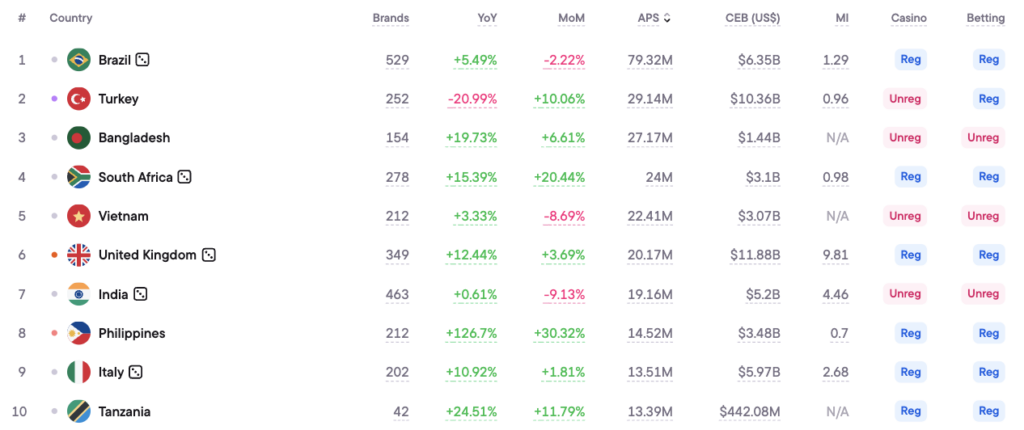
Blask data shows the UK iGaming market tracked 349 active brands in 2025, with 20.2 million new player acquisitions. Brazil, the most searched iGaming market in Blask’s database, recorded a Blask Index of 2.57 billion and 79.3 million new player acquisitions in the same period. Affiliates who captured Portuguese-language casino search traffic in 2025 entered a market four times larger than the UK by organic demand, with far less content competition.
How does iGaming affiliate marketing work
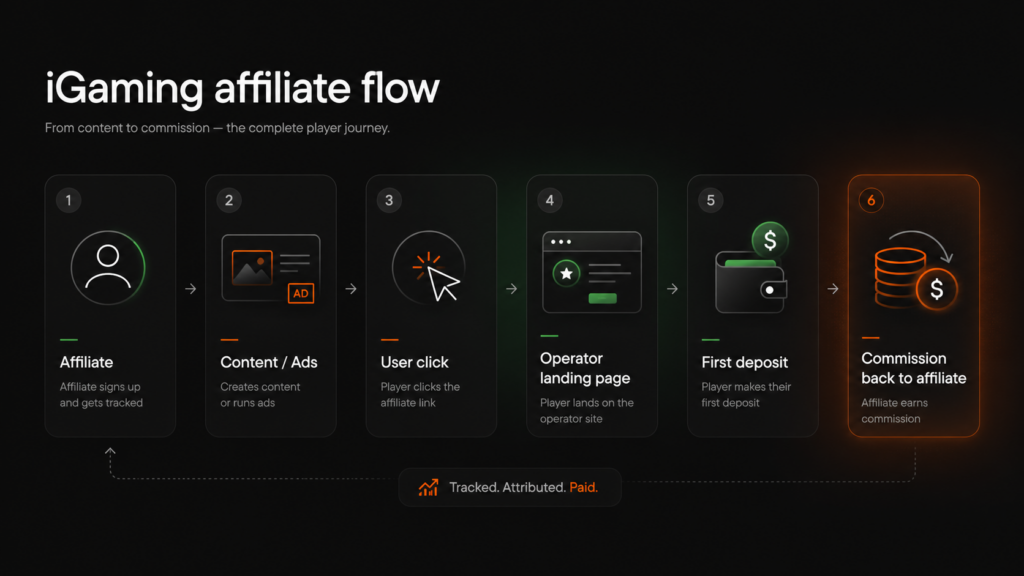
An affiliate joins an iGaming affiliate program, receives a unique tracking link, and places it across their content: review articles, comparison pages, social posts, or ad campaigns. When a user clicks that link and completes a qualifying action (typically a first deposit) the affiliate earns a commission.
Four steps:
Join a program. Apply directly to an operator or through a network. Regulated market programs require identity verification before activation.
Get tracking links. Each affiliate receives a unique URL with an embedded tracking code. Clicks, registrations, and deposits are attributed automatically.
Send traffic. Publish content, run paid campaigns, or distribute through email and social. Referred users land on the operator’s site.
Earn commission. When referred users deposit and play, earnings are calculated according to the agreed model: RevShare, CPA, or hybrid.
Commission calculations depend on the model, the NGR formula, and the program’s payout schedule. Most affiliates track performance through a real-time dashboard reporting clicks, registrations, deposits, and earnings in one place.
Why promote iGaming offers
Gaming marketing pays better than most affiliate verticals. CPA rates run $150–$800 depending on GEO and traffic quality. RevShare programs pay for the lifetime of referred players. A player who deposits regularly for three years generates commission for three years from the same original click, published once.
To understand what is iGaming in affiliate marketing from an economic standpoint: a single depositing casino player can generate $500–$2,000 in lifetime net gaming revenue. At 35% RevShare, that is $175–$700 per player, earned with no additional work after the referral.
Blask data shows 79.3 million new player acquisitions in Brazil in 2025 and 20.2 million in the UK. A content site capturing even a fraction of those acquisitions through affiliate links generates commission income at scale without owning product, inventory, or customer relationships.
Top 10 countries by APS metric in Blask, 2025
Blask Index measures brand demand derived from Google search volume data. A higher Blask Index signals stronger consumer intent toward iGaming brands in a given market — and more organic traffic for affiliates to capture.
Benefits of iGaming affiliate marketing
RevShare rates of 25–45% against an average UK casino player NGR of £800–£1,500 per year means a single referred player generates £200–£675 in annual passive commission. Refer 200 players in a year and that cohort keeps paying without additional work.
A site that built a UK casino review presence in 2020 still earns commissions today from players referred under articles written five years ago. Gambling.com Group and Catena Media, both publicly listed companies, built eight-figure revenue businesses on this model: rank review and comparison content across dozens of GEOs, earn RevShare from multiple operator programs, compound as the referred player pool grows.
Compare this to ecommerce.
A £200 ecommerce commission requires a product sale of £1,000–£4,000. In igaming affiliate marketing, £200 comes from a single moderately active player generating ~£570 in annual NGR at 35% RevShare. Ecommerce commission ends at the transaction. iGaming commission continues for the player’s active lifetime.
iGaming affiliates with multi-GEO portfolios spread revenue across brands and markets without owning product or inventory. A single domain can run programs from Bet365, Paddy Power, William Hill, and DraftKings in the US simultaneously.
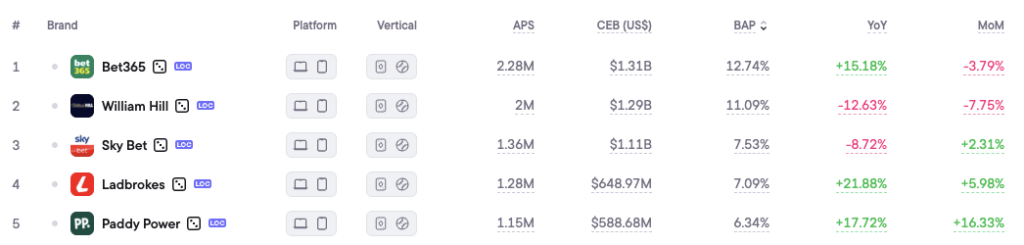
For operators, the model eliminates upfront acquisition cost. Bet365 ranked #1 in the UK in 2025 with a Blask Index of 75.6 million and an estimated 2.28 million new player acquisitions. The affiliate channel contributed to that position without Bet365 owning the review content, the SEO infrastructure, or the audience relationships.
Top 5 brands in UK by Blask Index metric, 2025
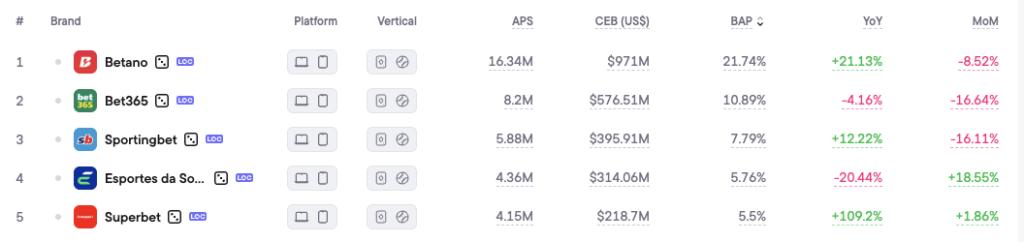
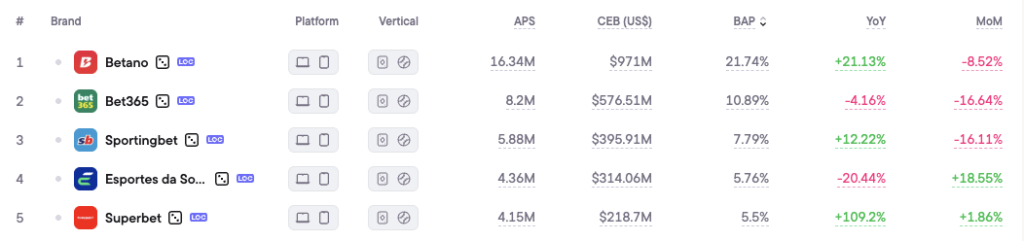
In Brazil, where Blask recorded 79.3 million new player acquisitions in 2025, operators like Betano and Superbet are growing affiliate budgets because building their own acquisition infrastructure in a new large market is slower and more expensive than activating networks of affiliates with Portuguese-language traffic. Superbet grew its Brazilian Blask Index by +109.2% YoY. That growth created affiliate opportunity before SEO competition caught up.
Top 5 brands in Brazil by Blask Index metric, 2025
The challenges of Affiliate marketing in iGaming
Negative carryover: the math that surprises new affiliates
Say you refer 80 players in March. Your cohort generates £4,000 NGR. At 35% RevShare, that’s £1,400. One player has a lucky month, wins £6,000, and produces -£4,200 NGR. Your cohort total drops to -£200 for the month. Under standard negative carryover terms, April starts at -£200 in the hole. Your April NGR of £4,000 nets out to £3,800, earning you £1,330 instead of £1,400.
That’s a minor example. A single high-roller winning £20,000 in one month can make a mid-tier affiliate’s RevShare earnings negative for two or three months with no change in traffic quality or volume.
Each experienced igaming affiliate promoting casino should check NCO terms before signing. Programs offering no-NCO reset the balance to zero each month regardless of player outcomes. Worth negotiating even at a slightly lower headline rate.
Regulatory changes cut earnings without warning
The UK Gambling Commission introduced online slots stake limits in 2025, capping bets at £5 for most players. For casino affiliates earning RevShare from UK slots traffic, this cut the NGR generated per session without any reduction in SEO costs or content investment. A RevShare deal signed in 2023 at 35% now earns less per referred player than it did on signing day.
William Hill’s UK Blask Index fell -12.6% year-on-year in 2025. Sky Bet dropped -8.7%. Affiliates who concentrated content around these brands under lifetime RevShare agreements watched commission income decline from the same player cohorts, on the same deals, with no change in their own output.
Compliance liability falls on operators and terminates affiliates
Under UKGC rules, operators bear legal responsibility for all marketing published by their affiliates. When an affiliate runs content with misleading bonus claims or missing responsible gambling disclosures, the regulatory action targets the operator. Operators respond by terminating the affiliate immediately.
Operators have been fined for affiliate-published content they neither reviewed nor approved. Regulated market programs now require content approval workflows, pre-approved creatives, and documented compliance processes — overhead that compounds as an affiliate scales across multiple GEOs.
Fraud is a structural problem, not an edge case
CPA programs pay on first deposit. Deposit-and-withdraw fraud works by meeting the minimum qualifying criteria, typically a £10–£20 deposit and one completed wager round, across multiple accounts, collecting the CPA trigger, and withdrawing immediately. At scale, coordinated abuse generates hundreds of CPA payouts on players who never intended to play genuinely.
Operators who detect high fraud rates in a traffic source clawback previously paid commissions and impose permanent account restrictions. Traffic quality determines whether a CPA program stays accessible long-term.
Various iGaming niches to focus on in 2026
The right niche depends on GEO, audience, and traffic source. Below is how each category performs by market, based on Blask data.
Casino
Online slots and table games dominate player activity across most regulated markets. UK slots GGY reached £747 million in 2025, up 9% year-on-year. Casino CPA rates run $100–$300 per first deposit, higher than sports betting, because casino player lifetime value is longer.
Blask data shows live casino driving strong demand growth in Brazil, where Blask Index scores for premium live dealer brands outpaced the overall market average. In Germany, the regulated casino segment is concentrated around a small set of licensed operators. Vulkan Vegas grew its German Blask Index by +719.5% YoY in 2025 by acquiring players outside established brand territory.
India shows rapid growth in crash games. Aviator and similar formats command high search volumes across Hindi-language queries and run primarily on social and influencer traffic.
Sports betting
The largest vertical by brand count globally. Blask data from the UK shows Bet365 (+15.2% YoY Blask Index), Ladbrokes (+21.9% YoY), and Paddy Power (+17.7% YoY) collectively driving over 20 million new player acquisitions in 2025. CPA rates for sportsbooks run $50–$150 in most markets, rising to $250 in Tier-1 jurisdictions.
In Brazil, sports betting dominates following the January 2025 regulated launch. Betano (+21.1% YoY) and Superbet (+109.2% YoY) are the fastest-growing brands. Football-focused content earns conversion rates well above other product categories in this market.
In the US, DraftKings and FanDuel anchor the regulated market across 38+ states. Affiliate CPA rates for US sports betting reach $200–$400 per qualified acquisition in major states, the highest rates globally.
Poker
RevShare runs 10–45% depending on volume and deal structure. Lower SEO competition than casino in most languages. PokerStars’ program sets the benchmark for tiered commission structures with lifetime RevShare options.
eSports betting
Blask UK category data shows eSports betting at 9,415 search volume units, an underpopulated niche relative to audience size. Appeals to younger demographics consuming content on Twitch and YouTube. Most European markets have minimal competition for eSports affiliate SEO, making early positioning viable at low difficulty.
Lottery
Lotto24 ranks in the top 10 German brands by Blask Index. Lottery affiliates earn lower commissions per player but benefit from high conversion rates because the product requires minimal education. Lotto and Keno formats maintain strong search demand in Germany and Poland.
Live dealer
The highest-engagement casino format. Live dealer produces longer sessions and higher average deposits. Review content performs well here because players research platforms before choosing where to play. Demand grows fastest in Brazil and Southeast Asia.
Crash games
The fastest-growing category across Tier-2 and Tier-3 markets. Aviator leads search demand in Nigeria, Kenya, India, and Brazil. High social and video traffic potential. Overconcentration is a risk: markets where one crash game format captures most of the category leave affiliates with limited diversification options. Already Media found this in Nigeria, where Aviator-focused content dominated but operator fragmentation was so low that switching players between brands was almost impossible.
Types of iGaming affiliates
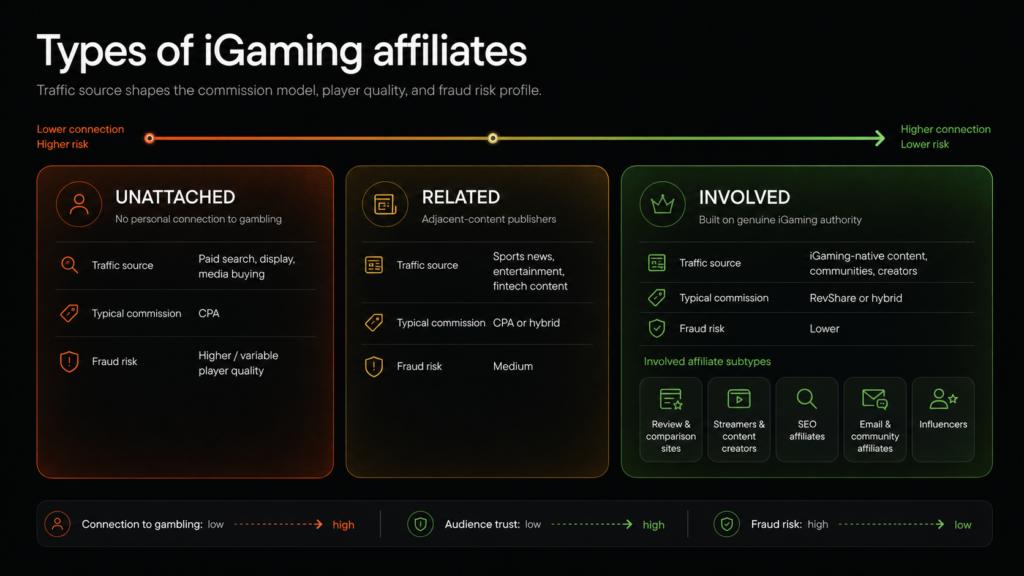
Not every iGaming affiliate operates the same way. The traffic source shapes the commission model, player quality, and fraud risk profile.
Unattached / Related / Involved
Unattached affiliates have no personal connection to gambling. They run paid search, display, or media-buy campaigns. Commission is typically CPA-based because player quality is variable and RevShare exposes them to unpredictable returns on ad spend.
Related affiliates operate in adjacent categories: sports news, entertainment, fintech content, and cross-promote iGaming offers. Traffic volumes can be large, but audience trust is lower than involved affiliates.
Involved affiliates build genuine authority around iGaming content:
Review and comparison sites. The core of iGaming SEO affiliate traffic. Sites ranking for “best online casino [country]” generate high-intent organic traffic with strong deposit conversion rates.
Streamers and content creators. Live streaming casino sessions on Twitch or YouTube. High audience trust, but subject to strict platform and regulatory rules in the UK and EU.
SEO affiliates. Focus on organic rankings for casino, betting, and poker keywords across multiple GEOs.
Email and community affiliates. Sports tipster newsletters, Telegram channels, casino forums: direct audience relationships with established trust.
Influencers. Social media personalities promoting operators to followers. UK advertising standards require sponsorship disclosures; MGA and UKGC apply equivalent rules across the EU.
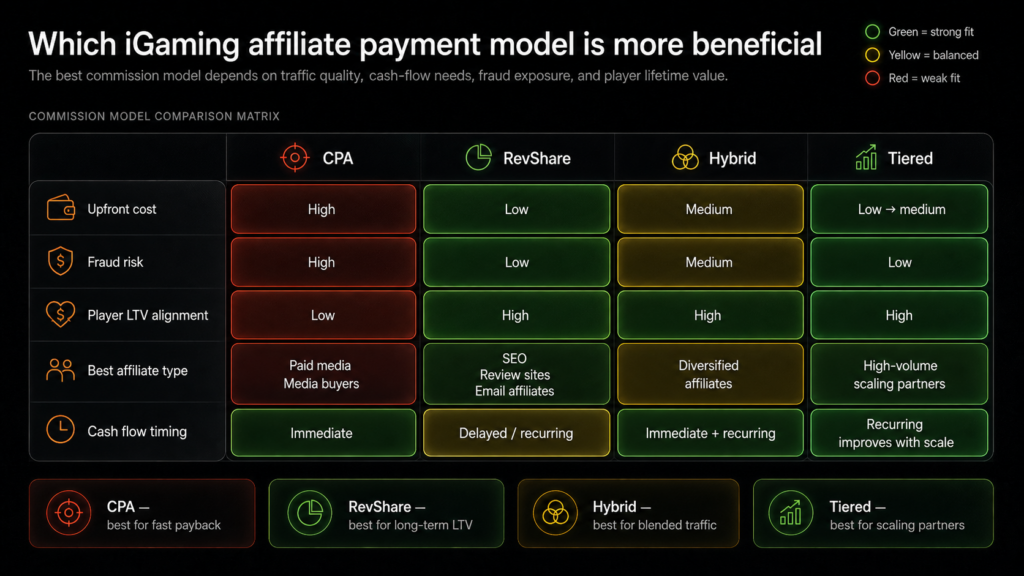
Which iGaming affiliate payment model is more beneficial
iGaming affiliate marketing uses several distinct commission structures. Choosing the wrong model for your traffic type is the most common mistake new affiliates make.
RevShare
Pays an ongoing percentage of NGR from referred players, for their lifetime. Standard rates: 25–45%. Top-tier programs offer 50–55% for high-volume partners. Any rate below 25% is below market and worth renegotiating before signing.
RevShare suits SEO and content affiliates with stable organic traffic. A cohort of high-LTV players continues generating commissions for years after the content was published.
Best for: Review sites, SEO affiliates, email affiliates with loyal audiences.
CPA (Cost per Acquisition)
Pays a flat fee per qualifying first deposit. Rates by GEO tier:
Market
Casino CPA
Sportsbook CPA
Tier-1 (UK, DE, AU)
$150–$400
$100–$250
Tier-2 (BR, MX, IN)
$50–$120
$30–$80
Tier-3 (NG, PH, KE)
$15–$50
$10–$30
CPA provides immediate income with no player variance exposure. Best for paid media affiliates who need to offset ad spend quickly.
Best for: Media buyers, paid search affiliates, high-volume campaigns.
CPL (Cost Per Lead)
Pays per registration, regardless of deposit. Lower rates than CPA, but lower conversion threshold. Less common in iGaming because it creates bonus-abuse exposure: users register to trigger the lead commission and never deposit.
Hybrid
A reduced CPA combined with ongoing RevShare, typically 40–60% of the standalone CPA rate plus 10–25% RevShare. Operators using hybrid models achieve 31% higher NGR per active affiliate compared to single-model programs. The structure gives affiliates fast payback on acquisition while aligning long-term incentives around player quality.
Best for: Established affiliates with diversified traffic, content and paid media combined.
Sub-affiliate Commissions
Affiliates earn 2–5% of the earnings generated by sub-affiliates they recruit. Useful for affiliate network builders and community-driven publishers.
Tiered RevShare
The RevShare rate increases as the affiliate hits NGR thresholds:
Monthly NGR
RevShare Rate
€0–€5,000
25%
€5,001–€15,000
30%
€15,001–€40,000
35%
€40,001+
40%
NGR vs. GGR: what’s the difference?
NGR (Net Gaming Revenue) = player losses minus bonuses, payment fees, and applicable taxes. GGR (Gross Gaming Revenue) = player losses before any deductions. RevShare is almost always calculated on NGR. The specific deductions vary between operators and licensing jurisdictions. Always verify the NGR formula in the affiliate agreement before signing.
Suitable iGaming affiliate traffic channels
Each traffic source carries different cost profiles, conversion rates, and compliance requirements.
SEO
The highest-LTV traffic channel. Organic rankings for “best casino [country]” or “sports betting bonus” attract players with verified deposit intent. SEO-acquired players produce 40–60% higher lifetime value than paid-traffic players because content affiliates pre-qualify their audience before the click. Limitation: SEO takes months to compound and is sensitive to Google algorithm updates.
Content marketing
Long-form review articles, game guides, strategy content. Works alongside SEO by targeting informational queries and building topical authority across a site’s full page portfolio.
Paid advertising
Paid search, display, and native ads. Fast to test and scale, but restricted in many regulated markets. Google requires certification for gambling advertising in each jurisdiction. High acquisition costs make RevShare less suitable; most paid media affiliates prefer CPA to close the payback cycle quickly.
Social media
Facebook, Instagram, TikTok, X. Most platforms require ad approval for gambling content. Platforms suppress organic reach for gambling topics in regulated markets. Social performs best in Tier-2 markets where platform policies are less restrictive and audience growth is faster.
Email marketing
Newsletter-based promotion to opted-in subscribers. High conversion rates due to existing audience trust. Must comply with GDPR in the EU and CAN-SPAM in the US. Operators in regulated markets require affiliates to maintain suppression lists for self-excluded players.
Push notifications
Web and mobile push messages. High open rates, low cost. Effective for sports betting affiliates promoting live odds and time-sensitive bonus offers to an already engaged audience.
Influencer marketing
Streamers and social creators. The fastest-growing channel in eSports betting and crypto casino segments. High audience trust, but subject to sponsorship disclosure requirements across the UK, EU, and Australian markets.
GEO tiers and market selection
Market selection determines commission rates, competition levels, and compliance requirements. Choosing the wrong GEO is expensive, either because competition is too high or because payouts don’t justify acquisition costs.
Tier-1: regulated, high-value markets
UK, Germany, Canada, Australia, Sweden, Netherlands. The UK market has 349 active iGaming brands tracked by Blask, with a combined Blask Index of 594 million. Estimated annual player acquisitions: 20.2 million. CPA rates run $150–$400. Competition for English-language casino SEO is high. Compliance requirements are strict. Player LTVs are the highest globally.
Blask data on UK top brands by 2025 growth: Ladbrokes +21.9% YoY, Paddy Power +17.7% YoY, Bet365 +15.2% YoY.
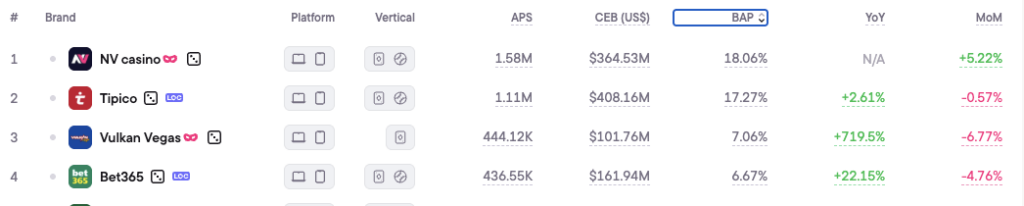
Germany has 349 active brands, 8.3 million annual player acquisitions, and notable demand growth. Vulkan Vegas grew its German Blask Index by +719.5% YoY in 2025 as it expanded from an offshore player base into the regulated market.
Top iGaming online brands in Germany, 2025
Tier-2: fast-growing, increasingly regulated
Brazil, Mexico, India, Poland, South Africa, Japan. Brazil leads all markets Blask tracks by organic consumer demand. Blask Index: 2.57 billion, more than four times the UK. Annual player acquisitions: 79.3 million. The regulated framework (Law 14,790) launched in January 2025. iGaming affiliates now operate in a structured, growing environment where Portuguese-language SEO competition remains far lower than English.
Top Brazilian brands by 2025 growth: Superbet +109.2% YoY, Betano +21.1% YoY, Sportingbet +12.2% YoY. Latin America is projected to grow at 34.6% CAGR through 2027. CPA rates in Brazil: $50–$120. RevShare: 25–35%.
Top iGaming online brands in Brazil, 2025
Tier-3: high volume, variable risk
Nigeria, Philippines, Kenya, Vietnam, Bangladesh. Largely unregulated or informally licensed. CPA rates: $15–$50. High traffic potential and high fraud risk. Best for affiliates with direct in-market audience relationships through social, push, or local-language SEO.
Tier-3 markets are not uniform. Blask data reveals structural differences that determine whether an affiliate can actually earn in a given market.
“Nigeria is a huge market that everyone talks about. However, in reality, the market isn’t growing. There is one dominant operator with 75% market share and the player switching rate between operators is almost zero.”
Dmitry Belianin
Co-founder Blask
Bangladesh tells a different story. Traffic Connect used Blask to identify which operators were actively investing in marketing, visible through rising Blask Index scores, rather than defaulting to brands with the most name recognition. “In the Bangladeshi market, our partners identified the brands currently investing heavily in marketing and started driving traffic to them. Result: a 25% increase in revenue in the first month.” — saidBelianin.
The difference: Traffic Connect wasn’t picking brands by commission rate. They picked brands that were growing, with money to pay and incentive to convert traffic well.
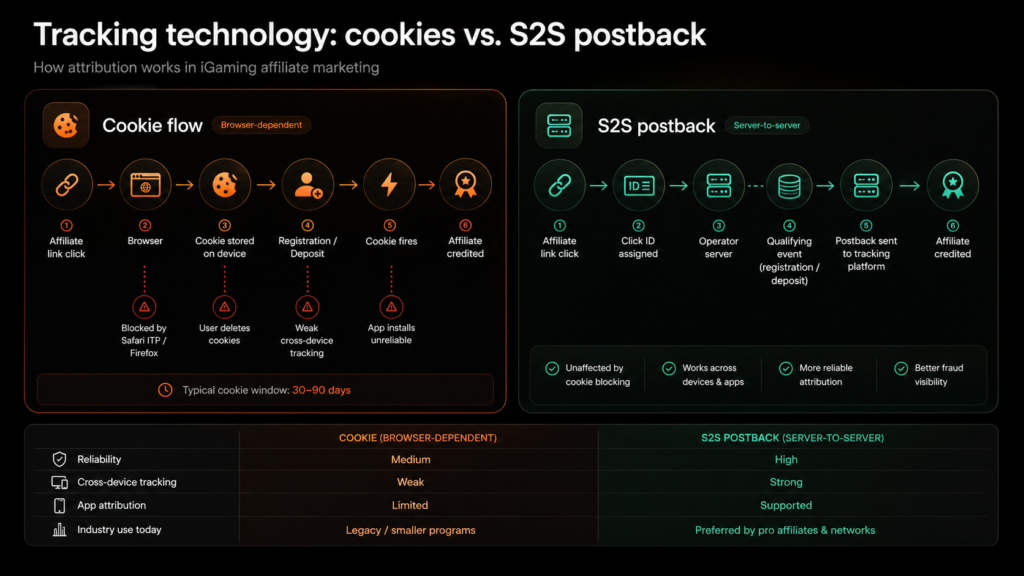
Tracking technology: cookies vs. S2S postback
Accurate attribution is non-negotiable. Without it, affiliates cannot verify commissions and operators cannot detect fraud patterns.
Cookie-based tracking places a browser cookie on the user’s device when they click an affiliate link. If the user later registers and deposits, the cookie fires and credits the affiliate. Standard cookie windows in iGaming run 30–90 days. Limitations: Safari and Firefox restrict or block third-party cookies; users can delete cookies manually; cross-device tracking and app installs cannot be tracked reliably.
S2S (Server-to-Server) Postback tracking bypasses the browser entirely. When a qualifying event occurs — deposit, registration — the operator’s server sends a direct call to the affiliate’s tracking platform, passing a unique session ID assigned at the moment of the click. S2S works across devices and apps and is unaffected by cookie-blocking policies.
Most professional affiliates and performance networks use S2S postback as the primary attribution method. Cookie tracking persists in lower-tech programs and some direct affiliate relationships with smaller operators.
The nuances of legal restrictions
iGaming marketing operates in one of the most regulated digital advertising categories globally. Rules differ significantly by jurisdiction.
United Kingdom (UKGC): Operators are legally responsible for all marketing published by their affiliates. Affiliates must age-gate and geo-gate content. Bonus advertising requires mandatory wagering requirement disclosures. Content promoting UK-licensed operators must link to responsible gambling resources. Operators must share self-exclusion lists with affiliates; marketing to self-excluded players is a social responsibility code breach.
Malta (MGA): Operators must maintain a register of all affiliates, complete due diligence before activation, and approve marketing materials before publication. Responsible gambling messaging is mandatory in affiliate content.
Germany: Since the 2021 GlüNeuRStV reform, online casino and poker operate under federal license. Bonus promotions are prohibited in TV and online advertising between 6am and 11pm.
Brazil: Law 14,790 (effective January 2025) requires operators to hold a national license to accept Brazilian players. Affiliates promoting unlicensed operators face increasing platform and legal risk as regulatory enforcement develops.
United States: Sports betting is legal in 38+ states; online casino in 7 states as of 2025. Each state has separate affiliate registration and advertising compliance requirements. New Jersey’s internet gaming win reached $2.64 billion YTD through November 2025, from one state alone.
Affiliate software for iGaming
iGaming affiliate marketing software is the operational layer connecting operators, affiliates, and tracking infrastructure. Platform choice affects commission accuracy, affiliate experience, fraud controls, and compliance workflows.
Key features
Real-time dashboard. Affiliates need live access to clicks, registrations, deposits, and commissions. Data lag creates disputes and erodes trust.
Flexible commission constructor. Support for RevShare, CPA, CPL, hybrid, tiered, and sub-affiliate models. Ability to assign different structures per affiliate, GEO, and brand.
Compliance tools. Affiliate KYC workflows, marketing material approval queues, suppression list management for self-excluded players.
Leading platforms
Affilka (SOFTSWISS) is built specifically for iGaming. Flexible commission constructor, sub-affiliate tiers, multi-brand support under one program. Won multiple industry awards in 2026.
Income Access (Paysafe) has operated for over 20 years and runs both affiliate software and a managed affiliate network. Covers casino, sports betting, lottery, poker, and bingo across North American and European regulated markets.
Cellxpert focuses on iGaming and Forex. Advanced NGR calculation with GEO and brand-level fee treatment. Supports dynamic banners, widgets, and HTML5 marketing assets.
A second category of iGaming affiliate marketing software serves the affiliate side: performance trackers like Voluum, Binom, and RedTrack, which consolidate data from multiple programs into a unified attribution dashboard. These tools are essential for affiliates running paid campaigns across several operators simultaneously.
How affiliates use this category is changing. TAG Media uses Blask to screen programs before committing to them. Instead of signing ten programs and testing each one, they filter by Blask Index growth rate to shortlist brands with demonstrated demand momentum, then negotiate with those programs specifically. This cuts weeks from the time between market research and first revenue.
“How long has the operator been on the market? On how many markets does this operator work? What is the general dynamics of this operator — is it growing, falling, stagnating? These are the questions you need to answer before you sign.”
Dmitry Belianin
Co-founder Blask
Top iGaming affiliate networks and programs
Networks aggregate multiple operator programs under one umbrella. Programs are direct agreements between affiliate and operator. Most serious affiliates use both.
Major networks:
Income Access network — multi-vertical coverage: casino, sports betting, lottery, poker, bingo. Strong presence in North American and European regulated markets.
Gambling.com Group — large SEO-focused affiliate operation running comparison portals across EU, UK, and North America.
Catena Media — comparison sites and direct programs across UK, EU, and North American markets.
Operator programs worth tracking (based on Blask demand data):
Brand
Key Market
2025 Blask Index YoY
Notes
Bet365
UK, DE, BR
+15.2% (UK)
Global reach, negotiated deals
Betano
BR, DE
+21.1% (BR)
Scaling fast in LatAm
Superbet
BR
+109.2%
Fastest-growing Brazilian brand
DraftKings
US
Tracked
CPA + RevShare, regulated states
FanDuel
US
Tracked
CPA + RevShare, regulated states
Tipico
DE
+2.6%
Dominant in German regulated market
Vulkan Vegas
DE
+719.5%
Massive demand growth in Germany
Brands with rising Blask Index scores attract growing player search demand, which translates to better conversion rates for affiliates sending traffic to those brands. Tracking Blask Index growth is a practical way to identify programs worth prioritizing before competition increases.
An iGaming affiliate program run directly by an operator typically pays higher commissions than a network deal because the intermediary layer is removed. Networks offer consolidated reporting, single-account access to dozens of programs, and payment aggregation: worth the tradeoff for affiliates early in their program diversification. “The most successful case with Blask is entering a new market. You can replicate an already successful strategy and adapt it to a new audience.” — said Dmitry Belianin, co-founder, Blask
Manage commissions and payouts
Payout mechanics affect affiliate cash flow and operator budget planning.
Common structures:
Monthly RevShare — commissions calculated on the previous month’s NGR, paid within 10–30 days of month close. Standard for most operator programs.
Weekly CPA — faster cycle, preferred by paid media affiliates who need to offset ad spend before month end.
Net-30 / Net-45 — standard approval and processing window before payment is released.
Negative carryover: When a player wins and generates negative NGR in a given month, many programs carry that deficit into the following month and offset future commissions. Programs offering no-NCO reset the balance to zero each month. No-NCO terms attract higher-quality affiliates and are worth negotiating before signing, especially for content affiliates sending high-variance VIP traffic.
Payment methods: Wire transfer (standard for large operators), Neteller, Skrill, USDT and other crypto (growing in Tier-2 and Tier-3 markets), platform-specific wallets.
Minimum payout thresholds range from £25 (some UK direct programs) to €500 (some European networks). Weekly programs tend to set lower minimums to support affiliates managing active paid campaigns.
Tips for success
Pick a niche before a GEO. Ranking for “best casino Brazil” competes with hundreds of established affiliate sites. Ranking for “best live casino Brazil” or “slots with fastest withdrawal Brazil” competes with far fewer. Niche specificity reduces keyword competition and improves conversion rates because traffic intent is more qualified.
Audit the NGR formula before signing. Two programs offering 35% RevShare can produce very different actual earnings if one deducts bonuses, payment fees, and taxes while the other only deducts bonuses. Request the full NGR calculation from the affiliate manager before committing.
Test models before committing to lifetime RevShare. A 60-day CPA test reveals conversion rates and player behavior before locking into a long-term revenue-share arrangement with an operator you haven’t validated. Player LTV assumptions can be wrong. CPA data gives you evidence first.
Verify your tracking data. A successful igaming affiliate uses S2S postback to cross-reference operator-reported conversions against their own tracking platform. Discrepancies under 5% are normal. Discrepancies above 15% warrant investigation before scaling traffic to that program.
Follow brands with growing Blask Index scores. Affiliates who identify operators gaining year-over-year search demand — Vulkan Vegas in Germany (+719.5% YoY), Betano in Brazil (+21.1%), Superbet in Brazil (+109.2%) — can position content around those brands before SEO competition catches up. Early positioning in a growing brand’s program captures the best placements at lower difficulty.
Screen programs by brand health, not commission rate. A brand with a high CPA but a declining Blask Index is losing player search demand. Traffic you send will convert at lower rates than it would to a growing brand, and the operator has less incentive to maintain generous affiliate terms.
Build compliance into content from the start. Age-gating, geo-targeting, responsible gambling links, and accurate bonus disclosures protect long-term program access. Operators in regulated markets terminate non-compliant affiliates without notice.
Future trends in iGaming affiliate marketing for 2026
5 patterns are reshaping how affiliates build and scale programs in 2026.
AI content and E-E-A-T pressure. As AI-generated casino reviews multiply, Google’s quality signals shift toward demonstrated experience, expertise, authority, and trust. Affiliates who document genuine player experience, produce video content, and build authoritative backlink profiles hold search positions. Generic AI-written comparison pages face ranking pressure in competitive GEOs.
Brazil and LatAm as the primary growth opportunity. With a regulated framework operational since January 2025 and a Blask Index four times larger than the UK’s, Brazil is the highest-opportunity affiliate market right now. Operators including Betano, Superbet, and Sportingbet are scaling affiliate acquisition budgets. Portuguese-language SEO content competition remains lower than English-language casino content.
Crypto affiliates and alternative program structures. Crypto casino programs offer RevShare rates up to 60% with no-NCO policies. Growth is fastest in markets with limited regulated operator access: Southeast Asia, Africa, and parts of Latin America. Higher variance, higher ceiling.
Compliance automation. Operators in the UK and EU are adopting automated affiliate content monitoring tools to meet UKGC and MGA requirements at scale. Affiliates using pre-approved creatives, standardized responsible gambling frameworks, and compliance-ready content management get faster program approval and access to higher-value deals.
Personalized commission structures. Operators are moving from static RevShare rates toward deal structures driven by real-time player LTV prediction, assigning commission rates per affiliate cohort based on historical performance data. Affiliates with clean, well-attributed traffic data negotiate favorable terms as this becomes standard.
Conversion rate is the percentage of users who complete a defined target action relative to the total number of users who had the opportunity to do so. In iGaming, the term covers multiple distinct measurement points: the share of ad impressions that generate clicks, the share of registrants who make a first deposit, the share […]
The deposit gets the headlines, but the withdrawal decides whether a player comes back. A poorly designed payout process drives churn just as effectively as a bad game lobby or a failed bonus — and at a moment when the player has already decided to trust the platform with their winnings. For operators, the withdrawal […]
Game provider is one of the most frequently used terms in iGaming B2B, and one of the most imprecisely used. It describes a company that develops casino game software — slots, table games, live dealer titles, crash games, and instant-win formats — and licenses that content to online casino operators. Understanding what a game provider […]