- Updated:
- Published:
What Is a Parlay Bet
A parlay bet is one of the most promoted and least understood wager formats in sports betting — this guide breaks down how it works, how to calculate the odds and payouts, which types exist, and why sportsbooks profit from it far more than from any other product they offer.
What Is a Parlay Bet
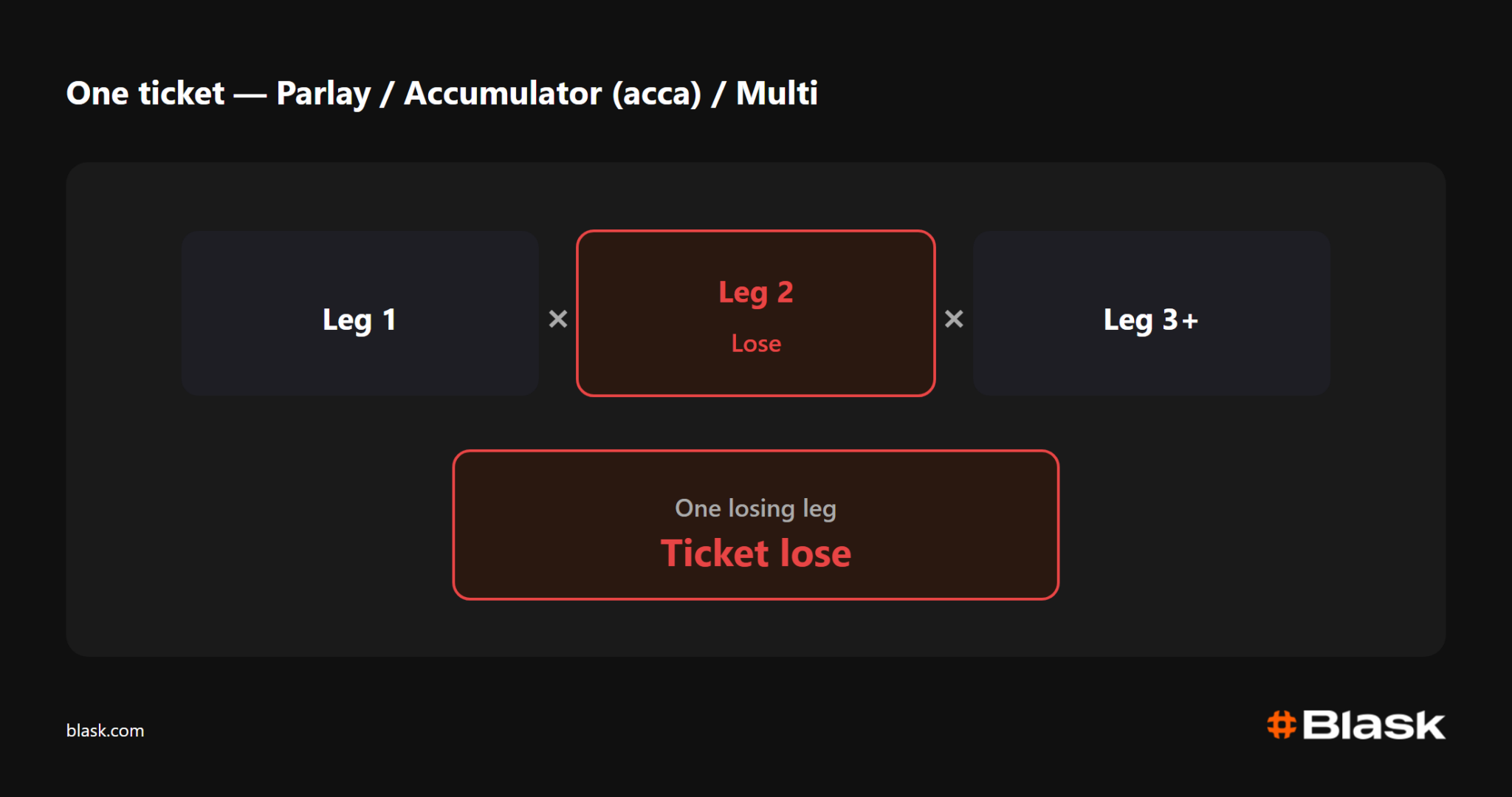
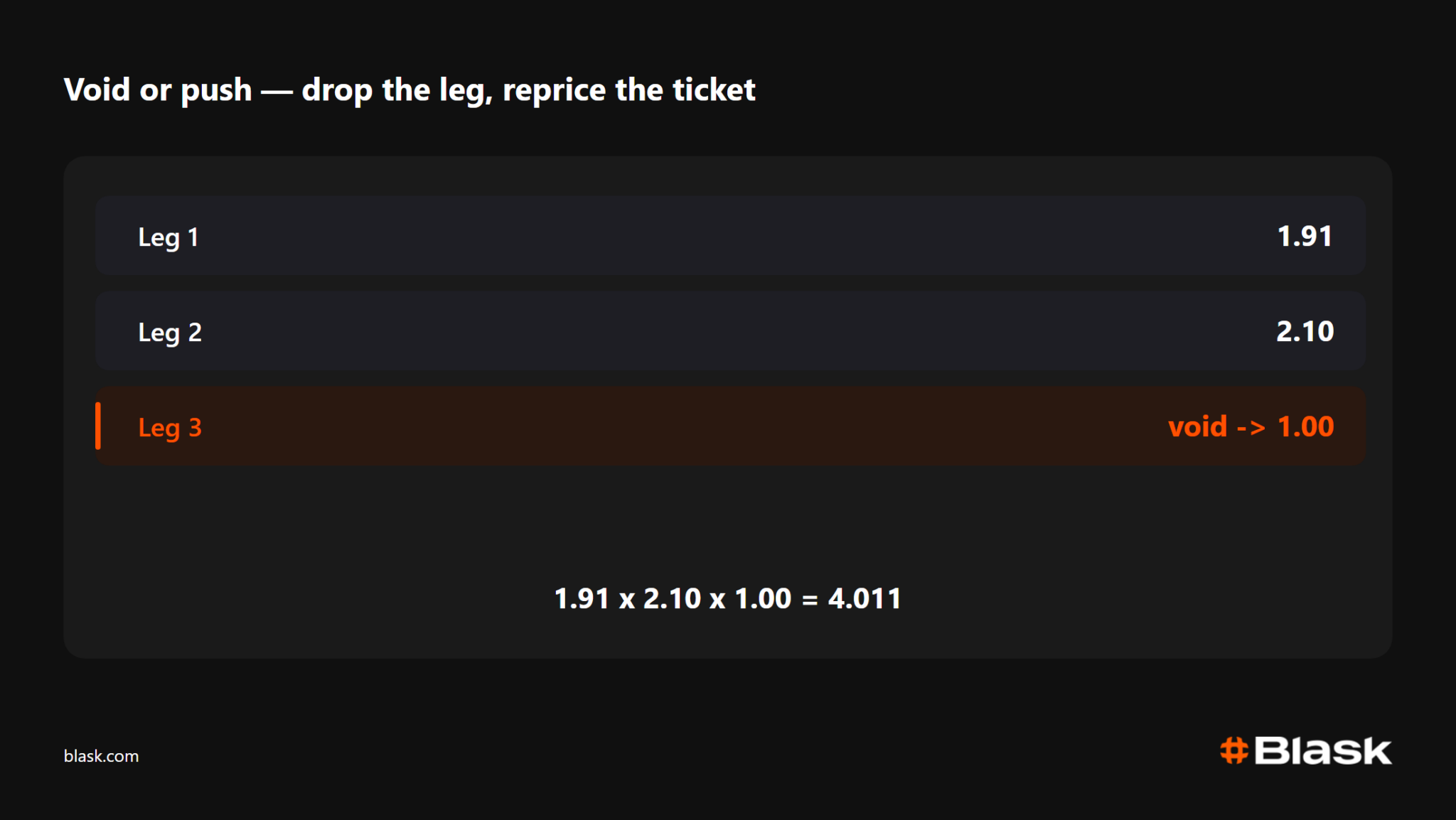
A parlay bet links two or more selections on one ticket, and every leg must win for the ticket to pay. If one leg loses, the whole wager loses, while a push usually drops the slip to a lower-leg version with smaller returns.
In search language, what is parlay is really a question about linked prices and compounded risk. Each added leg lowers the true chance of a full hit faster than most casual bettors expect, which is why this format creates both big excitement and a bigger built-in edge for the book.
Parlay vs Accumulator vs Acca vs Multi: Terminology by Region
The language around this bet type changes from market to market, but the core idea stays the same. In the United States, sportsbooks usually call it a parlay, while in the UK and much of Europe the more common terms are accumulator and acca. In other regions, bettors may also see labels such as combo, multi, or express, which can create confusion even though the betting structure itself is fundamentally identical.
| Region | Term | Notes |
| United States | Parlay | Universal in US apps and retail books |
| UK & Ireland | Accumulator / Acca | Most common in football betting |
| Europe | Accumulator | Widely understood across markets |
| Australia | Multi | Used in racing and sports |
| Asia / Global | Combo / Express | — |
US: Parlay
In the US, sportsbooks and apps mostly use the American label parlay. It is the standard word on bet slips, calculators, promo banners, and mobile bet builders.
UK and Europe: Accumulator / Acca
In the UK and much of Europe, the same structure is usually called an accumulator bet, while everyday slang shortens it to acca. When someone asks what is an accumulator, the answer is almost always the same multi-leg structure under a regional name.
Other Regions: Combo / Multi / Express
Elsewhere, books often prefer combo, multi, or express. The label changes, but the rule stays fixed. One ticket holds several picks, and the whole thing wins only if all active legs land:
- US books usually say parlay,
- UK books often say accumulator or acca bet,
- Many global apps use combo, multi, or express.
How Parlay Betting Works

At a basic level, this wager works by combining several selections into one outcome path, where each result affects the fate of the full ticket. The structure is easy to understand on paper, but the underlying math becomes more aggressive with every added leg, which is exactly why potential returns rise so fast while the true chance of winning drops just as sharply.
Multiplied Odds Mechanics
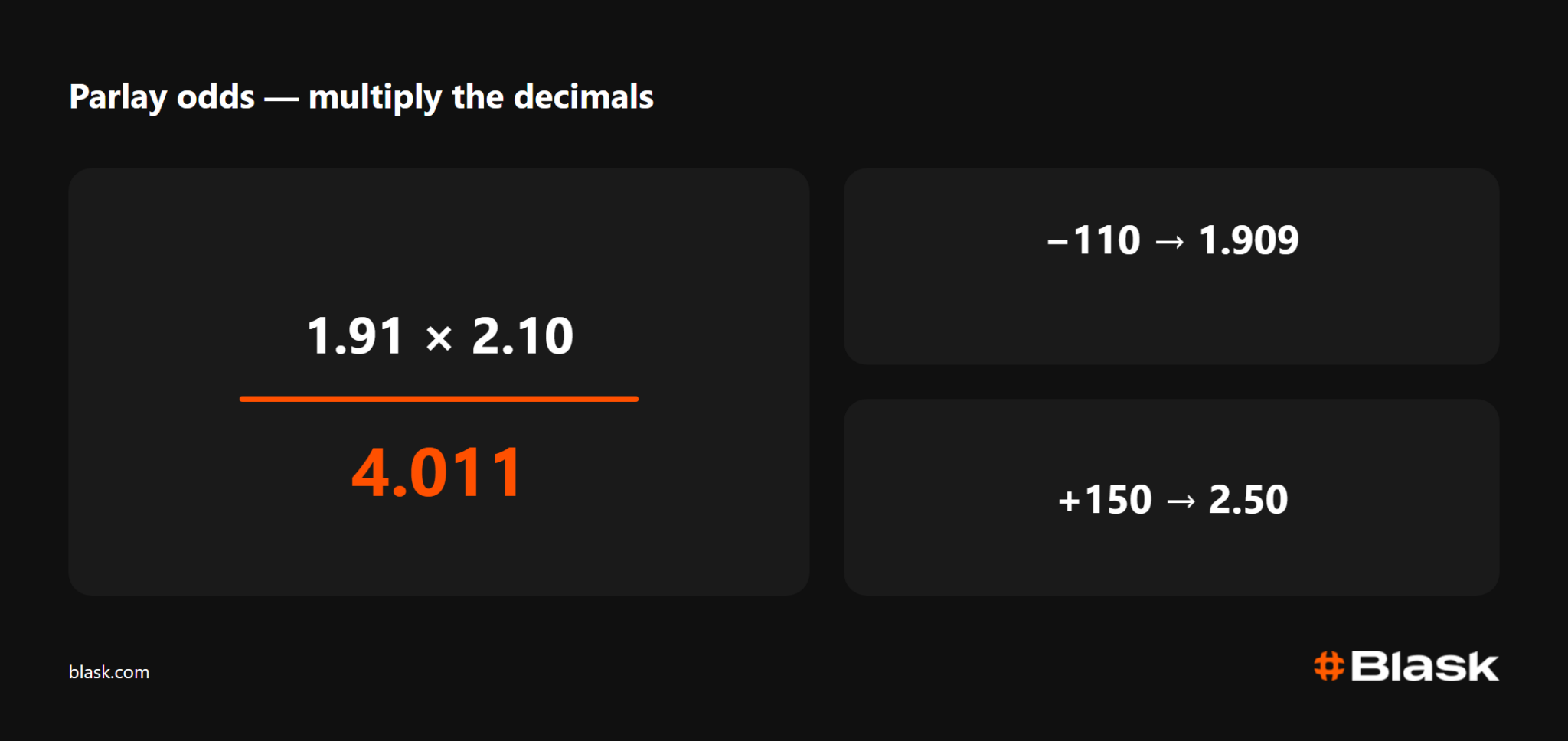
Parlay betting works by converting each leg into decimal odds and multiplying the numbers together. A leg at 1.91 combined with a leg at 2.30 becomes 4.39 in decimal, which is why payouts climb so quickly as selections are added.
All Legs Must Win Rule
The settlement rule is harsh and simple. Every active leg must win, while canceled events or pushes are commonly recalculated at 1.00 and removed from the pricing chain.
Why Parlay Payouts Are So High
Returns look huge because the odds stack on top of one another. That does not make the ticket generous, since books often pay less than true independent probability would suggest and keep a larger edge as slips get longer.

Types of Parlay Bets
Not every multi-leg wager works in exactly the same way, even if the general principle looks familiar at first glance. Sportsbooks now offer several variations, from classic cross-event combinations to more flexible formats built around one game, adjusted lines, or split structures that reduce all-or-nothing pressure. Understanding these formats matters because the payout logic, risk profile, and pricing model can change quite a bit from one version to another.
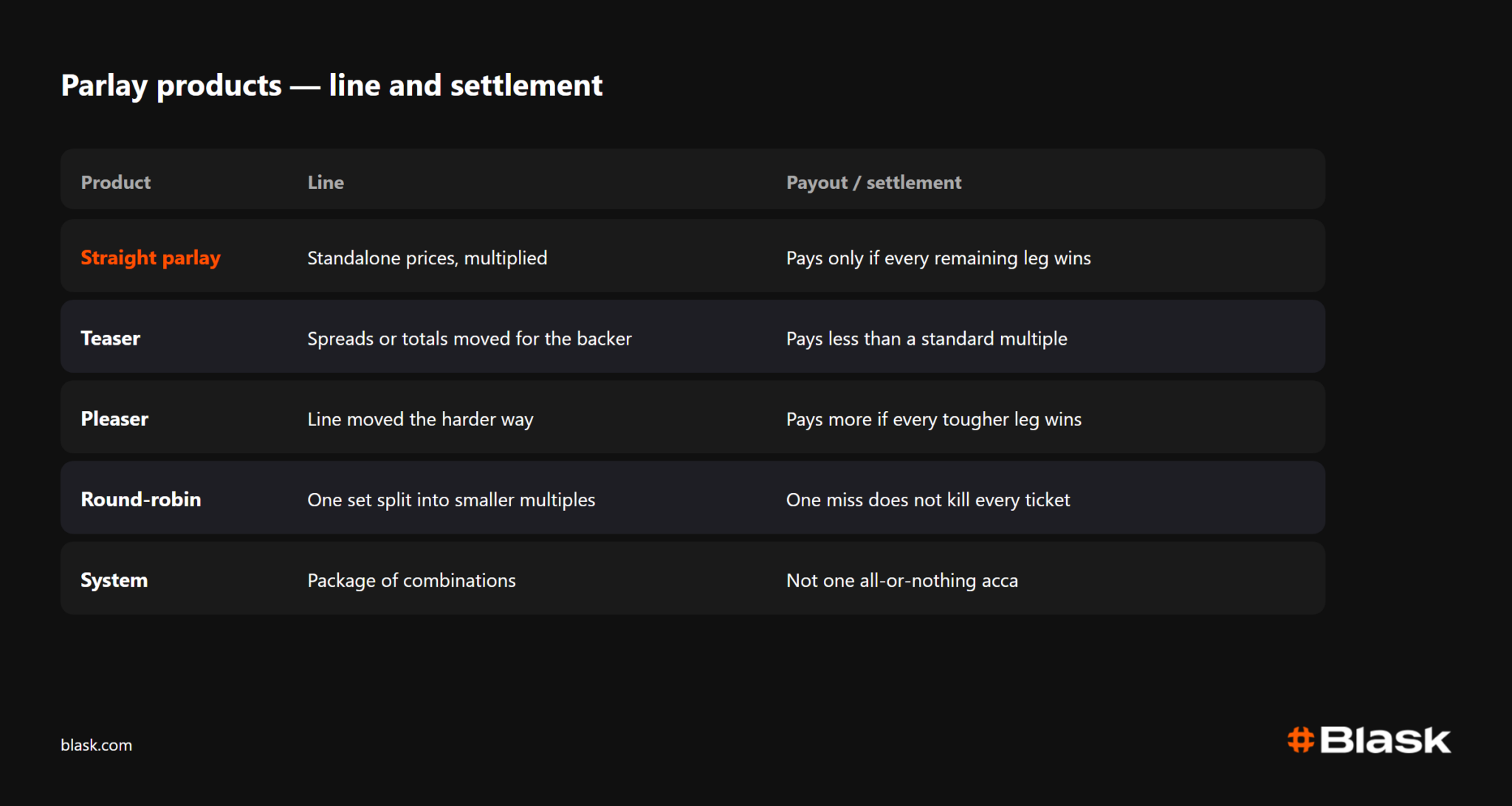
| Type | What’s linked | Risk / payout profile |
| Standard (cross-sport) | Picks from different games or sports | High variance; classic multiplied odds |
| Same-game parlay (SGP) | Multiple markets in one matchup | Correlation-adjusted pricing; books limit margin risk |
| Same-game parlay plus (SGP+) | One-game legs + picks from other fixtures | More builder flexibility; more internal price tweaks |
| Teaser | Adjusted spreads/totals in your favor | Lower payout; friendlier lines |
| Round-robin | Smaller parlays from one pick set | One miss may not kill every ticket |
| Pleaser | Lines moved against you | Higher payout if all tougher legs hit |
| Reverse parlay / if-bet | Chained stakes where each leg funds the next | No single combined price; each leg must settle before the chain continues |
Standard (Cross-Sport) Parlay
This version links selections from different games or even different sports on one slip. It is the classic multi-market ticket most bettors picture first.
Same-Game Parlay (SGP)
A same game parlay keeps every leg inside one matchup and often mixes spread, total, and prop markets. It became mainstream once books built engines that could price correlation instead of rejecting same-event combinations.
Same-Game Parlay Plus (SGP+/SGPx)
This expanded builder usually mixes one-game legs with extra picks from other fixtures or wider menus. The naming varies by app, but the product idea is the same: broader construction with more internal price adjustments.
Teaser Parlay
A teaser changes spreads or totals in a safer direction, then links those adjusted legs into one ticket with a lower payout. It is still a multiple, but line movement replaces part of the usual odds multiplication.
Round-Robin Parlay
A round robin parlay is a package of smaller combinations built from a larger set of picks. One miss does not always kill every ticket, which makes it less brutal than a single long multi.
Pleaser
A pleaser pushes the line the harder way and pays more if every tougher leg still wins. It is the opposite spirit of a teaser.
Reverse Parlay and If-Bets
These are older linked structures that chain stake progression instead of relying on one standard multi. They still matter in traditional sportsbook menus and legacy betting education.
How to Calculate Parlay Odds and Payouts
This is the part where the bet stops looking simple and starts showing its real mathematical shape. A multi-leg ticket may seem straightforward on the surface, but once several prices are combined, even a small change in one leg can noticeably affect the final number, which is why understanding the calculation process is essential for reading value, risk, and realistic return.
Converting Odds to Decimal
Minus 130 becomes 1.77 in decimal because the total return is 230 on a 130 risk. Plus 150 becomes 2.50 because the total return is 250 on a 100 stake.
Multiplying Odds Step-by-Step
Once prices are in decimal, multiply all legs together, multiply that result by stake, then subtract stake to get profit. That is the practical answer to what is a parlay bet from a math point of view.
Sample Payout Tables (2-10 Leg Parlays)
Typical fixed-odds schedules for spread cards around standard minus 110 pricing have often looked like this.
| Legs | Typical fixed odds |
| 2 | 2.6 to 1 |
| 3 | 6 to 1 |
| 4 | 11 to 1 |
| 5 | 22 to 1 |
| 6 | 45 to 1 |
| 7 | 90 to 1 |
| 8 | 180 to 1 |
| 9 | 360 to 1 |
| 10 | 720 to 1 |
How to Place a Parlay Bet (Step-by-Step)
Modern apps make the workflow very smooth because easy construction increases usage and revenue. The process usually looks like this:
- Pick two or more markets,
- Open the bet slip,
- Choose the combined ticket option,
- Enter stake and review projected payout,
- Check rules for pushes, voids, and payout caps,
- Confirm the wager.
Parlay Betting Strategy
Strategy matters here because this bet type is not just about picking several outcomes and hoping they all land. The real challenge lies in balancing price, probability, correlation, and ticket length, since a wager with attractive payout potential can still be poorly structured if the combined risk rises faster than the value of the return.
Why 2-3 Leg Parlays Are More Profitable
Shorter tickets are usually more rational because every added leg compounds both variance and hold. A two- or three-leg slip can still create useful upside without turning the whole ticket into a lottery stub:
- Fewer legs create fewer failure points,
- Price distortion compounds more slowly,
- Variance stays closer to straight-bet territory.
Correlated Parlays (and Why Sportsbooks Limit Them)
Books used to reject most same-event combinations because one outcome could make another much more likely. Today they allow more of them, but the price is heavily adjusted and often padded to protect margin.
Picking Favorites vs Underdogs
Favorites create smaller combined prices but usually carry a higher hit rate. Long underdog slips look exciting, yet flashy odds do not mean better expected value on their own.
Bankroll Management for Parlays
Because variance is strong, fixed staking matters more than confidence talk. Small, limited exposure becomes even more important when a same game parlay mixes props with main markets and stacks several uncertainty layers inside one result.
Common Parlay Mistakes
Most losing slips share the same structural errors rather than some deep mystery. The usual failures are easy to recognize:
- Adding legs only to chase a bigger screenshot,
- Ignoring push and void rules,
- Treating correlated outcomes as free value,
- Forgetting payout caps on long tickets.
Parlay vs Other Bet Types
This comparison matters because a multi-leg ticket is often presented as just another standard betting option, even though its risk and pricing logic are very different from other common wager types. Looking at these formats side by side makes it easier to see where the payout advantage is real, where the variance becomes heavier, and where the sportsbook edge starts to widen.
| Factor | Standard parlay | Single bet | Teaser / round-robin |
| Win requirement | Every leg must win | One pick only | Teaser: all legs; round-robin: partial combos can cash |
| Payout logic | Decimal odds multiplied | Straight market price | Teaser: line move + lower pay; round-robin: split tickets |
| Variance | Highest on long slips | Lowest | Teaser: medium; round-robin: reduced all-or-nothing risk |
| Best use case | Short 2–3 leg value plays | Core bankroll / edge bets | Teaser: key numbers; round-robin: hedging one doubtful leg |
vs Single Bets
Singles pay less per ticket but are cleaner to price and much less fragile. One good read can still cash even if another idea fails.
vs Teasers
A teaser parlay buys friendlier lines and accepts a lower payout in return. It is still a linked bet, but the price comes from spread movement rather than simple multiplication of market prices.
vs System Bets
System products split selections into several smaller combinations. An accumulator bet is cheaper because it is one ticket, but it is also harsher because one loss wipes out the whole attempt.
How Sportsbooks Profit from Parlays (Operator Side)
Books push these tickets because the margin is much richer than on singles. Washington Post reporting showed that in many reporting states they produce about half to two-thirds of sportsbook revenue, despite representing a smaller share of wager volume.
From the operator side, the accumulator bet is ideal app material. It is easy to build, easy to recommend, and psychologically sticky because near-misses feel close even when the ticket is already dead.
History of Parlay Betting
The modern US story reaches back at least to New York-area racetrack gambling in the late 1980s, when newspapers were already discussing these products and their limited popularity. Mass adoption came much later, after mobile books turned multi-leg construction into a one-tap habit in the late 2010s and 2020s.
Future Trends in Parlay Betting for 2026
The direction for 2026 is already visible. Books are investing in better correlation engines, deeper bet builders, faster repricing, and more personalized suggestions shaped by user behavior:
- More automated same-event pricing through dedicated engines,
- More tailored in-app suggestions,
- More scrutiny around limits, transparency, and settlement,
- More focus on high-margin multi-leg products over straight wagers.
By 2026, the product will likely feel less like a static coupon and more like a live mobile builder. In plain terms, what is parlay tomorrow is a data-shaped betting product built for speed, personalization, and operator margin first.