
- Updated:
- Published:
Gambling Affordability Checks
Gambling affordability checks are a family of financial protection tools, and the UK, the Netherlands, Sweden and Australia each use a different version.
The phrase sounds like a single test. In practice, it covers several tools that regulators and operators use to spot financial harm: public-record vulnerability screens, credit-data risk assessments, deposit thresholds and source-of-funds reviews.
Each one has its own trigger, data source and legal status. Players worry about bank statements and frozen accounts. Operators worry about cost, friction and lost customers. Both need to know which check applies, when, and what it can lawfully lead to.
What are gambling affordability checks?
Affordability checks in gambling are reviews an operator runs to judge whether a customer’s gambling spend may be causing or signalling financial harm. They sit inside an operator’s wider responsible gaming policy.
The term is informal. Regulators rarely use it in legal texts. The UK Gambling Commission (UKGC) speaks of “financial vulnerability checks” and “financial risk assessments”. The Dutch regulator uses “draagkrachttoets”, an assessment of financial capacity.
Why affordability matters in online gambling
Online play removes most of the natural brakes of land-based gambling. Deposits take seconds, accounts stay open around the clock, and one customer can hold accounts with several brands.
Regulators also point to specific risk in the top spending tier. In its July 2026 announcement, the UKGC said high-spending customers are two to four times more likely to have a debt management plan than the wider population. They are also two to five times more likely to have had a default in the previous 12 months.
Affordability checks vs responsible gambling monitoring
Responsible gambling monitoring is continuous. It watches behaviour: session length, deposit frequency, cancelled withdrawals, late-night play. In the UK, operators must run this kind of customer interaction for every customer.
A financial check is a discrete event. The first affordability check gambling customers meet in the UK is usually a financial vulnerability check. A threshold or an indicator triggers it, and it asks a narrower question about the customer’s financial position. The two feed each other, but passing one does not clear the other. A customer with a clean credit file can still show behavioural markers of harm.
How do gambling affordability checks work?
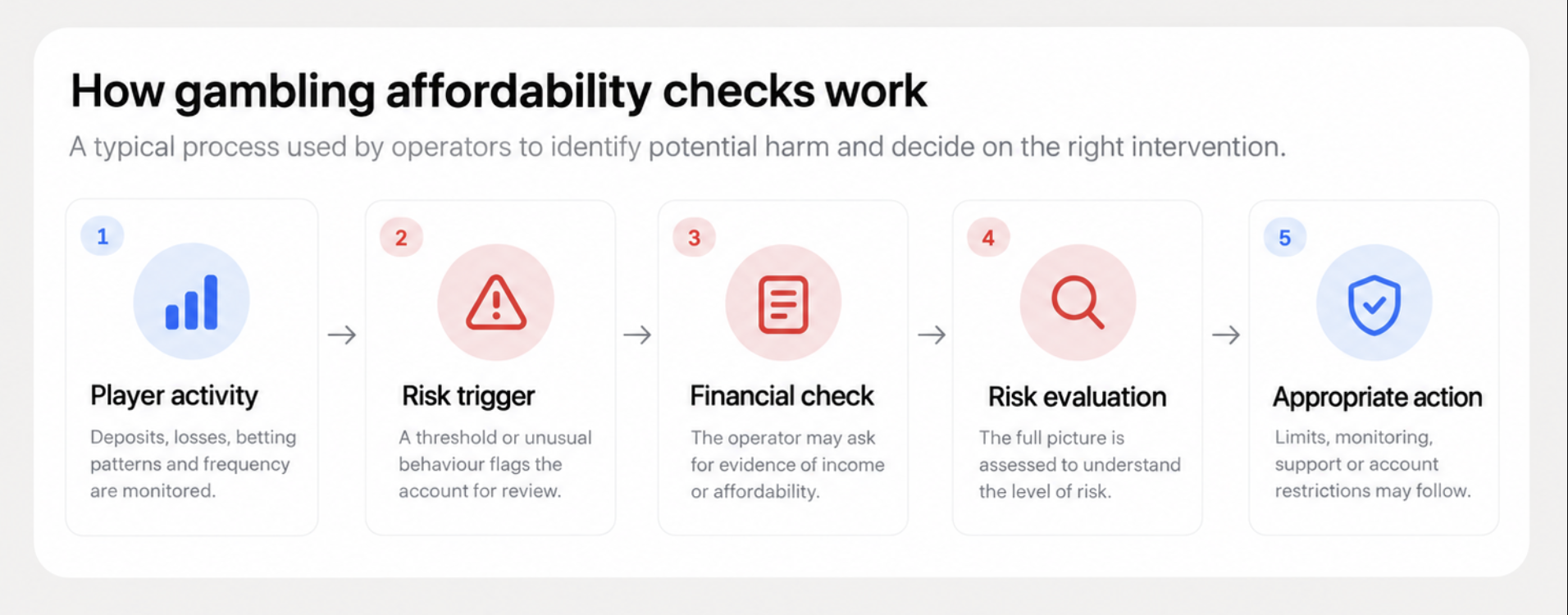
Most frameworks follow the same logic, even where the details differ. The operator tracks activity, a trigger fires, the operator gathers financial information, weighs it against what it already knows, and then decides on a proportionate response.
💡 Key point: The response can be nothing at all. In the UK and elsewhere, a triggered check is a reason to look, not a verdict on the customer.
What can trigger a gambling affordability check?
Triggers fall into three groups. Regulatory thresholds are the clearest: the UK’s £150 net deposits over a rolling 30 days, or the Dutch €700 monthly net deposit threshold.
Behavioural signals form the second group. These include a sharp rise in deposits, repeated failed payments or chasing losses. The third group is the customer’s own choice, such as a request to raise a deposit limit. Operators may also set internal triggers below the regulatory ones.
What information may be reviewed?
The data depends on the check. A UK financial vulnerability check uses only public records, such as bankruptcies and county court judgments. A UK financial risk assessment, once live, will use limited data from credit reference agencies.
Document requests sit at the far end of the scale. Payslips, tax returns or bank statements usually come in when automated checks cannot give a clear answer, or when an anti-money laundering review needs proof of where funds came from.
What happens after a check?
Most checks end with no visible change for the customer. If the check finds a risk indicator, the operator weighs it with everything else it knows about the account.
Possible outcomes range from a safer-gambling message to a deposit limit, a request for more information or, in serious cases, account restrictions. The outcome should match the level of risk found, not the mere fact that a check ran.
Different types of gambling financial checks
Five tools often get grouped under the affordability label. They answer different questions, use different data and come from different legal duties. Mixing them up leads to wrong expectations on both sides of the account.
The first three are harm-prevention tools. Source of funds and source of wealth come from anti-money laundering law. In practice, the same team often runs all of them, and the same customer may face more than one.
Financial vulnerability checks
Financial vulnerability checks look for specific signs that a customer is already in serious financial difficulty. In the UK, the list covers bankruptcy orders, county court judgments, individual voluntary arrangements, High Court judgments, administration orders and Debt Relief Orders.
They use publicly available records only. They do not look at income, credit scores or spending capacity, and they do not tell an operator how much a customer can afford.
Financial risk assessments
Financial risk assessments go one step deeper. They draw on credit reference data to flag signs of financial strain that public records miss, such as defaults and arrears.
In the UK, operators receive an overall risk assessment alongside four data points: defaults, multiple arrears, significant arrears and whether the customer has a debt management plan. This check requires no documents from the customer and leaves no mark on their credit file.
Source of funds and source of wealth checks
A source of funds check establishes where the money for a specific deposit came from, such as a salary, savings or property sale. By contrast, a source of wealth check looks at how the customer accumulated their overall wealth.
These reviews belong to anti-money laundering duties, not harm-prevention rules. They often involve documents. Their purpose is to confirm that funds are legitimate, which says little about whether the spend is sustainable.
Operator-level risk monitoring
Operators also run their own risk models on top of regulatory checks. These systems combine behavioural markers, payment data and account history into a risk score.
Internal thresholds are usually stricter than legal minimums, and they differ from brand to brand. That explains why two operators may treat the same customer differently.
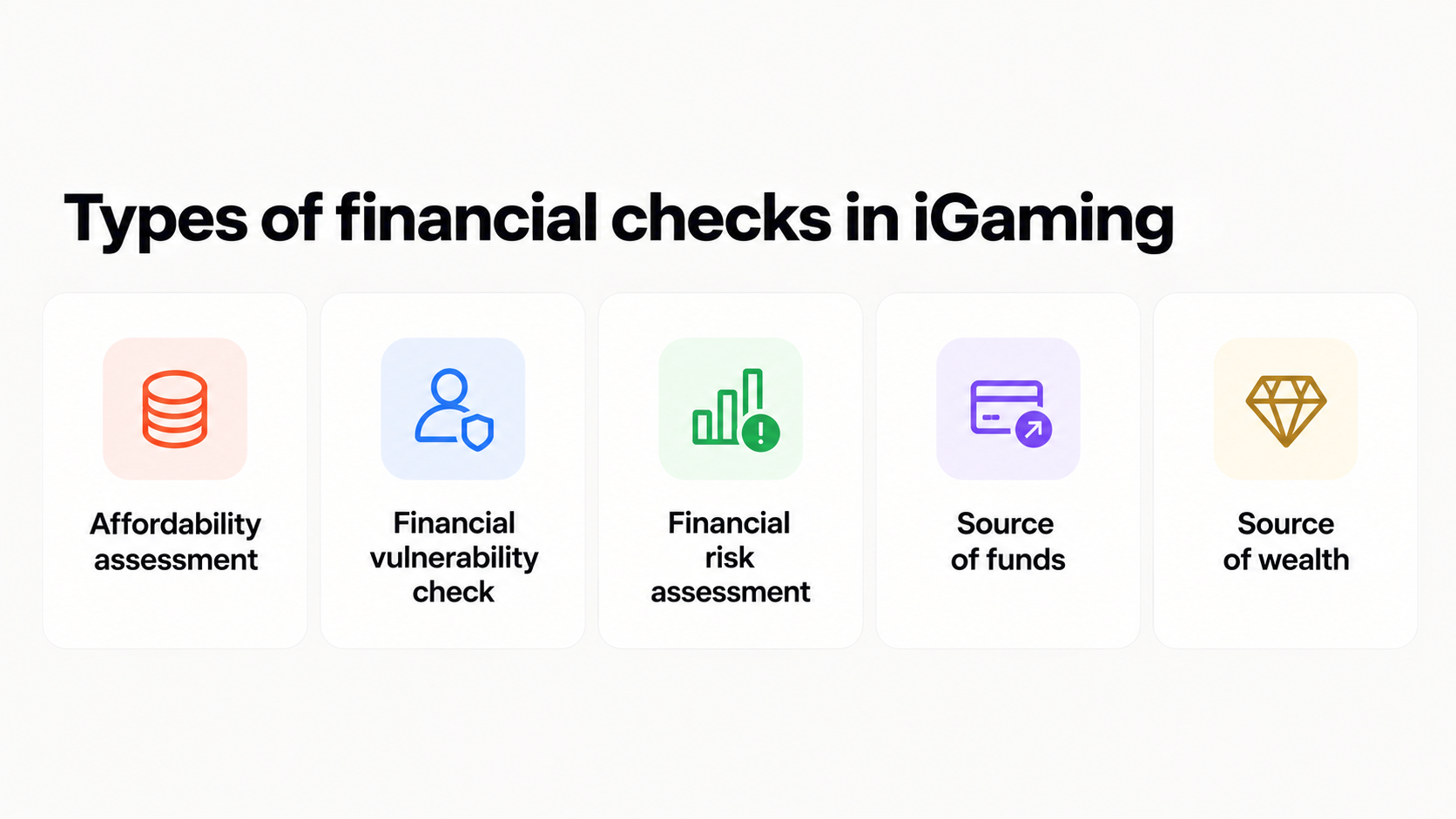
| Check | Primary purpose | Typical data | Legal basis |
|---|---|---|---|
| Affordability assessment | Evaluate whether gambling expenditure may be sustainable | Income evidence, spending data | Varies; e.g. Dutch policy rule above monthly thresholds |
| Financial vulnerability check | Identify specified indicators of financial difficulty | Public records (insolvency, court judgments) | UK licence condition for remote operators |
| Financial risk assessment | Identify financial risk using permitted data | Limited credit reference data | UK, staged rollout not yet started |
| Source of funds | Establish the origin of funds used | Payslips, bank statements, sale contracts | Anti-money laundering law |
| Source of wealth | Establish how overall wealth was accumulated | Wider financial documents | Anti-money laundering law |
Definitions, data sources and legal obligations vary by jurisdiction.
Gambling affordability checks in the UK
The UK has the most detailed framework, and it is also the most misread. The UKGC does not require a single affordability test that sets a maximum gambling budget for each player.
Instead, the gambling affordability checks UK operators run today come from two separate financial tools, layered on top of existing customer interaction and anti-money laundering duties. One is already in force. The other has a confirmed design but no start date yet.
UK Gambling Commission requirements
All UK-licensed remote operators must already monitor customers for signs of harm and act on them under the Commission’s customer interaction rules. Anti-money laundering rules separately require source-of-funds checks where risk calls for them.
UKGC affordability checks, in the everyday sense of the phrase, therefore start from this base. Most questions about affordability checks UK gambling customers ask relate to the two financial layers below. Financial vulnerability checks and financial risk assessments add a defined financial layer. They do not replace behavioural monitoring.
Financial vulnerability checks and the £150 threshold
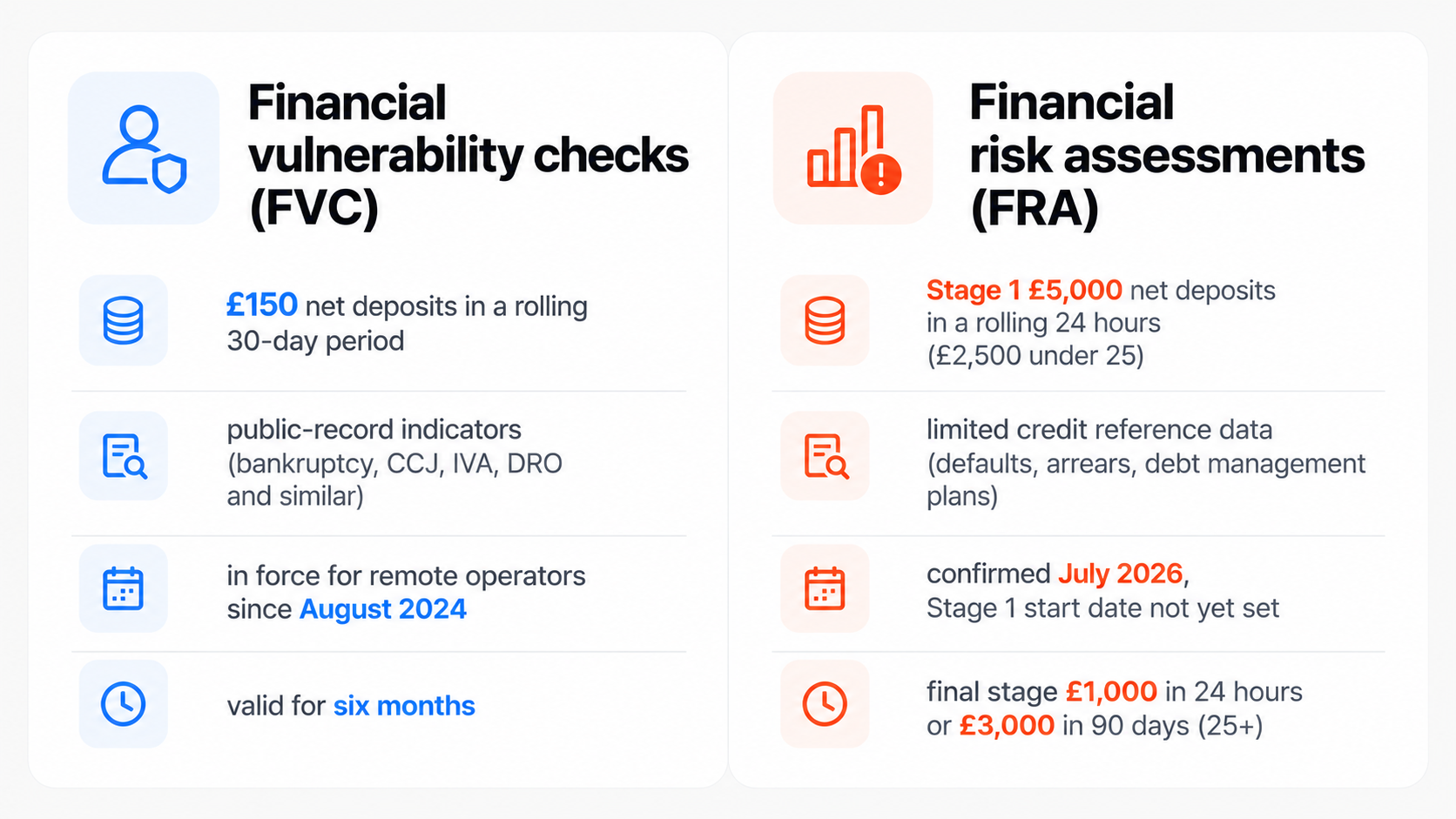
Financial vulnerability checks became a requirement for remote operators on 30 August 2024. The trigger was £500 in net deposits over a rolling 30-day period. In February 2025, the threshold fell to £150 in net deposits over the same rolling period.
Net deposits mean deposits minus withdrawals. The figure counts money moved into the account, not losses. Operators may check earlier, and the Commission’s implementation review found 36% of operators already did so at registration or first deposit.
A completed check stays valid for six months. Under the £500 threshold, operators checked 7% of active accounts on average in the first three months. Of those checks, 78% returned within 10 minutes.
The Commission also stated that operators do not have to apply automated high-friction actions, such as stopping an account, on the basis of a check alone. A single county court judgment may signal lower risk than a bankruptcy order.
What financial risk assessments check
On 7 July 2026, the Commission confirmed that the financial risk assessments gambling operators must run will start in stages. Stage 1 covers the largest operators. An assessment is triggered when net deposits exceed £5,000 in a rolling 24-hour period, or £2,500 for customers under 25. The Commission says fewer than 0.5% of customers exceed the £5,000 level.
Interim thresholds will follow after work with implementation groups. The final stage sets the bar at net deposits above £1,000 in 24 hours or £3,000 in 90 days for customers aged 25 and over. For customers under 25, the figures are £750 and £2,000.
At the time of writing, in October 2026, the Commission had not published the Stage 1 start date. Its July 2026 update says the date will come in a formal consultation response. During early rollout, it will not take enforcement action against operators for failing to act on an assessment, provided they meet existing requirements.
Pilot data shaped the design. According to the Commission, fewer than 3% of accounts would need an assessment at full rollout, and 97% of those could be assessed without friction. Fewer than 1 in 1,000 accounts would need an assessment but could not get one frictionlessly.
What UK checks do not measure
💡 Key point: Neither UK tool calculates a personal gambling budget. Neither asks for income by default, and neither affects the customer’s credit score.
Financial vulnerability checks only catch severe, already public events. The Commission itself notes they cannot identify defaults, arrears or general financial stress. Financial risk assessments will close part of that gap for high spenders, but they still measure risk signals, not disposable income.
Gambling affordability regulations around the world
No international standard exists for financial checks in gambling. Some regulators set hard deposit thresholds. Others rely on a general duty of care backed by specific contact points. Some focus on payment methods instead.
The four markets below show how far the approaches differ. Only rules confirmed by the regulators themselves are included.
United Kingdom
The UK combines continuous behavioural monitoring with defined financial triggers. Financial vulnerability checks at £150 net deposits over a rolling 30 days are in force for remote operators.
Financial risk assessments based on credit data are confirmed but not yet live. Market context matters here. In Q1 2026, locally licensed brands held 97.0% of UK demand by Blask Index, a real-time measure of market demand volume for iGaming brands in a given country, based on normalized search data. Offshore brands held 3.0%, up from 2.85% a year earlier, according to Blask’s Q1 2026 UK analysis. This data does not show what caused the shift.
📚 Read more: UK iGaming after the 40% tax: Bet365 gains ground as the market reshapes
Netherlands
The Netherlands Gambling Authority (Kansspelautoriteit, KSA) runs the closest thing to a true affordability test. Every player must set a deposit limit when opening an account. Since 1 October 2024, new accounts start with a monthly deposit cap of no more than €350 for adults and €150 for players under 24. Going higher requires contact with the operator.
A second layer comes from the KSA’s Responsible Gambling Policy Rule 2024: a monthly net deposit threshold of €700, or €300 for young adults. According to the KSA, operators must block further deposits for the rest of the month once a player exceeds it, unless an assessment of financial capacity supports more.
That assessment must rest on sufficient, correct and verifiable information, such as payslips or tax returns. In February 2025, the KSA warned operators that some tests relied on weak evidence. The government is also working on a cross-operator deposit limit linked to an affordability test. That measure remains a proposal and needs legislation.
Sweden
Sweden takes a duty-of-care route. The Gambling Act requires licensees to protect players from excessive gambling, and online players must set deposit limits.
Swedish rules add a specific contact point. Under Chapter 11, Section 5 of the Gambling Ordinance, a licensee must contact any player who sets a deposit limit above SEK 10,000 per month. In April 2026, Spelinspektionen opened supervision cases into how operators handled this for customers aged 18 to 24. It closed them in June 2026 with no further action.
Australia
Australia has no national affordability check requirement for online wagering. It relies on payment rules, self-exclusion and pre-commitment tools instead.
Since 11 June 2024, licensed online and telephone wagering operators may not accept credit cards, funds linked to credit cards or digital currency. The ACMA enforces the ban. BetStop, the national self-exclusion register, and operator-offered deposit limits form part of the national consumer protection framework.
Why regulatory approaches differ
Market structure explains much of the gap. The UK licenses online casino and betting with tax and duty rules that reward a large local market. The Netherlands opened its regulated online market only in 2021 and built strict defaults in from the start. Australia bans online casino entirely, so its rules focus on wagering.
Data access matters too. Credit reference data is widely available in the UK. Other countries restrict how private companies may use it for non-lending purposes. Privacy law and political pressure shape the rest.
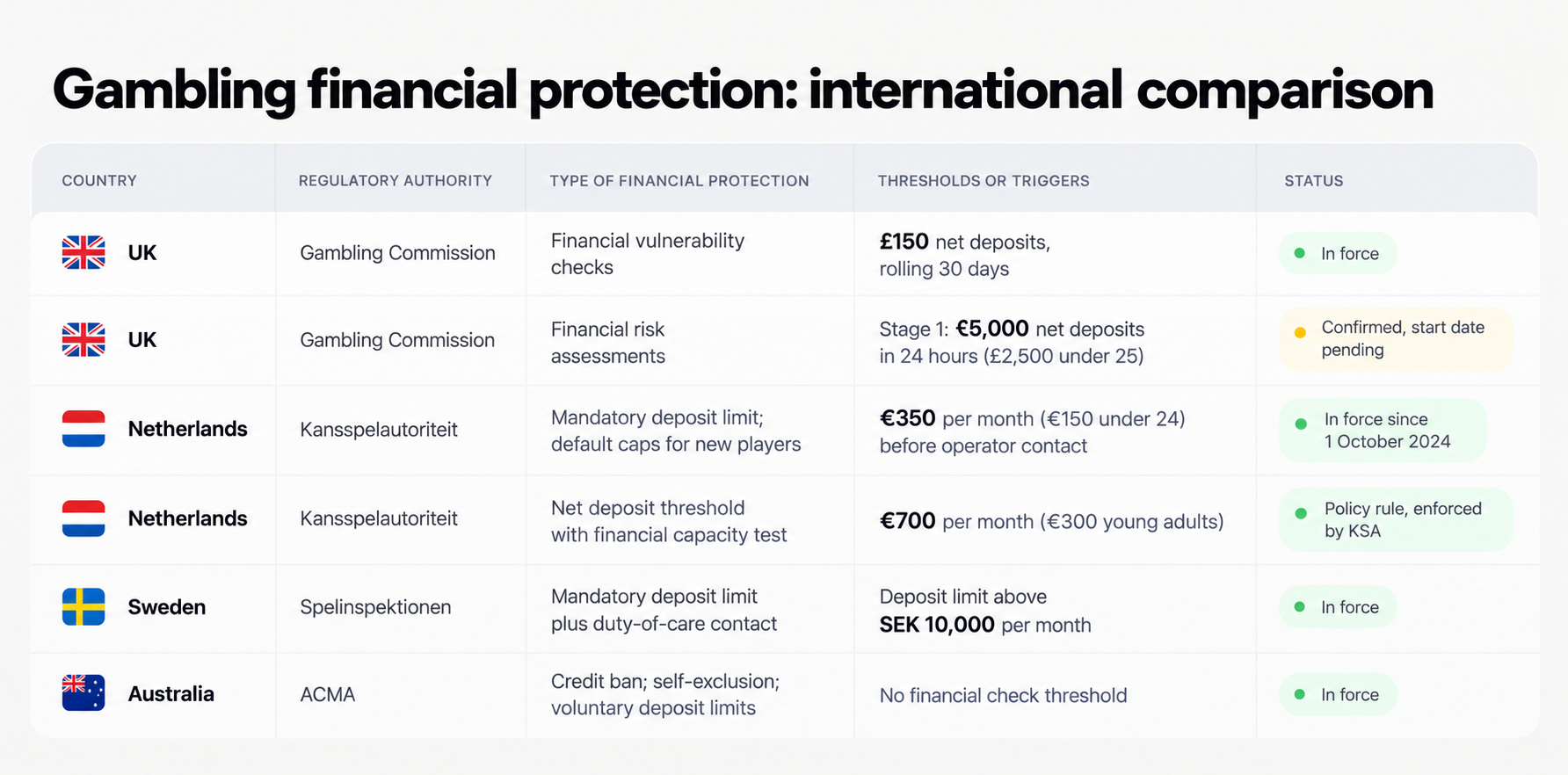
Deposit limits, affordability tests and source-of-funds checks are different regulatory tools. Thresholds use different measures and periods.
What happens when a player fails an affordability or financial risk check?
“Failing” is a misleading word. Most checks do not produce a pass or fail result. They return information, and the operator decides what to do with it.
A UK financial vulnerability check that finds a court judgment, for example, does not oblige the operator to close the account. A Dutch player above the €700 threshold, by contrast, faces a deposit block for the rest of the month unless the financial capacity test supports more.
Additional verification
The most common next step is a request for more information. The operator may ask the customer to confirm income, explain a deposit pattern or provide documents.
In the UK, document requests are expected mainly where frictionless checks cannot give an answer. Under the financial risk assessment design, that should apply to fewer than 1 in 1,000 accounts. Anti-money laundering reviews follow their own rules and can require documents at any spend level.
Deposit limits and account restrictions
Where the check shows risk, operators can set a deposit limit, reduce an existing one or pause deposits while a manual review runs. The UKGC lists automated deposit limits as one option, either as a final action or as a temporary measure.
Account suspension or closure sits at the end of the scale. It usually follows a combination of findings rather than one data point. Customers should still have access to withdraw their balance, as the KSA guidance confirms for the Dutch deposit block.
Player support and responsible gambling interventions
Many outcomes are supportive rather than restrictive. Typical steps include a safer-gambling conversation, links to debt advice or a cooling-off period.
Operators can also offer self-exclusion where the customer asks for it. These responsible gambling checks work best when the message explains why the operator stepped in.
📚 Read more: Responsible gaming policy
How affordability checks affect online casino and sportsbook operators
Where regulators impose affordability checks gambling operators carry most of the cost. For operators, the checks are both a licence condition and an operating cost. They change onboarding, payments, customer service and VIP management at the same time.
The impact concentrates in the top spending tier. That is where checks fire most often and where most revenue comes from. The UKGC openly acknowledges that financial risk assessments will reduce Gross Gambling Yield, mainly through lower spend by high spenders in financial difficulty. It did not give a figure.
Compliance and operational costs
Each check carries a data cost from the provider. Each escalation needs a trained reviewer. Operators also pay for system changes, audit trails and staff training.
Smaller operators feel this most. The UKGC limited Stage 1 of financial risk assessments to the largest operators, which gives smaller brands time to prepare.
Player onboarding and verification
Financial checks now sit next to identity checks in the verification process. Many UK operators run a vulnerability check at registration or first deposit, before any threshold applies.
This links closely to KYC, but the questions differ. KYC asks who the customer is. Financial checks ask whether the spend raises risk.
Retention and customer experience
Unexplained document requests are a frequent source of complaints. Customers may leave for a competitor, or for an unlicensed site, when a check feels intrusive or arbitrary.
Clear communication reduces that risk. Retention teams and CRM systems need to know which customers are under review, so bonus offers do not reach someone the risk team has just restricted.
Responsible gambling and risk management
Financial checks also give operators better information. A risk view built on credit and public-record data, combined with behavioural signals, gives a fuller picture than either alone.
For finance teams, the effect shows up in GGR and NGR concentration. Revenue that depends on a few high-spending accounts carries more regulatory exposure than revenue spread across a broad base.
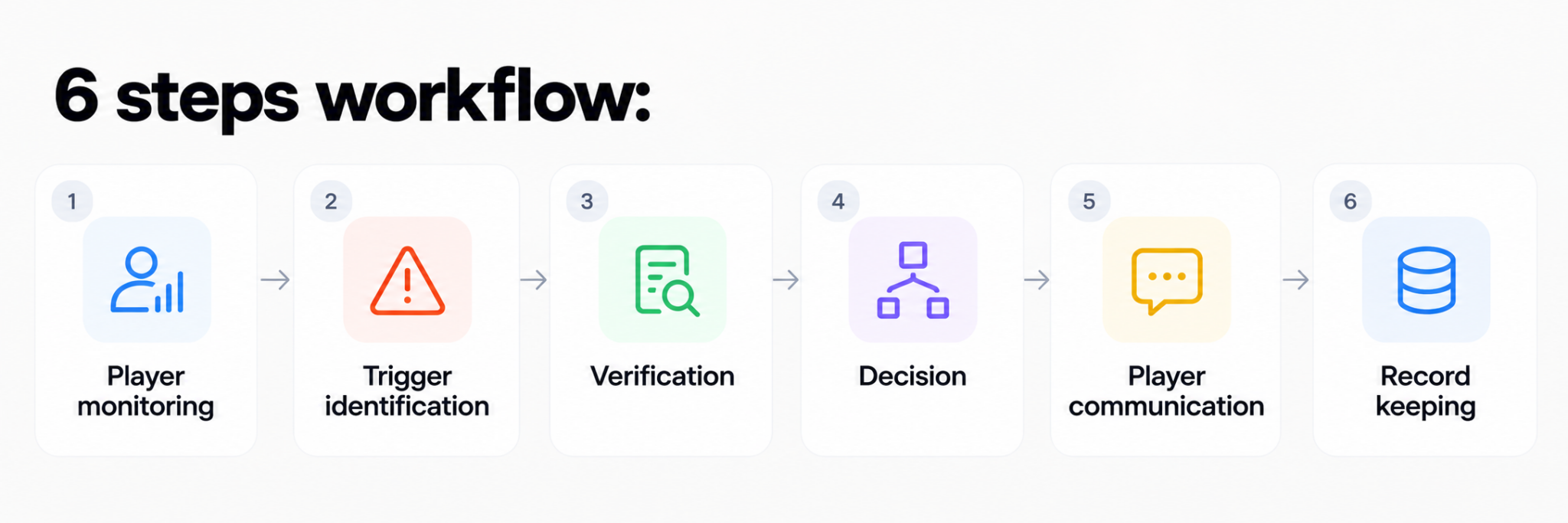
How operators implement gambling affordability
A working setup connects data, decisions and records. Regulators look less at whether an operator ran a check and more at what it did with the result.
The steps below reflect common practice in regulated markets. Specific duties depend on the licence.
Monitoring customer activity
Operators track net deposits per customer over the exact periods the rules use: rolling 30 days, rolling 24 hours or rolling 90 days in the UK, and calendar months in the Netherlands.
Getting the measure right matters. A system that counts gross deposits instead of net deposits, or a calendar month instead of a rolling window, will trigger checks at the wrong time.
Integrating third-party verification services
Most operators buy public-record and credit data from specialist providers through an API. In the UK, credit reference agencies will supply financial risk assessment data.
The Commission’s review found that most vulnerability checks return within minutes. Operators still need a fallback for timeouts, missing data and customers who cannot be matched.
Managing player data and privacy
Financial data is sensitive. Operators need a lawful basis to process it, a clear privacy notice and strict access controls.
Data minimisation applies. The UK financial risk assessment design gives operators four data points and an overall risk view, not a full credit report. Any extra request, such as bank statements, needs a specific reason.
Documenting decisions and compliance
Every check should leave a record: the trigger, the data received, the decision taken and the reason for it. Regulators ask for these records in compliance reviews, as Spelinspektionen did in its 2026 cases.
Good records also protect the operator in disputes. They show the decision was proportionate and based on evidence.
The debate around affordability checks
Affordability checks in gambling divide the industry and campaigners more sharply than most compliance topics. Both sides agree that serious financial harm exists. They disagree on how far checks should go and who should bear the cost.
Evidence on outcomes is still limited. Financial risk assessments have not launched in the UK, and regulators have published only early implementation data on the existing checks.
Consumer protection and harm prevention
Supporters argue that operators already see the warning signs in deposit data and should act on them. Credit data can reveal debt problems that behavioural monitoring alone would miss.
The UKGC’s own figures support part of this case. High spenders show debt management plans and defaults at two to five times the rate of the wider population.
Privacy and financial data concerns
Critics question whether a gambling operator should see credit information at all. Customers may object to sharing payslips or bank statements for a leisure activity.
The UK design tries to limit this through frictionless checks, a narrow data set and no effect on credit scores. Document requests remain possible, and they draw the strongest objections.
Risks of unnecessary player friction
Low thresholds catch many customers who face no financial risk. Each extra step adds delay and can feel like an accusation.
Regulators recognise this. The UKGC has warned against automated account stops based on a single low-risk indicator, and it chose a staged rollout partly to limit friction.
Potential movement toward unlicensed operators
The industry’s main concern is that strict checks push customers toward offshore casinos that run no checks at all. This risk is often cited but hard to measure in isolation.
Demand data can show the size of the offshore segment, as in the UK figures above. It cannot attribute a change to one specific rule, because tax changes, stake limits and enforcement all move at the same time.
How gambling affordability requirements may evolve
Three developments are worth tracking. First, the UKGC will publish the Stage 1 start date for financial risk assessments and later set interim thresholds. Second, the Netherlands is working on a cross-operator deposit limit tied to an affordability test.
Third, other regulators are watching both models. Expect more interest in single-customer views across operators, since per-brand thresholds miss customers who spread spend across several accounts.
For operators, the practical step is to build systems that can handle new thresholds and measurement periods without a rebuild. For players, the main point is simpler: most checks run in the background, and a request for information is not a judgment.
FAQ
What is a gambling affordability check?
It is a review an operator runs to judge whether a customer’s gambling spend may signal financial harm. Depending on the country, it can mean a public-record vulnerability screen, a credit-data risk assessment, an income test or a deposit-limit contact.
Are affordability checks mandatory?
Some are. In the UK, financial vulnerability checks are mandatory for remote operators, while financial risk assessments are confirmed but not yet live. In the Netherlands, deposit thresholds and financial capacity tests apply. Other countries have no such requirement, and operators may run voluntary checks.
What triggers an affordability check?
Triggers include regulatory thresholds, such as net deposits over a set amount and period, behavioural signals like a sharp rise in deposits, and customer actions such as raising a deposit limit. Operators may also use stricter internal triggers.
What is the UK gambling affordability threshold?
There is no single gambling affordability checks threshold in the UK. UK gambling affordability checks have two separate triggers. Financial vulnerability checks apply at £150 in net deposits over a rolling 30 days. Financial risk assessments will start at £5,000 in net deposits over a rolling 24 hours (£2,500 for under-25s), falling over time to £1,000 in 24 hours or £3,000 in 90 days.
Do affordability checks affect your credit score?
No. UK financial vulnerability checks use public records only. The Commission states that financial risk assessments use credit reference data without any impact on the customer’s credit score.
Can a casino ask for bank statements?
Yes, in some cases. Operators may request documents when automated checks cannot give a clear answer, during an anti-money laundering review, or, in the Netherlands, when a player wants to deposit beyond the monthly threshold. They are not a standard part of every check.
Can a gambling operator freeze an account after a check?
It can restrict an account if the overall risk picture justifies it, but a check alone does not require that. In the UK, operators are not obliged to stop accounts based only on a vulnerability check result. In the Netherlands, deposits are blocked for the month above the net deposit threshold, while withdrawals remain possible.
Are affordability checks the same as KYC?
No. KYC confirms identity and age and supports anti-money laundering duties. Financial checks assess financial risk. Both often run during onboarding, which is why customers confuse them.
Do all countries require affordability checks?
No. Approaches vary widely. The UK, the Netherlands and Sweden use different financial triggers and contact rules. Australia relies on a credit ban, self-exclusion and deposit-limit tools instead of financial checks. Many markets have no specific requirement.

“`