
- Updated:
- Published:
United Kingdom iGaming market H1 2026: brands, demand, and what changed

In the UK iGaming market H1 2026, Bet365 took the demand lead from William Hill as Evoke’s flagship shed 3.5 BAP points under a new 40% Remote Gaming Duty.
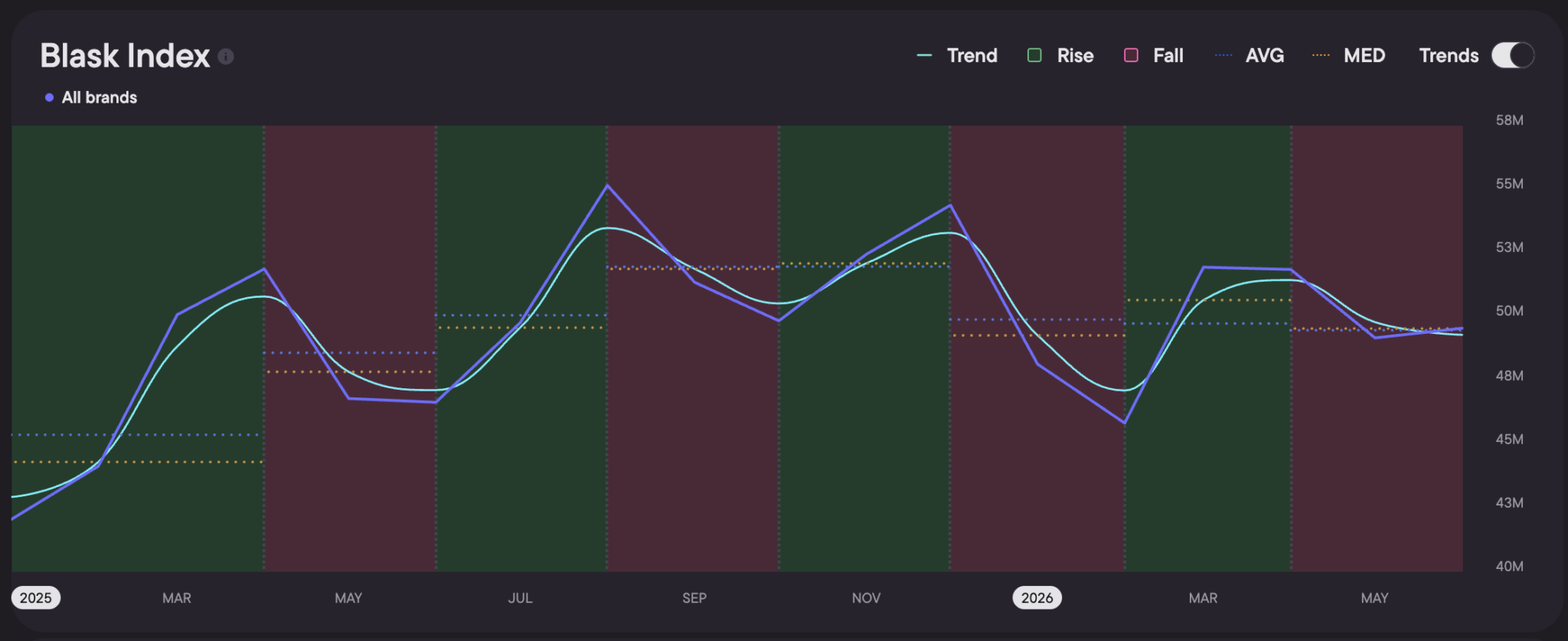
Totals for the UK iGaming market H1 2026 still grew. Blask Index rose 5.3% versus H1 2025 to 296.5M points. Competitive Earning Baseline (CEB) averaged $1.04B per month ($752M–$1.92B), up 10.9% YoY. Against H2 2025, demand fell 5.3% HoH: a seasonal step-down after a stronger second half, not a structural crash.
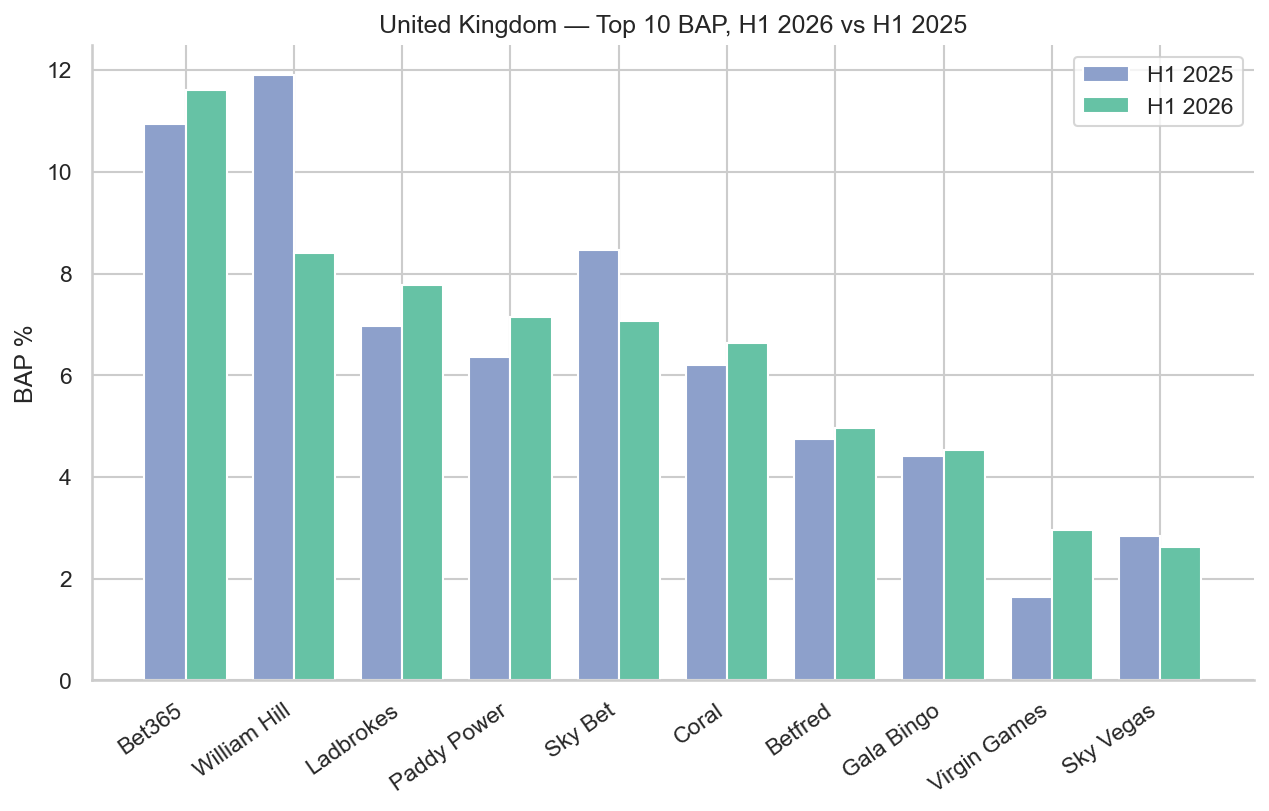
The competitive map moved harder than the totals. William Hill dropped from 11.9% BAP to 8.4% (−3.5 pp) and lost #1 to Bet365 (11.6%, +0.7 pp). Entain brands gained as a group. Virgin Games entered the top 10. Midnite lifted BAP from 0.3% to 0.8%. From 1 April 2026, Remote Gaming Duty doubled to 40%, the largest single UK online tax change in a generation.
About the data
Blask Index tracks consumer search demand for iGaming brands from Google Keyword Planner and Google Trends.
BAP (Brand Accumulated Power) is each brand’s share of that demand.
CEB (Competitive Earning Baseline) estimates revenue potential and is shown as a range.
All figures cover the United Kingdom, H1 2026 (January–June), with H1 2025 and H2 2025 as comparison windows.
Market demand in H1 2026
UK search demand summed to 296.5M Blask Index points in H1 2026, up from 281.6M in H1 2025 (+5.3% YoY). The same half sat 5.3% below H2 2025 (313.0M). Monthly series show why the HoH dip is seasonal: H2 2025 ran hotter through autumn and December, while H1 2026 tracked closer to the prior first half, with March–April as the peak months inside the window.
CEB grew faster than demand. Average monthly CEB reached $1.04B ($752M–$1.92B) versus $942M ($680M–$1.73B) in H1 2025 (+10.9% YoY) and edged H2 2025 (+2.6% HoH). Revenue potential kept climbing even as half-on-half search cooled.
+5.3% YoY demand with a −3.5 pp hit to the former #1 brand is the half in one line. Growth and redistribution ran in parallel.
Track the live series on blask.com/market/united-kingdom.
Offshore vs onshore: how the market splits
The UK remains an onshore-dominated market. Licensed (onshore) brands held 96.8% of Blask Index demand in H1 2026, down 0.4 pp from 97.2% in H1 2025. Offshore demand rose from 2.8% to 3.2%.
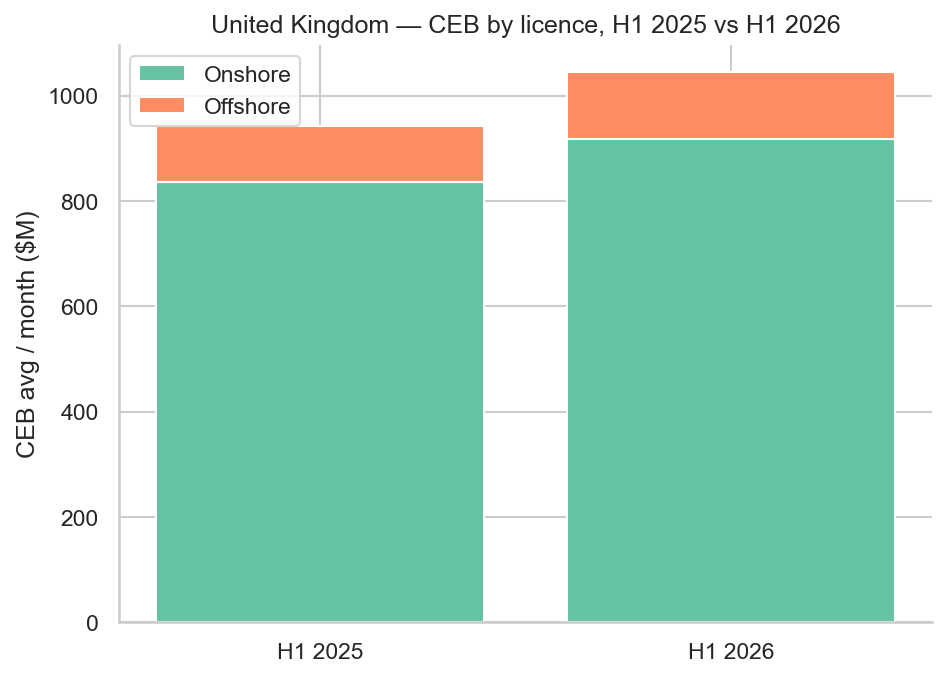
CEB diverges from demand. Onshore operators still take most of the revenue baseline: 87.9% of CEB in H1 2026 (avg $918M/month) versus 88.7% a year earlier. Offshore CEB share moved from 11.3% to 12.1% (avg $127M/month). Each unit of offshore demand still converts into about 3.8× more CEB share than demand share (3.79× vs 4.07× in H1 2025). The offshore premium narrowed YoY, but it did not disappear.
| H1 2025 | H1 2026 | Change | |
|---|---|---|---|
| Blask Index (local) | 97.2% | 96.8% | −0.4 pp |
| Blask Index (international) | 2.8% | 3.2% | +0.4 pp |
| CEB (local, avg/month) | $835M (88.7%) | $918M (87.9%) | +9.9% |
| CEB (international, avg/month) | $106M (11.3%) | $127M (12.1%) | +19.1% |
Regulation still pulls the bulk of demand and CEB toward licensed operators. After the April duty hike, the open question is whether offshore’s small demand wedge keeps widening as licensed casino margins compress 1(https://www.igamingcompliance.blog/uk-remote-gaming-duty-40-percent-april-2026-operator-response/).
Top brands in H1 2026
| Brand | BAP % | Blask Index | CEB avg/month | vs H1 2025 |
|---|---|---|---|---|
| Bet365 | 11.6% | 34,422,491 | $111.1M | +0.7 pp |
| William Hill | 8.4% | 24,903,442 | $99.9M | −3.5 pp |
| Ladbrokes | 7.8% | 23,075,817 | $61.4M | +0.8 pp |
| Paddy Power | 7.1% | 21,169,926 | $55.0M | +0.8 pp |
| Sky Bet | 7.1% | 20,978,630 | $88.9M | −1.4 pp |
| Coral | 6.6% | 19,680,727 | $53.1M | +0.4 pp |
| Betfred | 5.0% | 14,722,522 | $38.3M | +0.2 pp |
| Gala Bingo | 4.5% | 13,409,941 | $36.2M | +0.1 pp |
| Virgin Games | 3.0% | 8,792,897 | $20.5M | +1.3 pp |
| Sky Vegas | 2.6% | 7,756,789 | $22.8M | −0.2 pp |
Bet365 is the new demand leader. William Hill’s −3.5 pp is the largest top-tier brand move and drives most of Evoke’s group drop (−3.1 pp), even as 888 Casino gained a little share on its own. Entain (Ladbrokes, Coral, Gala Bingo) added about 1.4 pp as a cluster. Virgin Games entered the top 10 (+1.3 pp); Betfair dropped out. Midnite rose from 0.3% to 0.8% BAP outside the top 10. Five new geo entrants (Marsbahis, Boomerang, Monkey Tilt, Spin.io, Betahoy) registered; none cracked meaningful share.
What drove the period
1. Remote Gaming Duty doubled to 40% on 1 April 2026. The Autumn Budget 2025 raised RGD from 21% to 40% for remote gaming, with a new 25% online sports betting duty due from April 2027. Six weeks into the new rate, mid-tier exits had already started and licensed operators were cutting promotional spend, renegotiating affiliates, and tilting mix toward lower-duty verticals. H1 therefore split into a pre-duty Q1 and a post-duty Q2: acquisition economics changed mid-half.
2. Evoke prioritised UK profitability over volume. In FY25 results (published April 2026), evoke reported UK&I Online revenue −3% YoY while lifting group Adjusted EBITDA +14%, citing tighter marketing and a focus on contribution. William Hill gaming held up better than sports; 888 UK marketing was cut to protect returns. That choice shows up in Blask as a −3.5 pp BAP collapse for William Hill. Rivals filled the search vacuum.
3. White-paper compliance kept raising the cost of staying licensed. The statutory gambling levy (1.1% for most remote licences) has been live since April 2025 and raised just under £120M in its first cycle. The Gambling Commission continued phased Gambling Act Review delivery through 2025–26, including financial-risk work and consumer-tool reforms. Licensed operators absorbed levy + duty + compliance at once; challengers with lighter legacy stacks (Virgin Games, Midnite) found relative room to grow share.
No separate external driver explains the −5.3% HoH demand drop on its own. H2 2025’s stronger autumn/winter months look seasonal against H1’s calendar, not like a post-duty demand crash.
UK iGaming market H1 2026 vs H1 2025
| Metric | H1 2025 | H1 2026 | Change |
|---|---|---|---|
| Total Blask Index | 281.6M | 296.5M | +5.3% |
| Blask Index (local share) | 97.2% | 96.8% | −0.4 pp |
| Blask Index (international share) | 2.8% | 3.2% | +0.4 pp |
| Market leader | William Hill (11.9%) | Bet365 (11.6%) | leadership flip |
| CEB avg/month | $942M ($680M–$1.73B) | $1.04B ($752M–$1.92B) | +10.9% |
| CEB (local share) | 88.7% | 87.9% | −0.8 pp |
| CEB (international share) | 11.3% | 12.1% | +0.8 pp |
| Active brands | 336 | 354 | +18 |
| Maturity Index (June) | 7.45 | 5.73 | −1.72 |
What changed on structure: the leader, the cost base (levy + 40% RGD), and brand-search intensity (Maturity Index down to 5.73 in June 2026, with more demand concentrated on operator names). What looks seasonal: the HoH Blask Index dip versus H2 2025.
What this means for operators
Entry got harder on cost, not on demand. The UK still grew search interest and CEB, but the April duty reset makes casino-heavy acquisition expensive without scale or a sports/racing mix to lean on until 2027. Brands that gained BAP in H1 either already owned habitual search (Bet365), ran multi-brand retail+online clusters (Entain), or attacked niches with sharp product (Virgin Games, Midnite). The signals for H2 2026: whether William Hill stabilises after Evoke’s product push, whether offshore’s 3.2% demand wedge keeps creeping, and how sports-led marketers position ahead of the April 2027 sports duty.
Conclusion
H1 2026 confirmed a mature UK market that still expands and still reshuffles. Demand up 5.3% YoY, CEB up 10.9%, Bet365 on top, William Hill down 3.5 pp, and a tax regime that now prices licensed casino growth at 40% RGD. The next half will show whether that tax shift only culls mid-tier brands or starts to move a measurable slice of attention toward offshore and sports-weighted portfolios.
Track United Kingdom in real time → blask.com/market/united-kingdom
FAQ
How big was the UK iGaming market in H1 2026?
In H1 2026 the UK Blask Index reached 296.5M points, up 5.3% versus H1 2025. Competitive Earning Baseline averaged $1.04B per month ($752M–$1.92B), up 10.9% YoY. Versus H2 2025, demand was down 5.3% HoH on a seasonal calendar, while CEB still edged higher (+2.6% HoH).
Who led UK iGaming brand demand in H1 2026?
Bet365 led the UK iGaming market H1 2026 with 11.6% BAP, up 0.7 pp from H1 2025. William Hill fell to second at 8.4% BAP (−3.5 pp). Ladbrokes (7.8%), Paddy Power (7.1%), and Sky Bet (7.1%) completed the top five.
Why did William Hill lose share in the UK in H1 2026?
Evoke prioritised UK profitability over volume: FY25 UK&I Online revenue fell 3% YoY while group Adjusted EBITDA rose 14%, with tighter marketing and a deliberate cut in 888 UK spend. That corporate shift shows up in Blask as William Hill’s −3.5 pp BAP drop, the largest top-tier move of the half.
How did the 40% Remote Gaming Duty change the UK market?
From 1 April 2026 Remote Gaming Duty rose from 21% to 40% for remote gaming. Mid-tier exits began within weeks, and licensed operators cut promotions, renegotiated affiliates, and tilted mix toward lower-duty verticals. H1 therefore split into a pre-duty Q1 and a post-duty Q2.
What share of UK demand is onshore versus offshore?
Onshore brands held 96.8% of Blask Index demand in H1 2026 (down 0.4 pp YoY) and 87.9% of CEB. Offshore held 3.2% of demand and 12.1% of CEB, an efficiency gap of about 3.8×. The offshore premium narrowed versus H1 2025 (4.07×) but did not disappear.