• Updated:
  • Published:

What is a retention manager

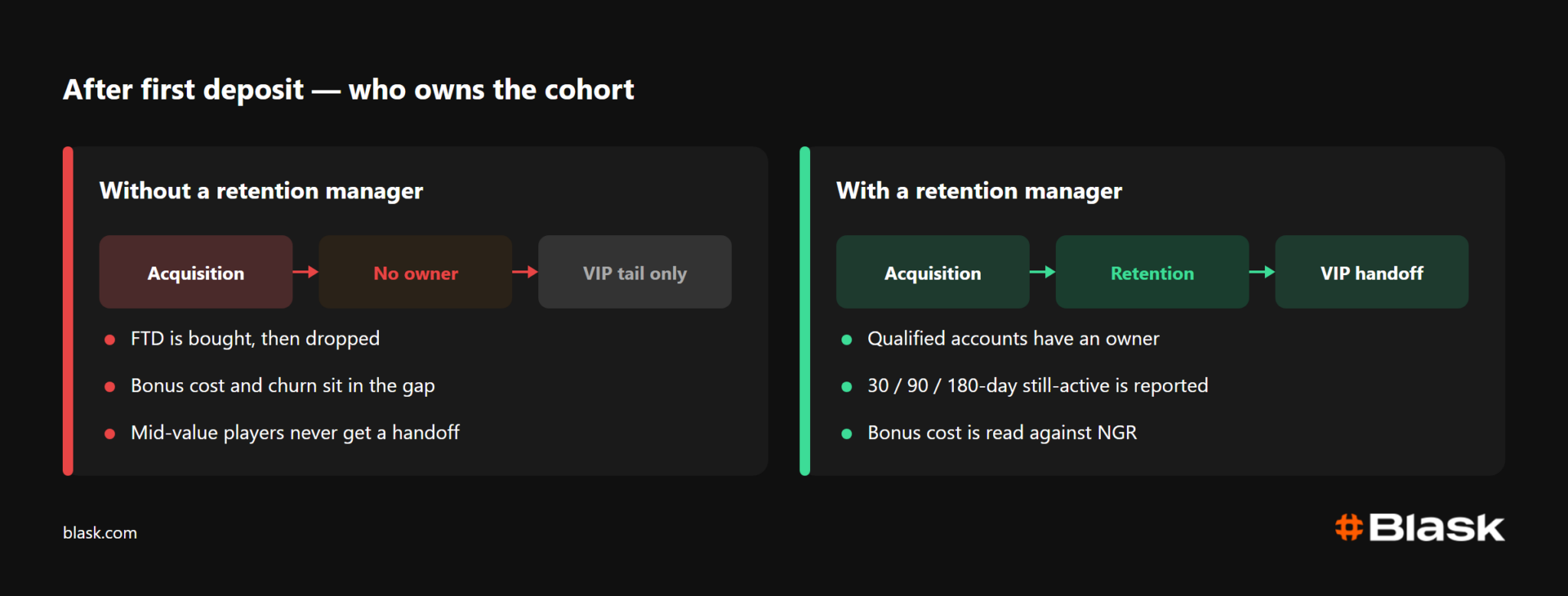
In iGaming, acquiring a player is only the opening move. With CPA in competitive markets regularly exceeding $500 per first-time depositor (FTD), economics hinge on what happens after registration. The retention manager — also called a player lifecycle manager or retention marketing manager — owns that post-acquisition phase: keeping players active, engaged, and profitable without burning margin on undisciplined bonus spend. The function sits between CRM strategy, product, and analytics. When it works, it extends LTV and reduces dependency on paid acquisition. When it fails — treated as “the email person” with siloed data — bonus cost rises and churn stays flat.

What Is a Retention Manager

A retention manager is the operator-side professional responsible for the post-FTD player journey at an online casino or sportsbook: segmentation, engagement campaigns, promotional calendar coordination, churn prevention, and reporting on lifecycle KPIs.

B2C operator focus (this article): the role manages end players — not B2B partner accounts. Suppliers sometimes use “retention” for client relationship management; that is a different function (account management toward operator clients).

Title overlap: many organisations use Retention Manager and CRM Manager interchangeably. Where distinct, CRM Manager leans toward platform, integrations, and campaign operations; Retention Manager leans toward commercial lifecycle strategy and cohort outcomes. Small operators often hire one person to do both — the comparison tables below explain the ideal split at scale.

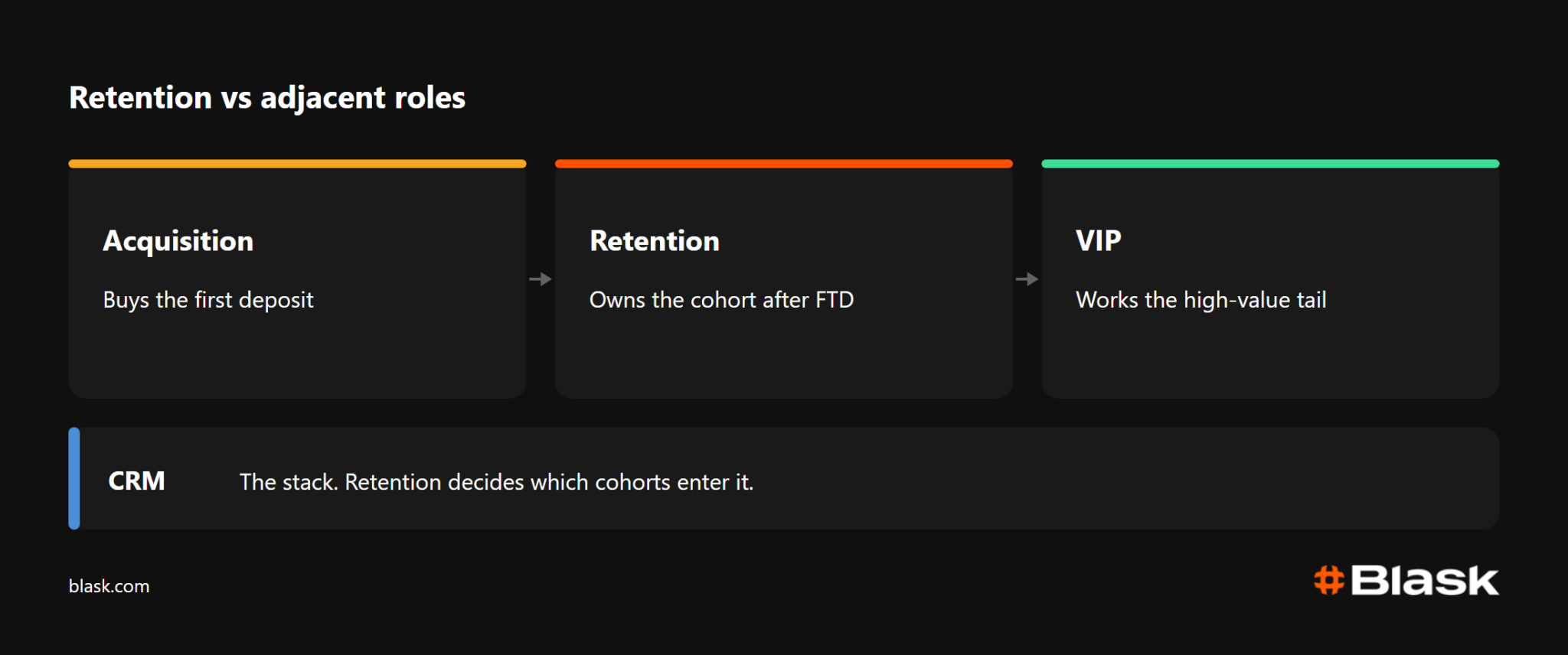
The retention manager covers the full active base — from newly deposited recreational players to the mid-value cohort approaching VIP qualification. VIP managers take over high-touch relationship work at the top tier.

Why Retention Managers Are Critical for iGaming Operators

Replacing a churned player typically costs as much as winning a new one. Retention extends active lifetime without incremental media spend — each extra month of play generates GGR on sunk acquisition cost.

Well-run retention also:

  • improves bonus efficiency through targeting and holdout testing instead of broadcast promos;
  • feeds a healthier VIP pipeline by nurturing mid-value players before handoff;
  • stabilises revenue when acquisition budgets tighten or regulation slows paid channels.

The maths operators ignore. Illustrative cohort logic: on 1,000 active players at €250 GGR per month, a 10-point improvement in quarterly retention (e.g. 50% → 40% churn) can mean dozens of extra active accounts and six-figure GGR delta — before any new FTD spend. One retention manager with holdout discipline can shift that curve; one without sends undifferentiated mail and trains players to wait for promos.

MetricWithout Retention ManagerWith Retention Manager
Post-FTD churnHigh; undifferentiated experienceCohort-based intervention; measured lift
Bonus spend efficiencyBroadcast promos; margin leakageTargeted offers; holdout-validated ROI
LTV / deposit frequencyFlat or declining ARPUImproved 30/60/90-day retention
VIP pipelineRandom high rollers onlySystematic mid-value → VIP nurturing
RG compliance in CRMAd-hoc exclusionsSuppression lists embedded in automation

Directional operator benchmarks — not Blask proprietary data.

Key Responsibilities of a Retention Manager

Segmentation and lifecycle staging

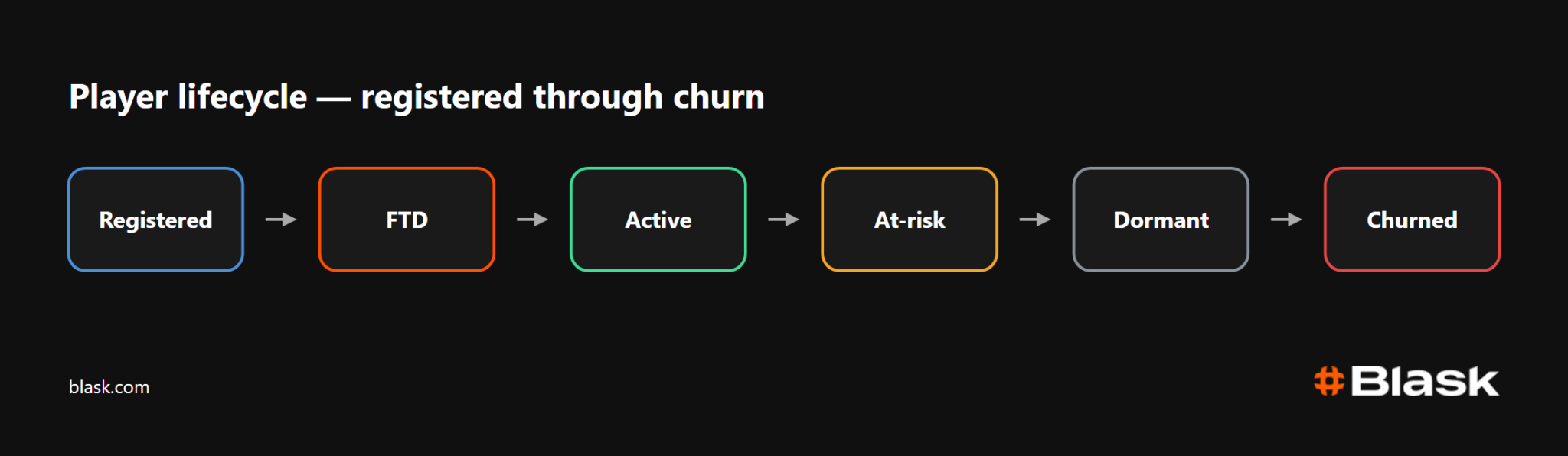
The base is divided into behavioural stages — newly registered, first-deposited, active, at-risk, dormant, churned — using deposit patterns, product preference, session frequency, and win/loss history. Cohort analysis is the operating language, not average-user dashboards.

Campaign execution (email, SMS, push, in-app)

Build triggered and scheduled campaigns tied to lifecycle events: inactivity windows, deposit anniversaries, game launches, sports fixtures — not generic weekly blasts. Channels include email, SMS, push, onsite messages, and in-app inbox depending on stack and market rules.

Example — deposit-frequency campaign. A retention manager identifies 2,000 players who deposited twice in week one but have been inactive for 10 days. A triggered email offers a 20% reload bonus; push notification carries a smaller incentive. A/B testing identifies the winner; the manager reports deposit-rate lift and net GGR after bonus cost — not open rate alone.

Bonus and promotional calendar ownership

Design the retention calendar with commercial teams: reload offers, free spins, cashback, gamification mechanics. Own bonus budget discipline at cohort level — ensuring promotions are net-positive against GGR, not only flashy in campaign reports.

Churn prevention and reactivation

Work with analysts on at-risk signals: declining deposit frequency, session-length drop, loss-chasing patterns. Translate model output into automated reactivation sequences.

Example — churn prevention flow. BI flags players with high 30-day churn probability after seven days inactive following a significant loss. The manager sets a sequence: day 3 — “we miss you” email with free spins on the most-played title; day 7 — cashback on next deposit; day 14 — stronger win-back offer. Lift is measured against an untreated holdout cohort.

VIP qualification and handoff

Define thresholds for VIP tier entry and manage transition to the VIP team. Retention nurtures; VIP hosts own the relationship after qualification.

Performance reporting and holdout testing

Report retention rate, ARPU, LTV by cohort, bonus-cost-to-GGR, and campaign conversion. Use holdout groups consistently — the only reliable way to prove incremental impact and justify bonus spend.

Required Skills for a Retention Manager

Data literacy and experimentation

Comfort with segmentation logic, A/B tests, holdouts, and reading cohort tables. SQL or BI tool basics at mid-senior level. Ability to say “this campaign did not work” when holdout proves null lift.

Tools Retention Managers Use Daily

Examples by operator scale (not endorsements):

  • Mid-market: Smartico, Customer.io, Braze, in-house CRM;
  • Enterprise / large base: Optimove, Salesforce Marketing Cloud, Adobe — often fed by a CDP;
  • Analytics: Looker, Tableau, platform BI, cohort exports;
  • Bonus engine / PAM configuration interfaces for offer rules.

Below ~20,000 active players, lighter stacks often suffice. Above ~100,000, deeper orchestration and CDP integration become economically necessary for precision.

Collaboration habits. Effective retention managers run weekly rhythm with product (onboarding UX, bonus engine limits), payments (deposit flow friction kills DC2), analytics (cohort models), and legal/compliance (message approval, RG rules). Retention fails when it is a marketing silo.

Key KPIs Retention Managers Track

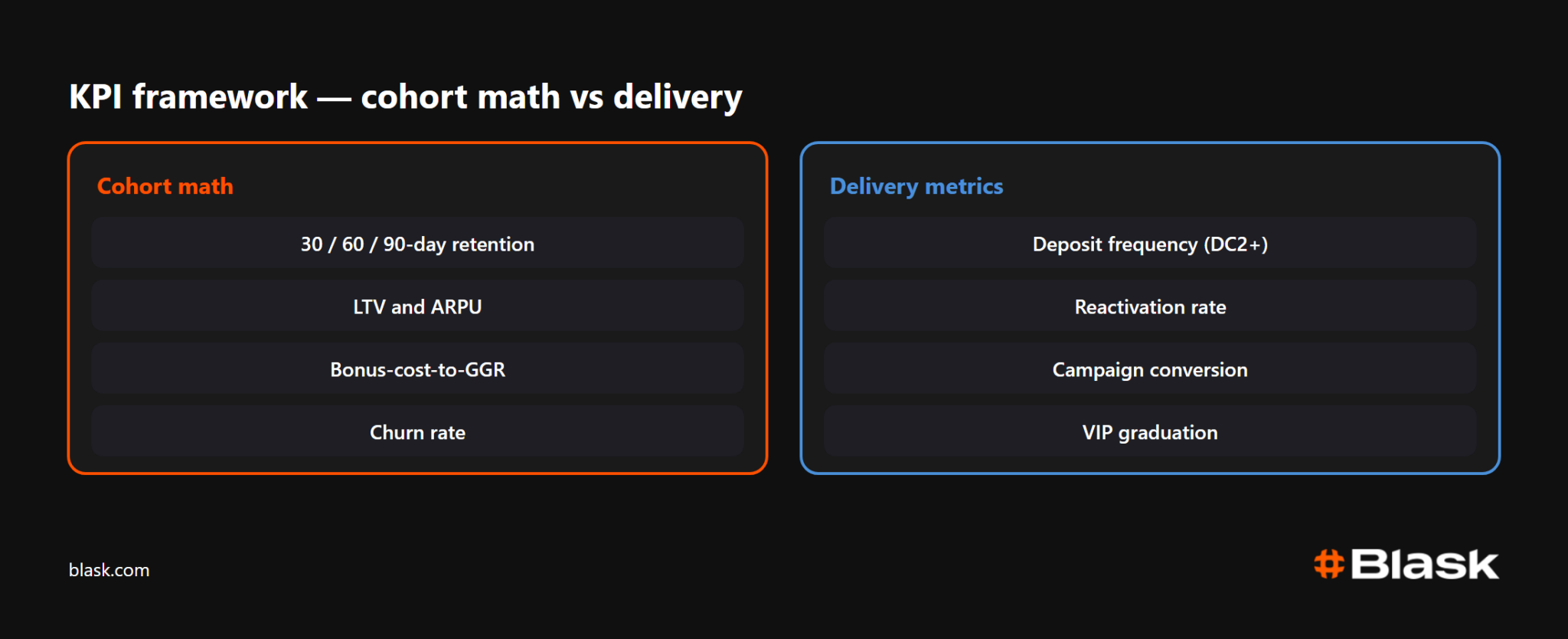
Retention managers own metrics tied to player economics, not vanity engagement alone:

  • 30 / 60 / 90-day retention rate — share of cohort still active;
  • ARPU and LTV by cohort — revenue per player over time;
  • Churn rate — period exits from active base;
  • Deposit frequency (DC2+) — repeat deposit behaviour after FTD;
  • Bonus-cost-to-GGR ratio — promo efficiency;
  • Reactivation rate — dormant players returned;
  • Campaign conversion — deposit or bet action after touch;
  • VIP graduation rate — mid-value players reaching VIP thresholds (secondary).

Industry jargon like RR New / RR Old (repeat rate splits) appears in some operators — define internally if used in reporting.

Retention Manager vs Other Roles

Retention Manager vs CRM Manager

CriteriaRetention ManagerCRM Manager
Primary focusLifecycle strategy and commercial retention outcomesPlatform, data flows, campaign operations infrastructure
ScopeSegmentation logic, bonus calendar, churn playbooksCRM config, integrations, deliverability, automation build
KPI ownershipRetention rate, LTV, bonus-cost-to-GGROften delivery metrics, uptime, send volume
Typical reporting lineCMO / Head of MarketingCMO / Head of CRM / Product
OverlapHigh in small operators — roles often mergedSame

When job posts say “CRM Manager,” read the description: if it owns lifecycle P&L and cohort strategy, it is functionally a retention manager even if the title says CRM.

Retention Manager vs VIP Manager

CriteriaRetention ManagerVIP Manager
AudienceFull active baseTop 1–5% by value
Engagement modelAutomated + segmented at scalePersonal 1:1
ToolsJourneys, triggers, A/B testsPortfolio notes, direct contact
HandoffDefines VIP thresholds; nurtures below lineOwns relationship above line

Retention Manager vs Performance / Digital Marketing Manager

CriteriaRetention ManagerPerformance Marketing Manager
Funnel stagePost-FTD lifecyclePre-FTD acquisition
Spend typeBonus and CRM costMedia and affiliate CPA
KPIsRetention, LTV, churnCPA, ROAS, FTD volume
OverlapOnboarding creativesMinimal unless team is combined

Retention Manager vs Head of Retention / CRM

CriteriaRetention ManagerHead of Retention / CRM
LevelManager / senior managerDepartment head
OwnershipCampaigns and cohortsStrategy, budget, team structure, vendor selection
Team sizeOften individual or small teamMultiple squads (ops, content, analytics)

Career Path for Retention Managers

CRM Coordinator / Marketing Executive → Retention Manager. Entry from digital marketing, customer support, or junior CRM ops — learning segmentation, deliverability, and platform basics. Coordinators often build journeys; managers own outcomes.

Retention Manager → Senior Retention Manager / Lead CRM. Larger budgets, multi-market calendars, analyst partnership, VIP handoff governance. Senior scope includes mentoring coordinators and signing off major calendar bets.

Senior → Head of Retention / Head of CRM / CMO track. Owns lifecycle P&L, team design, vendor selection (Optimove vs Smartico vs build), and board-level reporting on LTV and bonus efficiency.

Lateral moves. Product management, analytics, VIP programme leadership, or affiliate CRM — lifecycle literacy transfers across commercial functions.

Skills that accelerate promotion. Holdout discipline, documented cohort wins, clean RG audit history, and ability to explain trade-offs between bonus spend and CEB-level monetisation expectations to leadership.

Retention Manager Salary Ranges

Treat figures as directional (2025–2026 surveys and listings). EU pay-transparency rules increasingly require band disclosure on request in Malta and other EU hubs.

Junior / Mid (Malta, Cyprus)

  • Retention / CRM Manager: approximately €40,000–€52,000 mid-level (theigaming.eu Salaries Report 2025–2026; Boston Link CRM bands €45,000–€65,000 for CRM Manager titles).
  • CRM Coordinator / junior: lower entry band before manager scope.

Senior / Head of (UK, EU)

  • UK mid retention / CRM: roughly £55,000–£75,000 base (industry salary reports directional).
  • Head of CRM: approximately €70,000–€110,000 in Malta (Boston Link 2025).

Bonus and variable pay

Commercial CRM and retention roles often carry the largest variable components in marketing orgs — quarterly or annual bonus tied to retention, LTV, or GGR targets (CompensationForce iGaming pay structures 2026). Remote EU specialist tiers are sometimes cited around €3,000–€5,000/month fixed in commentary — verify per employer; strong performers can drive far more value than base alone implies.

How to Become a Retention Manager

Entry routes. Digital marketing, CRM operations, customer support, or analytics — ideally with exposure to iGaming bonus mechanics and regulated messaging rules.

Skills to develop. Segmentation, holdout testing, bonus economics, RG suppression logic, and cross-functional communication with product and payments.

Portfolio proof. Case studies showing cohort lift, bonus ROI, or churn reduction beat generic “I ran email campaigns.”

Certifications. Google Analytics, CRM platform certs, or RG/AML short courses add credibility. iGaming experience on a licensed product remains the primary filter.

From support or affiliate ops. Customer support teaches player psychology and complaint patterns; affiliate or performance marketing teaches CAC context — both are viable bridges if the candidate can learn cohort discipline and holdout testing.

Common challenges retention managers face

  • Bonus dependency — players who deposit only when prompted; fix with non-monetary engagement and loyalty programme design.
  • Siloed data — incomplete player view when BI, product, and support sit on separate stacks.
  • Narrow scope — execution-only role with no influence over onboarding, deposit flow, or bonus engine.
  • RG compliance gaps — campaigns hitting self-excluded or at-risk players; suppression must be standing config, not manual filters.

How to Hire a Great Retention Manager (For Operators)

Strong signals:

  • Defines lifecycle stages in behavioural terms before building campaigns;
  • Uses holdout groups and reports incremental GGR, not only open rates;
  • Tracks bonus cost at cohort level;
  • Embeds RG suppression (self-exclusion, deposit limits, harm flags) in automation from day one;
  • Can explain retention vs acquisition vs VIP boundaries clearly.

Weak signals:

  • “We send a weekly newsletter” as the strategy;
  • No holdout discipline;
  • Cannot diagnose a churn spike tied to product or payments;
  • Treats CRM as deliverability plumbing only.

Interview scenario: 30-day retention drops 8 points after a payment method outage in one GEO. What do you investigate first? Look for payment recovery comms, cohort impact isolation, holdout-safe win-back, and coordination with payments — not a blanket 50% reload for all players.

Trial tasks. Give candidates a anonymised cohort export and ask for one lifecycle intervention with success metrics and RG exclusions listed. Strong hires define the holdout before the creative.

Org design. Clarify whether the role owns CRM platform roadmap or only commercial calendar — title inflation causes churn when hires expect strategy but get ticket building.

Top iGaming Companies Hiring Retention Managers

Live listings commonly appear at LeoVegas Group / Flutter, Kindred, Betsson, Entain, 888 / Evoke, and Malta- and Cyprus-based operators under titles such as Retention Manager, CRM Manager, Lifecycle Marketing Manager, and Head of Retention. Verify current openings on LinkedIn, iGaming Careers, and specialist recruiters.

Future of the Retention Manager Role in 2026

Three trends shape the function:

CDP and AI-assisted personalization. richer real-time segments and content variation — under tighter RG guardrails.

Retention as P&L owner. leading operators give lifecycle teams measurable economic accountability, not only send volume.

Compliance-native automation. UK and EU frameworks require CRM logic that respects affordability triggers, self-exclusion, and interaction duties — built into journeys, not bolted on after launch.

Market benchmarking. Blask’s Retention metric and cohort-level competitive context help retention managers compare brand performance against market norms — combining external demand signals with internal CRM data for sharper lifecycle decisions and better-calibrated bonus allocation.

Lifecycle vs acquisition budget. Mature operators often under-invest in retention headcount relative to acquisition — one strong retention manager can materially shift cohort GGR on a five-figure active base when segmentation and holdouts are disciplined. The role is frequently the highest ROI hire in marketing after payments is stable.

Product levers retention cannot ignore. No campaign fixes a broken registration path, a cashier with 40% fail rate, or a bonus engine that credits wrong amounts. Retention managers who influence product backlog — even informally — outperform peers stuck in “CRM only” scope.