
- Updated:
- Published:
What is Pachinko
Walk through any Japanese city and you will hear it before you see it: the metallic rain of steel balls, amplified jackpots, and LCD reels selling the latest anime tie-in. Neon facades say pachinko in katakana, foreigners call it pinball. Neither label captures the economics. This is Japan’s largest commercial gambling category, a vertical that predates integrated resorts, ignores online casino licensing, and runs on a legal architecture everyone understands but almost no one quotes at dinner. For iGaming operators mapping East Asia, pachinko is the baseline offline giant you cannot import as a product template.
What is Pachinko?
| Pachinko is a mechanical arcade game where players launch small steel balls into a vertical field studded with pins, ramps, and pockets. Most balls fall to the bottom and disappear. A few hit the right pockets, trigger a digital lottery on an embedded screen, and release cascades of winning balls into a tray. Those balls are exchanged for prizes inside the parlor. What happens next is where Japan’s gaming law gets interesting. |
The machine looks like a vertical pinball cabinet. It behaves like a low-strategy, high-frequency gambling loop with audiovisual spectacle layered on top. Modern units are overwhelmingly electronic, with reels, animations, and licensed characters driving foot traffic the way franchise slots do in Western casinos.
Brief history and cultural context
Pachinko parlors spread after World War II as small entertainment halls and hardened into a national institution. For decades they occupied a grey zone: socially treated as gambling, legally classified under amusement and public morals regulation rather than casino statutes.
The industry peaked in scale when Japan had fewer digital distractions and smoking indoors was still the norm. JRPass’s cultural guide notes that market revenue reached roughly ¥35 trillion in 2005, a figure often compared to the combined gambling revenues of Las Vegas, Macau, and Singapore in the same era. Peak is not present. Demographics, smoking bans, mobile entertainment, and parlor consolidation pulled the market down, but it remains enormous by any global benchmark.
Integrated resorts arrived late to the story. The IR Promotion and Implementation laws (2016–2018) legalised casino gaming inside certified resort districts, with Osaka’s plan certified in 2023. That path does not legalise online casino play or replace pachinko’s street-level footprint.
How Pachinko works
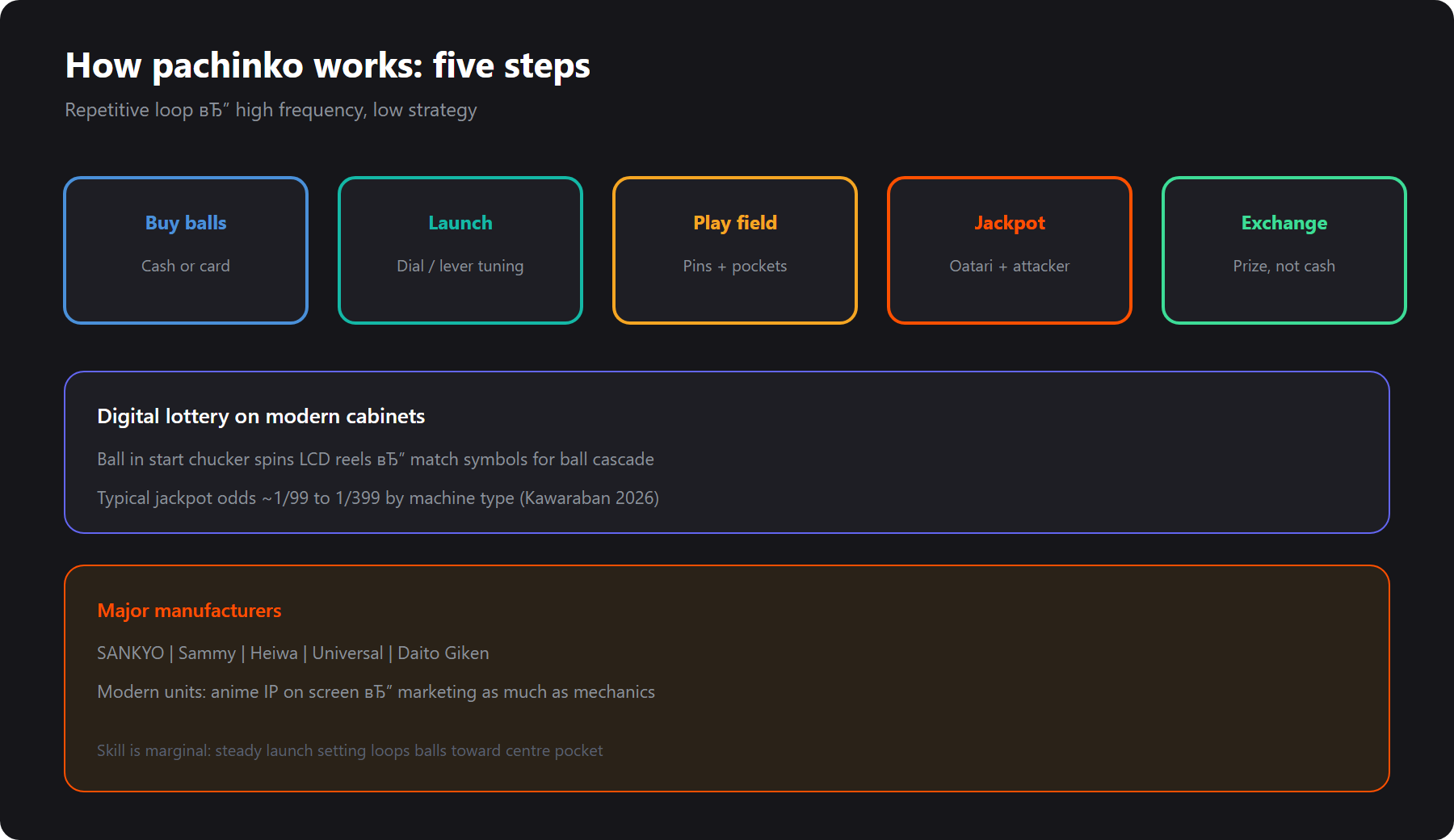
The player journey is repetitive by design.
- Buy balls. Cash or prepaid card at the counter or machine.
- Launch. A dial or lever controls how hard each ball fires up the field. Skill is marginal: find a steady setting that loops balls toward the centre, then let variance run.
- Play the field. Balls bounce through pins; many drain; some enter the start chucker under the screen.
- Trigger the lottery. Each ball in the start pocket spins digital reels. Match symbols and the machine enters a jackpot (ōatari) state, opening an attacker chute that dumps large volumes of balls with lights and sound.
- Exchange. Winning balls convert to prizes inside the parlor, not cash at the machine.
Kawaraban’s 2026 beginner guide for foreigners puts typical jackpot odds between roughly 1/99 and 1/399 depending on machine type, which is why experienced players talk about machine selection the way slot players talk about volatility. Major manufacturers include SANKYO, Sammy, and Heiwa; modern cabinets lean heavily on anime IP, with the screen acting as much as marketing as mechanics.
Pachinko vs Pachislot
Most parlors run two floors in one building.
Pachinko uses steel balls and continuous launch loops.
Pachislot (pachinko’s slot-machine sibling) uses tokens or coins, button timing, and reel stops closer to Western slot UX. The difference between pachinko and pachislot is mechanics and pacing: balls and launch tuning versus tokens and reel-stop timing; both share parlors and prize-exchange economics. Japan-Zone’s feature on pachislot describes cabinets with music, LED displays, and franchise tie-ins that would look alien on a Vegas floor but familiar to anyone who sells branded slots.
Both share prize exchange mechanics and parlor real estate. Pachinko is easier for first-time visitors to watch; pachislot demands quicker decisions. Online lobbies outside Japan sometimes label digital adaptations pachislot or pachinko-style games; those are product marketing borrowings, not licensed exports of the parlor supply chain.
Prizes, cash-out, and the three-store system
Direct cash payouts inside the parlor would run afoul of Japan’s Penal Code gambling provisions. The industry therefore runs the santen hōshiki (three-store system): a structure that splits parlor, prize buyer, and wholesaler so cash does not change hands on the gaming floor.
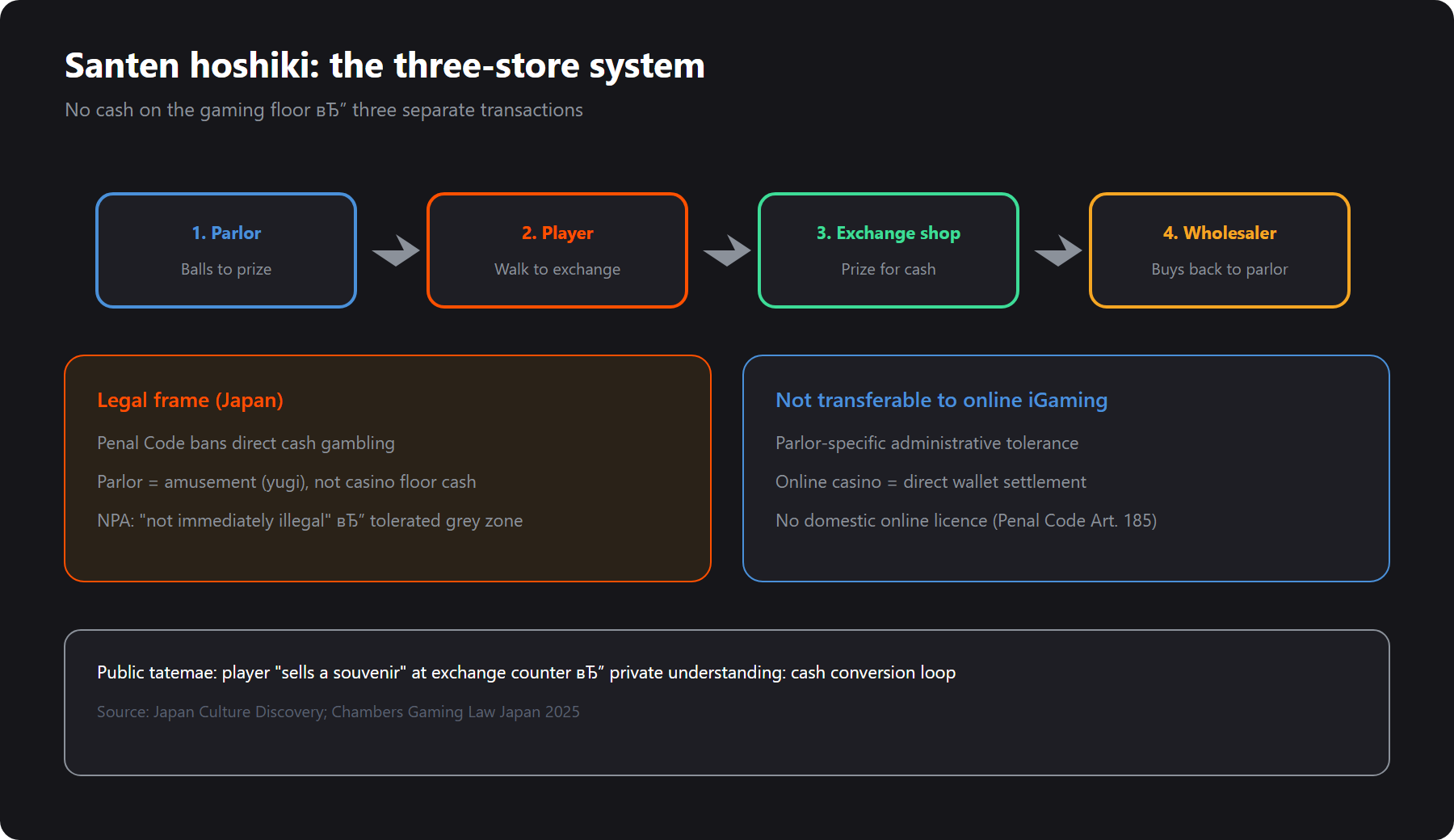
- The parlor exchanges balls for a special prize token or goods.
- The player walks to a separate exchange counter nearby, legally a different business.
- That counter pays cash for the prize.
- A wholesaler buys tokens back from the counter and resells to the parlor.
How do players get cash from pachinko? Winning balls convert to prizes inside the parlor; nearby exchange counters buy those prizes for cash under this three-step arrangement. Three entities, three transactions, no cash on the gaming floor. Japan Culture Discovery’s explainer describes the National Police Agency’s long-standing stance that the arrangement is “not immediately illegal” under existing statutes, a formulation that preserves public tatemae while everyone privately understands the economic loop.
Operators entering Japan for IR casino projects must not confuse this tolerance with a template for online real-money products. The loophole is parlor-specific, administratively tolerated, and unrelated to remote wagering licences.
Is Pachinko gambling? Legal status in Japan
Articles 185–187 of the Penal Code criminalise gambling and running gambling places for private gain, with narrow exceptions for public lottery and publicly operated racing products. Is pachinko legal in Japan? Parlors operate under amusement and public morals regulation with a long-tolerated prize-exchange system; they are not licensed as casino gambling on the gaming floor. Pachinko sits outside the casino chapter as yūgi (gaming/amusement) regulated under public morals enforcement rules on prizes and exchange methods.
Casino gaming is permitted only inside certified integrated resort districts under the Japan Casino Regulatory Commission, land-based only. Chambers’ Gaming Law Japan 2025 guide confirms that online gaming activities remain prohibited under the Penal Code even after IR legalisation.
iGaming Times’ Japan jurisdiction page states plainly: there is no route to a Japanese online casino licence; betting with offshore operators from inside Japan is an offence for the player as well as the operator.
Pachinko-style slots in online casinos
Are pachislots legal in Japan?
Japan’s online casino market, where it exists in consumer behaviour, lives offshore and unlicensed. Can you play pachinko online legally in Japan? Not as a licensed domestic online casino product: there is no Japanese online casino licence, and betting with offshore operators from inside Japan is an offence for the player as well as the operator under the Penal Code. Enforcement has tightened around advertising, celebrity endorsements, and payment rails, but the structural fact remains: domestic online casino GGR is not a regulated reporting category because the product is not legal to offer.
Digital pachislot titles in international online lobbies are adaptations for export audiences. They borrow aesthetics and reel metaphors; they do not replicate the parlor prize-exchange economy or its legal frame. Product managers labeling a Western Plinko build “pachinko-style” should know the comparison is visual, not regulatory or mechanical.
Pachislot examples
True ball-launch pachinko does not exist as a standard real-money online casino vertical outside Japan. What operators actually list under “pachinko” or “pachislot” search terms are almost always pachislot-inspired video slots: 3×3 grids, fast reel stops, respin chains, and bonus pacing modelled on Japanese arcade machines, delivered through normal RNG slot rails and direct wallet settlement.
Two supplier lanes dominate the licensed online shelf.
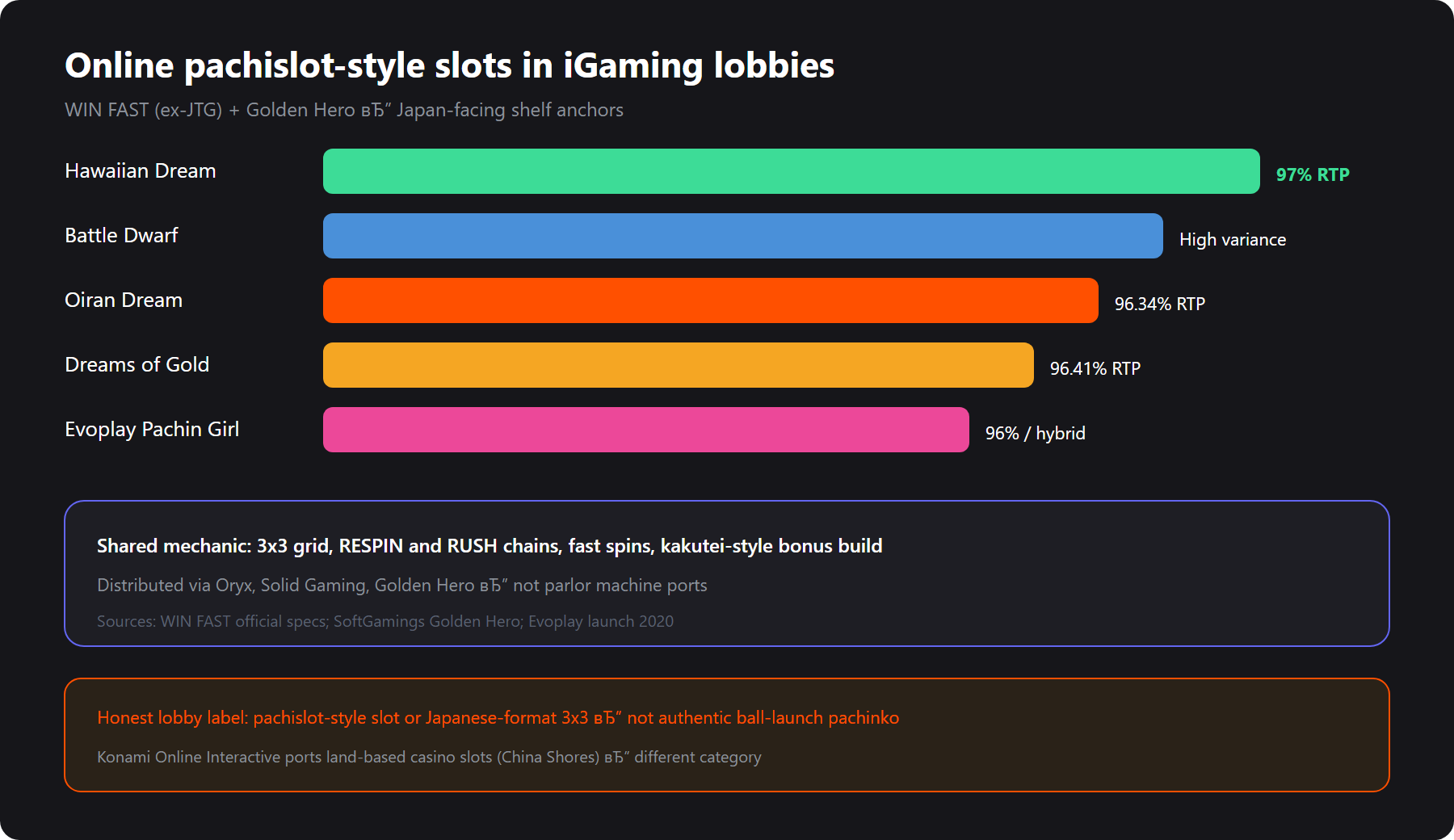
WIN FAST (formerly JTG / Japan Technical Games) + Golden Hero. This is the reference stack for “online pachislot” in Japan-facing lobbies. Golden Hero distributes the catalogue through aggregators such as Oryx and Solid Gaming; WIN FAST rebranded from JTG in 2022 but kept the same design language. Flagship titles operators and players recognise:
| Title | Studio / route | What makes it “pachislot-style” | Notes |
| Hawaiian Dream | WIN FAST × Golden Hero (2018) | 3×3 layout, RESPIN & RUSH™ chains, fast spins; 97% RTP on provider spec | Often cited as the first major online pachislot hit; Hawaii visuals, Japanese machine rhythm |
| Battle Dwarf | WIN FAST × Golden Hero (2019) | Same 3×3 pachislot pacing; high-variance bonus build | SlotCatalog Game of the Year 2019 |
| Oiran Dream | WIN FAST (2020) | Inherits Hawaiian Dream respin logic; Doki Doki Time and Kamon bonus board | Official game page lists 96.34% RTP, 3×3, moderate volatility |
| Dreams of Gold | WIN FAST (2019) | 3×3, respin-to-free-spin ladder, “kakutei”-style bonus escalation | Common in JP-oriented lobbies alongside Hawaiian Dream |
| Golden Dream | WIN FAST / Golden Hero | Same JTG family; alternate skin on the respin-and-rush template | Often bundled with the titles above in Japan-facing casinos |
Variants and sequels (Hawaiian Dream Xmas, Dreams of Gold Delight, Hawaiian Dream Boost announced for 2026) extend the same mechanic set rather than simulating steel balls. None of these titles run the three-store prize loop; they pay cash to the casino wallet like any other slot.
Evoplay — Pachin Girl (2020). A different hybrid: Evoplay markets it as an instant game that fuses a 3-reel, 1-row slot with a pachinko ball-drop side loop. Evoplay’s launch note describes steel balls released on spin, caught by an anime host, and exchanged for extra spins; published RTP is 96%. It is pachinko-inspired spectacle for global lobbies, not a port of a Sammy or SANKYO cabinet.
What is usually not on the real-money iGaming shelf. Major Western studios (NetEnt, Pragmatic Play, Play’n GO) do not ship authenticated parlor machine ports. Konami’s Online Interactive line digitises land-based casino slots (China Shores™, African Diamond™), which come from the same corporate family as pachinko but are not pachinko or pachislot mechanics.
Japan-only digital products (not online casino GGR). Separate from licensed iGaming, domestic apps simulate real parlour cabinets for play-money or item billing: 777Real (Sammy), GREE Pachinko / Grepachi, and SloPachi Spirit host licensed sims of machines such as Smart Slot Monkey Turn V, Pachislot Karakuri Circus, and Neon Genesis Evangelion: Roar to the Future. These are parlor marketing and engagement channels, not substitutes for Malta- or Curaçao-licensed slot lobbies. Product teams should not classify them as “online casino pachinko” in compliance copy.
For lobby taxonomy, the honest label is pachislot-style slot or Japanese-format 3×3 slot. Only Evoplay’s Pachin Girl and similar hybrids justify pachinko-inspired in the strict sense. Everything else in the WIN FAST / Golden Hero cluster is the online translation of pachislot rhythm: short cycles, visible respin buildup, and bonus modes that mimic a hall machine’s kakutei tension without balls, pins, or exchange counters.
Pachinko vs Plinko
Both involve balls falling through obstacles. That is where the kinship ends. Pachinko vs Plinko online: Plinko is a digital instant-win casino game with direct wallet payouts and operator-licence-dependent legality; pachinko is an offline Japanese parlor product built on physical balls, prize exchange, and the three-store system.
| Dimension | Pachinko (Japan parlors) | Plinko (online casino) |
| Medium | Physical balls, parlor floor | Digital drop, RNG or provably fair |
| Cash path | Prize exchange outside parlor | Direct wallet credit |
| Legal frame | Amusement + three-store system | Operator licence dependent |
| Skill | Launch tuning | Stake, rows, risk tier only |
| Session owner | Offline leisure giant | Instant-win / originals shelf |
Blask’s Plinko article covers the online variant in depth. Pachinko belongs in market briefings about Japan’s offline economy, not in the same product requirement doc.
Industry scale and market trends
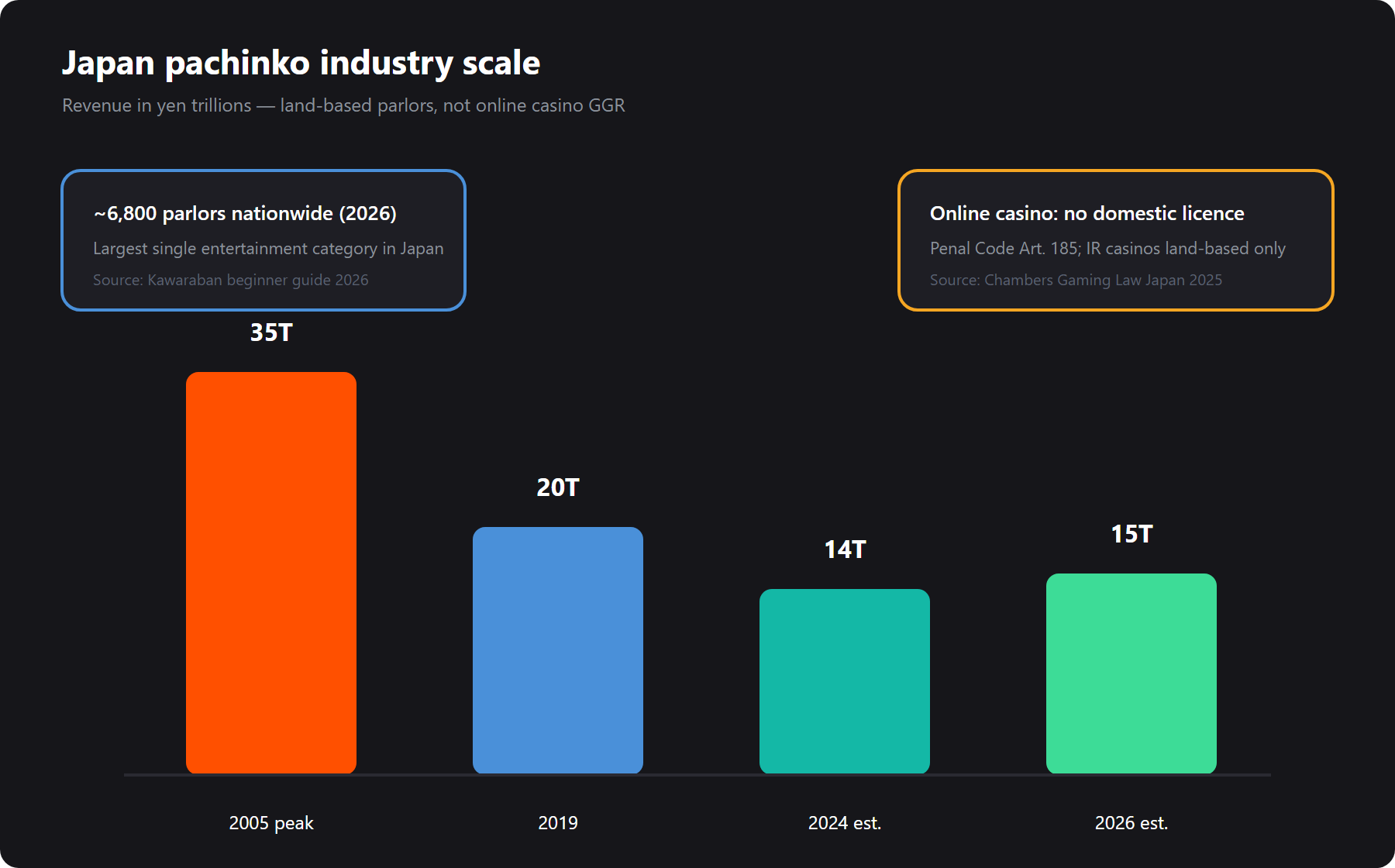
The industry still clears numbers most countries would call a national budget item. How big is the pachinko industry? Estimates vary by year and source; Kawaraban (2026) cites roughly 6,800 parlors nationwide and industry revenue on the order of ¥15 trillion in recent estimates. Peak ¥35 trillion (2005) remains the reference point for how large the category once was relative to global casino hubs.
Decline drivers include aging player bases, anti-smoking regulation that pushed sessions shorter, and competition from mobile games and legal alternatives. Closure and consolidation continue, but pachinko remains Japan’s single largest entertainment vertical by revenue in many industry summaries, distinct from the tiny licensed IR casino footprint still under construction.
Why Pachinko matters for iGaming operators
Market context. Any Japan strategy slide that ignores pachinko misstates where domestic gaming attention and yen already flow.
Naming hygiene. “Pachinko” in game lobbies attracts search volume and confusion; legal and compliance teams should review Japan-facing copy carefully.
No online shortcut. IR casinos will not open a remote product path. Partnership fantasies that treat pachinko suppliers as online casino vendors usually ignore Penal Code constraints.
Category comparisons. When benchmarking session frequency or audiovisual intensity, pachinko is the offline reference for what Japanese players already accept, not what regulators will license tomorrow.
Affiliate and media risk. Promoting offshore casino access to Japanese residents intersects with enforcement trends; land-based IR and public gaming products are separate compliance conversations.
Tips / best practices
Do not conflate pachinko with online Plinko in regulated copy. Players and regulators notice.
Treat three-store economics as Japan-specific. It does not generalise to LATAM or EU licence frameworks.
Source parlor stats from Japanese industry reporting. Western travel blogs round revenue; cross-check before investor materials.
Separate pachislot export games from domestic parlors. Digital titles in Malta-licensed lobbies (Hawaiian Dream, Oiran Dream, Pachin Girl) are RNG slots with Japanese pacing, not parlour machine ports.
Do not list F2P sim apps as casino products. 777Real and SloPachi Spirit belong in a different category from real-money lobbies.
Watch IR development independently. Osaka IR progress does not expand online casino permissibility.
Bottom line
Pachinko is Japan’s ball-based gaming institution: parlors, prizes, tolerated cash conversion through santen hōshiki, and a scale no online startup matches domestically. It is not a licensable online vertical, not a synonym for Plinko, and not going away because integrated resorts finally arrived. Operators who understand the legal and cultural frame avoid expensive category mistakes in East Asia positioning.