
- Updated:
- Published:
CRM (Customer Relationship Management)
CRM in iGaming is the system that decides what happens to a player after the first deposit: which message, which offer, which channel, and whether any of it is permitted in that player’s market.
The term carries two meanings that buyers routinely merge. One is software — a platform holding a unified record of every registered player. The other is the operating practice built on top of it: the segments, the lifecycle flows and the testing discipline that turn the record into revenue. A licence for the first does not produce the second.
What CRM means in iGaming
Customer relationship management in gambling covers the post-acquisition half of the funnel. The player record it works from holds registration data, deposit and withdrawal history, session length and frequency, game and vertical preference, bonus history, payment method, support contacts and responsible-gambling flags.
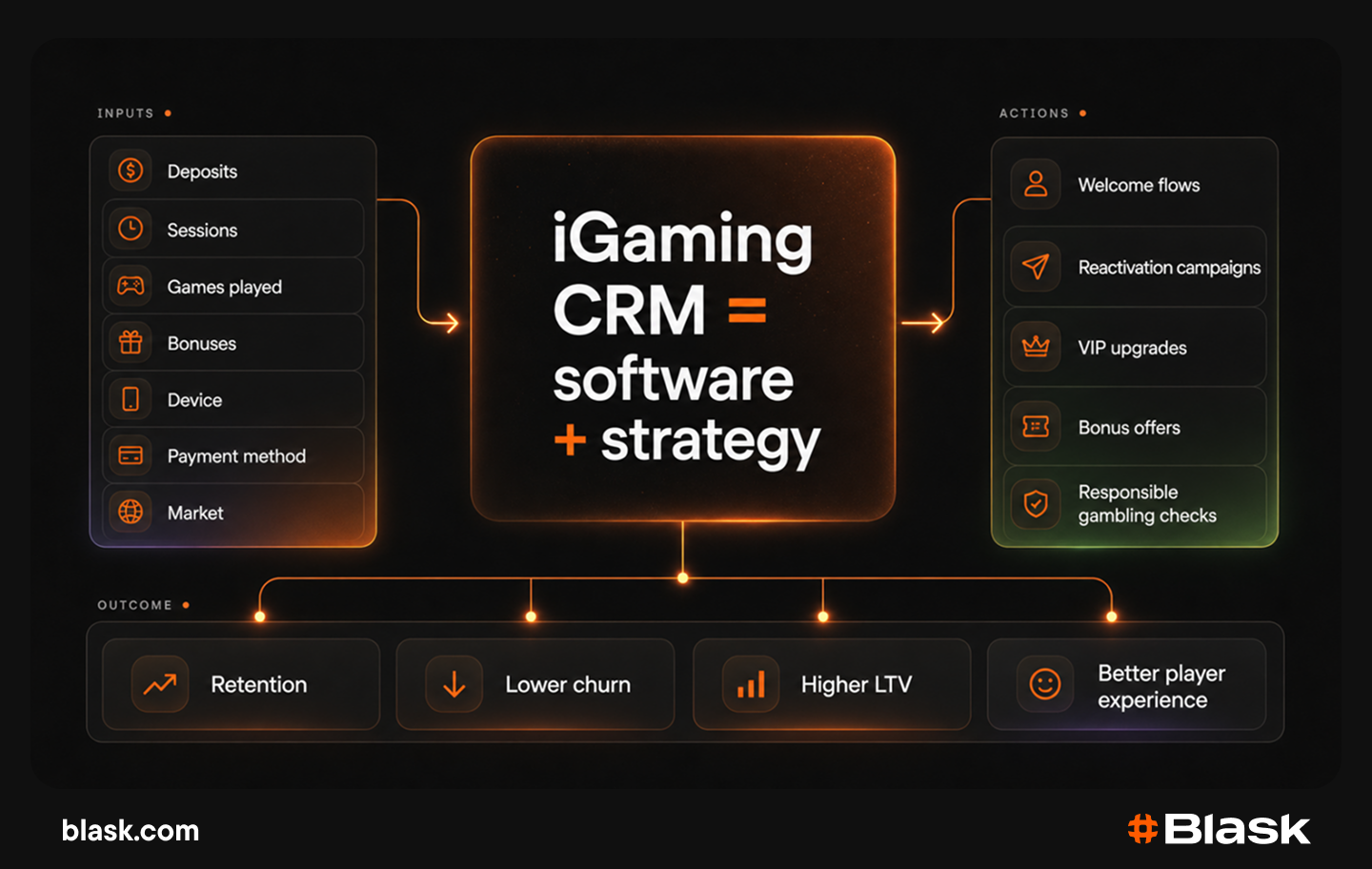
Two things separate the discipline from CRM in other industries. Event volume is higher: an active player generates hundreds of behavioural signals in a single session, where a B2B account produces a handful in a quarter. And the permitted actions come from licence conditions rather than the marketing calendar, applied per player and per market.
The CRM must enforce those rules automatically, per player, per market, and log every decision for potential audit.
How an iGaming CRM works
The system runs a loop. It ingests events from the player account management platform, the game servers and the payment gateway, resolves them into one profile per player, assigns that profile to segments, fires messages when a segment rule or behavioural trigger is met, and measures the outcome against a holdout group that received nothing.
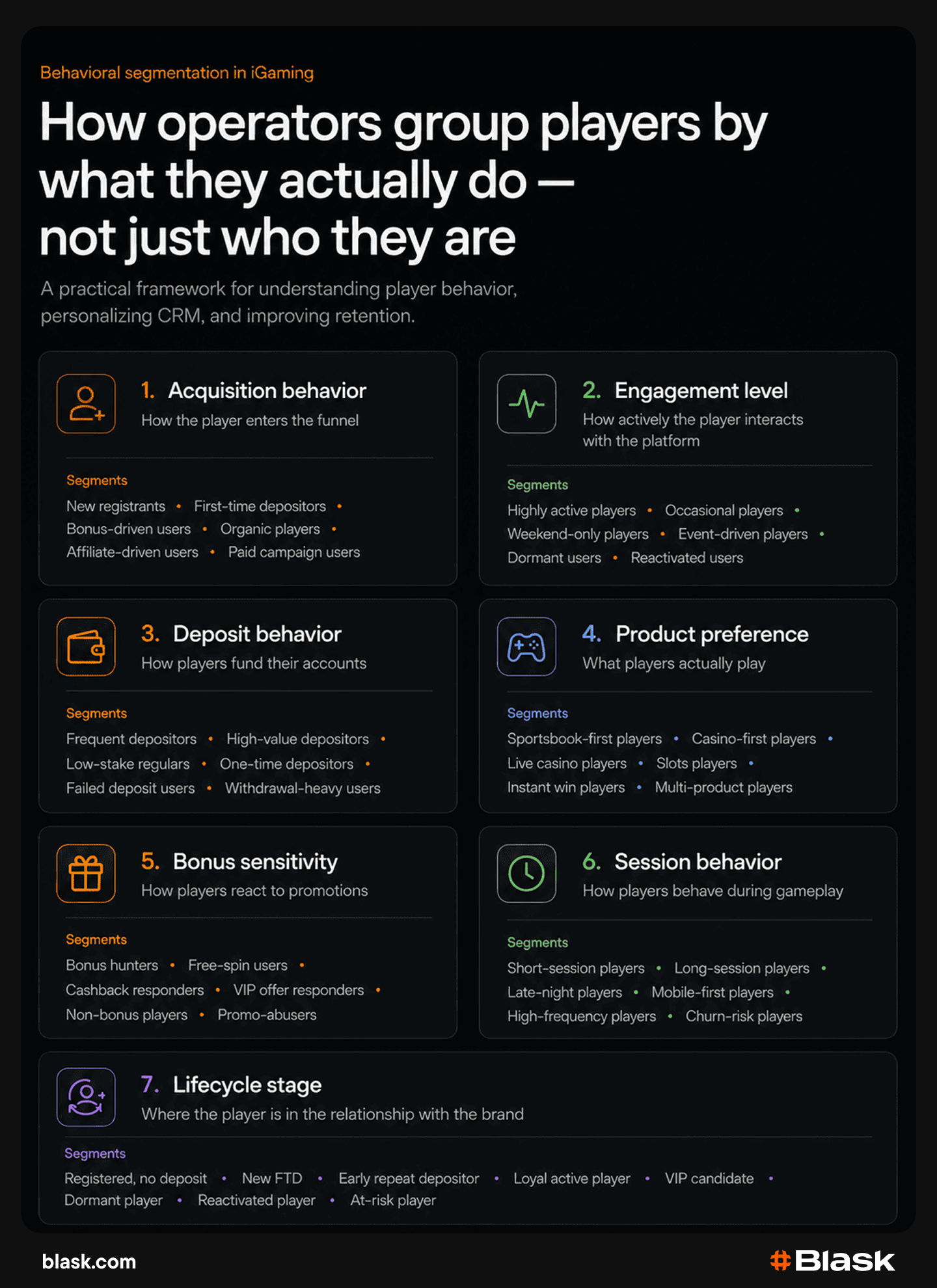
Segmentation is where operators separate from each other. Recency, frequency and monetary value (RFM) is the standard frame, and it is retrospective: it describes what a player has already done. Propensity scoring adds the forward view, estimating the probability that a player churns or deposits again inside a defined window.
Enterprise platforms cover similar ground at the feature level. Optimove, Fast Track, Smartico, Symplify and GR8.tech all handle segmentation, automation and multi-channel delivery; the differences that surface in production are integration depth with the PAM, gamification tooling and pricing model rather than the campaign builder.
CRM, CDP and marketing automation
The three labels describe different layers, and vendors have blurred the boundaries by extending their products into each other’s territory.
A customer data platform (CDP) unifies data. It ingests identifiers and events from every source, resolves them into one profile, and exposes that profile to other systems. In the narrow definition it sends nothing.
A CRM adds the decision and the action: it holds the same profile, applies segmentation and campaign logic, and delivers the message. Marketing automation is the execution layer inside it — the scheduler, the trigger engine and the channel connectors. Most platforms sold to operators as CRM now include identity resolution of their own, so the practical question is whether the unified profile stays reachable by systems outside marketing.
What the CRM cannot see
A CRM contains one operator’s players. It holds no view of the market those players move through, which is why internal retention curves shift without any change in campaign quality.
Blask data for H1 2026 shows how far the underlying demand can diverge between markets. German search demand for gambling brands fell 11.6% against H1 2025, while UK demand rose 5.3% and Brazil gained 15.8%. A reactivation rate holding flat in Germany over that period describes a different result from the same flat rate in Brazil. Blask Index measures that demand at market and brand level.
Where CRM sits in player economics
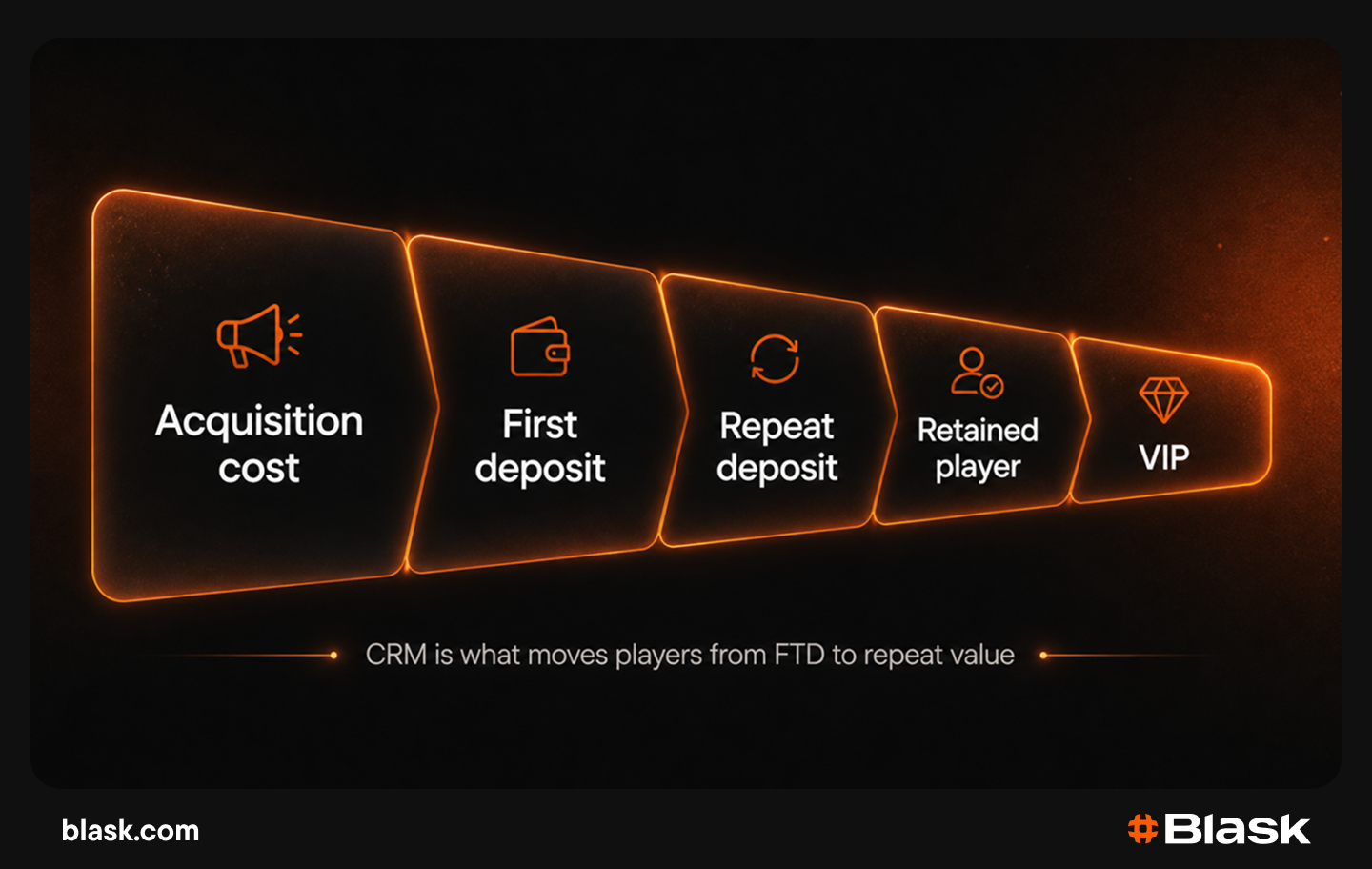
CRM is the mechanism that determines whether an acquisition cost is recovered. Acquisition sets the price of a first-time depositor; everything after it sets the return.
The link runs through lifetime value: revenue from a cohort over a fixed window, with CRM holding the main levers over deposit frequency, bonus cost and the point at which a player goes dormant. Set against customer acquisition cost, that value produces the payback ratio operators use to judge whether a channel scales.
At the top of the value distribution the work stops being automated. High-value accounts are handled by a VIP manager, whose judgement sits outside the campaign engine even when the CRM raises the churn flag.
“Some operators don’t communicate with players at all in the first minutes on the platform and lose those golden first 10 minutes. Others flood the channel with everything at once — the sensory overload kills any desire to act, and the player leaves.”
Farkhad Gasimoff CEO & Founder, GNB Agency
What regulation fixes in place
Marketing permissions in regulated markets come from licence conditions rather than campaign strategy. Operators holding a British remote licence must take all reasonable steps to prevent marketing material reaching a self-excluded customer, and must remove or flag that customer across every marketing database used by the company or group within two days of the completed self-exclusion notification. The prohibition outlasts the exclusion period until the customer asks for contact again.
Opt-outs cascade across channels and queued campaigns under the same logic. A platform refreshing suppression lists in batches leaves exposure in the window between runs, which makes self-exclusion handling an architecture question rather than a campaign setting.
Where CRM programmes fail
Four failures recur across operators, and none of them are platform faults. Data arrives incomplete because a source system — usually the payment gateway or the affiliate platform — was left out of the integration at setup. Message frequency runs unmanaged, so a player who satisfies three triggers receives three messages in an afternoon. Campaign impact is reported without a holdout group, which counts deposits that would have happened anyway and hides the churn already under way. And segmentation is built out to dozens of player types that no content team can write differentiated copy for.
Uladzimir Andryienka CEO, Handbox.io & GGRboost.io 
We start with what brings money fastest and requires the least data. First month — three mandatory scenarios: a welcome series of 3–5 messages after registration (without it the player forgets the brand within 24 hours); a first-deposit trigger for anyone who registered but hasn’t deposited within 24–48 hours; and reactivation for players inactive at 7, 14, and 30 days. VIP programs, complex RFM segmentation, A/B tests, predictive churn models — those come in month two and beyond.”

Farkhad Gasimoff CEO & Founder, GNB Agency 
“Email still works — but not in all GEOs. For Europe, email campaigns are a must-have. For Tier-3 markets, the result is near zero. In my agency we match the right channels to the right geographies. When the ESP doesn’t have the functionality we need, we use MessageWhizz.”
Uladzimir Andryienka CEO, Handbox.io & GGRboost.ioAdd here sending campaigns without segmentation. The operator buys an ESP, loads the database, and sends one promotion to everyone. A new registrant gets the same message as a VIP with two years of deposits. Within weeks: low open rates, high unsubscribes. Within months, the domain is in spam. We see this on 7 out of 10 audits.
Second: no lifecycle automations. No onboarding sequence, no reactivation trigger, no first-deposit reminder. The entire CRM is manual mass sends two or three times a week. The player registers, receives nothing personal, and leaves.”
Future trends in CRM
The direction of the market in 2026 is clear to practitioners on the front lines.
“The final move away from the old model of massive communication chains, toward precise, point-in-time trigger interactions. And gamification of everything.”
— Farkhad Gasimoff, CEO & Founder, GNB Agency
“Predictive analytics instead of rules. Not ‘send reactivation after 14 days of inactivity’ — but a model that predicts churn before the player leaves. AI content personalization that generates different offers, tone, and visuals for a casual slots player versus a poker VIP. And multichannel CRM beyond email — push, Telegram bots, in-app messages, WhatsApp in some GEOs. Email stays the foundation, but operators who stay in one channel lose to those building a coherent experience across 3–4 touchpoints.”
— Uladzimir Andryienka, CEO, Handbox.io & GGRboost.io
Operators who treat CRM as infrastructure — not a campaign tool bolted onto the back office — are building positions that competitors without that foundation cannot close quickly. The gap between a well-run CRM operation and a reactive one compounds over time: better data produces better models, better models produce better campaigns, better campaigns produce higher-value player cohorts that are more expensive to replicate through acquisition alon
FAQ
What is iGaming CRM?
iGaming CRM is the combination of software and operating practice used to manage players after registration: a unified behavioural profile per player, segmentation built on that profile, automated lifecycle and trigger campaigns, and suppression rules that enforce each market’s marketing regulation.
What is the difference between CRM and CDP?
A CDP unifies player data from every source into one profile and makes it available to other systems. A CRM holds that profile, decides what action it justifies, and sends the message. Most iGaming CRM platforms now include identity resolution, so the working question is whether the unified profile is reachable by systems beyond marketing.
How does CRM connect to LTV?
LTV is cohort revenue over a fixed window, and CRM governs most of what happens inside that window: deposit frequency, session frequency, bonus cost and the point at which a player goes dormant. Acquisition sets the cost side of the LTV:CAC ratio, and CRM determines how much of it comes back.
Bottom line
CRM in iGaming is a definition problem before it is a purchasing decision. The platform stores the player record and executes the rules; the retention curve comes from the segmentation, suppression logic and holdout discipline an operator writes into it. Two brands on the same software rarely report the same result.