
- Updated:
- Published:
What is autodeposit
A player completes registration, opens the cashier, faces twelve form fields and a redirect to a third-party banking portal — and closes the tab. The operator paid for the click. The affiliate earned the postback. Revenue never started.
That leak is the most expensive in the acquisition funnel. Optimove analysis of four European markets found 61–71% of depositing players fund on registration day — meaning the cashier they see in session one decides whether marketing spend converts or evaporates. PayPal research, referenced by Aeropay, shows 59% of users abandon a merchant after a single failed payment. To the player, a declined first deposit reads as a broken casino, not a card issuer timeout.
Auto-deposit mechanics compress that journey. They replace multi-step forms with one-click, in-flow, or pre-authorised funding — and they sit at the intersection of product economics, antifraud, and AML.
What is auto-deposit?
| Auto-deposit — often grouped with 1-click deposits, Pay N Play, or integrated cashier flows — refers to payment architectures that let players fund accounts with minimal manual input. Unlike a standard deposit flow, which demands manual card entry or an external banking redirect, auto-deposit uses tokenised credentials, digital wallets, or open banking to authorise payment in one or two taps inside the operator interface. |
Advanced implementations combine KYC verification and the first deposit into a single action via open banking: the bank authenticates identity and moves money in one session. The goal is immediacy — closing the gap between intent to play and a funded balance.
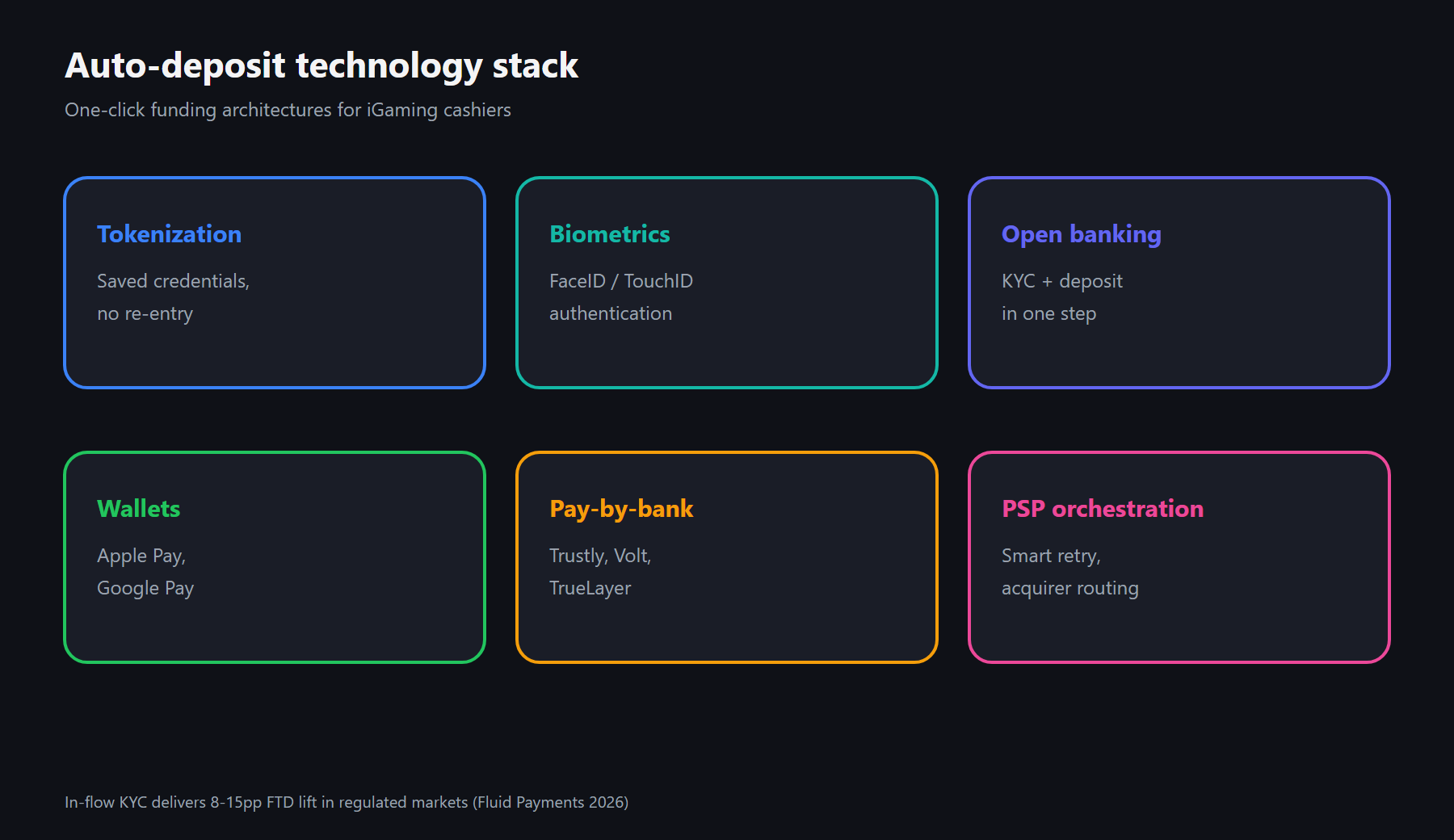
Core technologies:
- Payment tokenization — replacing card data with tokens so repeat deposits skip re-entry
- Biometric authentication — FaceID and TouchID on mobile wallets
- Open banking and Pay N Play — bank-level authorisation with identity bundled
- Digital wallets — Apple Pay, Google Pay, PayPal one-tap flows
- Regional instant rails — Interac Autodeposit in Canada, Trustly/Volt/TrueLayer in Europe
Nuvei highlights in-game deposits without returning to the main cashier, auto-suggested smart amounts, and SCA-exempt returning flows via stored credentials as conversion levers — all auto-deposit patterns in practice.
The cost of friction in the cashier
Payment friction is not a UX nicety. It is a P&L line.
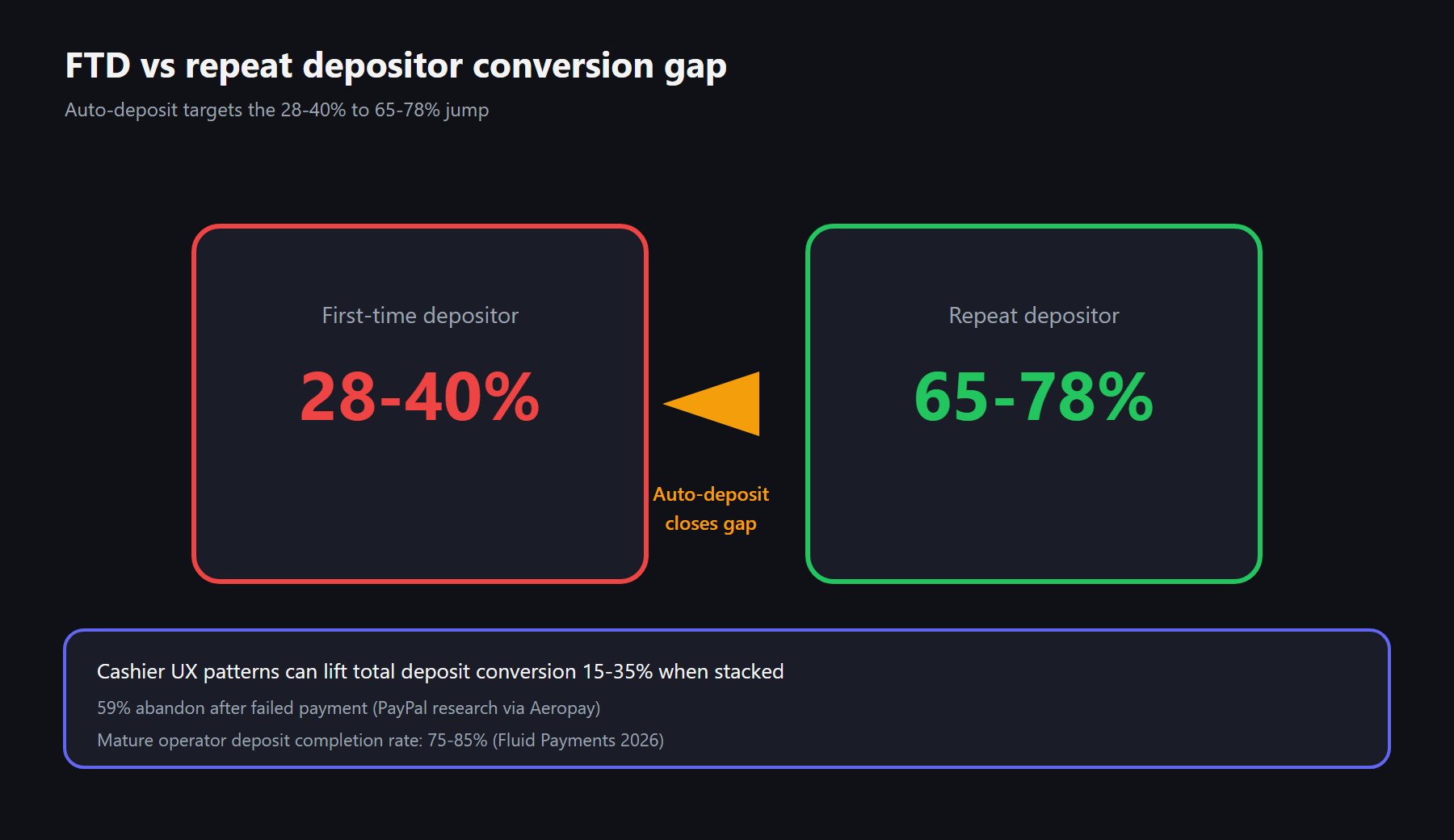
Fluid benchmark data, aggregated across 30+ jurisdictions and casino, sportsbook, and sweepstakes verticals, puts first-time depositor (FTD) conversion at 28–40% of registrants who reach the deposit intent. Repeat depositor conversion runs 65–78% once credentials are saved and verification is complete. The gap between those two numbers is where auto-deposit earns its budget.
Mature operators with brand-native cashiers hit 80–90% deposit completion rates. Hosted iframe cashiers sit at 60–75% — the iframe round-trip alone costs conversion. Fluid also reports that 62% of users abandon a platform after one payment failure — making payment success rate the highest-impact KPI with real-time alerting.
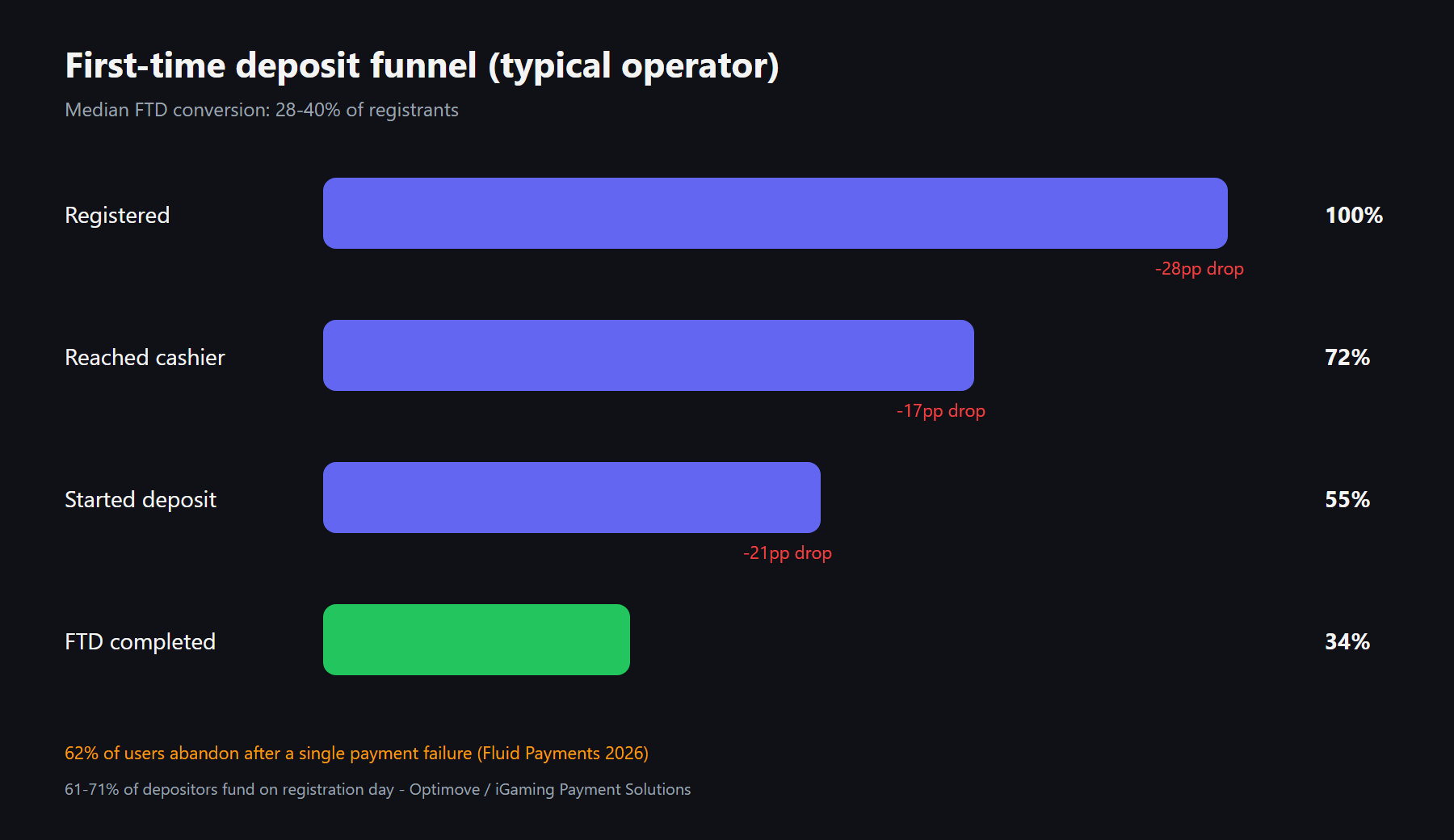
Common abandonment points: bonus claim friction, KYC triggered mid-funnel as a hard block rather than in-flow verification, slow page loads, and limited payment methods on the first attempt. Each is fixable without weakening compliance.
Deposit conversion by payment method
Not all rails convert equally. Fluid median benchmarks across comparable operator cohorts:
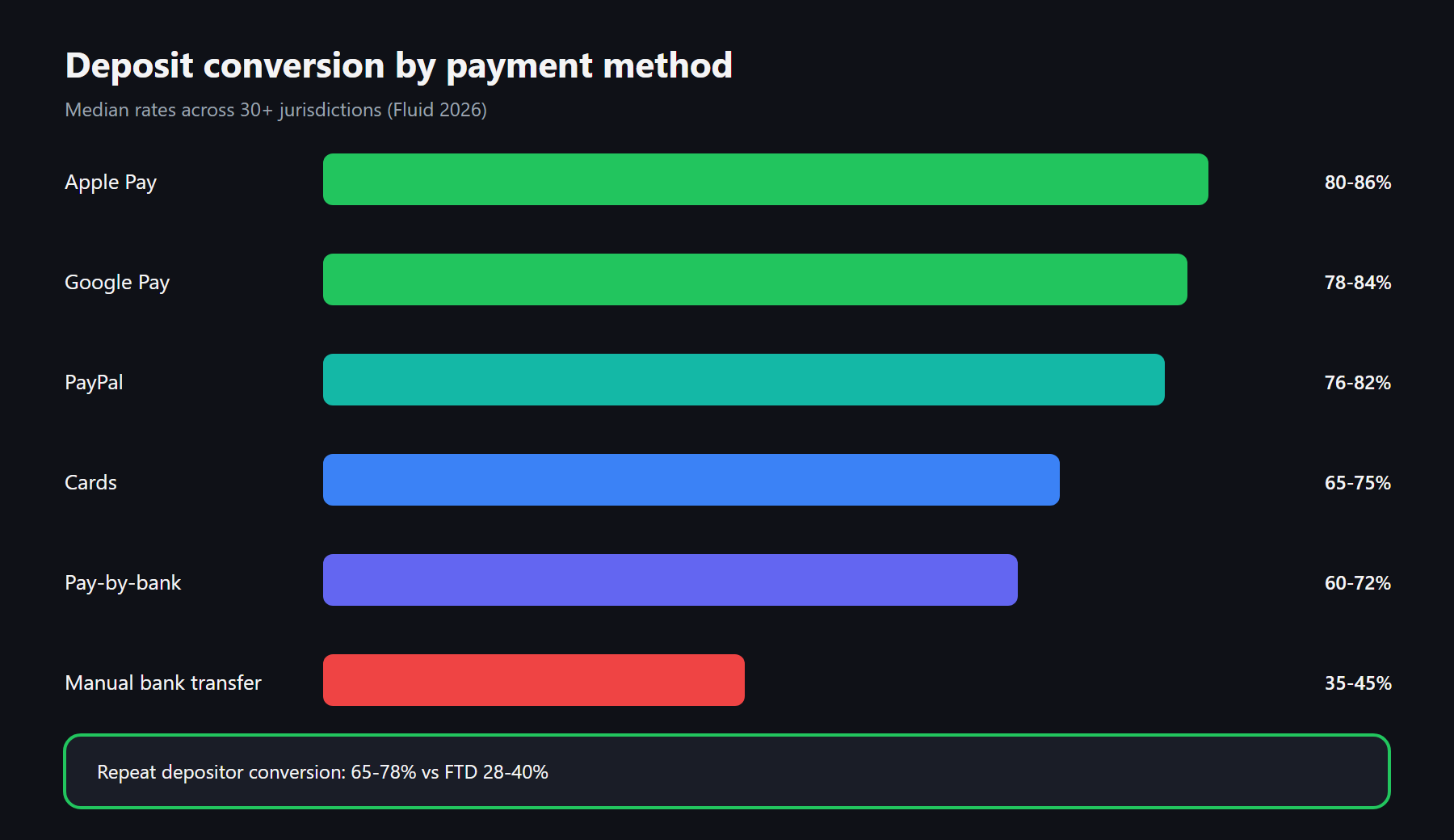
Wallet and tokenised rails outperform manual entry by double-digit percentage points. Fluid notes in-flow KYC — verification embedded in the deposit journey rather than blocking it — delivers the biggest single lift, typically 8–15 percentage points on first-deposit conversion in hard-regulated markets.
Geography shifts the baseline:
Auto-deposit closes gaps within each band; it does not erase regulatory friction.
Why operators prioritize fast payments
Maximizing first-time deposits
The registered-to-funded transition is the critical threshold. If a player can deposit in three seconds via Apple Pay or an open banking link, conversion spikes relative to a multi-page card form. Industry analysis estimates five cashier UX patterns — saved methods, fee transparency, retry logic, mobile-first layout, orchestrator routing — stack to 15–35% total deposit conversion gain depending on starting baseline.
Increasing deposit frequency and ARPU
When funding is effortless, players reload mid-session. In-game deposits — topping up without leaving a live table or slot — raise average revenue per user by removing the cognitive break of navigating back to a standalone cashier.
Security and compliance
Modern auto-deposit relies on bank-level tokenization and biometric auth. That reduces card-not-present fraud and chargeback exposure while supporting AML requirements: the payment rail carries identity assurance the operator can map to CDD records.
Canada illustrates the compliance-speed pairing. Interac Autodeposit clears e-Transfers in seconds without manual security questions — under 30 seconds versus 30 minutes to two hours for manual e-Transfer. Licensed Canadian sites operate under FINTRAC anti-money-laundering rules; identity verification remains standard before larger transfers. TODA Pay notes Interac e-Transfer’s chargeback-free architecture removes one of iGaming’s costliest operational liabilities — chargeback rates in gambling run 2–4% versus 0.5–1% in e-commerce.
The impact on player retention
Payment experience drives loyalty. A fast deposit paired with a rapid withdrawal builds trust. Saved credentials make the funding process invisible on return visits — and in mature markets, operators compete on cashier speed and reliability, not only game catalogues and bonus size.
Baymard 2026 abandonment data attributes 39% of cart abandonment to extra costs surfacing late at checkout — the largest single bucket, ahead of account creation and payment method gaps. In iGaming, the analogue is hidden fees, surprise FX spreads, or bonus terms that appear after the player commits to an amount.
Cashier UX patterns that move conversion
The same analysis breaks down five patterns with published-source mechanisms:
- Fee transparency before commit — surfaces total cost before the player locks an amount
- Saved payment method default — tokenized card-on-file with PSD2 TRA exemption routing for returning depositors
- Smart retry and orchestrator failover — routes declined cards to alternate acquirers or methods without player re-entry
- Mobile-native wallet prioritisation — Apple Pay / Google Pay above manual card entry on mobile web
- In-flow KYC — verification embedded in deposit, not a separate blocking step
PSD2’s recurring transaction logic — after SCA on initial setup, subsequent authorisations under the same consent may clear without step-up — applies to scheduled top-ups and operator-side auto-deposit patterns where the player consents to fixed amount and cadence.
Speed vs AML and antifraud
Faster rails do not suspend AML. They change where controls sit.
Open banking Pay N Play can merge identity and deposit — satisfying CDD at the moment money moves. Tokenized wallets reduce raw card data exposure but still require velocity monitoring and antifraud scoring on device, IP, and behavioural signals. Sumsub Q1 2026 fraud data shows suspicious transaction volume up 4.5x year-on-year — auto-deposit without parallel screening amplifies that curve.
Verified players typically receive higher limits. A Canada Interac guide cites high-limit verified deposits up to C7,000instantafterKYC,versusC2,000–3,000 daily caps for standard e-Transfer. The policy pattern: fast default for low-risk verified cohorts, step-up EDD and SoF checks at thresholds.
How to measure acquisition efficiency
Payment flow performance is a leading indicator, not a trailing one. Fluid distinguishes payment success rate and deposit completion rate as leading indicators (hours to respond) versus ARPU and new-player deposit rate as trailing indicators (7–30 days to fully reflect change).
Blask’s Acquisition Power Score (APS) measures a brand’s ability to convert market presence into funded customers. High visibility with lagging FTDs relative to APS often points to friction — not weak demand. When APS is strong but FTD lags, trace payment success rate and deposit completion rate before increasing acquisition spend: the bottleneck is usually the cashier, not the marketing budget. Competitive Earning Baseline (CEB) compares actual revenue to AI-projected potential; integrated auto-deposit infrastructure frequently separates operators who underperform baseline from those who exceed it.
Examples
Open banking Pay N Play. A Nordic operator routes the first deposit through Trustly. Bank authentication satisfies KYC identity requirements; funds land in under ten seconds. FTD conversion tracks toward the 80%+ wallet band rather than the 65–75% card median.
Interac Autodeposit (Canada). The player sends e-Transfer to the casino’s registered Autodeposit email. Payment clears automatically without security question — under 30 seconds versus up to two hours manual. FINTRAC rules still apply; larger transfers require completed identity verification.
Tokenized returning depositor. A UK player saved Visa via compliant card-on-file tokenization. The second deposit uses one tap with TRA exemption. Conversion moves from the 28–40% FTD band toward 65–78% repeat performance.
Challenges
Bank and issuer blocks. Canadian players hit delays when institutions block gambling merchants or Autodeposit emails mismatch casino records.
MCC 7995 constraints. Gambling merchant category codes face stricter issuer scrutiny — failed payments damage brand perception disproportionate to the technical cause.
Regulatory mid-funnel KYC. Triggering full verification as a deposit hard stop rather than in-flow step-up recreates the abandonment auto-deposit was built to eliminate.
Infrastructure timing. Payments Canada’s Real-Time Rail, expected Q3 2026, will enable irrevocable account-to-account settlement in seconds. Operators on RTR-ready PSP infrastructure gain measurable payout speed advantage over batch-processing competitors.
Bottom line
Auto-deposit is acquisition and retention infrastructure, not a payments feature tucked into the backlog. When 61–71% of depositors decide on day one, the cashier is the product experience that matters most — constrained by AML, protected by antifraud, and delivered through a PSP layer that orchestrates rails rather than hardcoding a single method.
Operators who treat payment speed and compliance as one design problem — not two teams in conflict — capture the 15–35% conversion lift available when friction, failure, and surprise are engineered out of the funnel.