
Virginia kills online casino regulation favoring offshore platforms
Virginia’s legislative session just concluded with a massive win for traditional casinos. Lawmakers failed to reconcile two competing bills before adjournment. This officially killed hopes for a regulated online casino market in 2026.
The National Association Against iGaming (NAAIG) immediately celebrated the legislative collapse. This organization operates as a coalition funded entirely by land-based casino operators. They successfully argued that regulating the digital market would cannibalize physical casinos and devastate local communities.
However, celebrating the death of this bill requires ignoring a massive structural reality. Virginia did not actually ban digital gambling. They simply voted to keep a multi-billion dollar industry entirely unregulated.
The illusion of prohibition
The casino lobby frames the absence of regulation as a victory for local businesses. Data from Blask completely dismantles this comforting narrative.
Virginia currently hosts an estimated $2.8 billion annual market, measured by the Competitive Earning Baseline (CEB). With no legal online casino framework, this intense demand does not simply vanish. It flows directly to platforms that operate outside the law.
Blask currently tracks 310 active gambling brands competing for players in Virginia right now. While licensed sportsbooks like FanDuel and DraftKings hold the top two spots, the third-largest brand by BAP is Bovada.
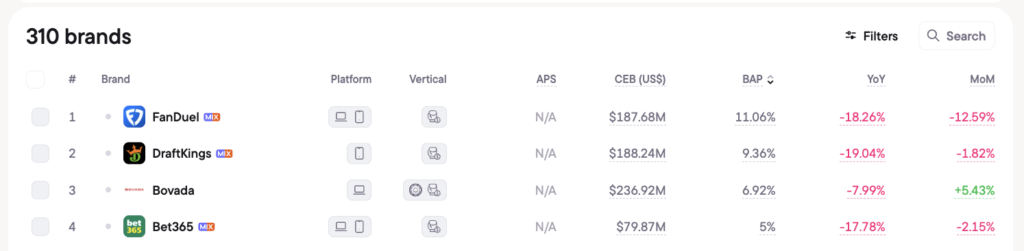
Bovada holds no licenses in Virginia. In fact, they hold no licenses anywhere in the United States. Yet, they seamlessly command a massive portion of local player demand.
Subsidizing the black market
The irony of Virginia’s legislative failure is profound. Land-based casinos spent significant resources lobbying to block digital competition. They argued an online casino market would cost the state $220 million in public education funding.
By killing the legislation, lawmakers ensured the state collects exactly zero dollars from digital casino products. A look at the top four brands in Virginia perfectly illustrates this revenue leak.
While licensed operators FanDuel and DraftKings lead the pack, they are bleeding momentum, showing year-over-year declines of 18.2% and 19% respectively. Meanwhile, unregulated Bovada sits comfortably at #3 with a massive $236.9M CEB — significantly higher than the top two and actually shows month-over-month growth (+5.4%).
Even Bet365 at #4 trails Bovada significantly. These unregulated operators capture hundreds of millions in local demand, yet pay no state taxes and employ no local workers.
The situation exposes a glaring contradiction in state leadership. Virginia Attorney General Jason Miyares recently joined a 50-state coalition. They actively urged the Department of Justice to crack down on offshore gambling. Yet, the state legislature just effectively voted to protect the exact black market the Attorney General wants destroyed.
A permanent structural shift
The debate in Virginia highlights a fundamental misunderstanding of modern digital behavior. Traditional casino operators view an online casino as an optional amenity that states can simply choose to reject.
The reality is that the digital market already exists. Players will always find the path of least resistance to access their preferred games. When lawmakers refuse to establish a regulated, taxed framework, they do not save local jobs. They simply hand a lucrative, billion-dollar monopoly to offshore operators who happily serve local players without consequence.