

- Updated:
- Published:
Brazil’s illegal betting market: 40% of operators, 22% of revenue
TCU estimated that 40% of operators still work without a licence, while Blask data shows offshore brands have lost most of the consumer-demand battle but still capture about one-fifth of Brazil’s estimated market revenue.
On May 19, Brazil’s Federal Court of Accounts (Tribunal de Contas da União, TCU) approved a package of recommendations for tighter oversight of the regulated betting market. The headline number: around 40% of active operators are still working without an SPA licence, 16 months after Brazil made authorisation mandatory.
TCU also identified a second problem. Brazil’s illegal betting enforcement chain remains fragmented, with responsibility spread across several agencies and no single authority clearly owning the full process. No single agency coordinates the rest. Current tools are not strong enough to block unlicensed operators at the required scale.
Bolsa Família: $608M in one month
According to Central Bank data, cited in TCU’s November 2025 report, recipients of Bolsa Família — Brazil’s federal cash-transfer programme for low-income families — sent $612M to betting companies via PIX in January 2025 alone. That was equal to roughly 20% of the programme’s entire monthly budget. One family transferred $347K in that single month.
TCU analysts also found “strong indications” that part of the transaction flow used third-party CPFs, Brazil’s taxpayer identification numbers, rather than the actual beneficiaries of the welfare payments. These flows ran to licensed and unlicensed operators alike — but they show how much uncontrolled player behaviour exists alongside the regulated market.
Where TCU’s 40% and Blask data diverge
In the licence-type split, offshore operators held 4.3% of total consumer demand in March 2026, down from 8.9% in January 2025. TCU’s 40% counts operators. According to Blask data, licensed brands represent about 30% of the visible market. The 4.3% offshore-demand share does not contradict this estimate. The two figures describe different layers of the market: brand presence on one side, and actual consumer attention on the other.
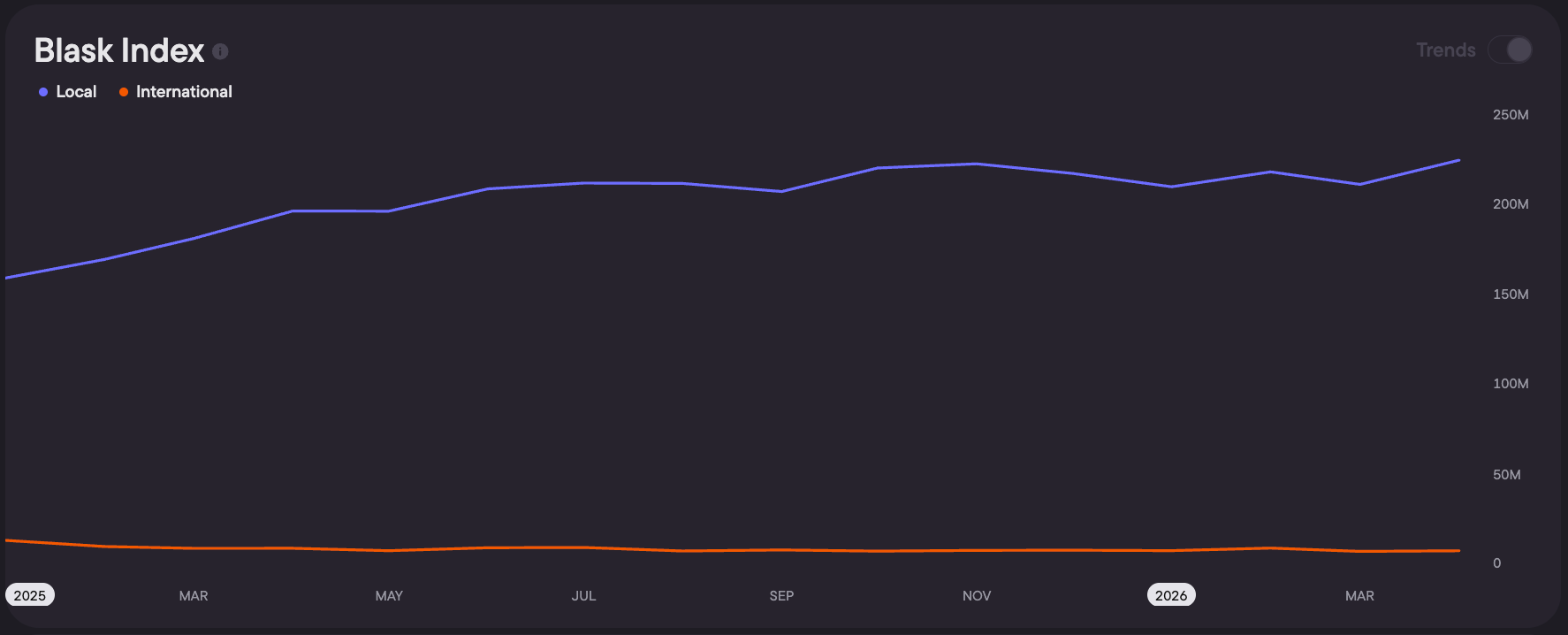
Domain blocking works on the supply side: Brazil blocked more than 25K unlicensed websites during 2025. Players rerouted to licensed platforms as the unlicensed ones disappeared. The offshore demand share more than halved over 15 months.
The revenue gap is the real problem
In Q1 2026, offshore operators still held about 22% of Brazil’s total CEB (Competitive earning baseline, estimated revenue potential), down from around 32% in Q1 2025. In absolute terms: roughly $119M in monthly CEB for unlicensed operators, against $440M for locally licensed brands.
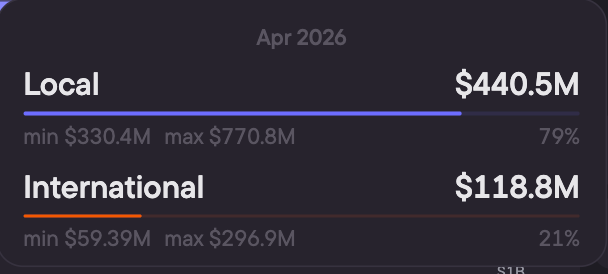
The gap between 4.3% of demand and 22% of estimated revenue points to a consistent pattern in partially regulated markets. Illegal operators lose on volume but extract more per player — no KYC controls, no deposit limits, no responsible-gambling requirements.
TCU targets illegal betting money
TCU’s core recommendation calls for establishment of a permanent interagency working group including SPA, Anatel, the Central Bank, COAF, and Receita Federal under formalized coordination protocols and clear divisions of responsibility. The mechanism is financial: track PIX flows to unlicensed operators, identify the payment processors serving them, and block those providers.
This is the same logic Blask examined in its analysis of Brazil’s regulated market: domain enforcement removes the interface; financial enforcement removes the business model. Over 16 months, regulation cleared most of the illegal market from the demand side. The revenue that remains runs through the payment rails — cutting that flow is TCU’s stated next step.