
- Updated:
- Published:
India iGaming market 2026: Parimatch leads with $82.5M in post-ban CEB

After the PROG Act Rules took effect, India’s tracked iGaming market shrank sharply before rebounding in July. Local operators exited, leaving the market fully offshore, with Parimatch in the lead and Jojobet showing only a brief spike.
Parliament passed the Promotion and Regulation of Online Gaming Act in August 2025, but the Rules needed to enforce the ban under the India betting market PROG Act 2026 only came into force on 1 May 2026. India’s iGaming market in 2026 shows that the national ban removed local operators while players’ search interest largely held. Blask tracks that entirely offshore betting interest: how demand moved month to month, which brands gained the most market share, and which lost it.
What the PROG Act is: Asia’s largest iGaming ban
India fantasy sports regulation 2026 rests on the Promotion and Regulation of Online Gaming Act, 2025, which removed the former distinction between games of skill and games of chance that for years allowed fantasy sports, rummy and poker to operate in a legal grey zone in individual states. The law bans any online money games regardless of whether the outcome is determined by skill, chance, or a mix of both. Alongside the games themselves, it bans their advertising and related payments. The enforcing Rules, however, only came into force on 1 May 2026.
The ban hit three segments at once: fantasy sports, including Dream11, MPL and My11Circle; skill apps with rummy and poker; and casino-style products with cash stakes. The largest local companies began winding down real-money games as early as August 2025, right after parliament passed the law. Dream11, MPL, Gameskraft, Zupee, Probo and others suspended cash products without waiting for the Rules to apply.
Dream11, with more than 280M registered users, switched to free-to-play and sports entertainment products. E-sports and online social games without cash stakes remained legal and are regulated through a separate registration process. Real-money products cannot obtain a licence under that scheme.
The local cash segment has effectively disappeared, but search interest in betting and casino has remained. Blask’s brand map for India is now made up entirely of offshore operators.
How did India online gaming ban affect demand 2026?
Blask Index measures search demand for iGaming brands within a market. As the India iGaming demand Blask Index, this metric in 2026 reflects interest in offshore bookmakers and casinos, now the entirety of Blask’s brand set in the country.
How did India online gaming ban affect demand 2026? Demand held up before the ban: Blask Index rose 31.4% month over month in February and another 5.8% in April. Once the Rules took effect on 1 May, the trend reversed hard — the Index fell 23.1% in May and a further 21.7% in June. The sharpest single-day move landed on 4 May, when interest dropped 27.4% in a single day.
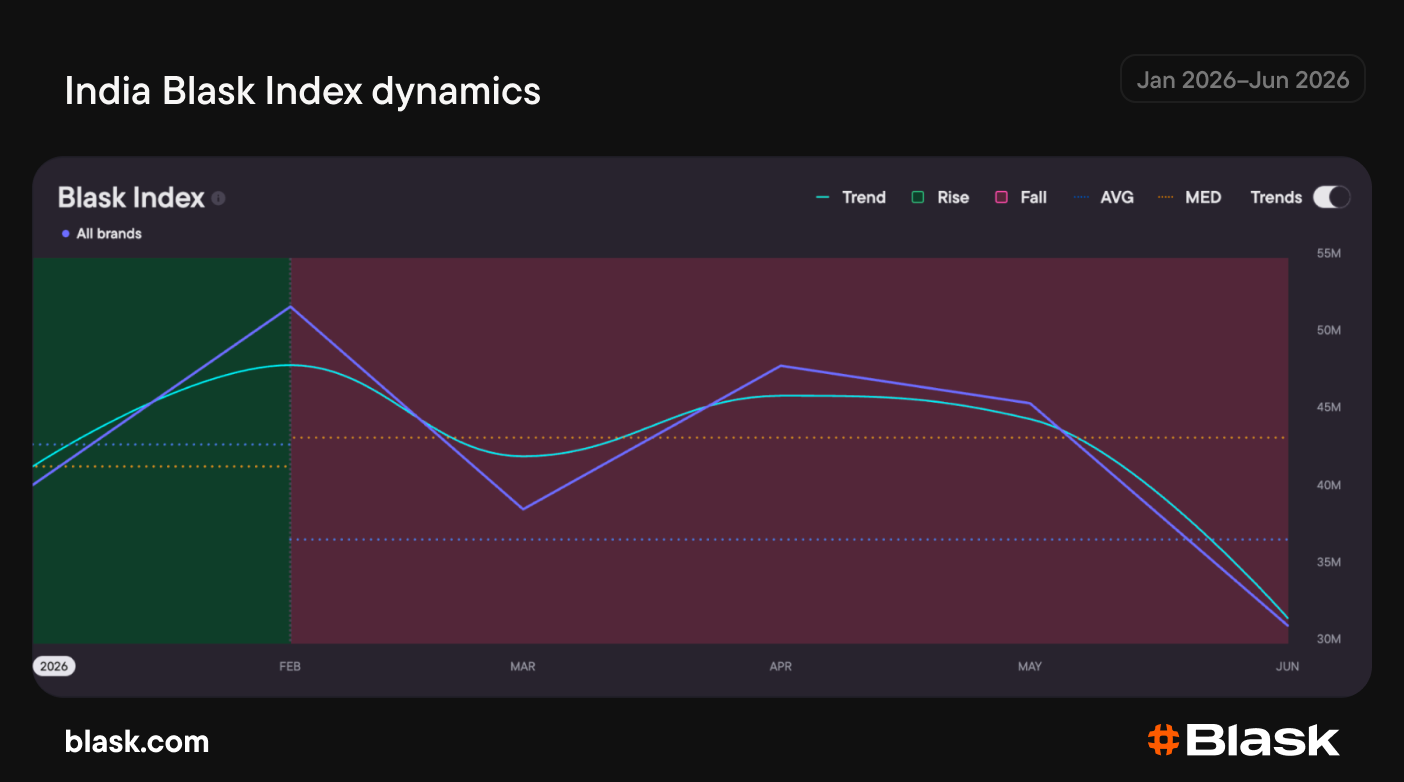
The May–June decline coincided with the end of the IPL calendar, so the swing cannot be read as a pure regulatory effect. The timing remains telling, though: the reversal started right after 1 May, not in the preceding months of anticipation.
Throughout the first half of 2026, the entire India Index that Blask classifies by licence status fell into the Offshore category. Local fantasy sports and rummy brands that stopped real-money operations in August 2025 were no longer shaping this trend.
Parimatch held the lead while Jojobet spiked and faded
Local operators had already exited, so comparing two equal three-month windows on either side of 1 May — Feb–Apr against May–Jul — measures competition and India online gaming brands market share 2026 shifts inside the offshore segment only.
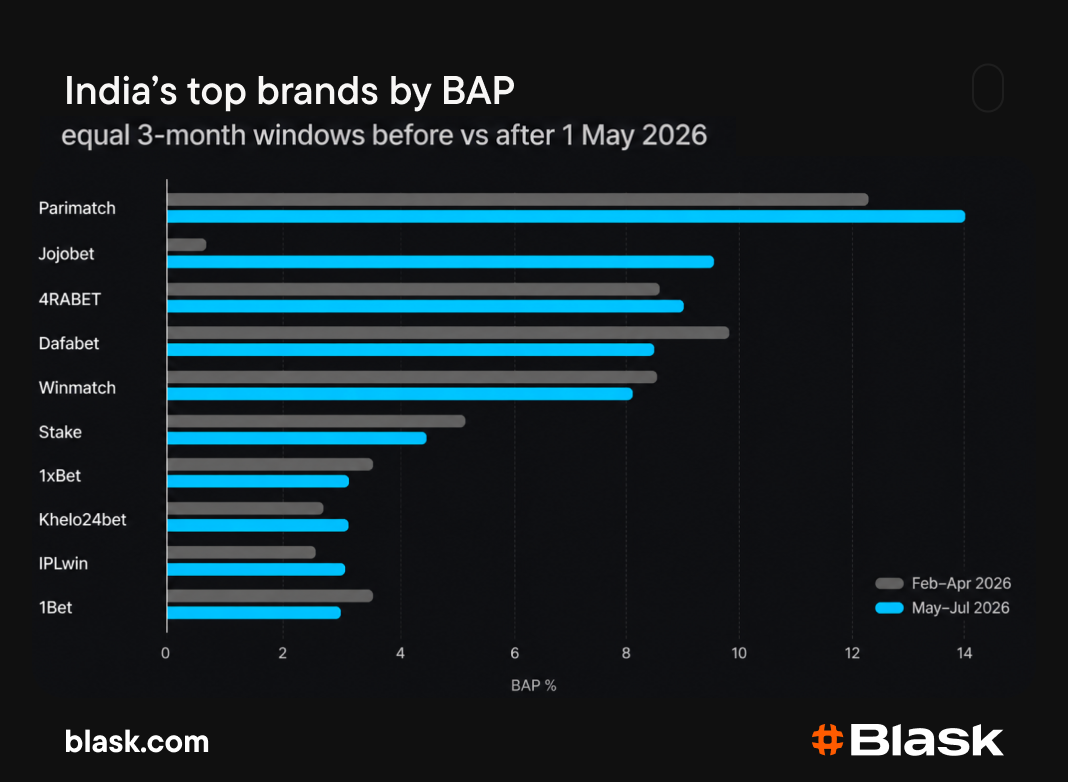
According to India online gaming brand rankings Blask data, Parimatch held first place and increased its BAP from 12.11% to 13.9% after the ban, while 4RABET also gained and Dafabet, Winmatch, Stake and 1xBet remained among the largest offshore brands. The Economic Times identifies the same operators among those that stayed active after local real-money platforms exited.
The main outlier was Jojobet, whose May spike briefly pushed it to first place before demand collapsed in June; HoliganBet showed a smaller version of the same pattern, while Skyexch recorded the steepest decline among major brands. CEB data confirmed Parimatch’s lead, with $82.5M generated in May–June.
What comes next: OGAI registration, not a real-money reopen
The Online Gaming Authority of India (OGAI) under MeitY is responsible for registering e-sports and approved online social games. Real-money products fall outside that system, so online money games remain banned.
By mid-2026 OGAI published a registration form, but it covers only permitted game categories. Neither the Act, the Rules, nor MeitY guidance provides a path for fantasy sports, poker, rummy or casino products to obtain a new real-money licence.
For the market Blask measures, the fight for user attention has shifted entirely into the offshore segment. Parimatch, 4RABET, Dafabet, Winmatch and Stake already form a durable leading group. At the same time the market remains dynamic enough: Jojobet showed that a new brand can sharply grow its demand share in a single month, while Skyexch showed how quickly positions can be lost after a regulatory shift.
What MeitY is rolling out next is OGAI registration for permitted e-sports and online social games: the authority published an application form by mid-2026, but as of June the designated OGAI portal to submit it was still not live. Under the PROG Act framework, real-money gaming remains outside that registration model, and the search interest Blask records is still concentrated around offshore operators.
Bottom line
India removed the local real-money industry and kept a large offshore demand market. Blask Index shows a drop after 1 May, a two-month dip and a July rebound, and BAP and CEB data answer who leads India iGaming market after PROG Act 2026: Parimatch, 4RABET, Dafabet, Winmatch and Stake. The open question for H2 2026: will OGAI registration for social games and e-sports change anything for players who already moved stakes offshore, or will Blask Index keep measuring an illegal market the ban did not empty.
See the latest India brand and demand data with free Blask analytics: blask.com/market/india/
FAQ
What happened to India’s iGaming market after the PROG Act 2026?
The Act banned online money games nationwide. The Rules and Act came into force on 1 May 2026. Local fantasy and skill-cash operators had already stopped paid contests in August 2025. The brand set Blask tracks remains entirely offshore — Blask Index dynamics are covered in the demand section above.
Which brands are winning in India’s online gaming market in 2026?
Among brands Blask tracks, Parimatch leads on BAP after May, ahead of 4RABET, Dafabet, Winmatch and Stake. Jojobet briefly led in May, then rolled back. Dream11, MPL and Gameskraft are absent from the betting top 10 after exiting real-money.
Is online betting legal in India in 2026?
No. Online money games (including fantasy sports, rummy and poker with stakes) are banned under the PROG Act and Rules from 1 May 2026. E-sports and online social games without cash stakes may operate under OGAI definition and registration rules. Offshore betting sites remain outside that legal frame and outside Indian consumer protection.