

- Updated:
- Published:
The US online poker market is shaped by a liquidity problem

Legal poker rooms operate in fewer US states than legal online casinos — offshore operators fill the gap.
In the US, online poker is regulated in eight states, but only six of them have licensed operators actually running games. That is a consequence of how the vertical works — and it does not help channelise demand, which flows to offshore operators instead.
This article draws on findings from Blask’s comprehensive report covering the US and Canadian iGaming markets — state-by-state and province-by-province breakdowns, offshore vs. domestic dynamics, brand rankings, and expert commentary.
A game that needs a crowd
Poker is a game of skill. The outcome of a single hand involves chance, but over any meaningful stretch of play, strategy, reads, and decision-making determine the winner. That makes it fundamentally different from other gambling products and shapes how regulators treat the vertical.
Some countries where online poker is legal consider it a part of the online casino licence framework. Others regulate the vertical separately, and often online poker is legal in the same market where other online casino games are not — like in France.
But regardless of how a country classifies it, poker has a structural constraint unfamiliar to other iGaming verticals — it needs players at the table. Slots run against the house, roulette spins whether one person is watching or twenty. Poker requires a pool — enough people sitting down at the same time to make the game viable.
That is why some countries, like the UK, allow licensed operators to participate in shared international player pools. Others chose to share liquidity between specific jurisdictions — in 2017, the regulators of France, Spain, Portugal, and Italy signed an agreement to pool their online poker markets. Italy, though, has never implemented it.
In the US, the same logic applies — but the borders are state lines.
Six US states share a pool, the rest share a problem
In the US, poker is regulated at the state level — like every other form of online gambling. But the map of legal online poker does not match the map of legal online casino.
In particular, in Nevada, the online casino vertical is prohibited to protect the state’s land-based gambling economy, but Nevada pioneered online poker regulation. On the other hand, Connecticut and Rhode Island have regulated online casino and online poker verticals, but no major poker rooms operate there as their population is too small to sustain a viable player pool on its own.
Other states where online poker is legal solved the problem by combining a player base via the Multi-State Internet Gaming Agreement (MSIGA). Nevada and Delaware signed the founding compact in 2014, New Jersey joined in 2017, Michigan in 2022, West Virginia in 2023, and Pennsylvania in April 2025.
MSIGA does for US poker what the European liquidity agreement does for France, Spain and Portugal. When the regulated pool is big enough, players have less reason to go offshore.
The split at the top
The US and Canada Blask report, published in March, revealed the structure of the US online poker market in 2025. Demand for the game last year was highly concentrated. Two brands — Americas Cardroom and PokerStars — together held roughly half of the total online poker demand. Their shares were broadly stable throughout the year.
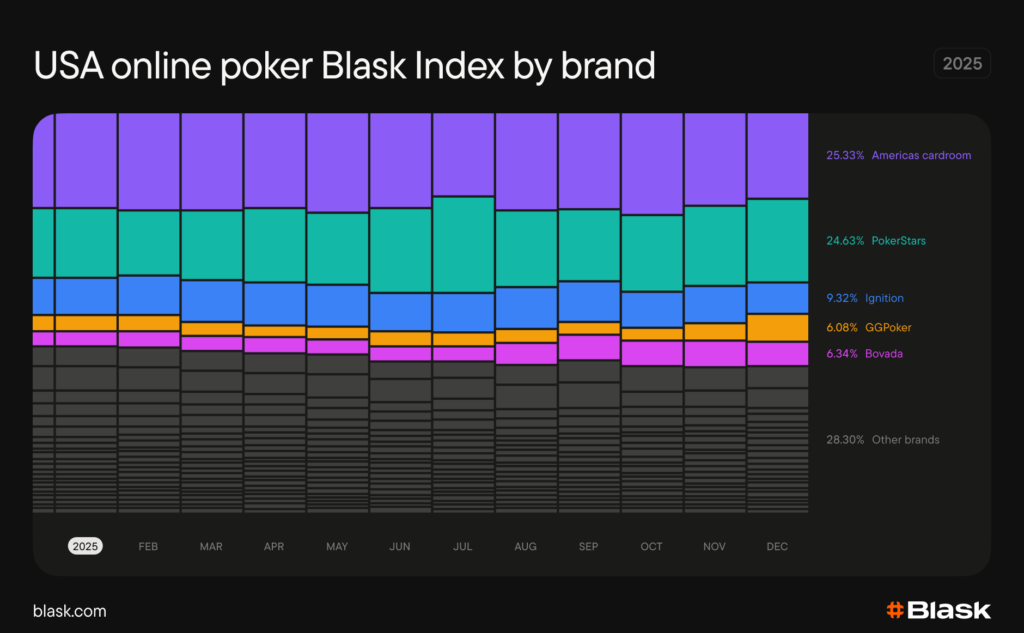
The two brands operate in entirely different regulatory worlds, though. PokerStars sits inside the US state-licensed system. It participates in the MSIGA compact, subject to state-level oversight, geolocation requirements, and licensing conditions in every jurisdiction where it operates.
Americas Cardroom does not hold a licence from any US state regulator. However, it reserves broad geographic restrictions and generally does not accept players from states with their own regulated poker markets.
In the six MSIGA states, PokerStars and other licensed operators serve a regulated pool. Across the rest of the country — states where online poker is unregulated or legalised but dormant — offshore platforms like Americas Cardroom fill the vacuum.
In online poker, as in other iGaming verticals in the US, regulation reduced offshore dominance, but did not eliminate it.
Bottom line
Poker rewards skill over the long run, but the game only exists if enough players show up. In the US, regulation provides that in six states. Offshore operators cover the rest. The regulated map is expanding, but it has not yet caught up with the market.