- Updated:
- Published:
Click-to-registration rate (Click-to-Reg) in iGaming
The click-to-registration rate (Click-to-Reg) is the percentage of tracked clicks that end in a completed player registration. It sits between the ad click and the first deposit in the iGaming acquisition funnel. Operators and affiliates use it to check whether landing pages, traffic sources, and sign-up flows turn interest into accounts.
What is Click-to-Registration Rate (Click-to-Reg)?
Click-to-Reg is the share of eligible tracked clicks that lead to registrations under a defined set of attribution and measurement rules. It answers one question: of the people who arrived, how many created an account?
Three components define the number:
- Clicks: eligible tracked interactions, such as an affiliate click-out to an operator or a paid ad click.
- Registrations: valid, completed player account sign-ups.
- Attribution: the rules that connect each registration to the click that produced it.
Some reports, however, divide by unique clicks or landing-page sessions instead. Every report should name its denominator.
A registration is not a verified account and not a first-time depositor.
Click-to-Reg formula
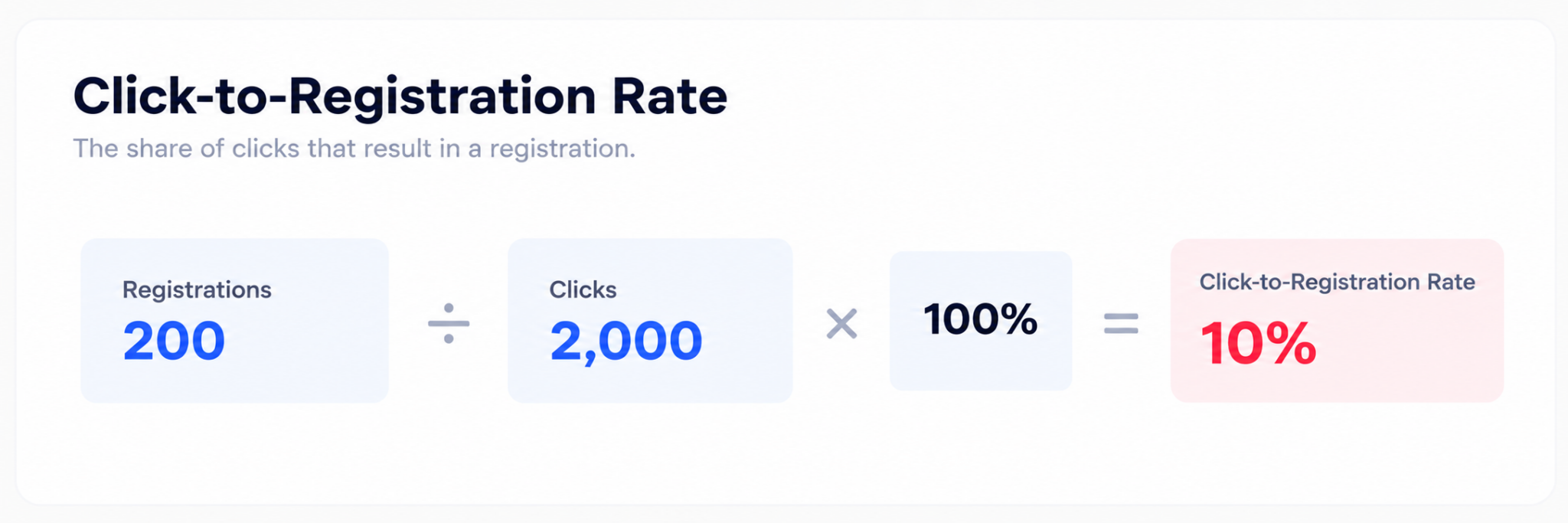
Click-to-Reg (%) = (Attributed Registrations ÷ Eligible Tracked Clicks) × 100
For example, a campaign generates 2,000 tracked clicks and 200 attributed registrations.
Click-to-Reg = 200 ÷ 2,000 × 100 = 10%
Thus, the campaign produced 10 registrations for every 100 eligible tracked clicks.
Also, count both numbers under the same attribution rules and observation window. Google Ads, for example, credits conversions within a conversion window after the ad interaction, 30 days by default.
How to calculate Click-to-Reg: step-by-step example
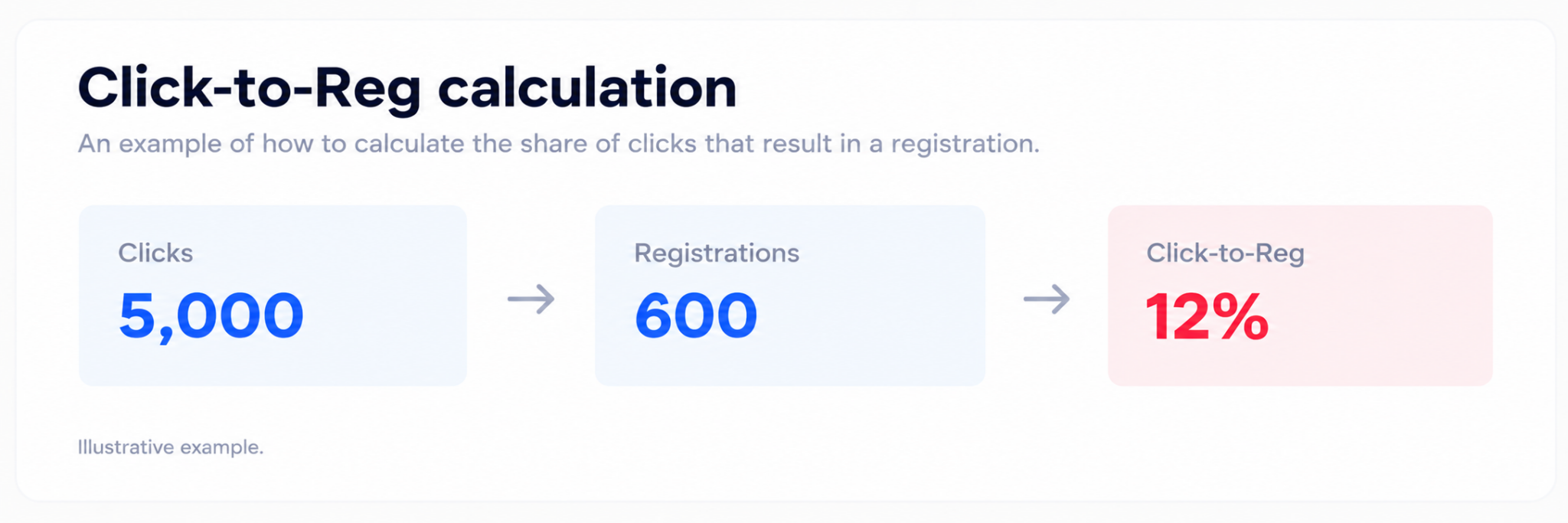
An affiliate campaign for a casino brand delivers these results over one month:
| Metric | Value |
|---|---|
| Tracked clicks | 5,000 |
| Attributed registrations | 600 |
| Click-to-Reg | 12% |
- Choose a reporting period and attribution window. For example, clicks from October 1–31, with registrations counted up to 30 days after each click.
- Identify the eligible tracked clicks. Exclude test traffic, filtered bot clicks, and duplicates under your click rules. Result: 5,000.
- Count valid attributed registrations. Include only completed sign-ups that the tracker links to those clicks. Result: 600.
- Divide registrations by clicks. 600 ÷ 5,000 = 0.12.
- Multiply the result by 100. 0.12 × 100 = 12%.
Four problems distort the result. For example, bot clicks inflate the denominator. Duplicate registration events inflate the numerator. Unattributed registrations vanish from the count. Finally, tracking changes make two periods incomparable.
Timing matters too. A player can click on October 30 and register on November 2. If the October report closes on October 31, that registration falls outside it. As a result, the newest campaigns look weaker than they are.
Click-to-Reg vs CTR: what’s the difference?
Click-through rate (CTR) measures engagement before the click: how often an impression turns into a click. Click-to-Reg, in contrast, starts where CTR stops. It measures what happens after the click, when the visitor decides whether to create an account.
| Metric | CTR | Click-to-Reg |
|---|---|---|
| Funnel stage | Impression → Click | Click → Registration |
| Formula | Clicks ÷ Impressions × 100 | Registrations ÷ Clicks × 100 |
| Main purpose | Ad engagement | Registration conversion |
| Main influencing factors | Creative, placement, audience | Traffic intent, landing page, registration flow |
For example, the illustrative campaign has 100,000 impressions → 2,000 clicks → 200 registrations.
- CTR = 2,000 ÷ 100,000 × 100 = 2%
- Click-to-Reg = 200 ÷ 2,000 × 100 = 10%
A high CTR does not guarantee a high Click-to-Reg. For example, a loud bonus banner can collect clicks from people who never planned to sign up. However, reading both shows where visitors drop.
Still, each metric is a form of conversion rate for its own step of the funnel.
Click-to-Reg vs Reg-to-FTD vs Click-to-FTD
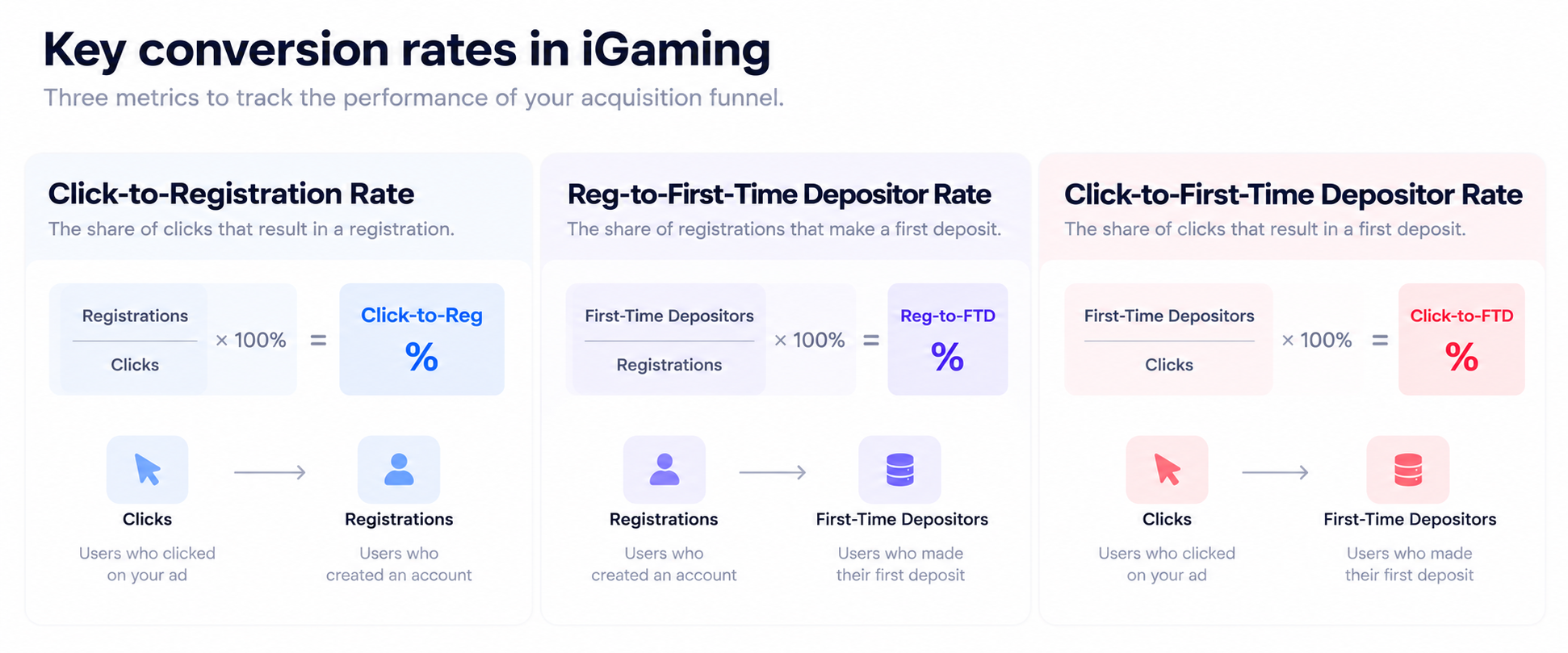
Click-to-Reg covers one step. Next, two more metrics carry the funnel through to the first-time deposit (FTD). The three formulas are:
Click-to-Reg = Registrations ÷ Clicks × 100
Reg-to-FTD = First-Time Depositors ÷ Registrations × 100
Click-to-FTD = First-Time Depositors ÷ Clicks × 100
Also, some teams calculate Reg-to-FTD against verified registrations or another eligible population, not all registrations. State which one.
Illustrative funnel:
| Stage | Volume | Conversion |
|---|---|---|
| Clicks | 5,000 | — |
| Registrations | 600 | Click-to-Reg: 12% |
| First-time depositors | 120 | Reg-to-FTD: 20% |
| Total Click-to-FTD | — | 2.4% |
The three rates connect:
Click-to-FTD = Click-to-Reg × Reg-to-FTD
Still, the equation holds when both stage rates use consistent populations and attribution rules. First, convert percentages to decimals before multiplying. For example, 0.12 × 0.20 = 0.024, or 2.4%.
It also shows why registrations alone mislead. For instance, a campaign can double its Click-to-Reg and still deliver fewer depositors if Reg-to-FTD falls by more than half.
📚 Read more: How to improve first deposit conversion in online casino

What is a good Click-to-Reg rate in iGaming?
No single Click-to-Reg benchmark fits every iGaming campaign. The same landing page can convert very differently depending on where the traffic comes from and whom it reaches.
These factors move the baseline:
- Traffic channel and intent. A bonus comparison page and a display banner send different visitors.
- Brand vs non-brand traffic. Someone who searched for the operator by name has already chosen it.
- GEO and language. Market maturity and payment habits shape sign-up behavior.
- Casino vs sportsbook. Betting traffic peaks around fixtures.
- Mobile vs desktop. Form usability and speed differ by device.
- Landing-page format. Sign-up pages, bonus pages, and reviews set different expectations.
- Registration requirements. The number of fields and steps.
- Attribution methodology. Click definition, window length, raw vs approved registrations.
- Regulatory and verification requirements. Some markets require identity checks before play.
Public benchmarks rarely disclose sample, GEO, product, period, and definition together. Because of this, one publisher’s number can’t serve as an industry standard.
Instead, your own data gives a better benchmark. Group campaigns with the same GEO, channel, device mix, product, and attribution rules, and judge each group against its own history.
What affects Click-to-Reg conversion?
Seven factors explain most changes. Each, however, gives you a hypothesis to test, not a verified cause.
- Traffic intent. The visitor’s real interest in the offer. A sports fan who arrives through a casino bonus ad often leaves without registering.
- Message match. Whether the page delivers what the ad promised. If the ad offers free spins and the page leads with a sportsbook bonus, visitors drop.
- Registration flow. Steps, form errors, device compatibility, and clarity. A date-of-birth field that rejects valid input on one mobile browser blocks sign-ups silently.
- Brand trust. Recognition, visible licensing, and clear terms. Visitors who can’t find the license often stop before sharing personal data.
- Page performance. Load time, errors, and usability. Google’s web.dev treats a Largest Contentful Paint of 2.5 seconds or less as good. Consequently, a slow mobile page loses visitors before the form appears.
- GEO and localization. Language, currency, and payment methods. For example, a machine-translated page with the wrong currency signals the operator doesn’t serve this market.
- Verification requirements. Mandatory checks and their place in the flow. In Great Britain, the Gambling Commission requires licensees to verify a customer’s name, address, and date of birth before that customer can gamble. Also, where the check sits changes what counts as a completed registration.
So a drop right after a landing-page change makes that change a suspect. Only a controlled test confirms it.
How to improve Click-to-Reg in iGaming
Six practices help performance marketing and product teams lift registration conversion without hurting traffic quality.
- Match traffic intent to landing-page content. The page should reflect the source ad or affiliate recommendation. Send casino traffic to casino offers.
- Improve registration usability. Find unnecessary steps, validation errors, unclear instructions, and mobile issues. Keep every legally mandatory identity, age, and compliance check.
- Optimize page performance. Monitor load time, broken forms, server errors, and abandonment, on mobile and desktop separately.
- Segment conversion performance. Split by GEO, source, device, affiliate, campaign, and page version. A blended rate hides the falling segment.
- Run controlled experiments. Test page versions, messaging, and form layout with identical attribution across variants.
- Evaluate downstream conversion quality. Check whether a Click-to-Reg gain comes with a matching change in Reg-to-FTD, cost per acquisition (CPA), and longer-term lifetime value (LTV).
💡 Key point: Still, a higher registration rate is not automatically better. Aggressive bonus headlines or buried terms lift sign-ups from people who never deposit.
Click-to-Reg in affiliate marketing
In affiliate marketing, Click-to-Reg is one of the first numbers operators and affiliates review together. Several mechanics shape it:
- Click tracking. The affiliate platform records each click on a tracking link.
- Campaign identifiers. Sub-IDs and click IDs tie each click to a source and placement.
- Registration postbacks. The operator returns the click ID in a server-to-server postback. Trackers such as Voluum document separate postbacks for sign-up, FTD, and deposit.
- Attribution windows. How long a registration still counts toward a click.
- Duplicate handling. Rules for repeat sign-ups from one person or device.
- Approved vs raw registrations. Operators can later reject sign-ups as ineligible.
- Source comparisons. SEO, paid, and social traffic from one affiliate convert differently.
Two click types often get mixed up. A click from an ad to the affiliate’s page is one funnel stage. A click-out from that page to the operator is the next stage. Each needs its own denominator. Otherwise, two conversions merge into one number.
However, a high Click-to-Reg can still mean weak results if registrations don’t verify, deposit, or qualify.
Why high Click-to-Reg does not always mean high-quality traffic
| Metric | Campaign A | Campaign B |
|---|---|---|
| Clicks | 5,000 | 5,000 |
| Registrations | 1,000 | 500 |
| Click-to-Reg | 20% | 10% |
| FTDs | 50 | 100 |
| Reg-to-FTD | 5% | 20% |
| Click-to-FTD | 1% | 2% |
Campaign A generates twice as many registrations as Campaign B and half as many first-time depositors. By contrast, Campaign B converts 2% of clicks into depositors, against 1% for Campaign A.
Also, at the same price per click, Campaign B’s cost per FTD is half of Campaign A’s. As a result, judging by registrations alone would scale the wrong campaign. Instead, read registration volume together with acquisition cost, traffic validity, and deposit conversion.
However, low downstream conversion doesn’t automatically mean fraud. For example, mismatched offers, a different GEO mix, or missing payment methods can cause it too.
📚 Read more: How to calculate true CAC in iGaming: formula & hidden costs
How to analyze Click-to-Reg alongside market demand
First, Click-to-Reg comes from internal data: ad platforms, affiliate trackers, and the operator’s registration events. It shows what happened inside your funnel, not in the market around it.
Blask Index also adds that outside view. It is an AI-enhanced indicator of iGaming demand built from search activity, tracked by country and brand.
📚 Read more: How Blask measures, calculates, and presents iGaming market intelligence
Take an operator whose registration conversion in Brazil declines in the third quarter of 2026. The team first checks landing pages, traffic composition, tracking, and registration friction. Then it looks at the market. For example, Brazil’s monthly Blask Index fell from 239.2M in June 2026 to 156.13M in September, a 34.7% decline. A shift that size, in turn, can change who clicks on ads and why.
💡 Key point: Market demand can’t explain or predict campaign-level Click-to-Reg on its own. However, it narrows the hypotheses. For example, a falling rate in a stable market points to the funnel. In a contracting market, check both.
Acquisition Power Score (APS) is a separate reference point: an AI-estimated monthly benchmark of how many new customers a brand’s market position supports, given as a min–avg–max range. However, it is modeled, so it doesn’t measure tracked registrations.
Click-to-Reg analysis: practical workflow
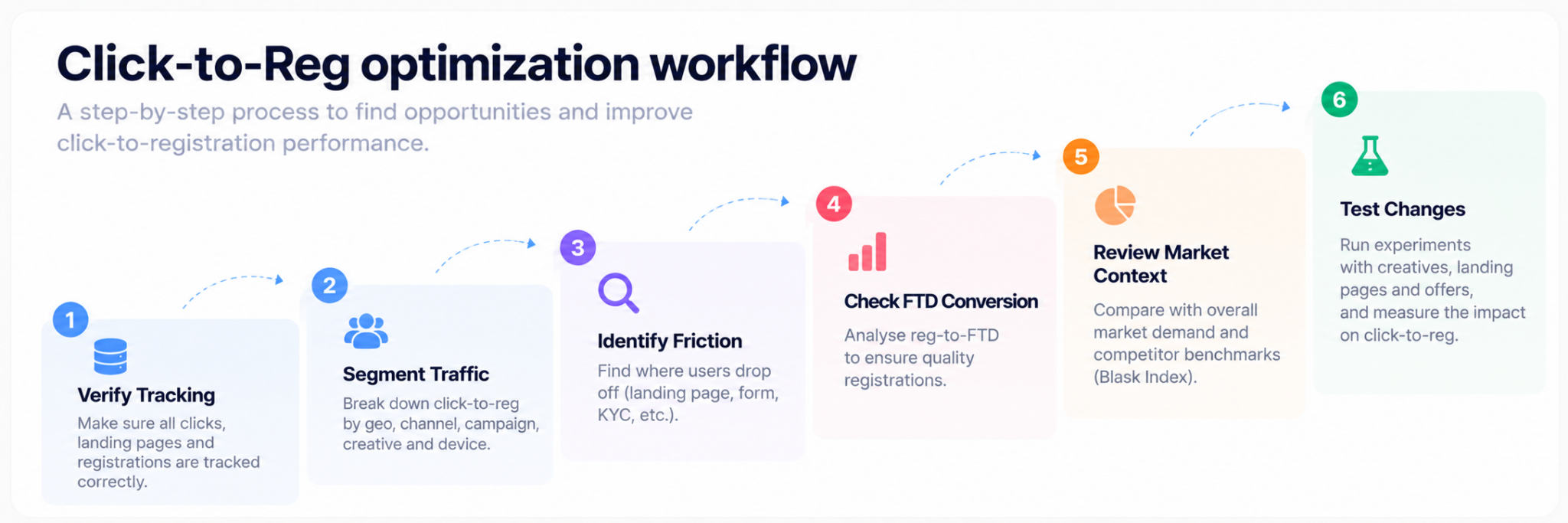
Scenario: Click-to-Reg falls from 12% to 8% across two comparable campaign periods.
That is a drop of 4 percentage points. Relative to the starting rate, it’s a decline of about 33.3%: (12 – 8) ÷ 12 = 0.333. So reports should say which of the two numbers they mean.
- Verify attribution and event tracking. Confirm events fire correctly and nothing changed in postbacks or windows.
- Check whether the traffic mix changed. A new affiliate or more non-brand traffic can lower the blended rate with no funnel problem.
- Segment conversion. Split by GEO, source, device, and landing page to locate the decline.
- Investigate registration errors and usability. Review form errors, load times, and session recordings.
- Compare Reg-to-FTD and acquisition costs. If deposits held steady, the lost registrations may have been low-intent.
- Review market context and test a hypothesis. Check Blask Index for the GEO, then test one hypothesis with a controlled change.
Tracking comes first, because a broken event makes every later step unreliable.
Common Click-to-Reg tracking mistakes
- Mixing all clicks and unique clicks
- Comparing ad clicks with operator click-outs
- Using inconsistent attribution windows
- Counting duplicate registrations
- Ignoring invalid or bot traffic
- Comparing raw and approved registrations
- Combining different GEOs and channels into one benchmark
- Evaluating immature conversion cohorts
- Treating Click-to-Reg as equivalent to Click-to-FTD
Each one breaks comparability. Thus, define clicks, registrations, and attribution once, in writing, and apply them to every campaign and period.
Frequently asked questions
Definitions and calculation
What does Click-to-Reg mean in iGaming?
Click-to-Reg, or click-to-registration rate, is the percentage of tracked clicks that end in a completed player registration at a casino or sportsbook. Thus, it measures the post-click step of the acquisition funnel: how well landing pages, traffic intent, and the sign-up flow turn visitors into account holders. It doesn’t show whether those players deposit.
How do you calculate Click-to-Registration Rate?
Divide attributed registrations by eligible tracked clicks and multiply by 100. For example, 600 registrations from 5,000 clicks give a 12% Click-to-Reg. Use the same reporting period, attribution window, and click definition for both numbers. Finally, exclude bot traffic, test clicks, and duplicate events before you calculate.
Benchmarks and comparisons
What is a good Click-to-Reg rate?
No universal benchmark exists. The rate depends on traffic channel, brand vs non-brand intent, GEO, product, device, landing-page format, and verification requirements. Public figures rarely disclose their sample, period, or methodology, so they don’t transfer well. Therefore, the most reliable benchmark comes from your own comparable campaigns, grouped by GEO, channel, and attribution rules and tracked over time.
What is the difference between CTR and Click-to-Reg?
CTR measures the step before the click: clicks divided by impressions. Click-to-Reg measures the step after it: registrations divided by clicks. Creative, placement, and audience drive CTR. By contrast, traffic intent, landing pages, and the registration flow drive Click-to-Reg. A campaign can have a strong CTR and a weak Click-to-Reg at the same time.
Funnel and optimization
What is the difference between Click-to-Reg and Reg-to-FTD?
Click-to-Reg shows how many clicks become registrations. Reg-to-FTD shows how many registrations become first-time depositors. Then, multiply the two, as decimals, to get Click-to-FTD. A campaign with high Click-to-Reg and low Reg-to-FTD attracts sign-ups that never deposit, so both rates belong in the same report and the same decision.
How can affiliates improve Click-to-Reg conversion?
Match content and offers to the operator’s landing page, so visitors find what they expected. Send traffic to the right product and GEO. Use click IDs and postbacks to track each source separately, then cut placements that convert poorly. Check Reg-to-FTD too, because operators value depositing players over raw registrations.
Conclusion
Click-to-Reg shows how well tracked clicks turn into player registrations. In addition, it isolates the post-click step of the iGaming acquisition funnel: traffic intent, landing pages, and the sign-up flow. Read it next to Reg-to-FTD, Click-to-FTD, acquisition cost, and traffic quality. Thus, the most useful optimization decisions come from the full funnel, not from maximizing registrations on their own.