
- Updated:
- Published:
What is Jogo do Bicho
Jogo do Bicho is Brazil’s century-old animal lottery: players bet on animals or numbers in an informal street draw that remains illegal under federal law, deeply rooted in everyday culture, and — for licensed operators — off-limits online under SPA rules.
What is Jogo do Bicho?
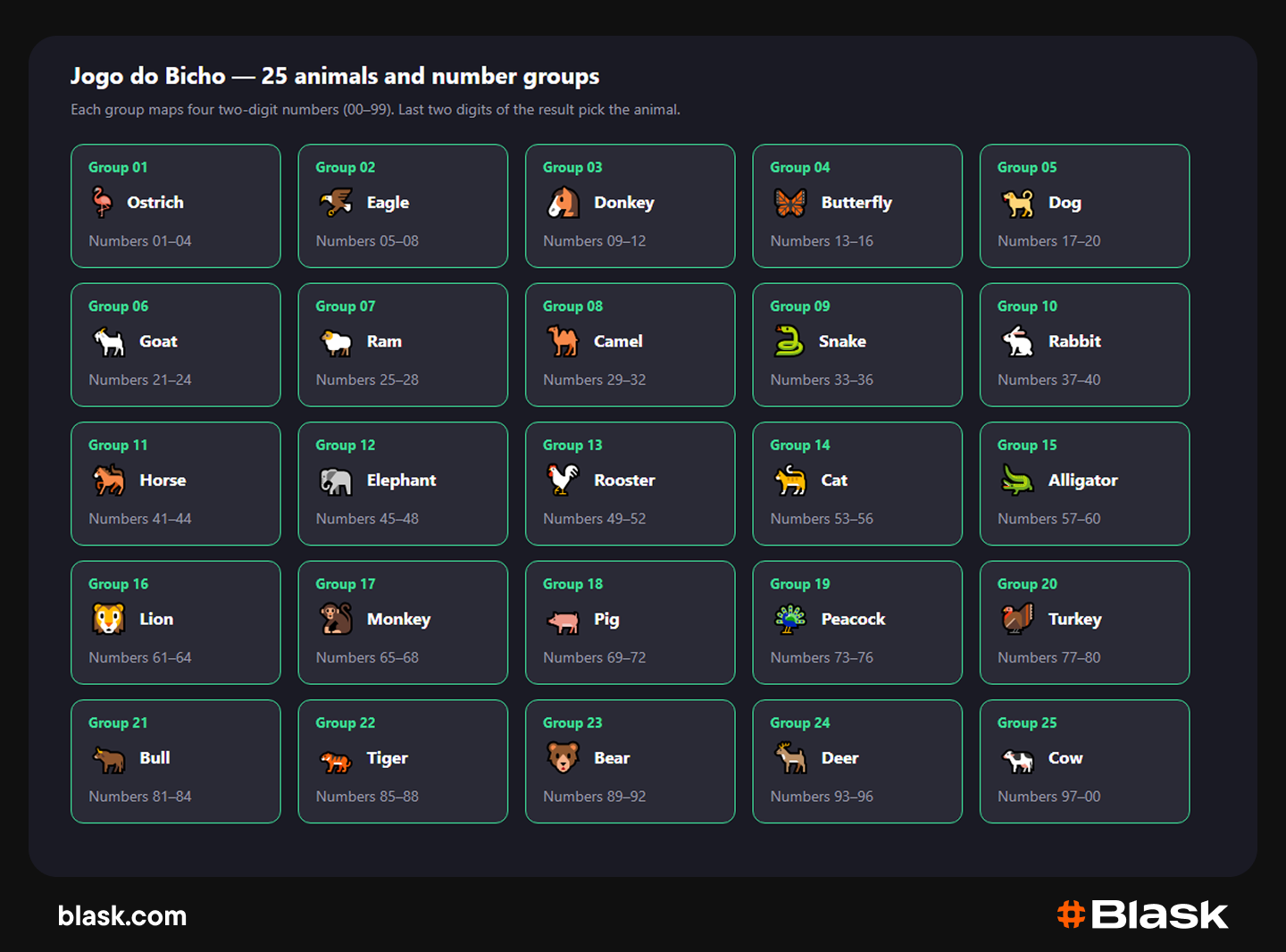
| In product terms, Jogo do Bicho is a lottery-style numbers game mapped to a fixed table of 25 animal groups. Each animal covers four consecutive two-digit numbers (00–99). Bettors choose an animal, a two-digit number, a three-digit number, or a four-digit number; a regional draw produces winning numbers; the last digits decide which animal came out. |
It is not sports betting, not a classic slot by default, and not a federal state lottery product. It is also not a regulated fixed-odds online game under Laws 13.756/2018 and 14.790/2023. The closest Knowledge cousins are lottery-style formats such as Keno — pick numbers, wait for a draw, collect on matches — but the distribution, culture, and legal treatment of Jogo do Bicho are uniquely Brazilian. Casino catalogues sometimes label digital clones as “slots”; operators should separate lottery simulators from reel slots (see the online section below).
Brief history
Wikipedia traces the format to 1892, when Baron João Batista Viana Drummond used an animal raffle to promote the Rio de Janeiro Zoological Garden. Visitors received tickets tied to animals; a daily draw paid winners. Within months the idea escaped the zoo and became a street numbers game with any stake size — a feature that helped it spread through Brazil’s cities.
Federal gambling bans in the 1941 Criminal Misdemeanours Act and the 1946 crackdown framed Jogo do Bicho as a criminal misdemeanour rather than a licensed lottery. The game did not disappear. Informal bankers kept networks of street sellers, funded cultural patronage in places such as Rio samba schools, and embedded animal and number vocabulary into everyday Brazilian slang.
By the mid-1990s, Wikipedia records estimates of more than US$2 billion a year in turnover, about 50,000 people employed in Rio de Janeiro alone, and income for roughly 400,000 people nationwide.
A later Getúlio Vargas Foundation study, also summarised on the same page, put illegal gambling in Brazil at R$1.3–2.8 billion in 2014 — a band some observers already called an underestimate. Organised-crime reporting sits beside that economic footprint; for market teams it is background, not a reason to put the game in a licensed lobby.
How does Jogo do Bicho work?
How Jogo do Bicho works — and how to play Jogo do Bicho in the traditional street sense — is a simple stake-draw-map-to-animal loop, even when regional rules and payouts vary.
| Step | What happens | Why it matters |
| Stake | Bettor chooses an animal group and/or number depth at a street point of sale | Any amount historically accepted — low ticket, high frequency |
| Book | Bets move to a central bank run by informal bankers | Liquidity and risk sit with the banker, not a regulator |
| Draw | Regional extraction produces winning four-digit results / prize positions | Multiple draws per day are common in large cities |
| Map | Last two digits → two-digit number → animal group | The 25-animal table is the shared language of the game |
| Pay | Payout by bet type | Street odds are traditional/illustrative, not SPA odds sheets |
Classic street structure is hierarchical: street sellers, managers, and central banks. Banks historically managed bankruptcy risk — if too much money sat on one number, that outcome could be pulled from the lot — and redistributed exposure across stronger bankers. That is the opposite of a certified RNG instant win title, where opacity is structural.
Results were historically chalked on lampposts. Today the same habit shows up as live result boards online.
The 25 animals and number groups
The Jogo do Bicho animals table is the product’s entire mnemonic system: 25 groups x 4 two-digit numbers = 100 endings (00–99). The last two digits of the relevant result pick the animal. 00 belongs to group 25 (Cow).
Bet types: animal group, tens, hundreds, thousands
Street Jogo do Bicho is a depth ladder. Wikipedia lists traditional prize framing as a clean teaching table; real banks vary multipliers and which prize positions count.
| Bet type | What you pick | Approx. chance (traditional framing) | Operator note |
| Animal group | 1 of 25 animals (any of its 4 two-digit numbers) | 1 in 25 | Easiest entry; Wiki cites ~15× on a simple animal hit — other street tables often quote ~18×; treat as illustrative |
| Tens (2 digits) | Number from 00–99 | 1 in 100 | Mid difficulty |
| Hundreds (3 digits) | Number from 000–999 | 1 in 1,000 | Harder |
| Thousands (4 digits) | Number from 0000–9999 | 1 in 10,000 | Hardest / highest headline payout |
Combination bets exist in some regions. None of this is a regulated fixed-odds catalogue sheet for SPA-licensed bets.
Scale and economics
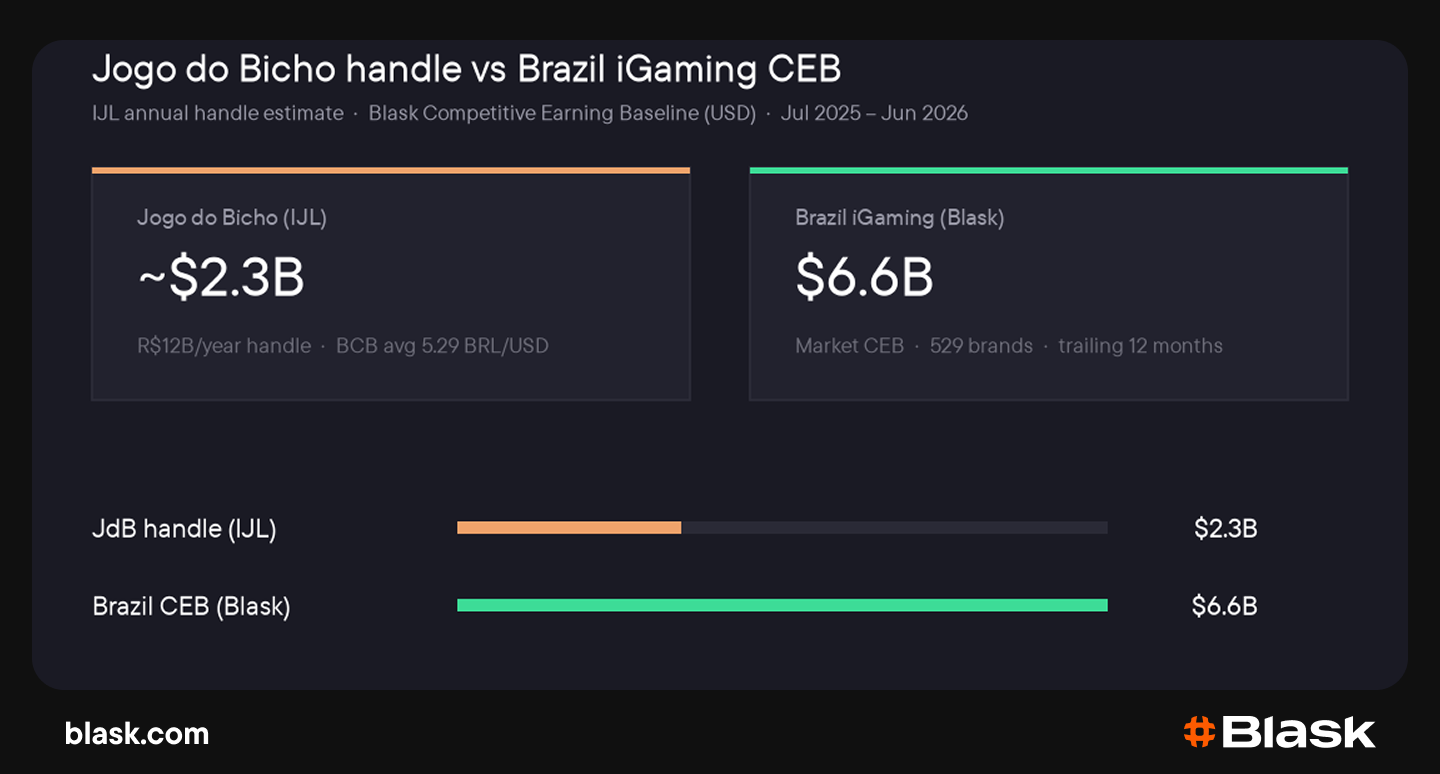
Because the market is informal, every headline figure is an estimate — but the order of magnitude is consistent across industry sources. The Instituto Brasileiro Jogo Legal puts Jogo do Bicho at about R$12B a year in handle, sold through more than 350,000 points of sale, against roughly 12,600 Caixa lottery retailers. The same IJL/BNL material credits the game with more than 20 million Brazilians betting daily, a traditional prize payout near 60% versus about 31% on average for Caixa lotteries, and on the order of 450,000 informal jobs that legalisation advocates want to formalise. BNLData relays the R$12B / 350,000 POS pair as an IJL reading for 2024, which is why those numbers still frame most Brazil gambling briefs.
Put beside Blask’s Brazil Competitive Earning Baseline (CEB) for the tracked online brand set, that street handle is still large enough to matter for wallet competition. For July 2025–June 2026, Blask puts Brazil market CEB at about USD 6.6B across roughly 530 brands (about USD 6.4 billion for calendar 2025). Converted at the Banco Central do Brasil monthly USD average of about 5.29 BRL per USD for the same window, IJL’s R$12 billion handle is roughly USD 2.3 billion — about one-third of that trailing CEB, or a CEB stack roughly 3× the JdB handle print. The comparison is order-of-magnitude only: IJL reports informal handle (turnover), while CEB is Blask’s earning baseline for online brands in USD, not audited SPA GGR and not a like-for-like handle series.
Legal status in Brazil
Current status (as of mid-2026)
Jogo do Bicho is still illegal under federal law. It is a criminal misdemeanour under Article 58 of Decree-Law 3.688/1941 (Criminal Misdemeanours Act): Planalto sets imprisonment and a fine for exploring or running the lottery, and a fine for players aiming at a prize. SPA restates that framing in its December 2024 technical note when it excludes Jogo do Bicho from the licensed online lottery stack.
Brazil’s fixed-odds betting laws (Laws 13.756/2018 and 14.790/2023) authorised regulated sports and online chance products. They did not legalize Jogo do Bicho. Social acceptance and street visibility are not a SPA authorisation. Blask treats Brazil as a regulated sports-betting and casino market with live games coverage — and that regulated brand landscape does not include an informal animal-lottery operator.
Federal basis and state exceptions
Federal prohibition is the default. Wikipedia cites Paraíba as the main state-level regulation case via the state lottery (licensed points, scheduled draws), even while federal law still treats the game as illicit. That is a local exception. Other state experiments appear in the press from time to time and should be checked case by case.
Reform track: Congress and courts
Legalisation discourse (including Bill 2.234/2022 covering casinos, bingo, and Jogo do Bicho) continues in Congress without a finished national licence regime as of mid-2026 reporting. Senator Irajá Abreu, rapporteur of the broader land-based gambling package, has argued that Jogo do Bicho alone can generate on the order of R$27 billion a year with no tax return to the state today. Full reform could attract around R$100 billion in investment, create about 1.5 million jobs, and raise roughly R$20–22 billion a year in public revenue — figures that belong to the legislative debate, not to a certified SPA market model.
Parallel court debate about whether 1941 gambling prohibitions remain compatible with the 1988 Constitution may change the misdemeanour frame over time, but even a favourable constitutional finding would not automatically create a certified online market. There is no reliable launch date to plan around.
Jogo do Bicho online: lottery clones, slots, and the SPA red line
Jogo do Bicho online exists in three different layers. Operators and affiliates often blur them; product and compliance should not.
1. Informal digital channels
Street banks digitised intake long ago — messaging apps, result sites, and unlicensed web/app fronts that mirror regional draws. These channels compete for attention with regulated brands but sit outside SPA authorisation. They are not casino content.
2. Online lottery simulators (often mislabelled as slots)
Studios rebuilt the animal lottery loop as an RNG casino title: pick animals or numbers, trigger an instant draw, and pay fixed multipliers. BGaming lists Jogo Do Bicho as a lottery product released on 30 April 2019, with a published 94% RTP and a maximum multiplier up to 17,000x. Players bet on one to five of the 25 animals, or on two-to-four-digit numbers; a draw opens boxes, and position affects the multiplier.
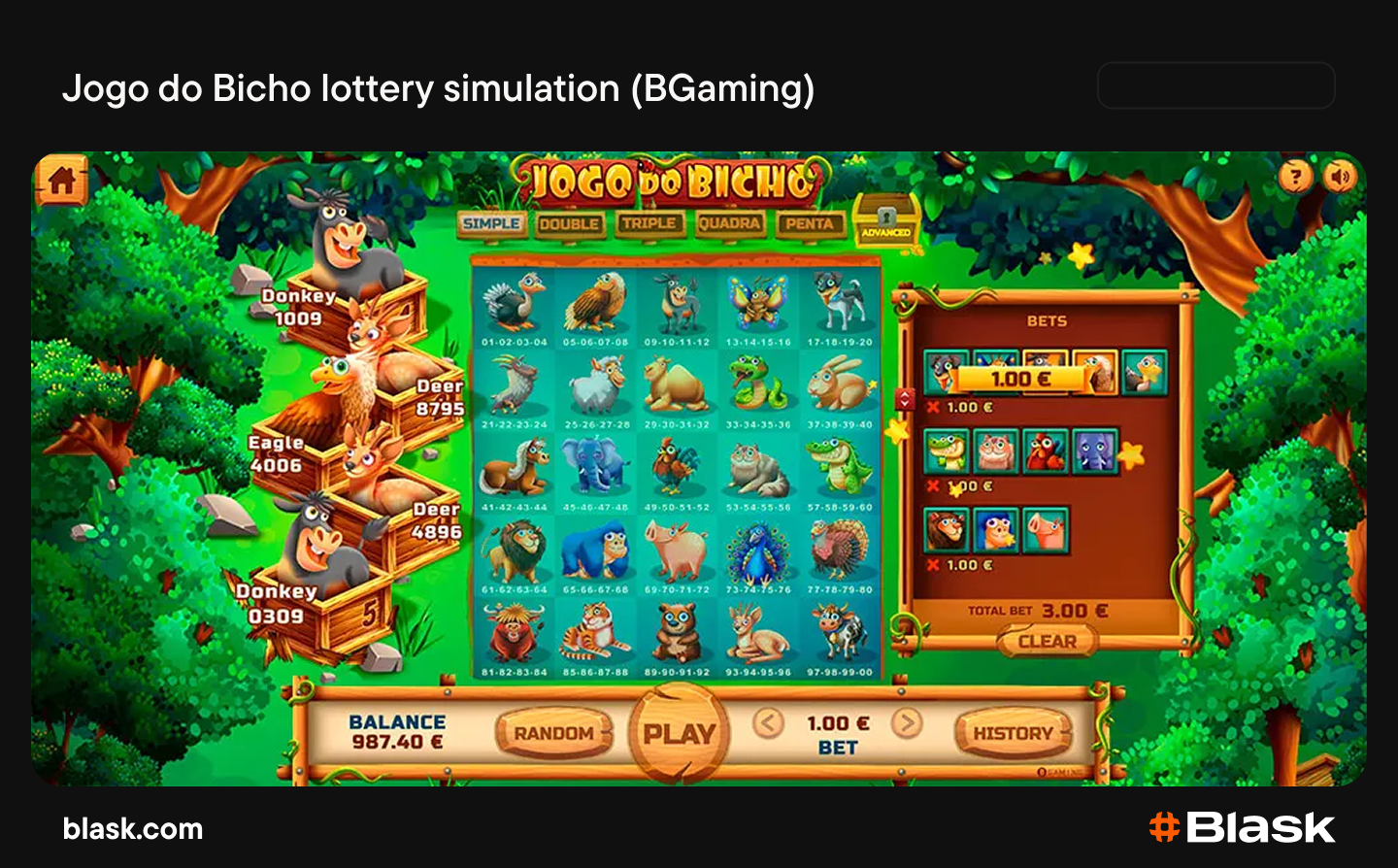
Screenshot source — BGaming’s website.
Affiliate and casino pages frequently call this a “Jogo do Bicho slot.” Mechanically it is closer to a Keno-style or lottery instant game: no paylines, no free-spin feature buy in the slot sense. For lobby taxonomy, file it under lottery / instant win — not next to book-of slots — unless local reporting forces another bucket.
3. Jogo do Bicho video slots
True video slots that use the theme also exist, separate from the lottery simulator. Skywind presents a 5×3 reel game with about 30 paylines and an Animal Wheel that can trigger respins, random wilds, a bingo-style bonus, and free games. JDB Gaming and other studios market arcade or reel-style animal titles under the same brand name; published RTP and max-win figures vary by sheet, so the in-game info panel remains the source of truth. In short: Jogo do Bicho slots (reel games) exist, and so do Jogo do Bicho lottery games that casinos market as slots. Theme recognition is high for Brazilian audiences; mechanics and certification paths differ.
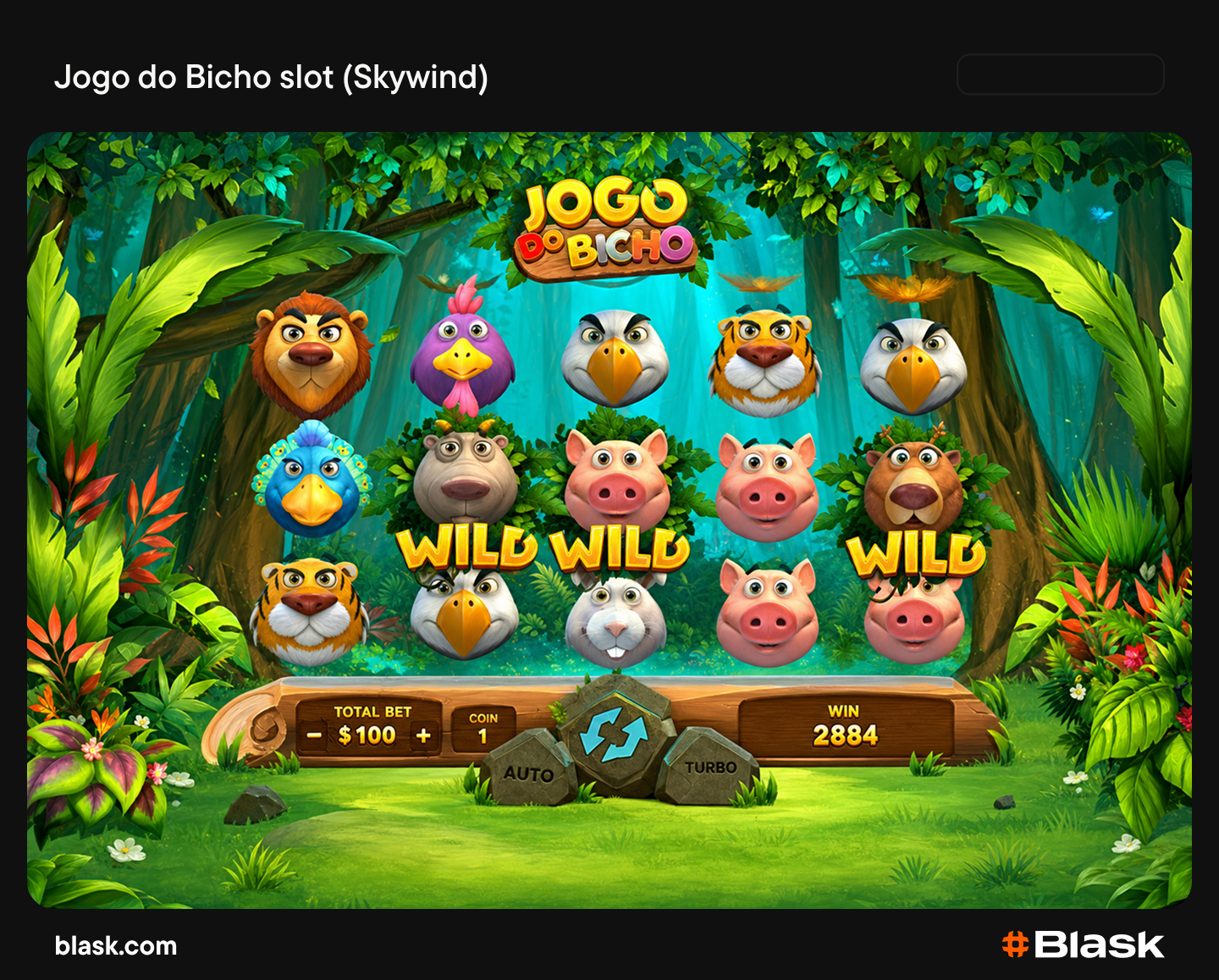
Screenshot source — Skywind’s website.
SPA red line for licensed Brazilian bets
In December 2024, SPA issued Technical Note SEI nº 3826/2024/MF: authorised fixed-odds operators must not offer online games named Jogo do Bicho or adopting the modality’s characteristic rules, and certifiers should not certify such titles — including ones certified before the note.
That covers lottery clones and same-rules lookalikes. A jungle animal reel skin without the Jogo do Bicho name or lottery rules is a different compliance question from shipping “Jogo do Bicho” or the 25-group loop itself. For Brazil-licensed operators, a cultural theme is not enough: keep aggregators and testing labs aligned on what must stay out of the catalogue. Offshore lobbies outside Brazil may still carry these titles — that does not create a SPA path.
Why Jogo do Bicho matters for operators
Informal competition for the betting wallet
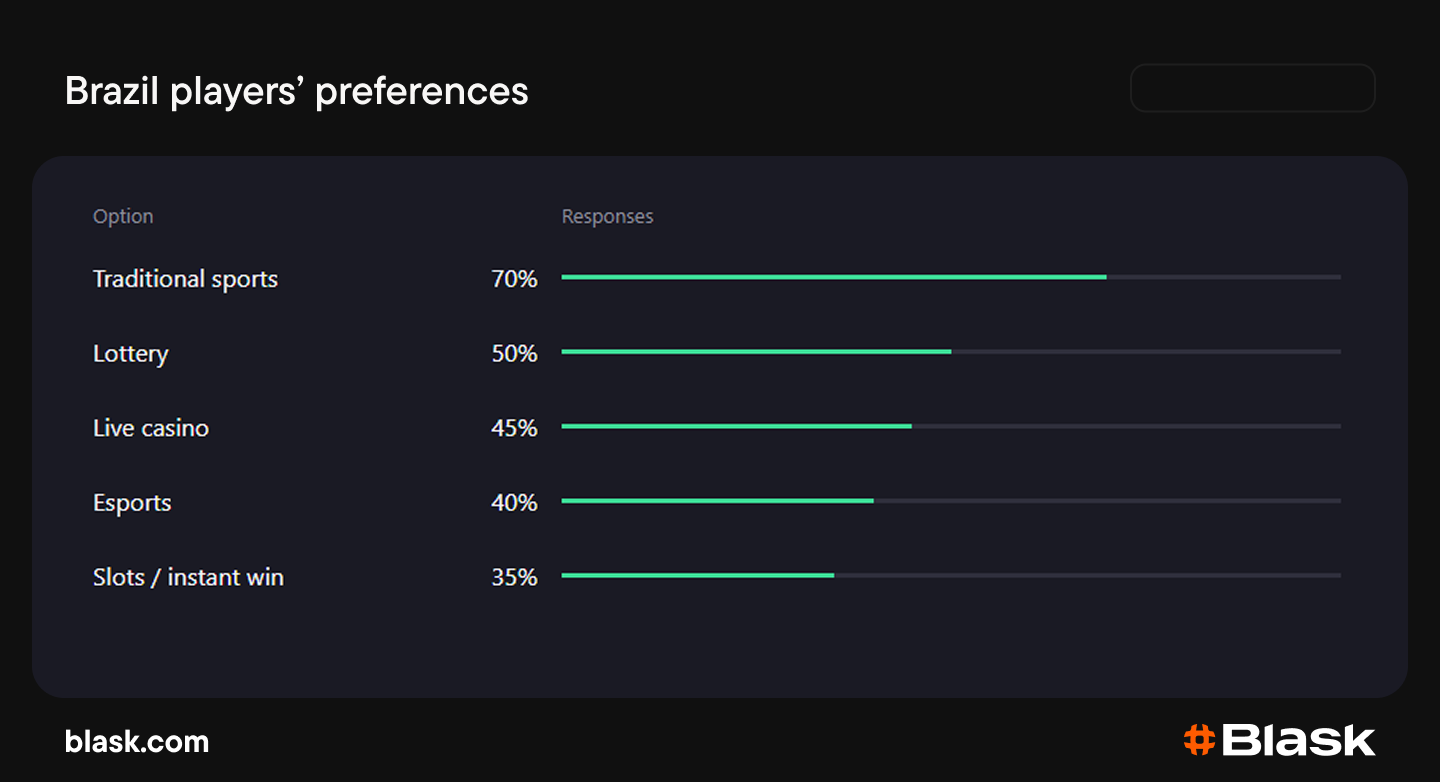
Jogo do Bicho is a low-ticket, high-frequency numbers habit competing for the same discretionary spend as licensed apps. In Blask’s Brazil customer profile, Lottery was selected by 50% of respondents among products used — behind traditional sports (70%) and ahead of live casino (45%), esports (40%), and slots/instant win (35%). That is affinity for lottery-shaped products inside the regulated survey base, not a Blask measure of street Jogo do Bicho turnover.
Competition from apps is already visible on the informal side. O Globo described Civil Police spreadsheets from Rio in which paper-game gains fell by up to 90% and slot-machine takings by about 75% over two decades as bets and online casino grew. The Guardian chronicled the same squeeze on the street product’s cultural hold. Brazilians still understand draw + number + payout without a tutorial; the wallet fight is whether that habit stays informal or migrates into licensed sports and casino.
Compliance and catalogue risk
For SPA-licensed operators, games named Jogo do Bicho and same-rules online lookalikes are off the table — lottery simulators included. Product, aggregation, and lab partners should agree what stays out of the catalogue. In Blask’s Brazil brand rankings for the first half of 2026, leaders such as Betano, Bet365, Superbet, Sportingbet, 7Games, Esportes da Sorte, and Betnacional compete for those wallets under licence — not by offering Jogo do Bicho.
Cultural literacy for Brazil go-to-market
Every Brazil gambling brief eventually mentions the animal lottery. Teams need clear product language — animal group, tens/hundreds/thousands bets, street banker, lottery simulator versus reel slot — so legal, CRM, and affiliate copy do not accidentally promise “legal Jogo do Bicho online.” Position federal lotteries and licensed sports and casino as the formal alternatives; keep Jogo do Bicho in the context column next to Keno-style number literacy, not on the Brazil-licensed lobby row.
Bottom line
For operators, Jogo do Bicho remains Brazil’s animal numbers lottery: illegal under the 1941 Criminal Misdemeanours Act, outside the fixed-odds betting statutes, and barred online for authorised operators by SPA’s 2024 note. Industry estimates still place it among the country’s largest informal gambling products; digital suppliers have shipped both lottery simulators and themed video slots; licensed Brazil brands compete for overlapping wallets without putting the animal lottery in the catalogue. Treat it as market literacy and a compliance boundary, not as a Brazil content acquisition target.