- Updated:
- Published:
Africa iGaming market 2026: South Africa and Nigeria speed up, Kenya stalls
Blask data from the Vision by Clast magazine is now online, and nine months of 2026 data show where the Africa iGaming market is actually growing.
For SBC Summit 2026, Vision by Clast published a print feature called “Africa, the iGaming frontier.” Blask provided the data behind it: demand, revenue potential and player acquisition across more than 20 African countries for 2025. MelBet Partners & Affiliates CMO Anastasiia Shcherbyna added the operator’s view.
The issue is now available in digital format. You can read the full magazine here
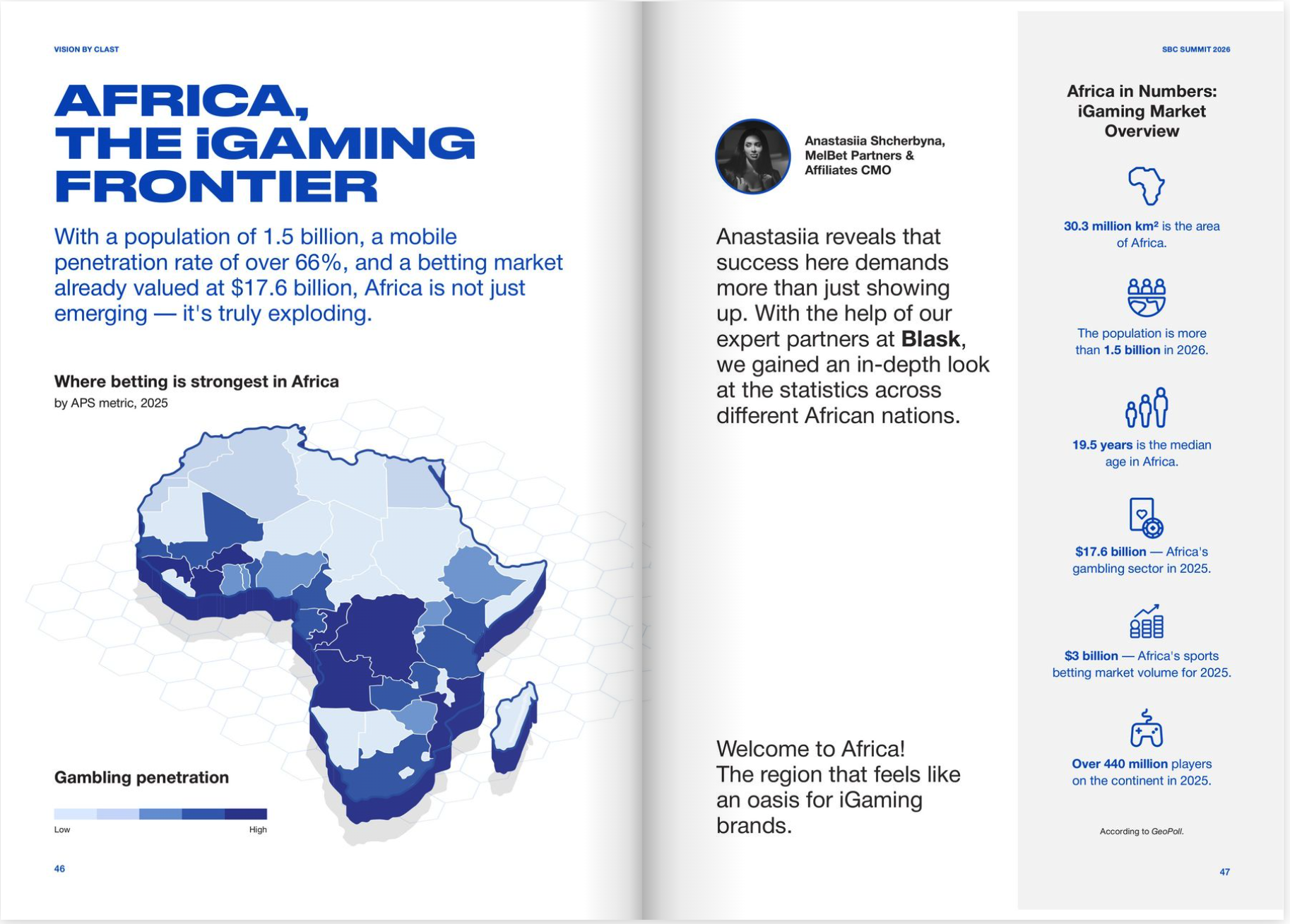
The magazine captured the Africa iGaming market in 2025. We pulled the same metrics for January–September 2026 and compared them with the same period a year earlier. The continent is still growing, but the growth has moved to different countries.
What the magazine showed
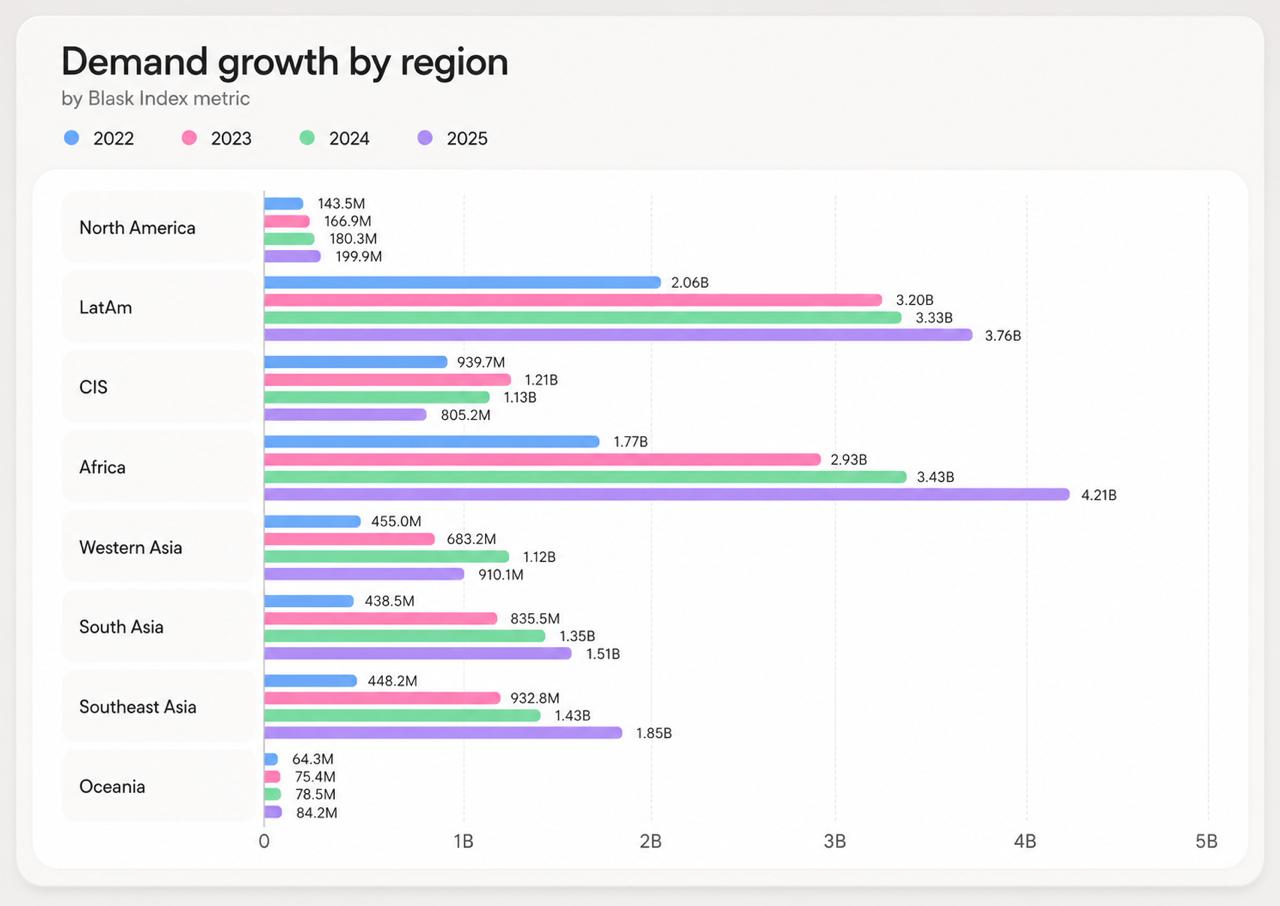
The headline chart in the feature tracks the Blask Index by region from 2022 to 2025. Africa grew from 1.77B to 4.21B over that period and has led all regions since 2024. It overtook LatAm (3.76B in 2025) and is now almost five times larger than CIS.
💡 What the metrics measure: The Blask Index measures player demand for iGaming brands, built from search activity across every operator Blask tracks in a market. Competitive Earning Baseline (CEB) estimates the revenue a market can support, based on brand strength and competition rather than operator-reported financials. Acquisition Power Score (APS) estimates how many new customers brands should acquire. CEB and APS come as min–avg–max ranges because outcomes depend on competitive scenarios, seasonality and campaign timing.
Three things stood out in the 2025 picture:
- South Africa dominated revenue potential, with CEB above $3B
- East Africa (Kenya, Tanzania, DR Congo) led on acquisition volume
- Shcherbyna named Côte d’Ivoire, Kenya and Senegal as the most promising markets for iGaming brands
📚 Read more: iGaming market growth by region, H1 2026
South Africa and Nigeria pull ahead in 2026
Two markets account for most of Africa’s new revenue potential this year.
South Africa’s CEB for January–September 2026 reached $3.12B ($2.32B–$5.55B range). That is 40% above the same period of 2025, and it already exceeds the country’s full-year 2025 figure.
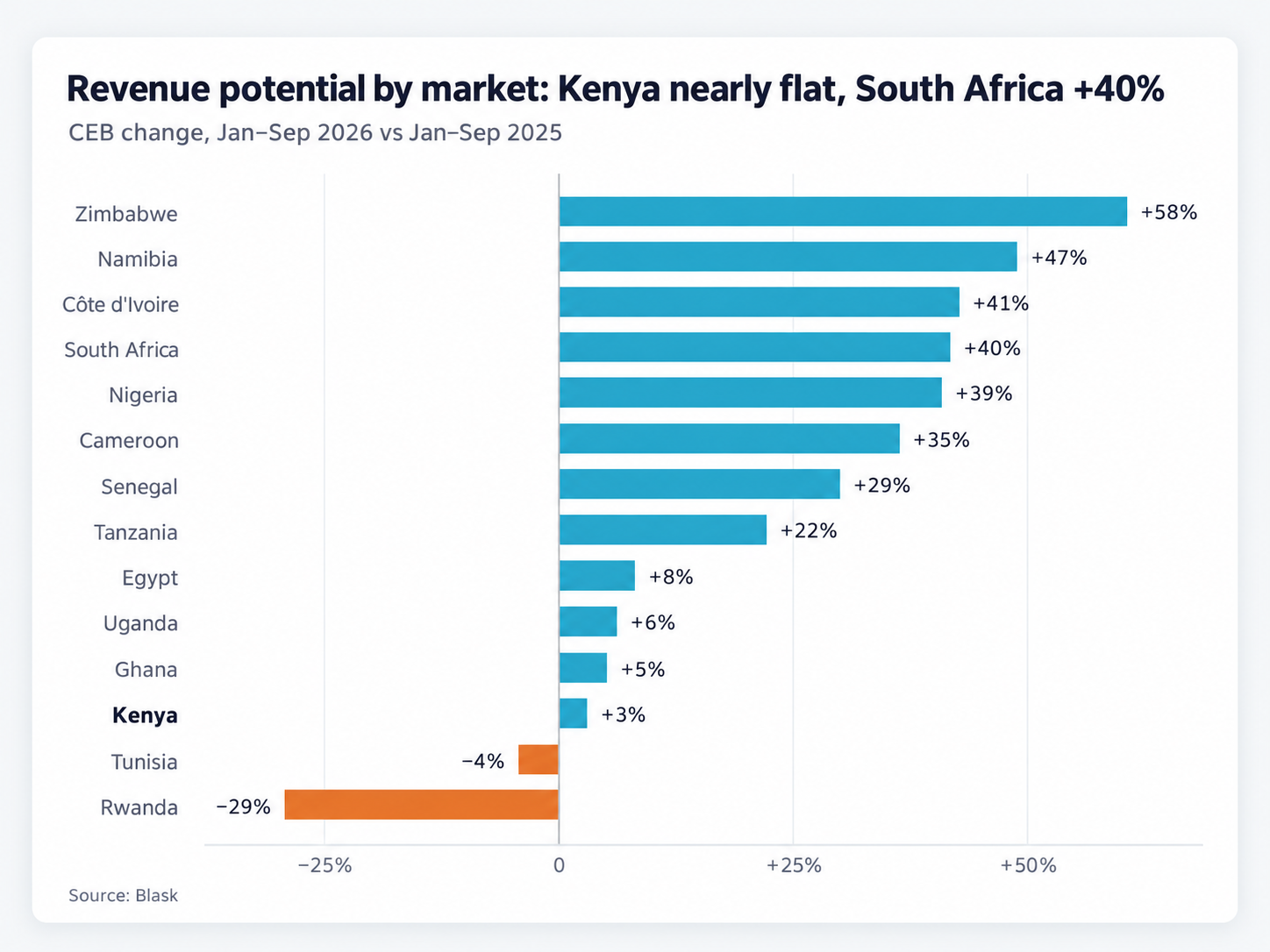
Demand moved in step: the Blask Index grew 42% year-over-year.
Official numbers point the same way. The National Gambling Board reported that betting GGR grew 44.7% in FY 2024/25, while casinos, LPMs and bingo all declined. 86% of betting revenue now comes from online.
The National Treasury has already put a national gambling tax on the table, which shows how much attention online growth now draws.
Nigeria posted almost the same growth rate. Its CEB rose 39% to $619.2M ($461.8M–$1.09B range), and the Blask Index added 38%. Nigeria is also the most onshore market in the group: offshore brands hold about 1% of demand.
Since the Supreme Court ruling of November 2024, states rather than the federal government regulate lotteries and gaming. Demand has kept growing through that transition.
| Market | CEB, Jan–Sep 2026 (min–avg–max) | CEB YoY | Blask Index YoY |
|---|---|---|---|
| South Africa | $2.32B – $3.12B – $5.55B | +40% | +42% |
| Nigeria | $461.8M – $619.2M – $1.09B | +39% | +38% |
| Kenya | $348.5M – $475.6M – $857.2M | +3% | +7% |
| Tanzania | $196.1M – $268.1M – $484.2M | +22% | +22% |
| Egypt | $112.5M – $225.0M – $562.6M | +8% | –2% |
| Côte d’Ivoire | $112.7M – $153.9M – $277.7M | +41% | +34% |
| Cameroon | $113.3M – $152.5M – $270.2M | +35% | +34% |
| Tunisia | $73.7M – $138.1M – $331.4M | –4% | n/a |
| Senegal | $66.2M – $107.5M – $231.6M | +29% | +1% |
📚 Read more: betPawa’s acquisition power across Africa
Kenya: big, but no longer fast
Kenya remains one of the largest betting economies on the continent. Kenyans staked about Sh330 billion in one fiscal year, more than the value of all shares traded on the Nairobi Securities Exchange.
Growth is another story. Kenya’s CEB rose only 3% year-over-year to $475.6M, and the Blask Index added 7%. Tanzania, its neighbour, grew its CEB seven times faster (+22%).
This matches what Shcherbyna told the magazine. International operators have targeted Kenya for years, so acquisition costs keep rising.
Regulation also tightened: President Ruto signed the Gambling Control Act in August 2025, and a new Gambling Regulatory Authority replaced the BCLB. For operators, Kenya now looks like a mature market where share comes from competitors, not from new demand.
📚 Read more: Kenya gambling market overview: statistics, brands and trends
APS confirms the scale. Brands in Kenya should acquire about 20.2M new customers over nine months (14.7M–36.5M range). APS counts sign-ups per brand, so one player who opens three accounts counts three times.
South Africa (44.5M) and Nigeria (32.5M) lead the continent on this metric in 2026.
Côte d’Ivoire: growth plus a shift onshore
Côte d’Ivoire is the strongest of the three markets Shcherbyna picked. Its CEB grew 41% to $153.9M, and demand added 34%. In 2025, its CEB was about a quarter of Kenya’s. In January–September 2026, it reached a third.
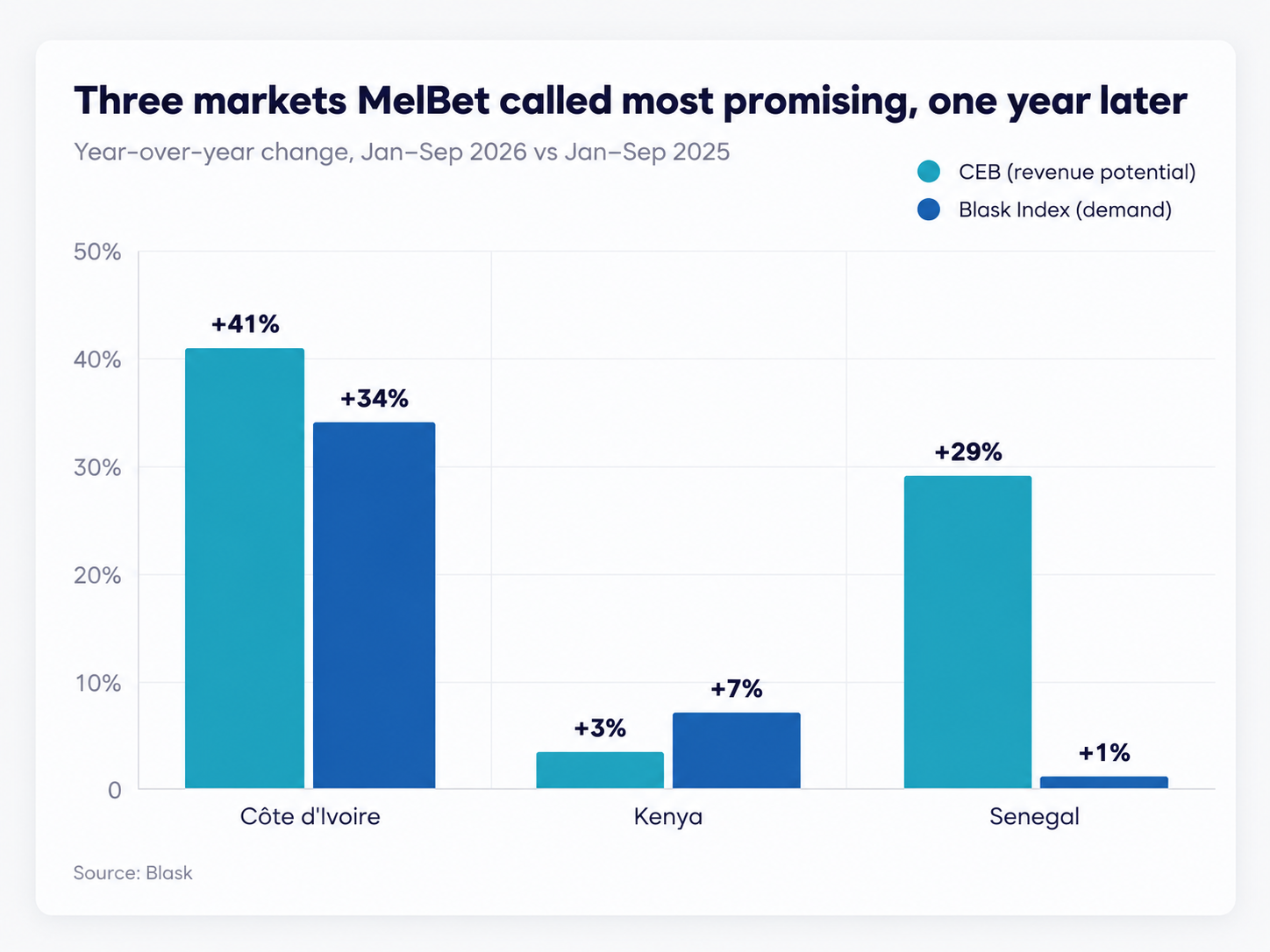
The structure of demand changed too. Offshore brands held 25% of the Blask Index in January–September 2025. A year later, their share fell to 14%.
The timing matches the regulator’s actions: in late 2025, ARJH launched a national campaign against illegal gambling and rolled out a digital monitoring platform.
For brands, this supports the magazine’s advice. Localisation, a licence and local partners matter more as the regulator squeezes unlicensed operators.
Senegal: revenue grows, demand doesn’t
Senegal shows a split. CEB grew 29% to $107.5M, but the Blask Index barely moved (+1%). The market earns more per unit of demand, while the player base stays flat.
The offshore share moved the other way from Côte d’Ivoire. Offshore brands held 22% of demand in January–September 2025 and 32% in the same period of 2026.
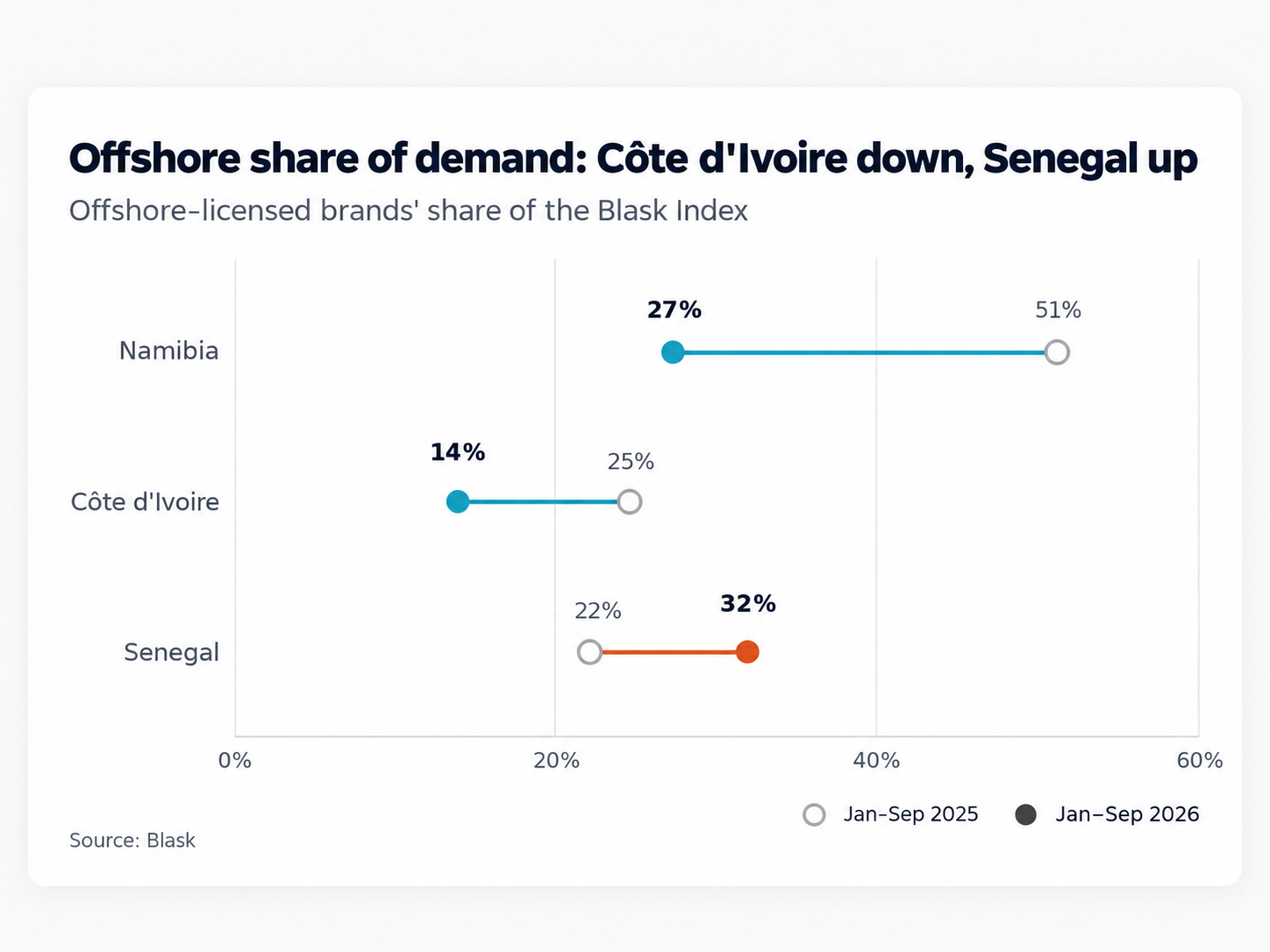
Since November 2025, LONASE has withheld a 20% tax on player winnings. As the magazine noted, Senegal has no separate online betting law and does not block foreign sites.
When local winnings are taxed and offshore sites remain reachable, part of the demand moves offshore.
Smaller markets with fast growth
Several smaller markets grew faster than the large ones, from a lower base:
- Zimbabwe: CEB up 58% to $72.0M, Blask Index more than doubled (+127%)
- Namibia: CEB up 47% to $49.8M, Blask Index up 81%, offshore share down from 51% to 27%
- Cameroon: CEB up 35% to $152.5M, now level with Côte d’Ivoire
Some markets went the other way. Rwanda’s CEB fell 29%, and Tunisia’s dropped 4%. Growth on the continent is real, but it is not universal.
The takeaway
💡 Key point: Africa still leads global iGaming demand growth. But in 2026, the growth comes from South Africa, Nigeria and a group of French-speaking markets, not from Kenya.
Operators who planned for Africa on 2025 numbers should check which of their markets have moved from expansion to competition for share.
The full 2025 picture, with country charts and MelBet’s operator view, is in the Vision by Clast digital issue.