
- Updated:
- Published:
Bolivia’s World Cup playoff win pushed iGaming demand up 15%. Today’s final could do more
Bolivia beat Suriname 2–1 on March 26. Blask Index for the country jumped 15.2% in the 48 hours that followed. The final against Congo is March 31.
On March 26, Bolivia defeated Suriname 2–1 in the semifinal of the FIFA World Cup 2026 inter-confederation playoff tournament in Monterrey, Mexico. Two second-half goals — from Moises Paniagua in the 72nd minute and Miguel Terceros in the 79th — flipped a 0–1 deficit into a historic win. Bolivia hasn’t reached a World Cup since qualifying for the 1994 tournament in the United States.
The search data caught it immediately.
What Blask saw after the match
Bolivia’s Blask Index — a demand signal built from search activity across iGaming brands — rose 15.2% in the 48 hours following the Suriname win. Blask Index measures how actively players are searching for betting and casino brands, making it a leading indicator of wagering intent before a single bet is placed.
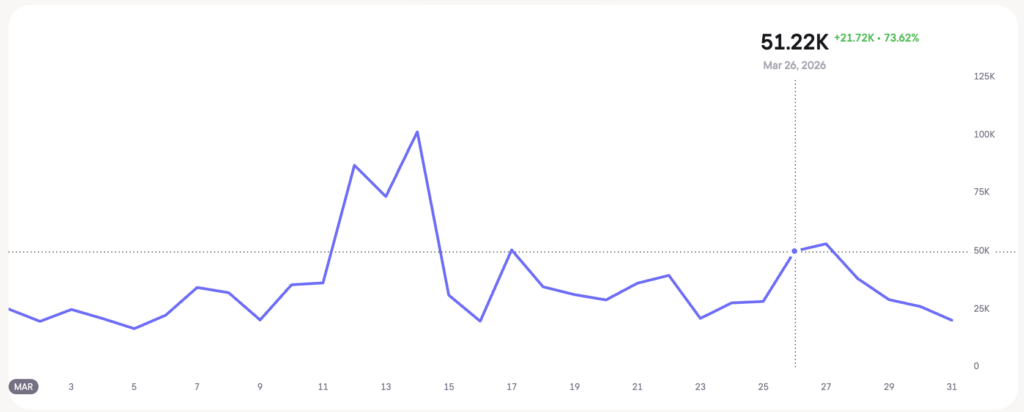
The spike was concentrated in sports betting operators. 1xBet, the second-ranked brand in Bolivia by Q1 2026 demand, saw its individual Blask Index rise from 2,020 on March 25 to 3,728 on match day — up 84.6%. Blask index stayed elevated the following day at 3,907 before gradually returning toward baseline.
This is not an isolated pattern. Sports moments create identifiable short-term demand spikes in markets where there is no formal betting infrastructure to absorb them — and Bolivia is exactly that kind of market.
Bolivia’s iGaming market: large, offshore, mostly gray
Bolivia’s Autoridad de Juegos (AJ) issued 1,226 gambling licences in 2025 and ramped up enforcement, but online iGaming remains a gray zone with potential reform ahead in 2026. All five of the country’s top operators by demand are offshore platforms with no local license.
In Q1 2026, Blask tracks 90 active brands in Bolivia. The total market Blask Index for the quarter reached 498,128. Combined Competitive Earning Baseline (CEB) for all active operators sits at an estimated $13.0M average for the quarter ($6.5M–$32.6M range).
CEB is Blask’s market-based revenue benchmark, derived from brand strength and competitive positioning rather than operator-reported financials; the range reflects different competitive and seasonal scenarios.
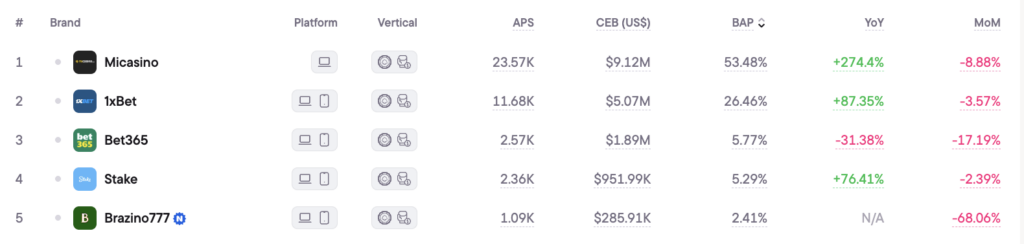
The top five brands by Blask Index in Q1 2026:
| Rank | Brand | APS (avg) | CEB (avg) | YoY change |
|---|---|---|---|---|
| 1 | Micasino | 15,965 | $6.3M | +197.4% |
| 2 | 1xBet | 7,965 | $3.5M | +64.83% |
| 3 | Bet365 | 1,788 | $1.3M | –34.9% |
| 4 | Stake | 1,595 | $651K | +53.58% |
| 5 | 1win | 437 | $261K | +68.66% |
Acquisition Power Score (APS) — Blask’s benchmark for how many new customers a brand’s market position should deliver — puts the market’s combined monthly acquisition capacity at 30,290 new players on average (15,144–75,724 range). The spread reflects how sharply seasonal and event-driven demand can shift the ceiling in a market this dependent on organic, undirected interest.
Micasino’s 197% year-over-year growth is the standout story in the data. A local-facing platform launched in mid-2024, it overtook 1xBet — a global giant with five years of Bolivian presence — as the #1 brand by demand in under two years. 1xBet still leads on sports betting specifically, which is why its spike on match day was proportionally sharper than the market aggregate.
Why sports trigger demand in unregulated markets
In markets with functioning licensed operators, a football win channels betting intent into existing platforms — promotions go live, push notifications fire, in-app activity spikes. The platform captures the moment.
In Bolivia, that infrastructure doesn’t exist at scale. The top operators are offshore. There are no domestic promotions calibrated to Bolivian football. When a major match happens, demand manifests as search activity: players go looking for platforms, often for the first time or the first time in months. The Blask Index captures exactly that — not confirmed bets, but the intent that precedes them.
The 15.2% market-wide rise after the Suriname match reflects a large number of Bolivians looking for somewhere to bet on a win they hadn’t expected.
The final is today
Bolivia play Congo in the inter-confederation playoff final on March 31 — today. A win sends them to the 2026 FIFA World Cup, which is co-hosted by the United States, Canada, and Mexico. It would be Bolivia’s first World Cup appearance in 32 years.
Demand data for today will be available in Blask within 24 hours. If the match follows the Suriname pattern, the spike will be larger — a final carries more emotional weight than a semifinal, and the stakes are unambiguous.
The broader point holds regardless of the result: sports moments in unregulated markets are demand events with no natural ceiling.
There is no licensed operator ready to capture them, no promotional push to convert the spike into registrations, and no retention mechanism to hold the players who show up. The Blask Index shows the demand. What happens to it is the market’s problem to solve.