
- Updated:
- Published:
Brazil’s betting sponsorship ban: 14 of 20 Série A clubs lose a master sponsor
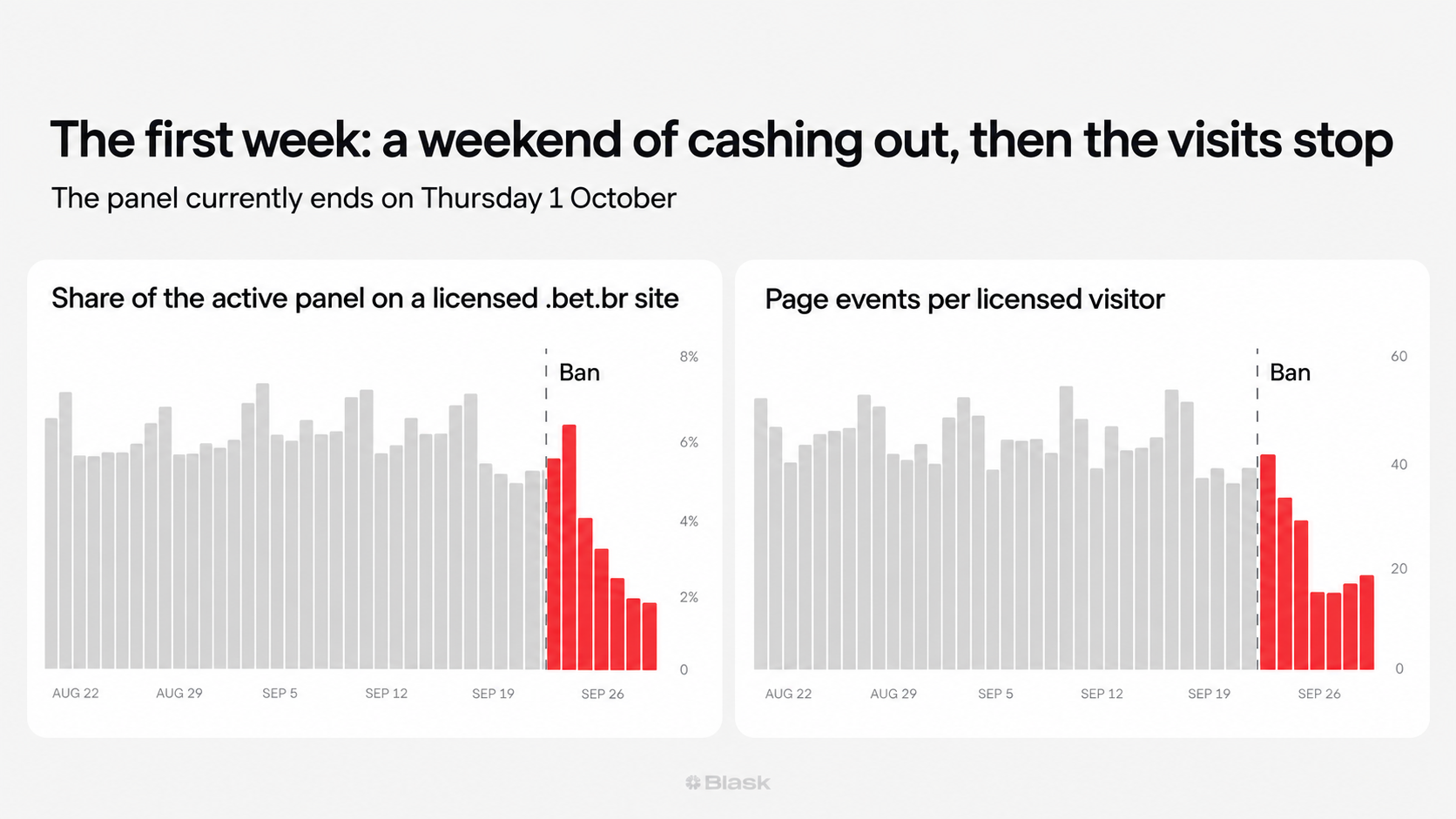
Brazil’s betting sponsorship ban hits 14 of the 20 clubs in Série A, where betting brands are master sponsors in deals worth about R$910 million (about $180 million) a year, according to Brazilian press reports. Since Provisional Measure 1.394 banned those brands, Blask Index shows demand for licensed betting brands in Brazil fell 83% below normal by October 1.
Blask Index is a real-time measure of market demand volume for iGaming brands in a given country, based on normalized search data. The ban therefore removes a revenue line from clubs and an audience from sponsors at the same time.
What the betting sponsorship ban puts at risk in Série A
The money at stake is large and concentrated. Betting sponsorships were 7.9% of Série A clubs’ revenue in 2025, about R$1.14 billion, according to Estadão’s analysis of club financial statements. For 4 clubs the share was above 10%.
The sponsors’ audience collapsed in a week
Blask Index for licensed brands in Brazil was 52% below normal by Sunday, September 27, and 83% below by Thursday, October 1. Betano, Sportingbet and Superbet were each down 85% to 88%. Searches for offshore brands fell far less, by 7% to 17%.
As a result, offshore brands’ share of all branded betting searches in Brazil quadrupled, from 4% to 16%. The licensed side collapsed while the offshore side barely moved.
💡 Key point: a sponsorship buys attention, and the attention on these brands collapsed in a week.
Football is lobbying to keep the deals
Outdoor and sponsorship material had to come down by October 5, and platforms must remove betting advertising by October 8. Brazil’s broadcasters’ association Abert asked the Supreme Court on October 1 to suspend the measure. At least 26 amendments have been filed in Congress, one of them to keep shirt sponsorships for 24 months.
President Lula has said he doubts Congress will reverse the ban.
What India suggests: advertising moves, it does not disappear
India banned the promotion of real-money games in August 2025. Its advertising regulator ASCI kept flagging offshore betting ads in similar numbers: 3,694 between April and August 2025, before the ban, and 3,239 between September 2025 and January 2026, after it. Many of the later ads ran on social platforms.
Blask’s panel shows where the players came from. Before the ban, search engines brought 16% of visits to India’s offshore betting sites and ad networks and other sites 21%. By May to September 2026, search brought 8% and ad networks 41%. The full India comparison is in India’s betting ban and the 63% who kept betting.
In plain terms, players stopped finding betting sites through Google and started arriving through advertising networks.
📚 Read more: Brazil’s betting ban lifted offshore search to 11.3% in five days
What changes for sponsors and clubs
Brazil’s ban removes licensed operators’ TV, shirt and influencer spending. It does not reach the channels offshore operators use. For clubs, 14 master sponsorships and about R$910 million a year are at risk. The detailed data, methodology and sources are in Blask’s report on Brazil’s betting ban.