
- Updated:
- Published:
Offshore betting risks for Brazil’s 25.2 million legal bettors after the ban
Blask projects that about 21.6 million of Brazil’s 25.2 million legal bettors will carry on betting after the ban, almost all of them offshore. The offshore betting risks they take on are the part of the story that regulators can least measure.
The 21.6 million figure is a projection from India’s data, not a measurement of Brazil.
How Blask projected 21.6 million
The projection comes from India, where three months after its own ban players were still betting at 86% of the rate of Brazilians facing no ban. Of 100 Indians who had used legal sites before the ban, 63 were still betting three months later, almost all offshore. In Brazil, where there was no ban at the time, 74 of 100 were.
For scale, 86% of Brazil’s 25.2 million legal bettors is roughly 21.6 million. The comparison with India explains the cohort and the control market.
Offshore betting risks: what players lose outside the licensed perimeter
What those players lose is the protection layer. Brazil’s self-exclusion register, age checks and deposit limits all stop at the licensed perimeter.
More than 1.5 million Brazilians have self-excluded from licensed sites. That register has no force offshore. Neither do the identity checks, the transaction monitoring or the anti-money-laundering obligations that came with the .bet.br licence.
💡 Key point: more than 1.5 million Brazilians have self-excluded from licensed betting. An offshore site has no obligation to honor that register.
What India shows after a year
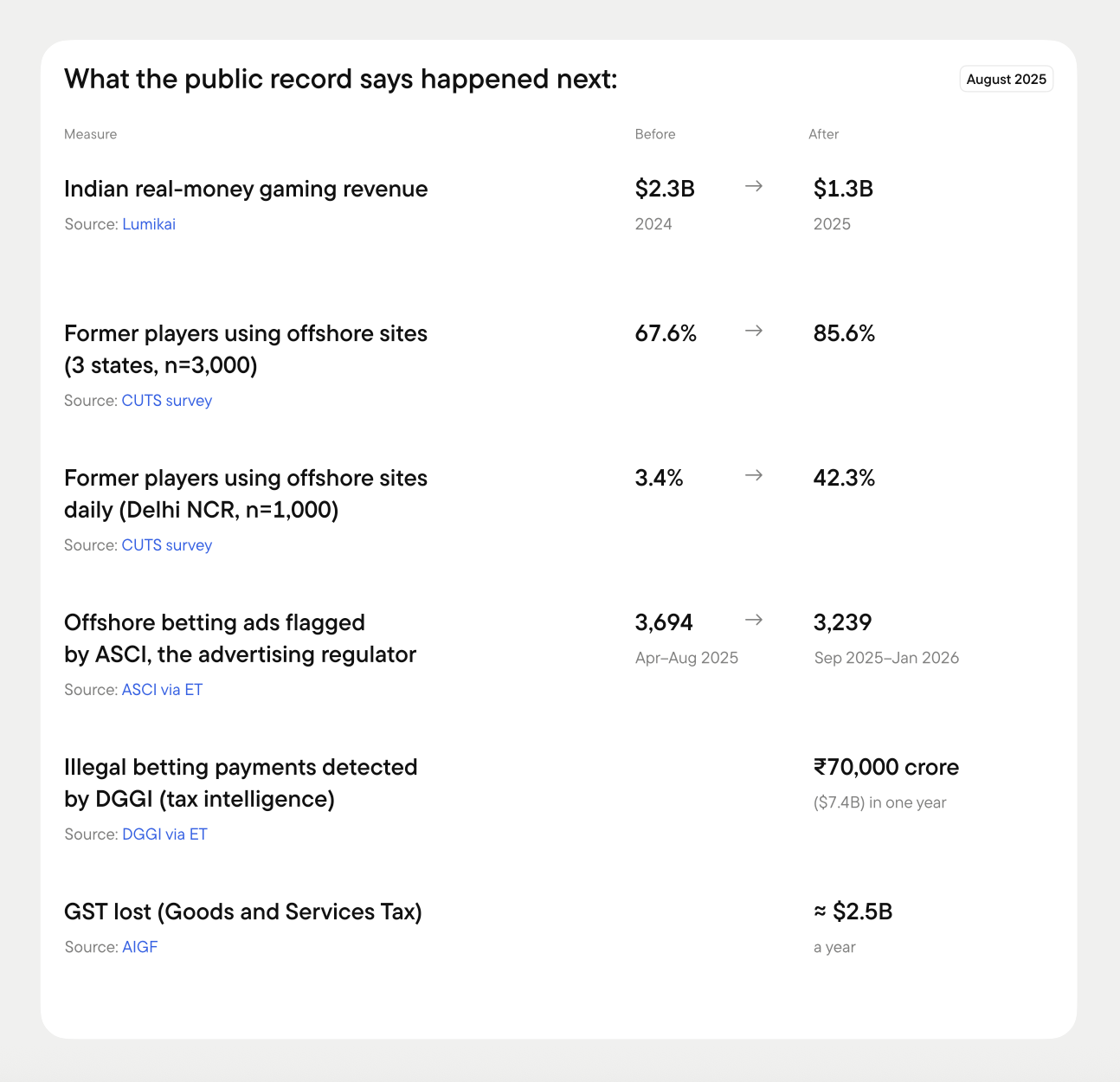
India has a year of evidence on what replaces the protection layer. In a CUTS survey of former players, the share using offshore sites rose from 67.6% to 85.6% after the ban, and the share using them daily rose from 3.4% to 42.3%.
The harm shows up in the same survey. Among offshore users surveyed in Delhi, 26.8% reported fraud or lost funds. Complaints about blocked withdrawals continue a year on.
Brazil’s first week: a slower start, not a smaller end state
The first week in Brazil is consistent with a slower start rather than a smaller end state. Of panelists who had used only licensed sites, 6.7% reached an unlicensed one in the week after the ban, against 5.1% in a normal week.
Most simply stopped. Licensed use among that group fell from 35.4% two weeks before the ban to 23.2% in the week after. Those who did switch went to names they recognized rather than to anything new. We detail where they went in Brazil’s licensed betting sites.
📚 Read more: Brazil’s betting ban lifted offshore search to 11.3% in five days
What to watch
Three numbers will show whether the projection holds: the share of former licensed players who reach an unlicensed site each week, the volume of withdrawal complaints, and the pace of new illegal sites. The detailed data, methodology and sources are in Blask’s report on Brazil’s betting ban.