- Updated:
- Published:
FanDuel and DraftKings 2025 growth: double-digit gains but still behind offshore in US market
America’s two largest licensed operators added billions in 2025. But the unregulated sector remained larger and, in some ways, harder to dislodge than ever.
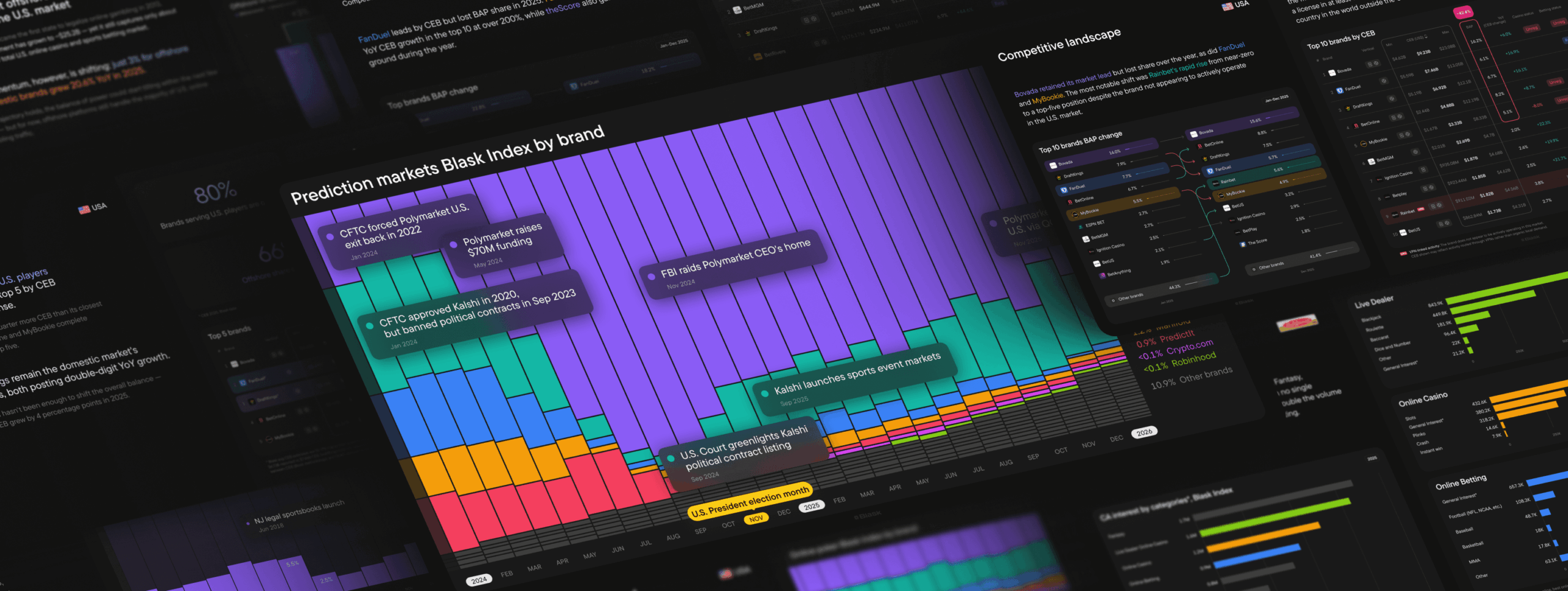
FanDuel and DraftKings, the two dominant licensed online gambling operators in the United States, both posted strong growth in 2025. FanDuel’s estimated Competitive Earning Baseline rose 16.9%. DraftKings grew 16.1%.

Under normal circumstances, those would look like unmistakable signs of market control.
But in American online gambling, growth does not necessarily mean dominance. According to new data from Blask, the offshore sector expanded its share of the total U.S. online gambling market by four percentage points over the same period — an uncomfortable reminder that the country’s regulated leaders are still operating inside a system that leaves much of the market open to rivals they cannot fully confront.
The paradox is real: the leaders are getting bigger, but the market is growing around them even faster.
FanDuel’s estimated 2025 CEB reached $7.46 billion, up from roughly $6.38 billion a year earlier. DraftKings rose from about $5.96 billion to $6.92 billion. Together, the two companies added roughly $2 billion in estimated revenue in a single year.
That is not stagnation. It is scale.
By Blask’s methodology, FanDuel is now the second-largest online gambling brand in the United States, behind only Bovada. DraftKings ranks third. Their growth is real, significant and, in most other sectors, would be enough to define the competitive story.
But not here.
Bovada alone added an estimated $520 million over the same period. The offshore sector as a whole added roughly $1.6 billion. Even if regulated operators are growing faster in percentage terms, the offshore market remains so large that it continues to generate more new volume in absolute dollars.

This is the central paradox of American gambling regulation: licensed operators are winning more business each year, yet the unregulated market remains large enough to widen its footprint anyway.
The problem is not brand strength. It is market structure.
FanDuel and DraftKings are not losing because they lack scale, customer recognition or marketing power. They are losing ground because, in much of the country, they are forced to compete with only part of the product.
The strongest performances for both brands came in states where operators can offer the full package: online casino and sports betting together.
FanDuel grew 35.8% in Michigan, 18.2% in New Jersey and 18.2% in Pennsylvania. Those are markets where regulated operators can compete more directly with offshore sites because they can offer what many players actually want — not just a sportsbook, but casino products as well.
Where that full offering is unavailable, growth becomes harder.
In Illinois, a sports-betting-only state, FanDuel’s estimated CEB fell 5.1%. In New York, it was essentially flat. DraftKings showed similar weakness in Illinois and only modest gains in New York. The pattern is not especially mysterious. In markets where online casino remains illegal, licensed operators are competing with one hand tied behind their backs.
Offshore operators are still benefiting from the products the legal market does not offer.
This is the licensed sector’s structural weakness, and it is not one that better advertising can solve.
A large share of online gambling demand in the United States comes from casino players, not sports bettors. In states where online casino is not licensed, that demand does not disappear. It simply flows elsewhere — often offshore.
No loyalty program, cross-sell strategy or customer acquisition campaign can fully capture a player whose preferred product is unavailable on a licensed platform.
That helps explain why BetMGM posted the fastest percentage growth among the top 10 domestic operators in 2025, with national CEB growth of 22.3%. Its casino-heavy positioning gave it an advantage in states like Michigan and New Jersey, where it could offer both casino and sportsbook products inside a regulated framework.
The pattern across operators is clear enough: where online casino is legal, licensed brands grow faster. Where it is not, offshore operators retain a built-in edge.
For FanDuel and DraftKings, the biggest opportunity remains locked behind politics.
In theory, the long-term outlook for both companies is favorable.
If California, Texas or New York eventually authorize online casino, FanDuel and DraftKings would enter those markets with enormous advantages: brand recognition, existing databases, operational scale and capital. They are better positioned than most smaller licensed competitors to absorb and dominate newly regulated demand.
But theory is not legislation. And legislation is not close.
The three largest unregulated markets remain either politically stalled or openly resistant to online casino legalization. That means FanDuel and DraftKings are likely to continue growing in places where they already operate successfully, while remaining boxed out of some of the country’s richest untapped demand.
That is why their 2025 results can look impressive and incomplete at the same time.
This is not a failure of the market leaders. It is a limit of the current regulatory map.
There is a temptation to read the offshore market’s persistence as evidence that licensed operators are underperforming. The numbers suggest something else.
FanDuel and DraftKings are doing what market leaders are supposed to do. They are expanding, gaining revenue and strengthening their positions in regulated states. But they are operating in a country where regulation remains partial, fragmented and, in key places, absent altogether.
As long as that remains true, offshore operators will continue to benefit from what the legal market does not yet provide.
So the bigger story of 2025 is not that FanDuel and DraftKings failed to grow. They did. Substantially.
It is that in American online gambling, even double-digit growth is not enough to settle the larger competitive question.
Not when the market is still unfinished.