Blask Index data from both markets shows what happened when the first ball was bowled on March 28.
Royal Challengers Bengaluru beat Sunrisers Hyderabad by six wickets in Bengaluru on March 28, 2026 — IPL 2026’s opening match. Ishan Kishan’s 80 off 39 balls gave SRH a target of 202. Virat Kohli’s 69 and Devdutt Padikkal’s composure sealed the chase in 15.4 overs. RCB defended their 2025 title with a statement win.
What happened off the pitch was equally predictable, and equally significant.
The demand signal
Blask Index measures iGaming demand in real time — built from search activity across operators in a given market, it captures player interest before it converts to bets or revenue. It’s a leading indicator: it moves when players do, not when operators report their numbers.
In the week before IPL 2026 launched (March 21–27), India’s total Blask Index averaged 1.4M per day. On March 28, it hit 2.3M. The following day it climbed to 2.4M.
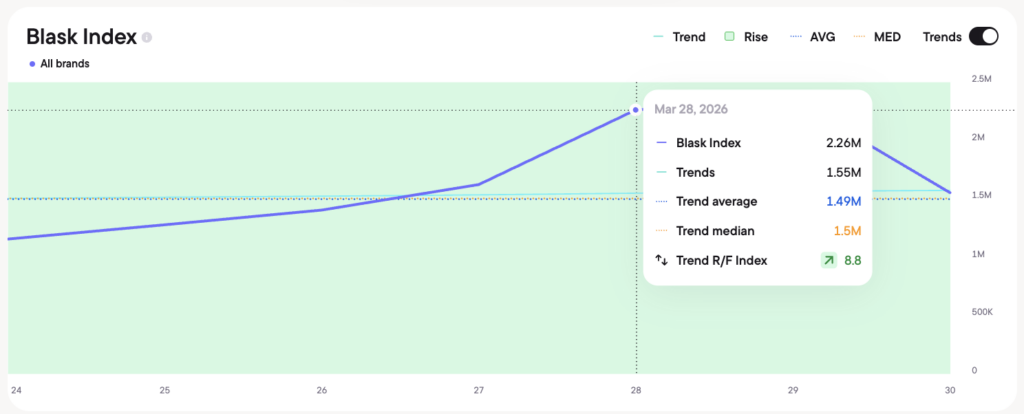
That’s a 62% jump in a single day, sustained through day two.
Both India and Sri Lanka recorded double-digit YoY growth in the IPL opening window — India at 18.2%, Sri Lanka at 13.4%. Two markets moving simultaneously is the pattern that separates IPL from other cricket events on the calendar.
Read more: IPL and Indian iGaming: an 18x growth story that repeats every spring
India: the established pattern
India’s iGaming market is offshore-only — no licensed domestic operators — which means demand flows entirely to international brands. When IPL runs, that demand concentrates.
Among the top brands, 4RABET grew its Blask Index in India 41% year-over-year in the IPL opening window. Skyexch, one of the fastest-growing operators in the market, posted a 68% YoY gain — the sharpest move among tracked brands.
The season runs 74 matches through May 31. That’s a 65-day window where India’s iGaming market operates at structurally elevated demand.
Sri Lanka: demand and drama
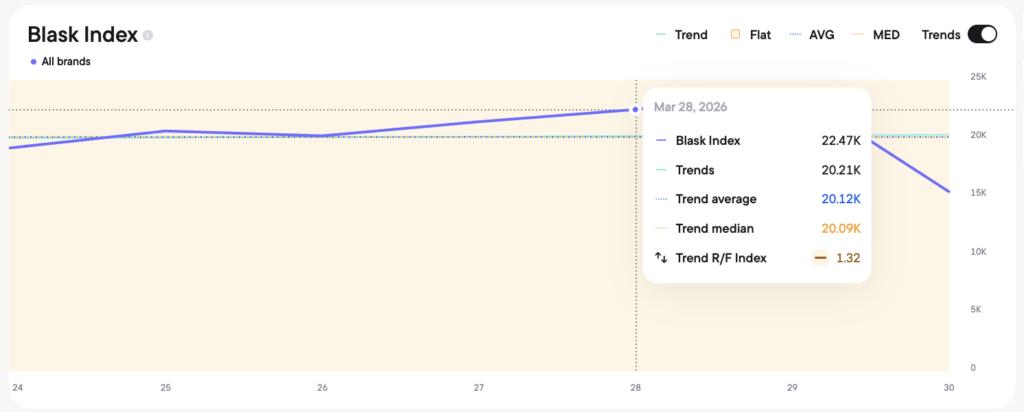
Sri Lanka’s Blask Index moved alongside India’s. The pre-IPL baseline sat at around 20K per day through March 21–27. On March 28, it rose to 22.5K. On March 29, it reached 24.1K — a 20% increase over the opening weekend.
The demand movement came with an added layer of player availability uncertainty. Sri Lanka Cricket required Wanindu Hasaranga, Matheesha Pathirana, Nuwan Thushara, and Malinga to pass fitness tests before issuing NOCs for the tournament. Nissanka, Mendis, and Chameera cleared earlier.
Thushara failed his fitness test and was denied an NOC — he missed RCB’s opener entirely. His window to retake the test opened 4–5 days after the denial. Hasaranga’s status remained under question into match week.
Player availability uncertainty didn’t suppress demand. If anything, it added a reason for Sri Lankan fans to track the tournament from the first ball.
Sporting Times, the dominant brand in the Sri Lanka market, posted 53% YoY growth in the opening period — the largest move among tracked operators in the country.
The IPL window
IPL is the single largest calendar trigger for iGaming demand across South Asia. Blask’s analysis of IPL 2025 showed the demand effect accumulates through the tournament rather than peaking on day one. The opening match sets the floor, not the ceiling.
Operators who move early capture attention before competition intensifies. The 2026 season is 65 days long. Three days are already gone.