
The largest state gambling market in the U.S. still sends most of its online casino demand offshore.
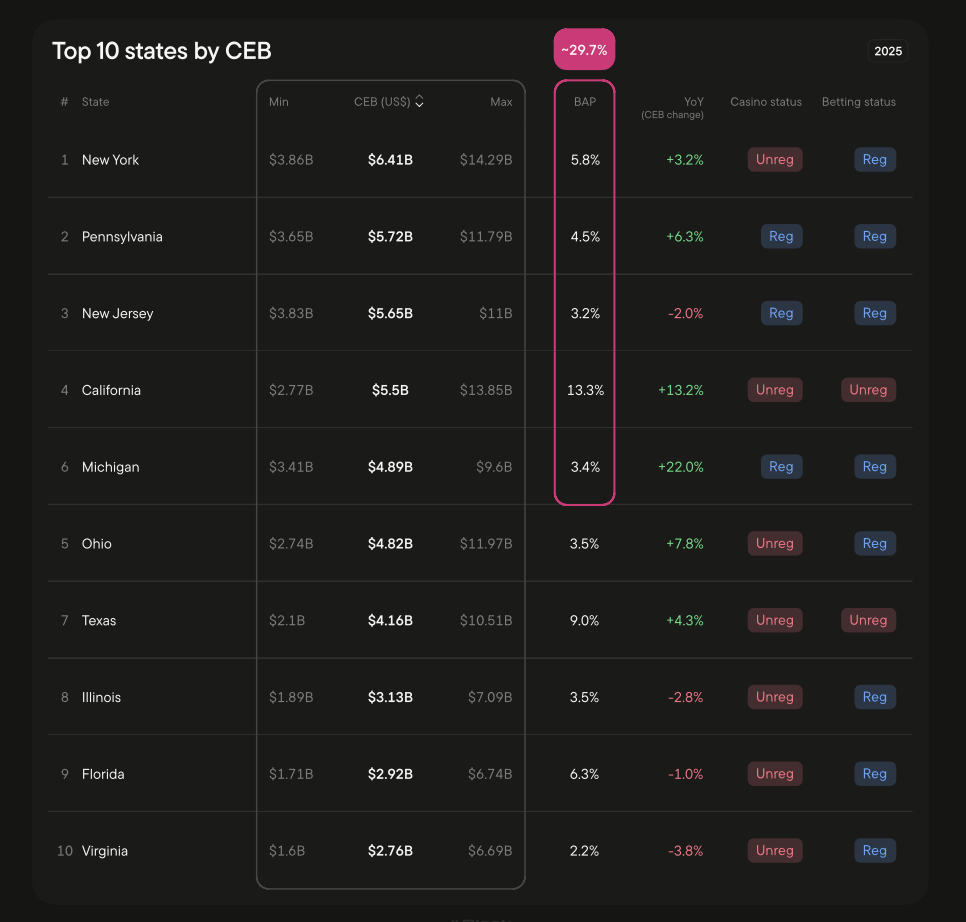
New York is the largest online gambling market among U.S. states, generating an estimated $6.41B in Competitive Earning Baseline in 2025 — and yet approximately 61% of that total, or nearly $3.9B, flows to offshore operators that pay no New York taxes and are subject to no New York consumer protection requirements, according to new Blask data that quantifies the gap between what regulation has captured and what it has not.
The structural cause is straightforward: New York legalized mobile sports betting in January 2022 but has not legalized online casino gaming. Players who want to bet on the Giants have a legal option.
Players who want to play blackjack or spin slot machines online do not. They go offshore. At an estimated $3.9B annually in offshore casino gambling from New York residents, the cost of that gap in regulatory coverage is not abstract.
The largest gambling market in the country
New York’s position as the largest state gambling market in the country reflects its size — the fourth-largest state by population, home to the nation’s largest city — combined with a gambling culture that consistently generates above-average demand across sports betting, live dealer games, slots, and online poker.
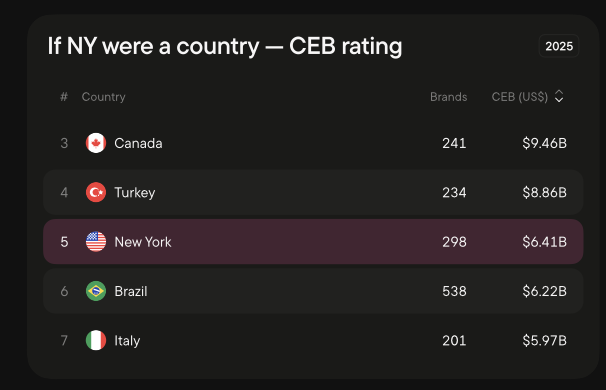
The state would rank fifth globally by CEB if it were a country, between Turkey and Brazil.
Strong growth, but mostly offshore
The domestic segment — primarily FanDuel and DraftKings operating licensed sportsbooks — grew 19% year-over-year in 2025, reaching approximately $2.5B.
That represents strong growth for the regulated market. But the offshore segment grew as well, reaching $3.9B, and the ratio between them — 39% domestic, 61% offshore — improved only marginally from the prior year’s 33% domestic.
The top brands reveal the divide
The composition of New York’s top 10 brands illustrates the divide with unusual clarity.
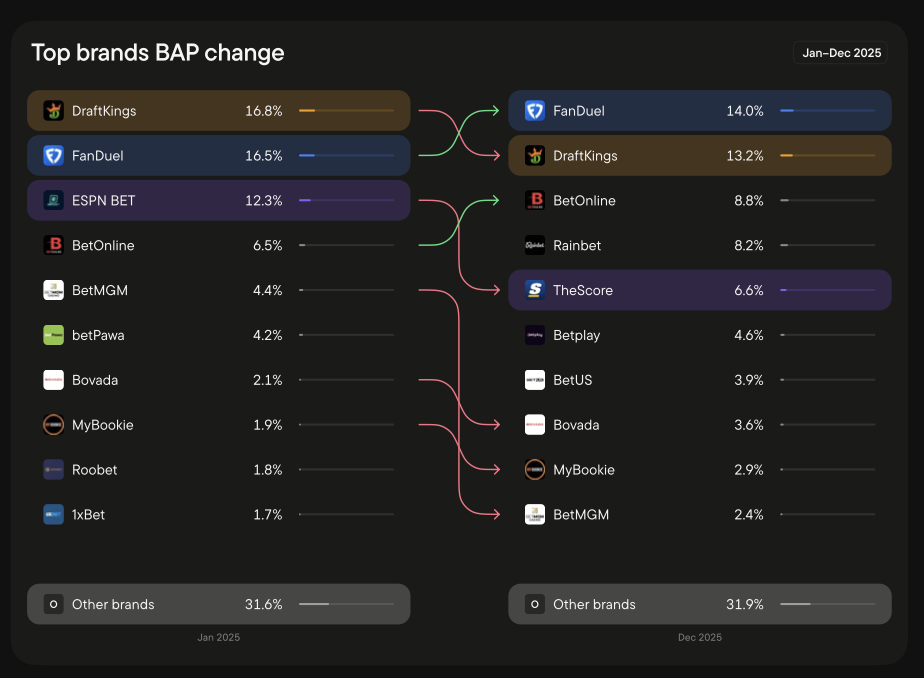
FanDuel and DraftKings hold the top two positions, each generating more than $1B in CEB through their licensed sportsbooks.
Positions three through ten are dominated by offshore casino-sportsbook hybrids: BetOnline, MyBookie, Bovada, and Betplay — platforms that offer slots, table games, and live dealer content alongside sports betting, none of it licensed in New York.
The tax structure adds another layer
New York’s sports betting market is one of the most taxed in the country, at a 51% gross gaming revenue tax rate — a figure that has been criticized by operators as the highest effective tax in the industry.
High taxes have not prevented FanDuel and DraftKings from competing, but they have made New York economics difficult for smaller licensed operators, which may partly explain why the licensed field has not expanded aggressively despite strong demand.
Why online casino legalization has stalled
The legislative effort to legalize online casino in New York has been ongoing since at least 2022 and has repeatedly stalled against competing priorities.
The primary obstacles are familiar: concern about cannibalizing the state’s land-based casino industry (New York has recently licensed three major new downstate casinos), disagreement about tax rates, and lingering responsible gambling concerns.
The economic case for online casino legalization in New York is now supported by data rather than projections.
The Blask analysis shows that approximately $3.9B in casino gambling demand exists in New York, that New York residents are currently satisfying that demand through offshore platforms, and that the only question is whether they will do so through regulated platforms that pay taxes and offer consumer protections or through offshore platforms that do neither.
New entrants can still grow in the regulated segment
Fanatics, the sports merchandise conglomerate that entered online sports betting in 2023, posted the strongest year-over-year CEB growth in the New York top 10 at 115.7%.
Its New York CEB remains below $200M — a fraction of FanDuel’s and DraftKings’ — but the trajectory illustrates how a well-capitalized new entrant can grow quickly in an active regulated market.
If New York legalizes online casino, the same dynamic would likely play out on a much larger scale.