- Updated:
- Published:
Super Bowl LX triggered a 5x demand spike — how the NFL postseason shaped US in 2026
Blask Index daily data for the US market maps five clear demand peaks from Wild Card weekend through March Madness, each tied to a specific sporting event.
The US online betting market does not move in a straight line. It spikes. Blask Index daily data for January through late March 2026 shows that kind of precision: flat baselines, then sharp single-day surges that trace directly back to the NFL postseason calendar.
Five dates account for almost all the meaningful demand above baseline. Four fall within a 29-day window in January and February. One sits alone above everything else.
What Blask Index measures
Blask Index is an AI-enhanced demand signal built from search activity across iGaming brands. It measures how much player interest a brand generates in a given market on a given day — before that interest converts to registrations or bets. It is a leading indicator. Operators see their own handle after the fact; Blask Index shows what was building before those bets were placed.
The daily view makes event-driven demand visible at resolution most analytics tools miss. A monthly average smooths away a Super Bowl spike entirely.
The NFL playoff run: four weeks of escalating demand
The 2025-26 NFL postseason began on January 10-11 with Wild Card weekend.
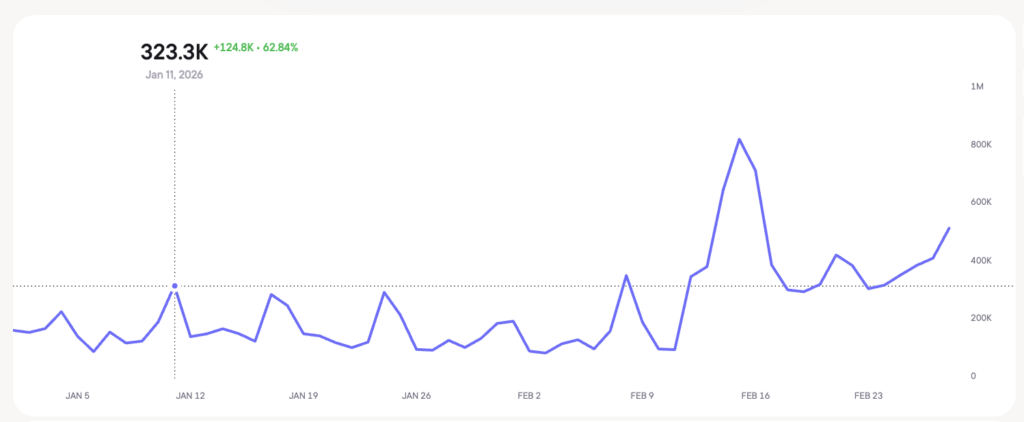
DraftKings recorded a Blask Index of 50,423 on January 11 — a Sunday when multiple Wild Card games ran simultaneously. FanDuel’s reading that same day was 37,605. Both were roughly 2.5x above their typical mid-week baselines.
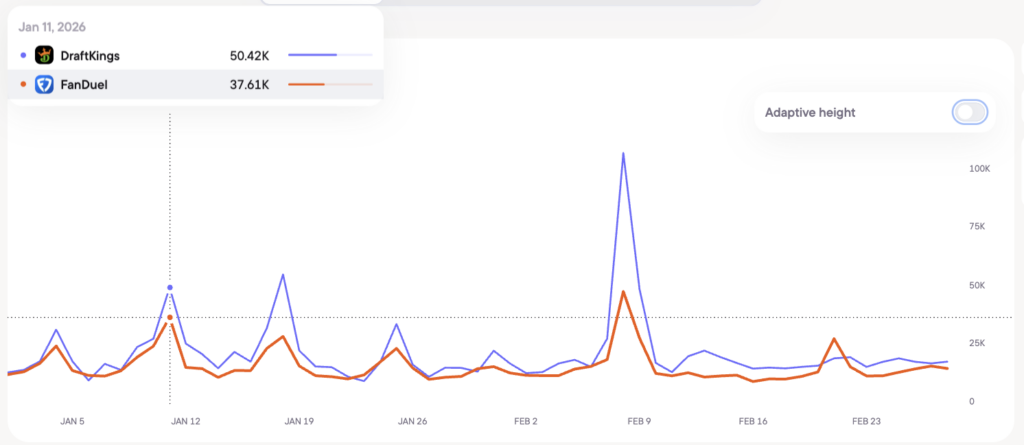
The pattern held the following weekend.
Divisional Round games on January 17-18 produced a second, slightly larger spike. DraftKings peaked at 56,006 on January 18 — the day Denver Broncos knocked out Josh Allen’s Bills and the Seattle Seahawks advanced. FanDuel reached 29,402 the same day.
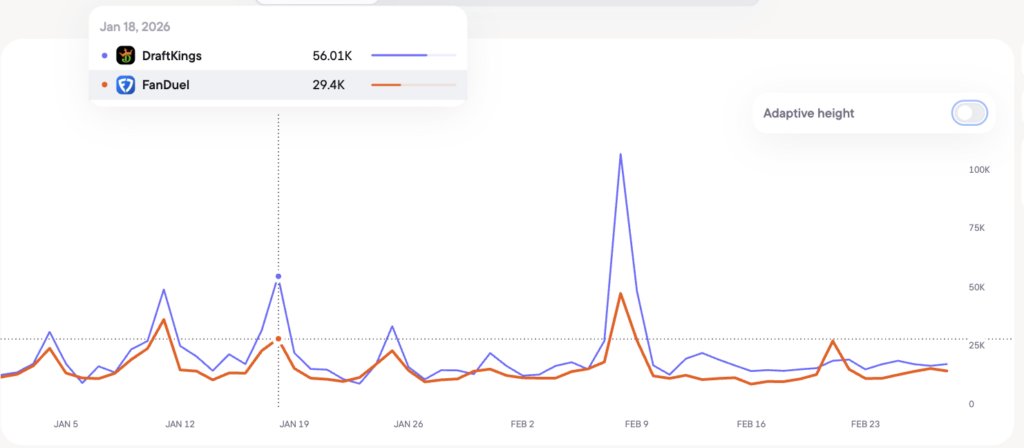
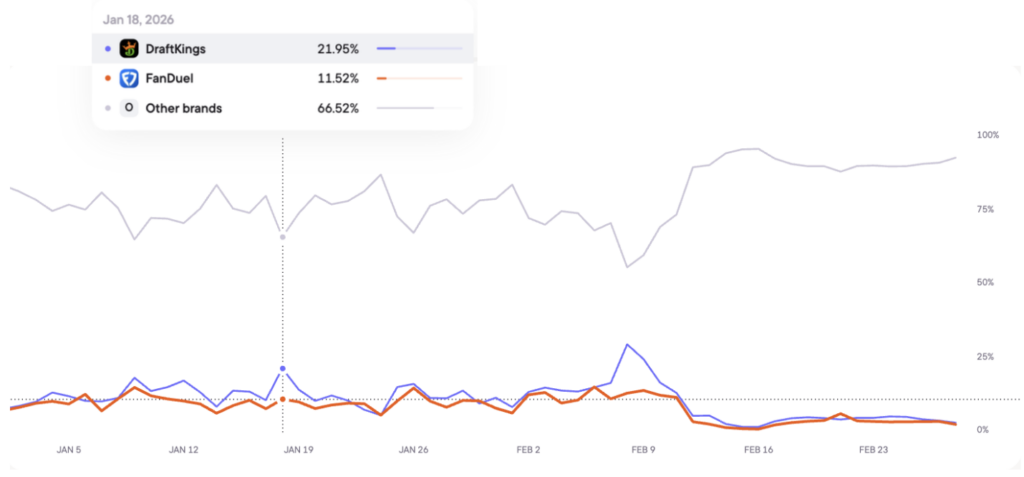
DraftKings’ Brand Accumulated Power — its share of total US market demand — touched 21.95% on that Sunday alone.
Conference Championship Sunday on January 25 produced the third NFL spike. The matchups — New England Patriots versus Denver Broncos in the AFC, Seattle Seahawks in the NFC — generated DraftKings Blask Index of 34,755 and FanDuel at 24,258.
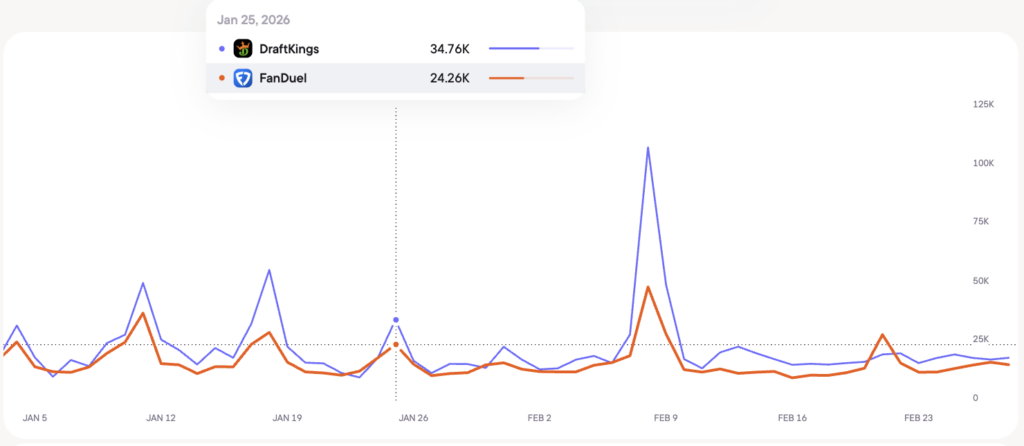
Both figures sat above the inter-week baseline, but below the Divisional numbers. The closer you get to a championship game, the more search demand consolidates around the specific teams involved — and that does not always mean higher aggregate numbers.
| Date | NFL event | DraftKings Blask Index | FanDuel Blask Index |
|---|---|---|---|
| Jan 11 | Wild Card Sunday | 50,423 | 37,605 |
| Jan 17 | Divisional Saturday | 32,983 | 24,272 |
| Jan 18 | Divisional Sunday | 56,006 | 29,402 |
| Jan 25 | Conference Championships | 34,755 | 24,258 |
Super Bowl LX: the dominant peak
February 8. Seattle Seahawks versus New England Patriots. Super Bowl LX at Levi’s Stadium in Santa Clara.
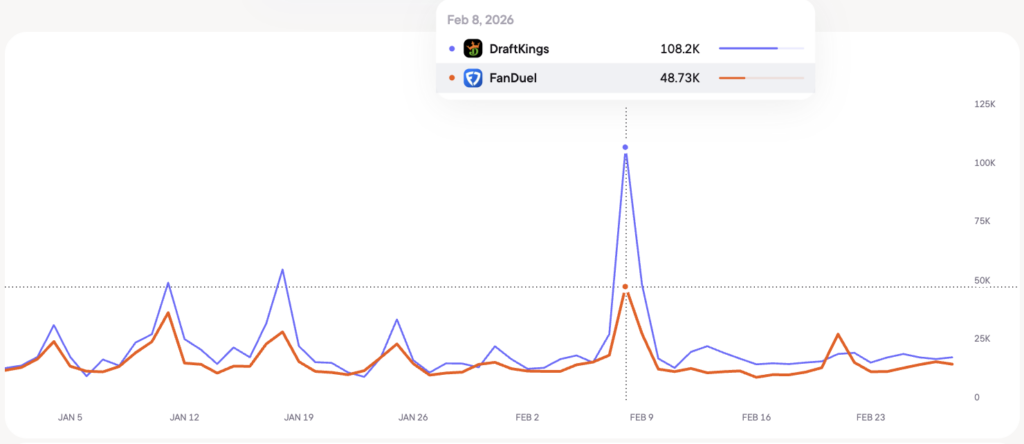
DraftKings Blask Index hit 108,167 that day. FanDuel reached 48,734. Both are the highest single-day readings for either brand in the entire January-March period.
For DraftKings, the Super Bowl number was more than 5x its typical daily baseline and nearly double its second-highest reading of the period (56,006 on Divisional Sunday). Its BAP — the brand’s share of total US market demand — reached 30.14% on Super Bowl day. Nearly one in three searches across all US sportsbooks that day went to DraftKings.
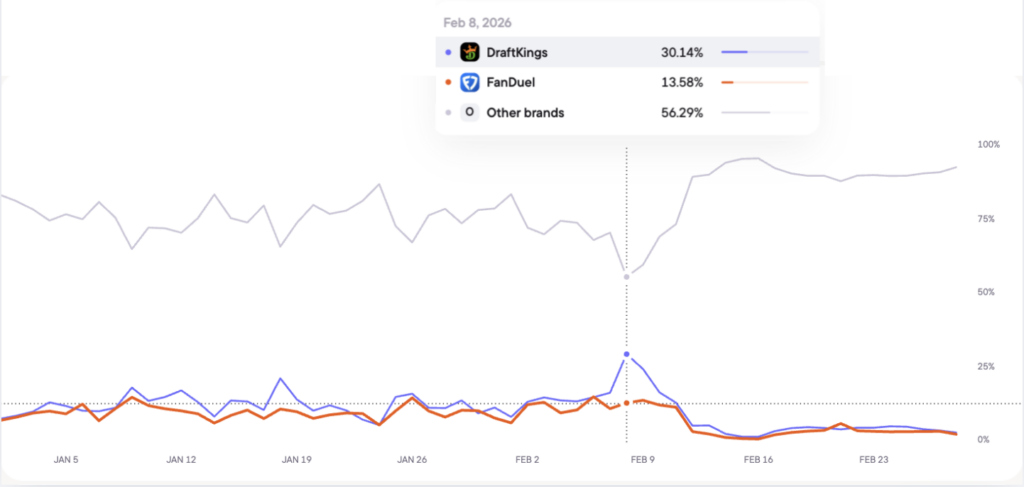
The American Gaming Association projected $1.76 billion wagered on Super Bowl LX with US sportsbooks — a record for a single game. New York state alone recorded $572.5M in handle for Super Bowl week. The Blask Index spike preceded and correlated with that volume: search demand does not lag the game, it builds into it.
The day after the Super Bowl (February 9) still showed elevated readings — DraftKings at 49,653, FanDuel at 28,668. That is the Super Bowl accounting tail: bettors checking results, settling parlays, reading post-game coverage. By February 10, both brands had dropped back to near-baseline levels.
The dead zone between Super Bowl and March Madness
The six weeks between Super Bowl LX and the start of the NCAA tournament were quiet by comparison. DraftKings traded between 13,000 and 24,000 daily. FanDuel between 10,000 and 20,000. The NBA regular season provides background noise but not event-driven spikes of the kind the NFL postseason produced.
This is a structural feature of the US betting calendar, not a failure of marketing. The NFL postseason is a concentrated sequence of high-stakes games on specific Sundays. The NBA regular season offers volume but not the same single-event intensity.
March Madness: $4 billion projected, modest Blask elevation
The 2026 NCAA Men’s Basketball Tournament began with Selection Sunday on March 15. March Madness betting was projected to reach a record $4 billion in handle, driven by continued US market expansion and growing online penetration.
The Blask Index daily data for this period shows a modest elevation relative to the post-Super Bowl baseline. DraftKings ranged between 19,000 and 26,000 in the second and third weeks of March — the first and second rounds of the tournament. FanDuel followed a similar pattern: 15,000 to 21,000 across the same window.
The elevation is real but structurally different from the NFL spikes. March Madness spreads demand across 67 games over three weeks. There is no single day where everything concentrates. The aggregate handle is enormous — but on a per-day basis, the Blask signal shows gradual buildup rather than sharp peaks.
| Period | DraftKings Blask Index range | FanDuel Blask Index range |
|---|---|---|
| Post-Super Bowl (Feb 10-Mar 14) | 13,657 – 24,792 | 10,051 – 20,709 |
| March Madness first rounds (Mar 15-28) | 15,430 – 26,180 | 13,323 – 21,058 |
What the data shows operators
The US sports betting demand curve in 2026, at daily resolution, is not a growth story. It is a calendar story.
DraftKings’ cumulative Blask Index for January through late March was down 15.2% year-over-year. FanDuel’s trend lines followed a similar pattern. The market has matured. Baseline demand is stable but not compounding.
What is compounding is the event multiplier. The Super Bowl Blask Index reading for DraftKings was 5.4x its typical daily baseline. The NFL playoff run produced four distinct above-baseline Sundays before it. For operators, that is a planning signal: the US sports betting calendar concentrates meaningful customer-acquisition moments into a 30-day window in January and February, then again for three weeks in March.
The operator that understands which days drive real demand — and positions acquisition spend, bonus structures, and product pushes around those specific dates — is working with the same data the Blask Index makes visible.