
- Updated:
- Published:
While courts debate rules, offshore operators are winning Canada’s iGaming market
While Canadian regulators and courts debate whether Ontario can legally pool online poker players with other countries, offshore brands are winning the battle for actual users. Unlicensed operators captured 59% of Canada’s total online gambling market in 2025, which reached an estimated $9.5 billion.
Blask analytics reveal a structural divide between the country’s two regulatory models. In Ontario, which operates an open competitive market, licensed brands retain 85% of user activity. The province’s regulated market generated more than $4 billion in revenue in 2025.
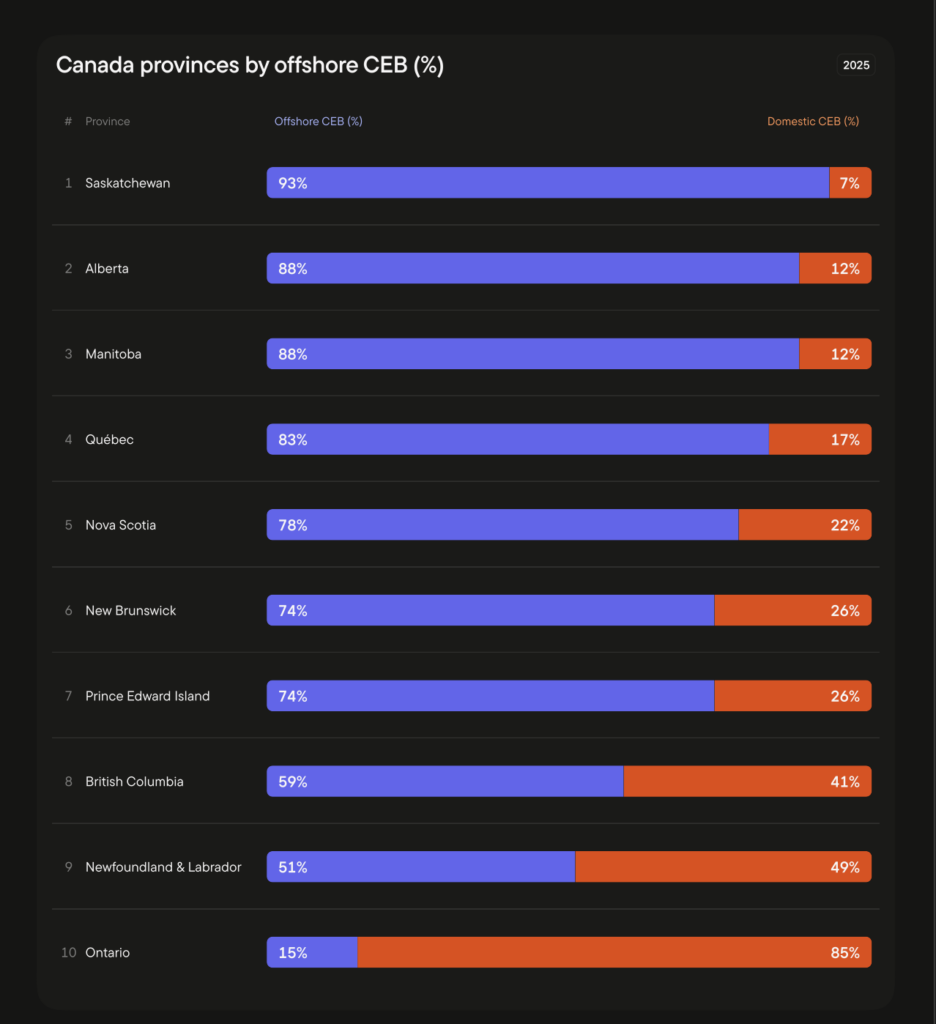
Meanwhile, in provinces with government gambling monopolies, offshore operators control an average of 76% of the market.
The clearest example is Alberta, which is preparing to launch a regulated commercial market in the spring or summer of 2026. The Alberta government estimates that roughly 70% of online gambling in the region occurs in the unregulated market.
Blask data confirms this real-time shift.
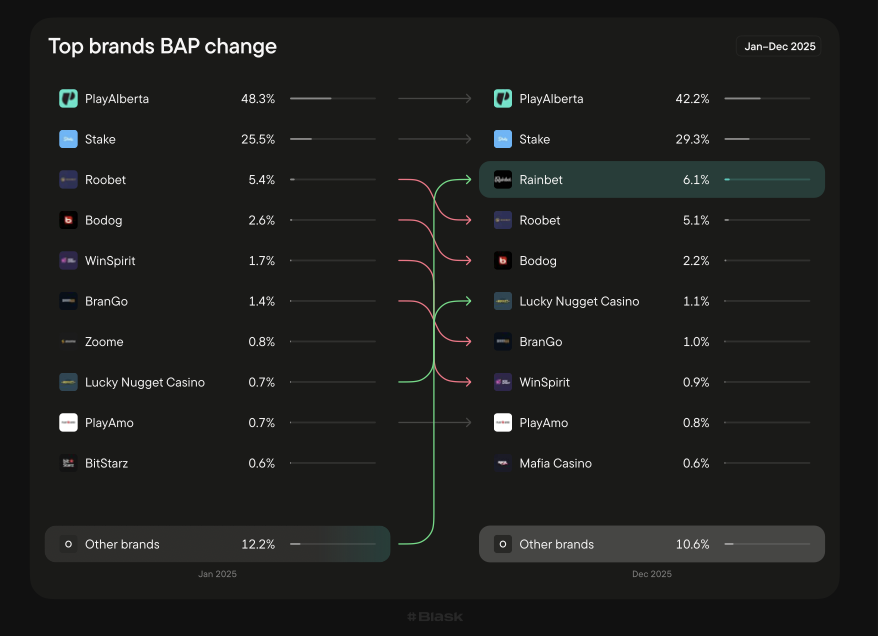
In February 2025, the share of offshore platforms in Alberta reached 54%, up 7 percentage points from March 2024. Over the same 12 months, the state monopoly PlayAlberta lost 7.4% points, falling to 47.2%. Concurrently, the unregulated crypto-brand Stake grew by 166.5% YoY within the province.
A nationwide offshore trend
The situation in Alberta reflects a nationwide trend. The Canadian market is the third largest in the world by Competitive Earning Baseline (CEB). However, the offshore segment’s growth rate (+40% YoY) is nearly double that of licensed local brands (+23%).
The top two operators in the country — Stake and Roobet — operate without licenses, with Stake’s CEB exceeding its nearest competitor by 3.5 times. Of all brands serving Canadian players, 63 percent are offshore.
Against this backdrop, the legal battle over liquidity pools appears disconnected from market realities. The Canadian Lottery Coalition (BCLC, MBLL, ALC) appealed to the Supreme Court to overturn an Ontario court ruling that legalized international P2P pools. Provincial monopolies are attempting to protect their positions through legal channels, while offshore brands expand their presence through broader product offerings and aggressive marketing.
Alberta’s transition to an open market in 2026 will be the industry’s next major test. Ontario has already demonstrated that open competition is an effective mechanism for transitioning players to legal platforms. Regulation can shift the balance of power, but only if local operators offer products capable of competing with global unlicensed brands.