
- Updated:
- Published:
iGaming market weekly report | Jun 8–14, 2026
The 2026 FIFA World Cup opened on June 11 and immediately restructured the global iGaming search map. Latin America produced four of the five largest weekly movers; the gainers table is almost entirely a World Cup story, though the mechanism differs by market.
Among decliners, the reasons for suppression are related to government enforcement operations such as in-week arrests and illegal websites’ blocks. South Africa (–8.2%) registered an event hangover: the national team lost its opening World Cup match and the regulator simultaneously warned consumers about fraudulent platforms.
Top gainers
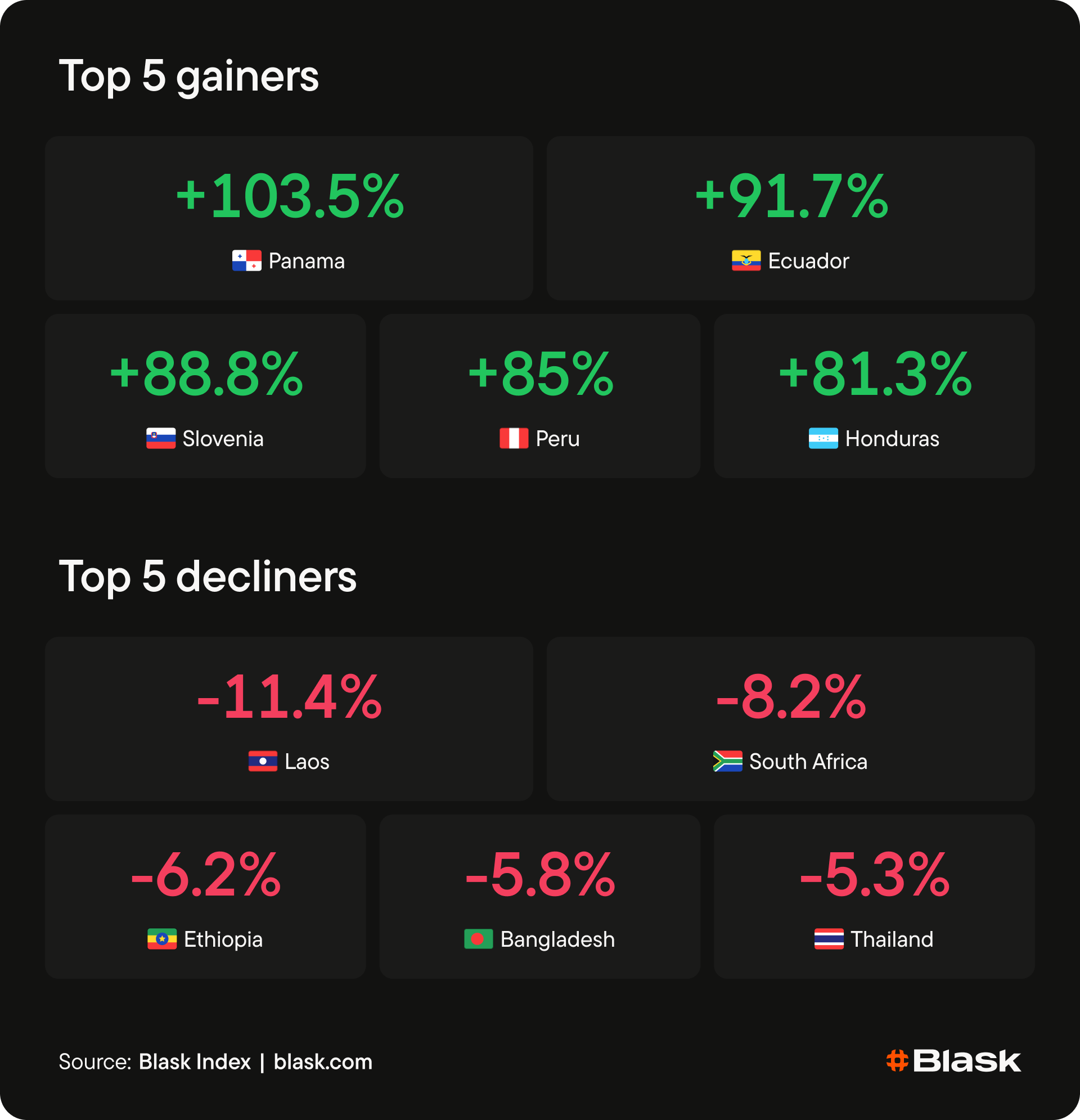
Panama +103.5%. Panama’s first World Cup match (Ghana, June 17) had not yet kicked off within the reporting window, meaning that the market reflected pre-match anticipation. Simultaneously, Law 527’s five-day ISP blocking mandate for unlicensed sites remained in active public attention following the Blask newsroom analysis published on June 4. Offshore brands — Stake, 1xBet, Betify — have grown from 9.6% to 14.9% of Panama’s Blask Index since April 2024, making the law’s enforcement implications commercially significant for the market’s fastest-growing segment.
Ecuador +91.7%. After last week’s –38.6% decline Ecuador executed the week’s cleanest mean-reversion, compounded by two concurrent triggers. Ecuador plays in Group E (Germany, Ivory Coast, Curaçao), with tournament markets active from the June 11 opener. On June 12, President Noboa signed Executive Decree N°422, the law of 306 articles. The Executive Decree introduced five-year betting licenses and a 655-salary annual payment structure. Regulatory and event gravity reinforced each other.
Slovenia +88.8%. Although Slovenia did not qualify in the World Cup, the bettors’ interest is high in this country. It is also fueled by RTV, a national broadcaster, which ran a full-tournament prediction game launched around the opening day of the World Cup. This prediction game anchored domestic fan engagement.
Peru +85%. Peru did not qualify for the 2026 tournament, but the Sports Betting category is heavily dominating the market. According to Blask data, it has nearly 69% share while the second-ranked category, Live Dealer Online Casino, accounts for just 12%. Also, Peru is one of the densest licensed betting ecosystems in LATAM — the whole leaderboard is taken by MINCETUR-licensed operators.
Honduras +81.3%. Honduras did not qualify but local operators coordinated pre-tournament launches inside the reporting window. Apostemos unveiled a redesigned platform with a dedicated World Cup campaign on June 6, while Hondubet activated its HonduQuiniela Mundialista prediction pool with a 304,000 HNL (US$11,370) prize structure. Platform launches and marketing concentration created a demand spike from an unregulated market relying entirely on offshore and quasi-local operator access.
Top decliners
Laos –11.4%. No clear country-specific trigger surfaced for the reporting window.
South Africa –8.2%. South Africa played the 2026 World Cup’s opening match on June 11 and lost 0–2 to Mexico. The National Gambling Board compounded the signal with a June warning about illegal gambling scam platforms and fake betting apps circulating during the tournament — a suppression layer layered onto an already disappointed domestic audience.
Ethiopia –6.2%. No catalyst was found within the reporting window.
Bangladesh –5.8%. The CID’s enforcement campaign continued through the reporting week: on June 8, three syndicate members were arrested in Tangail under the Cyber Security Act 2026, with the network operating across bKash, Nagad, and cryptocurrency channels. Bangladesh appeared in the prior week’s table at –29.5% — the seventh-deepest decline across both datasets — and the current reading indicates a slowing rather than a reversal. A draft law to replace the 1867 Gambling Act was announced June 2, signaling that suppression is legislative as well as operational.
Thailand –5.3%. Thai authorities deployed a Football Betting Suppression and Protection Centre ahead of the World Cup and blocked 717,000 URLs between October 2025 and May 2026, with 309 additional sites targeted for May–June operations. The Royal Thai Police launched AI-powered detection systems calibrated specifically for the tournament window.
Market spotlight: Panama | +103.5%
Panama’s +103.5% WoW gain is the largest percentage movement in the current dataset. It emerged from two forces that did not share a cause but shared a timing window. Panama’s first World Cup match — against Ghana on June 17 in Toronto — had not yet taken place; every query was generated by pre-match market activity, Group L analysis, and operator-level regulatory attention.
The regulatory dimension is not background noise. Law 527 grants the Gaming Control Board authority to require ISPs to block unlicensed gambling platforms within five days. Blask data shows offshore brands grew from 9.6% to 14.9% of Panama’s Blask Index share between April 2024 and April 2026, led by Stake (+128% YoY), 1xBet (+404% YoY), and Betify (+79% YoY). That growth rate makes Panama’s offshore segment the market’s fastest-growing layer, and Law 527 puts that layer on a compliance clock precisely as tournament demand peaks.
Regional snapshot
Europe
The region was pulled upward by World Cup event gravity even in non-qualifying markets. Slovenia’s +88.8% rebound — reversing last week’s –23.9% — was the clearest expression of mean-reversion compounded by the June 11 opener. Hungary (+69.7%) and Belarus (+54.3%) also registered strong gains without direct qualification stakes. The counterpoint was Greece (–3.4%), mean-reverting after last week’s +8.5% gain, with no World Cup participation and no new regulatory trigger to sustain momentum.
Asia-Pacific
The region produced the week’s most coherent enforcement story. Bangladesh (–5.8%), Thailand (–5.3%), and the Philippines (–4.3%) all declined under active suppression; Thailand and Bangladesh explicitly calibrated their crackdowns around the World Cup’s arrival. Singapore was the sole counterweight, gaining +50.4% in a well-regulated market where event gravity was unobstructed. Laos (–11.4%) posted the largest percentage decline of all decliners but the smallest absolute volume loss — a drift reading in a structurally restricted domestic market.
Africa
The continent produced no markets in the current week’s gainers. South Africa (–8.2%), Ethiopia (–6.2%), and Tunisia (–4.8%) all declined, spanning a first-match loss, a six-month license void, and baseline drift respectively.
Next week watchlist
Group L debut (June 17) and Law 527 enforcement in Panama
Panama plays Ghana on June 17 in Toronto — its first World Cup match. Search momentum should remain elevated or expand through match day. Concurrently, any Gaming Control Board blocking orders issued under Law 527’s five-day ISP compliance mandate will be visible in the market’s signal; a confirmed offshore blockage during tournament week would be a market-structure event for the LATAM region.
Ecuador and Germany mixture
Ecuador’s next group-stage match against Germany carries outsized signal implications — a competitive result against a tournament favourite would sustain current search momentum into the final group-stage week. Additionally, Executive Decree N°422’s influencer marketing ban is newly active; compliance-search traffic from operators and content creators is expected to add a regulatory undercurrent to any tournament-driven gains.
AI enforcement trajectory in Thailand
Thai authorities have committed AI detection resources specifically for the World Cup group stage’s peak betting window (June 18–27). If enforcement intensity plateaus, event gravity could begin lifting Thailand’s signal from –5.3% toward neutral. If blocking operations escalate — the Ministry of Digital Economy and Society blocked 78,796 URLs in May alone — Thailand’s signal would remain negative through mid-July regardless of regional match outcomes.
Methodology note
Blask Index tracks real-time iGaming player interest via AI-analyzed Google search data, updated hourly and filtered to remove low-intent noise (scams, complaints). WoW% measures momentum: positive indicates growing attention; negative indicates declining attention.