

- Updated:
- Published:
Georgia fast-tracks split gambling bill — 5% GGR for international operators, closed market for locals
Georgia’s parliament is fast-tracking a bill that creates a separate license category for international online operators, blocking them from serving Georgian users in exchange for a 5% GGR tax.
The bill was submitted on June 23, setting up two parallel regulatory tracks for online gambling. It is not a sudden policy reversal — the document extends the tightening course Georgia has been building steadily since 2021.
Local brands hold 99% of a tightly regulated market
Domestic gambling regulation in Georgia remains among the strictest in Eastern Europe. Citizens under 25 cannot place bets online or offline, and the Revenue Service self-exclusion register had grown to 1,577,247 people by end-2025 — more than half of the country’s adult population. Operators must check every customer against this list before granting access to games.
Tax pressure has also intensified: the rate of revenue from Georgian players rose from 10% GGR in 2022 to 20% today. Gambling contributions to the budget reached $660M in 2025, up 26% YoY.
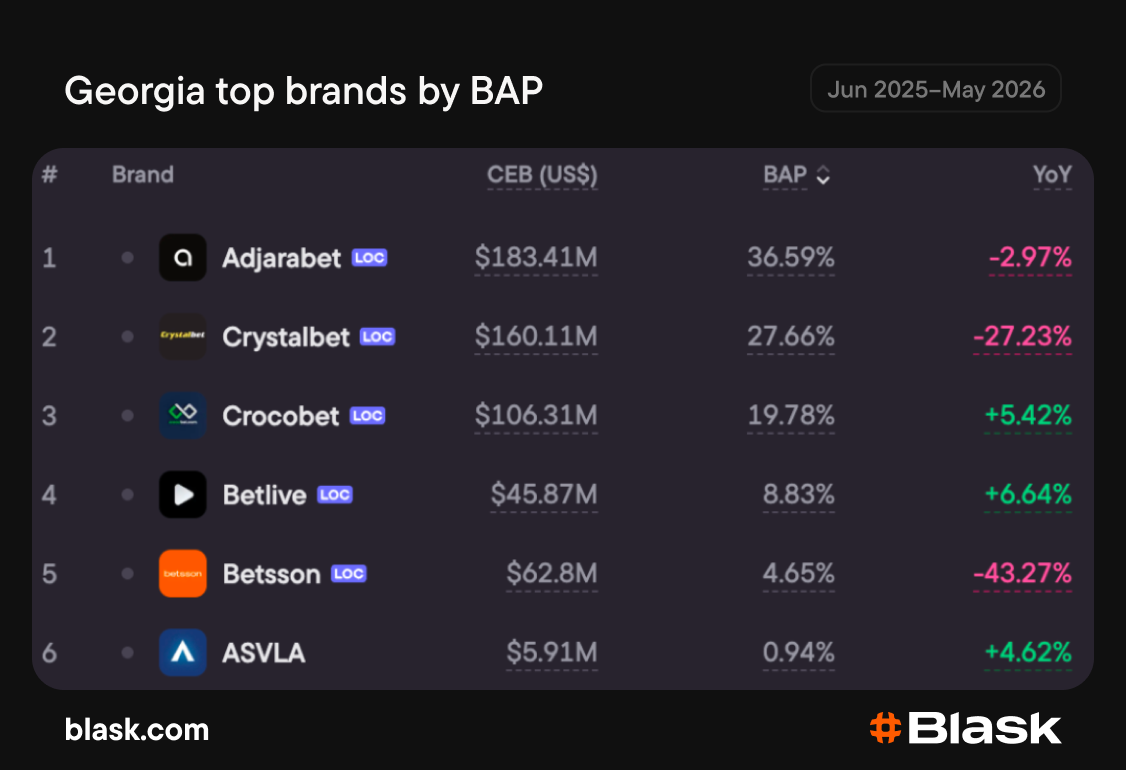
Blask data shows the market remains almost entirely local. In May 2026, local brands held 99.26% of measurable demand, with international brands accounting for only 0.74%. Total CEB over 12 months stood at $585.51M, concentrated among a small group of local operators.
A cheap license base for operators serving foreign markets
The bill introduces three permit categories — casino, slots, and betting — with an annual fee of around $38,000 against the standard $1.9M, and a 5% GGR tax. The key condition: platforms must fully block players with Georgian IPs.
Tbilisi’s goal is not to ease domestic restrictions but to draw international operators at scale and generate revenue through volume. If passed, the bill will make Georgia one of the few countries running a formal split between local and offshore licensing — not opening its market to citizens, but positioning itself as a low-cost base for operators who serve players elsewhere.