

- Updated:
- Published:
Egypt criminalises online betting with life sentences — Blask data shows offshore market up sixfold
Launching or promoting online betting platforms is now a criminal offense in Egypt, with organizers facing up to life imprisonment.
Parliament approved harsh amendments to the cybercrime law after two years of failed enforcement against illegal bookmakers. Cairo had already blocked roughly 80% of betting apps in the country — including 1xBet and Melbet in local stores — yet the market kept growing, pushing authorities to treat online operators as organized crime.
Bans and blocks only accelerate Egypt’s grey betting market
Regulatory tightening has not shrunk Egypt’s gambling sector; the market has grown substantially instead. According to Blask data, monthly CEB stood at $3.9M in January 2023 and reached $25.1M by May 2026 — more than a sixfold increase. Egypt has no legal segment: all 85 active bookmakers operate offshore, up from 47 brands in 2023.
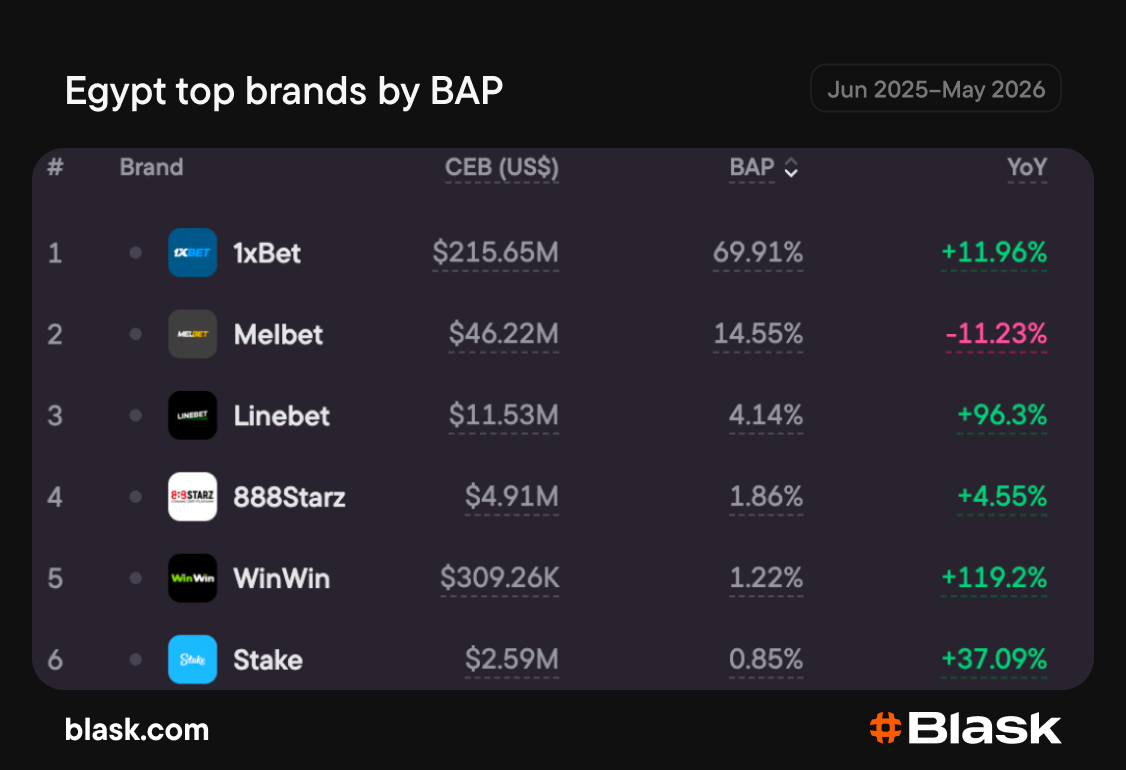
1xBet became the primary enforcement target. In 2024, parliamentary pressure forced removal of the bookmaker’s app from Egyptian Google Play and App Store; demand fell after the December 2023 peak and the intervention initially looked successful. Grey-market adaptation took just over a year, however, and by December 2025 1xBet set a new record in Egypt, with demand now up 12% YoY.
Pressure on the leader redirected traffic rather than removing it. While 1xBet was under scrutiny, Melbet’s demand rose almost fourfold over 14 months. Parliament then turned on Melbet, whose demand slipped 11% year on year — yet blocking one bookmaker only shifts players to rivals as the wider Egyptian market keeps expanding.
Outdated rules leave VPN traffic beyond reach
Egypt’s enforcement problem is structural: laws built for land-based casinos cannot contain digital offshore betting. App removals temporarily suppress visibility, but users migrate en masse to web versions via VPN, mirror domains, and social channels.
The cybercrime amendments aim to criminalize the full chain — operators, payment systems, and players. The bill still offers no practical answer on VPN traffic, however, so brand-specific blocks are unlikely to halt overall market growth while that gap remains.