- Updated:
- Published:
Betano’s World Cup 2026: where the marketing worked, and where the market did the work

Betano backed the tournament with regional FIFA rights, a national-team sponsorship and a campaign across 14 countries. An event that lifts every operator at once is also the hardest place to prove that any of it worked.
The tournament ran from 11 June to 19 July across Canada, Mexico and the United States, the first World Cup staged in the Americas since Brazil 2014. Evening kickoffs across South America made it the most watchable edition in over a decade for the region where Betano does most of its business.
The brand went in with an Official Tournament Supporter package from FIFA covering Europe and South America, a sponsorship of Argentina’s national team signed weeks before kickoff, and a campaign that launched in 14 markets on 1 June.
What that bought is harder to establish than it looks. Across its Latin American markets Betano’s search demand rose 23% over the five weeks, according to Blask data, and the figure on its own proves nothing, because a World Cup pulls every operator in a market up together. The test that survives the tournament is relative: whether the brand grew faster than the market it competes in, and by how much.
Latin America: Brazil carried the volume, the smaller markets carried the growth
Betano’s Latin American book is dominated by one country. Brazil accounted for 71.4% of the brand’s regional demand during the tournament, and the next largest market is smaller by a factor of six.
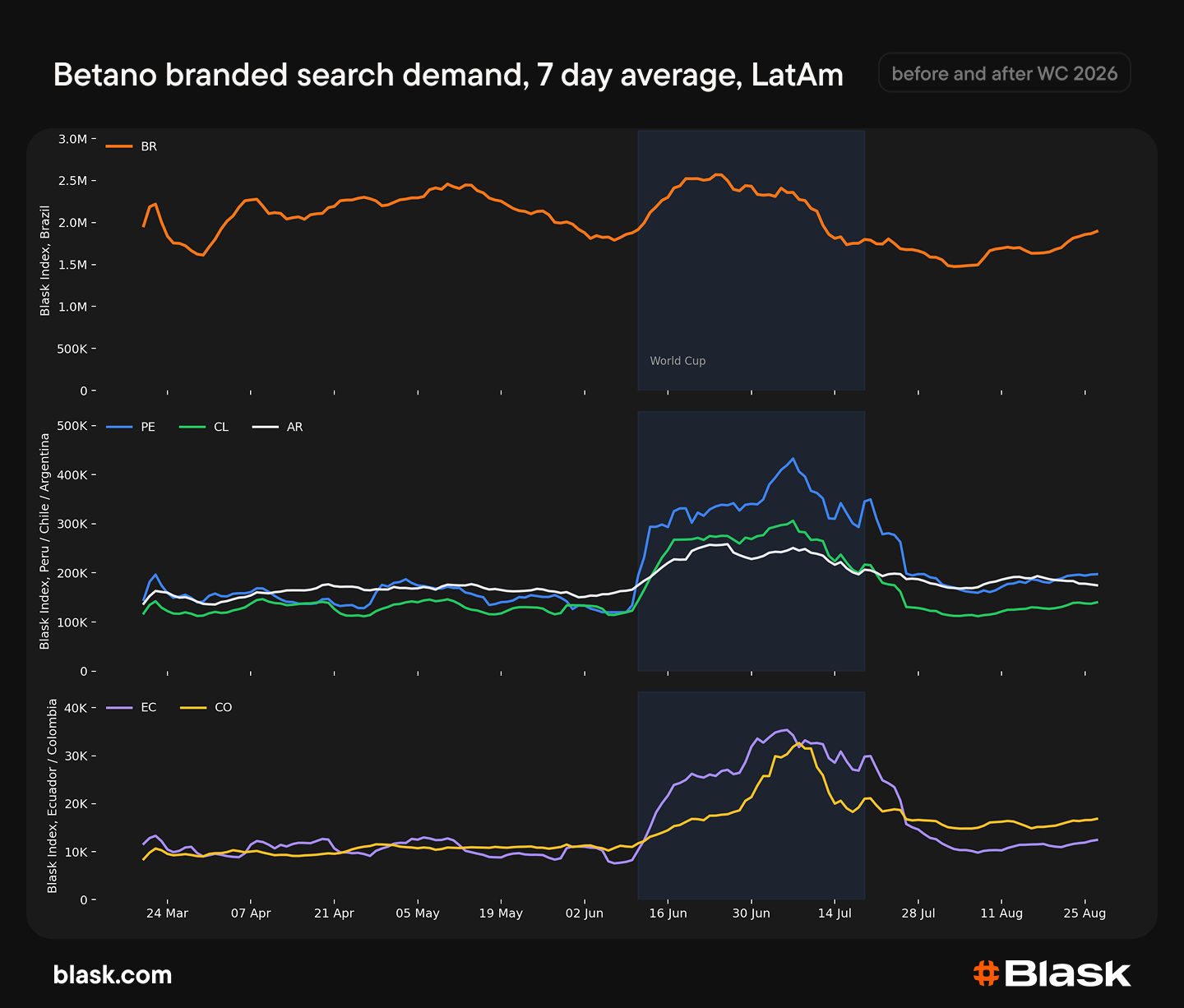
That concentration cuts both ways. Peru added more absolute demand over the five weeks than Brazil did, despite being a market a sixth of the size. Ecuador posted the steepest percentage gain in the portfolio and still added barely a tenth of what either of them contributed.
Against the market, the campaign separates into two very different outcomes.
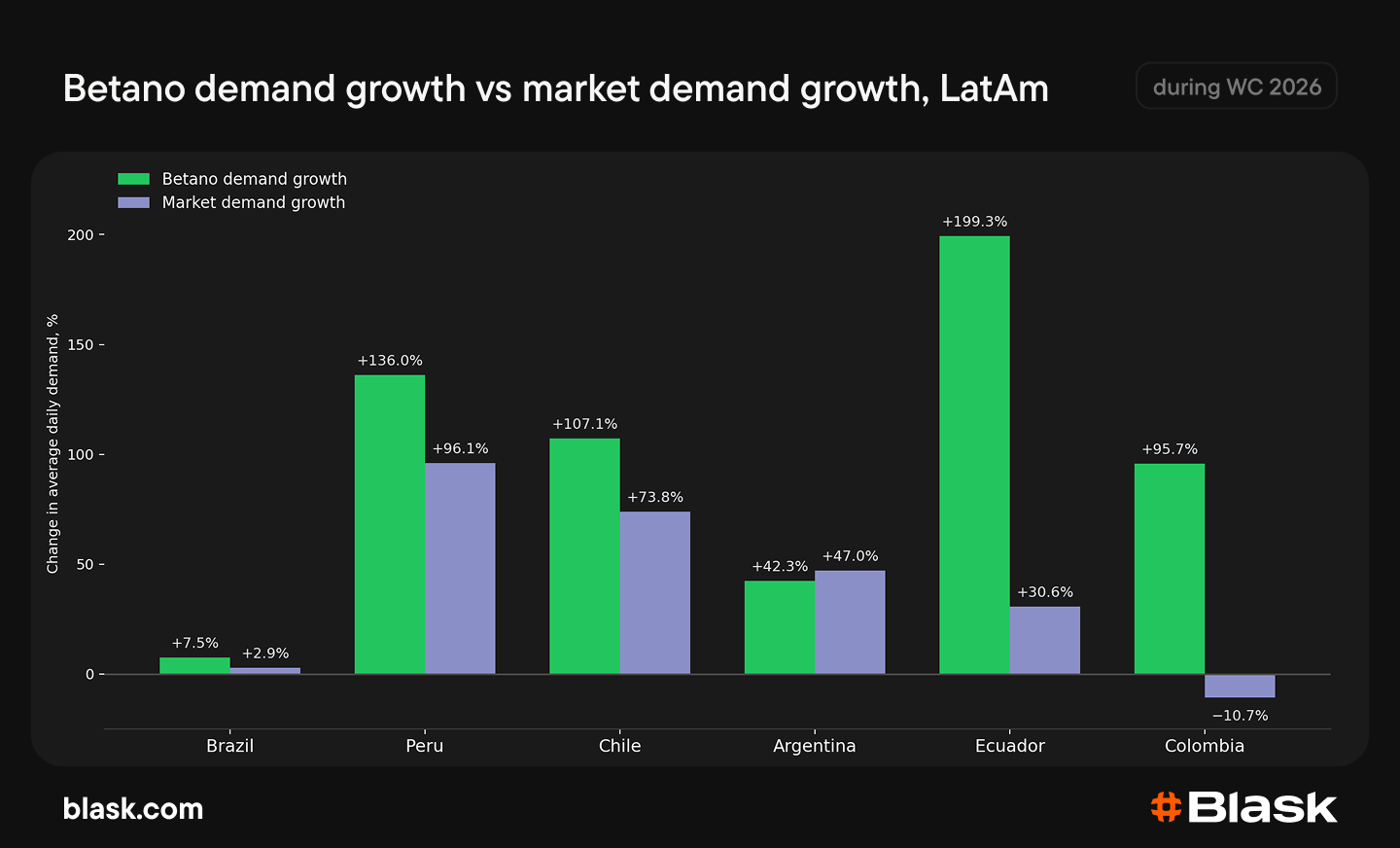
Peru, Chile, Ecuador and Colombia all outgrew their markets. Peru and Chile did it without a team in the tournament — both finished at the bottom of CONMEBOL qualifying and missed North America entirely.
Ecuador and Colombia did qualify, and Betano still outgrew both by a wide margin: Ecuador’s demand nearly tripled against a market up 31%, and Colombia’s nearly doubled while the category itself contracted. Chilean BAP, the brand’s share of all iGaming search demand in a country, moved from 50.6% to 60.3% over the five weeks, which means six in ten searches in the market pointed at a single operator.
Argentina is the exception, and it is the market Betano paid for most visibly. The national team ran all the way to the final, and that lifted every operator in the country, including those with no marketing deal to show for it.
Europe: the same rights, a fraction of the effect
The FIFA package covered Europe and South America on identical terms, and the response was nowhere near comparable. Betano’s European markets together accounted for 4% of the brand’s combined European and Latin American demand during the tournament.
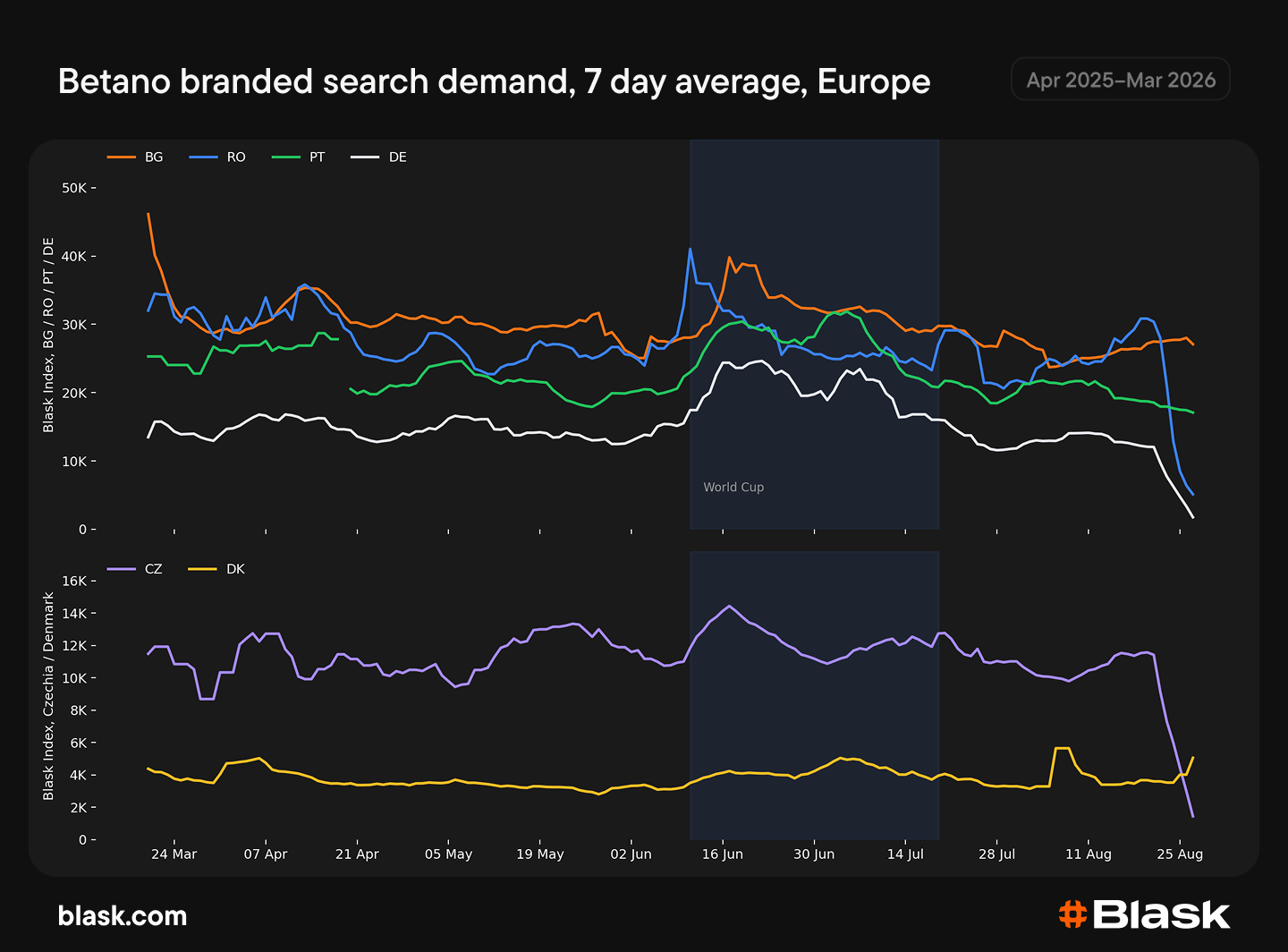
Bulgaria is Betano’s largest European market by demand and it moved the least of the six in percentage terms. Germany added the most on both measures, but the scale gap with Latin America stays wide. All six European markets combined added less new demand over the five weeks than Chile did on its own, and only marginally more than Ecuador.
The competitive picture mirrors Latin America closely, with a few markets where Betano pulled away from the category and one where it simply rode it.
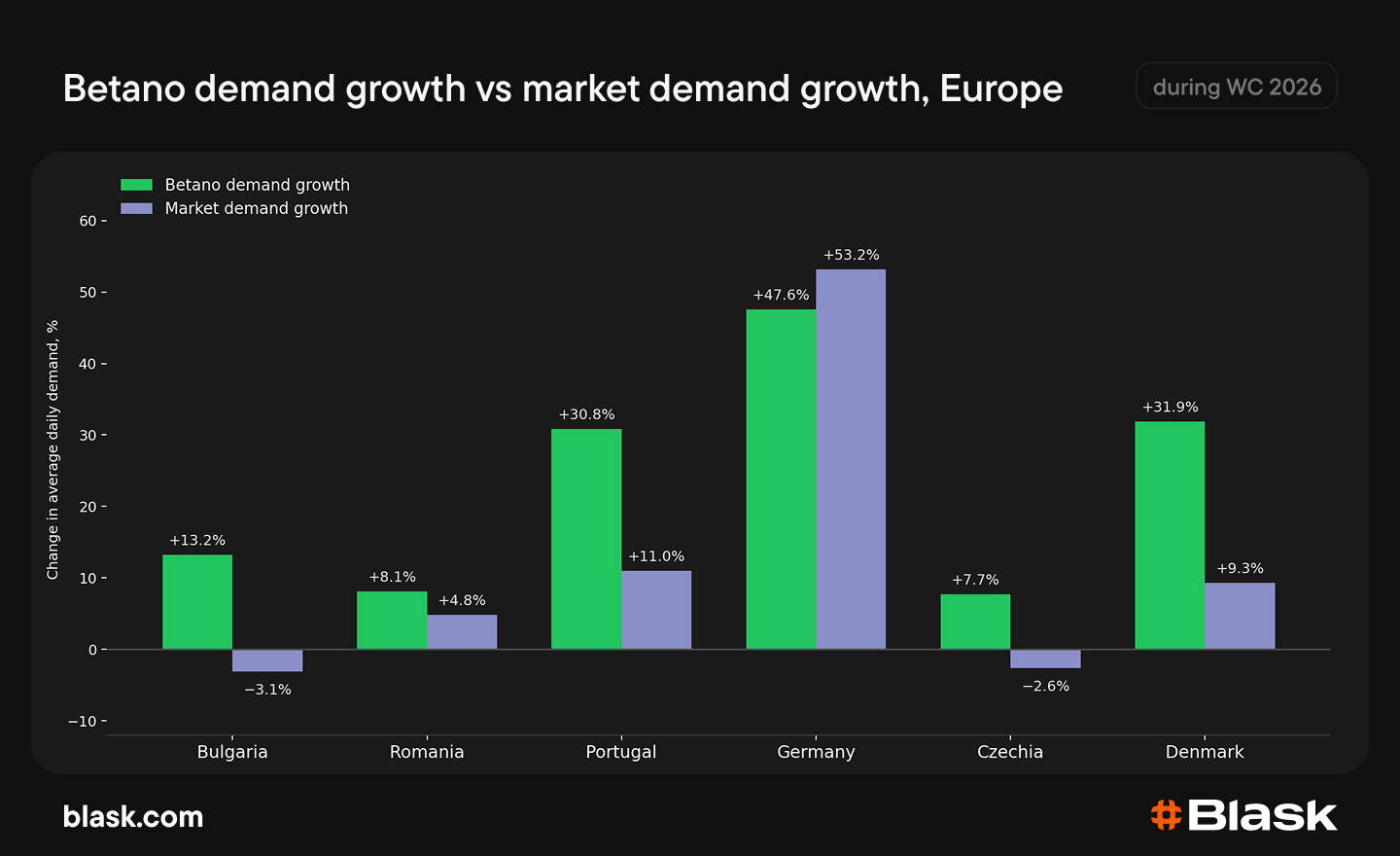
Portugal is the European version of Ecuador — a decisive gain against a market that grew far more slowly, with BAP rising from 21.2% to 25.0%. Denmark followed the same pattern: demand there rose 31.9% against a market up 9.3%. Germany is the European version of Argentina, where strong brand growth still trailed a faster-growing category, so the tournament carried Betano along without moving it past anyone. Bulgaria and Czechia took ground from markets that were shrinking, though the volumes involved are small enough that the share gain matters more than the demand behind it.
Bottom line
On the relative test the campaign worked in most places: Betano grew faster than its own market in ten of the twelve countries examined. The two exceptions are Argentina, whose team reached the final, and Germany, where the category outpaced the brand by roughly six percentage points. Backing the deepest run of the tournament bought Betano reach in Argentina without buying separation from the operators that paid for nothing.
The widest margins over the market came from Ecuador and Colombia off small bases, and the largest among the major markets from Peru and Chile, neither of which had a team in the draw. Nowhere did the tournament lift the brand and its rivals equally: the gap between the two ran from six points against Betano in Germany to well over a hundred in its favour in Ecuador. Five weeks is a short window to judge a deal built on a longer association, so the open question is whether those margins hold through a year with no tournament to defend them.