
- Updated:
- Published:
India’s betting ban left 63% of players betting offshore, and Brazil is next
India’s betting ban was meant to close the market. Blask data shows it closed the legal side only. Domestic real-money sites lost 73% of their reach within three months of the August 2025 law, yet 63% of the players who had used them were still betting, 61 of every 100 on offshore sites.
Brazil is now in the same position. Provisional Measure 1.394 took effect on September 25, 2026. Blask followed the same Indian internet users before and after India’s ban, with Brazil as a control market, and then tracked Brazil’s own first days.
How Blask followed the same players
Blask measured behavior directly, through an opt-in panel of people who agreed to share browsing data. The panel held 13,700 to 111,000 people in India and 25,000 to 72,000 in Brazil over the period.
The core comparison uses a fixed cohort: every panelist seen on at least five days both before India’s ban (June 1 to August 19, 2025) and after it (September 1 to November 30, 2025). The panel grew roughly eightfold in India and threefold in Brazil over the period, so every trend in the report is either indexed to Brazil or measured on the same fixed group of people.
| Market | Panel size over the period | Fixed cohort |
|---|---|---|
| India | 13,700–111,000 | 19,924 |
| Brazil | 25,000–72,000 | 31,785 |
Domestic sites lost 73% of reach, but players kept betting
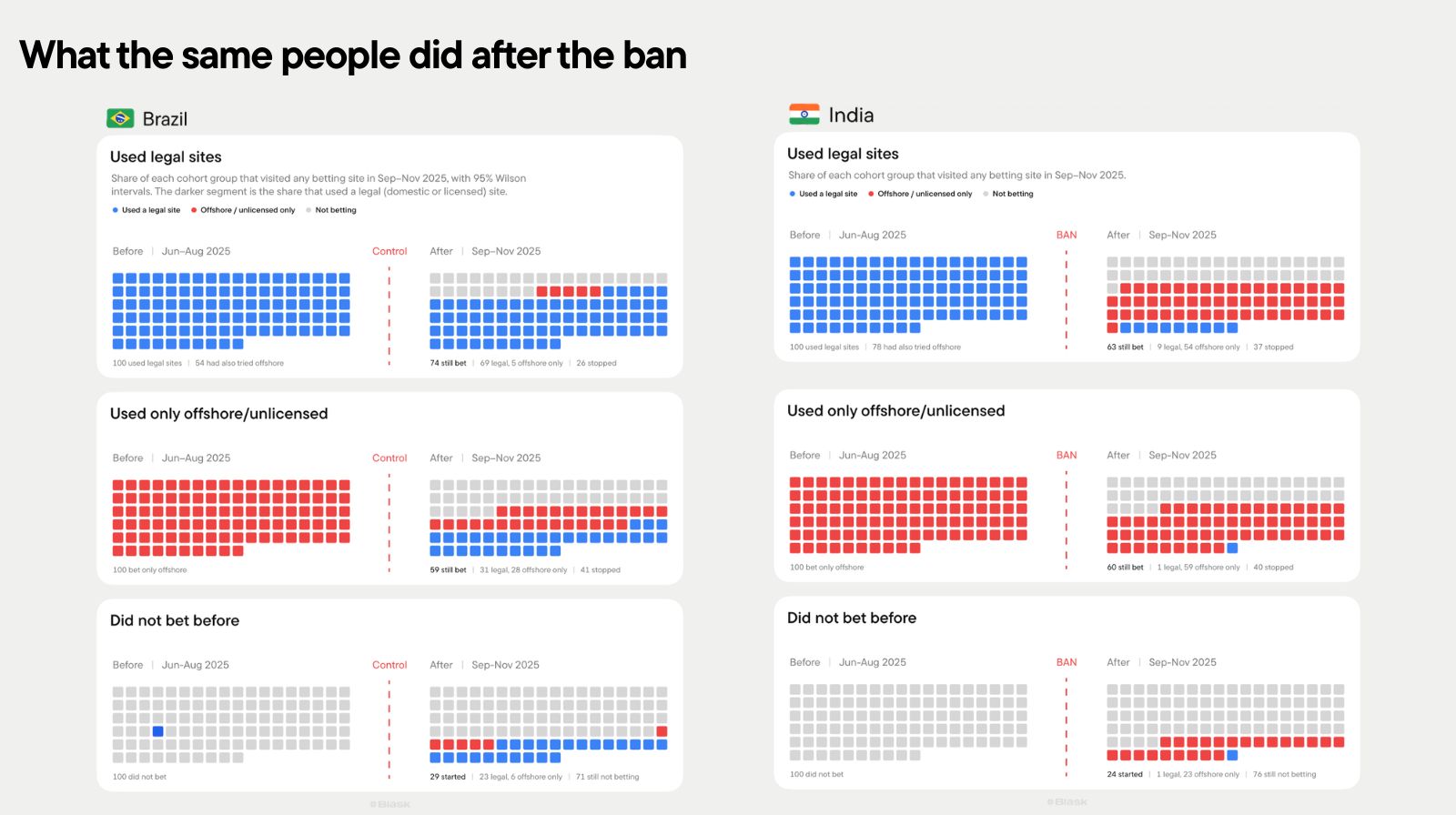
In India, domestic real-money sites lost 73% of their reach within three months. Of 100 Indians who had used legal sites before the ban, 63 were still betting afterward, and 61 of them used offshore sites.
Brazil had no ban in the period, so it shows what betting behavior looks like when nothing changes. There, 74 of 100 players were still betting over the same window. Three months after its ban, India was at 86% of that rate.
💡 Key point: the legal market in India lost 73% of its reach, yet most of the people who used it kept betting.
Offshore use did not fall after India’s betting ban
Indian panelists who had only ever used offshore sites kept betting at 59.8% after the ban. The equivalent Brazilian group, with no ban at all, was at 59.0%.
India blocked 8,376 URLs over the period. Offshore reach still held level with the control.
Acquisition moved to channels nobody audits
The way players reached offshore operators changed more than the number of players. Between the two periods, the mix of traffic sources into India’s offshore sites shifted like this:
- Search engines: from 16% to 8% of visits
- Pop-under ad networks, redirect trackers and pirate streaming sites: from 21% to 41% of visits
Players stopped finding betting sites through Google and started arriving through advertising networks. Those networks are harder for a regulator to monitor than search results.
Why Brazil is moving faster than India
By Thursday, October 1, six days after the measure, the share of Blask’s Brazilian panel visiting a licensed site was 74% below normal. India took three months to reach a comparable point. The day-by-day figures are in our look at licensed betting sites in Brazil.
Brazil bans the same products offshore operators already sell. Brazilian players need a new address, not a new product.
📚 Read more: Brazil’s betting ban lifted offshore search to 11.3% in five days
Blask expects Brazil to follow the same pattern as India, and faster. This is an inference from India, not a measurement of Brazil.
What the India precedent shows
India’s evidence points in one direction. A ban removes the legal market quickly and leaves demand in place. What changes is where players go and how they find it.
The full comparison, with the complete panel analysis and methodology, is in Blask’s report on Brazil’s betting ban.


“`