
- Updated:
- Published:
Blask’s path to a novel metrics breakdown framework for local and international iGaming brands

Blask’s updated CEB framework brings clarity to local and international iGaming brands. By combining AI, regulatory data, and market metrics, it helps operators optimize strategy and benchmark success with greater accuracy.
In regulated markets, iGaming brands typically fall into two categories — local and international. This distinction matters, especially where laws and compliance rules differ between jurisdictions.
- Local brands are licensed and regulated within the country where they operate. They follow national laws, pay taxes, and often report financial results to local authorities. While these brands benefit from legal transparency and player trust, they also face stricter operational rules.
- International brands, on the other hand, operate in regulated markets without holding local licenses. Many are based in more lenient jurisdictions or hold licenses elsewhere. As a result, they may avoid taxes or some compliance costs. However, they must also work harder to build trust and manage legal risk.
This distinction shapes the methodologies used to calculate Competitive Earning Baseline (CEB), as the availability of data and the operational context vary greatly between local and international brands.
📌 To understand market potential and brand performance in iGaming, accurate CEB estimates are crucial. But local and international brands operate in very different conditions — and one method alone can’t reflect that complexity.
That’s why, at the start of 2025, Blask launched a major update to its Competitive Earning Baseline (CEB) methodology. This update introduced powerful new tools and expanded data sources for even more accurate projections.
Here’s what’s new:
🔍 Multilingual regulatory analysis — Our system now processes reports in multiple languages to extract insights from licensing structures worldwide.
💡 Gambling tax data integration — We now include country-specific tax frameworks to fine-tune revenue estimates.
📊 Alignment at both country and brand level — Blask connects local conditions with broader benchmarks to show how brands really perform.
Together, these improvements ensure that every CEB projection reflects the market it represents — whether it’s shaped by strict local rules or cross-border competition. The result? Sharper insights, smarter comparisons, and a better view of real brand potential.
How Blask calculates CEB for local brands.
Local brands follow strict regional rules. That means we can access detailed, reliable data — the perfect foundation for accurate CEB estimates.
Here’s how it works:
- Start with country-level data
Blask gathers reports from regulators, gambling commissions, and official publications. These sources often include verified GGR (Gross Gaming Revenue) figures for the entire market. - Use AI to process complex reports
Our system scans multilingual documents, charts, and tables to extract useful data. It also pulls in tax rates to reflect each market’s true revenue conditions. - Calculate brand-level market share
Blask uses two key metrics — Acquisition Power Score (APS) and Average Revenue Per User (ARPU) — to estimate each brand’s position in the market. - Align brand CEBs with the total GGR
Once the market total is set, we make sure no brand’s CEB exceeds it. If a brand publishes financial data, we use it directly. If not, we distribute the remaining value proportionally using its APS and ARPU.
This method keeps CEB grounded in reality — always tied to real data, verified sources, and clear market logic.
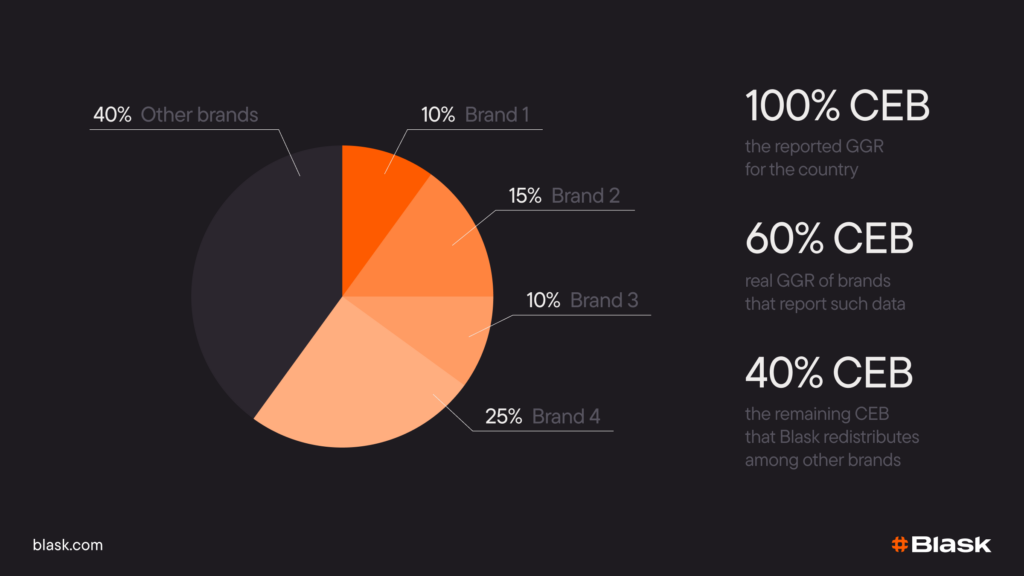
💡 Blask blends verified data and AI to get it right.
By combining real market data from regulators with smart AI analysis, Blask delivers CEB estimates that are both precise and trustworthy. This gives local brands a clear, reliable benchmark they can actually use to plan and grow.
How Blask calculates CEB for international brands.
Unlike local brands, international operators don’t follow the same regulations — and they rarely publish detailed financial data. This makes estimating their CEB more complex.
To solve this, Blask relies on behavioral signals. We use the Blask Index, which tracks search trends and player activity, to measure brand engagement. Then, we apply ARPU benchmarks (Average Revenue Per User), adjusted for each region.
By combining ARPU with APS and engagement data, Blask delivers a reliable CEB estimate — even in markets where brands avoid traditional oversight.
💡 In short: we already know the ARPU and APS for local brands. That allows us to apply the same logic to international brands — using their APS and market share to calculate a fair CEB.
How licensing data appears on the Market Overview page.

Blask makes it easy to see who’s licensed — and who isn’t.
On the Market Overview page, every brand has a badge:
- ✅ LOC – fully licensed locally for all verticals
- ⚠️ MIX – licensed in only one vertical (casino or betting)
- ❌ No badge – treated as an international operator
In unregulated markets, all brands are considered international by default.
You can hover over any brand to see details like license type (casino, sports betting, or mixed), regulatory authority, and expiration dates — all in one view.
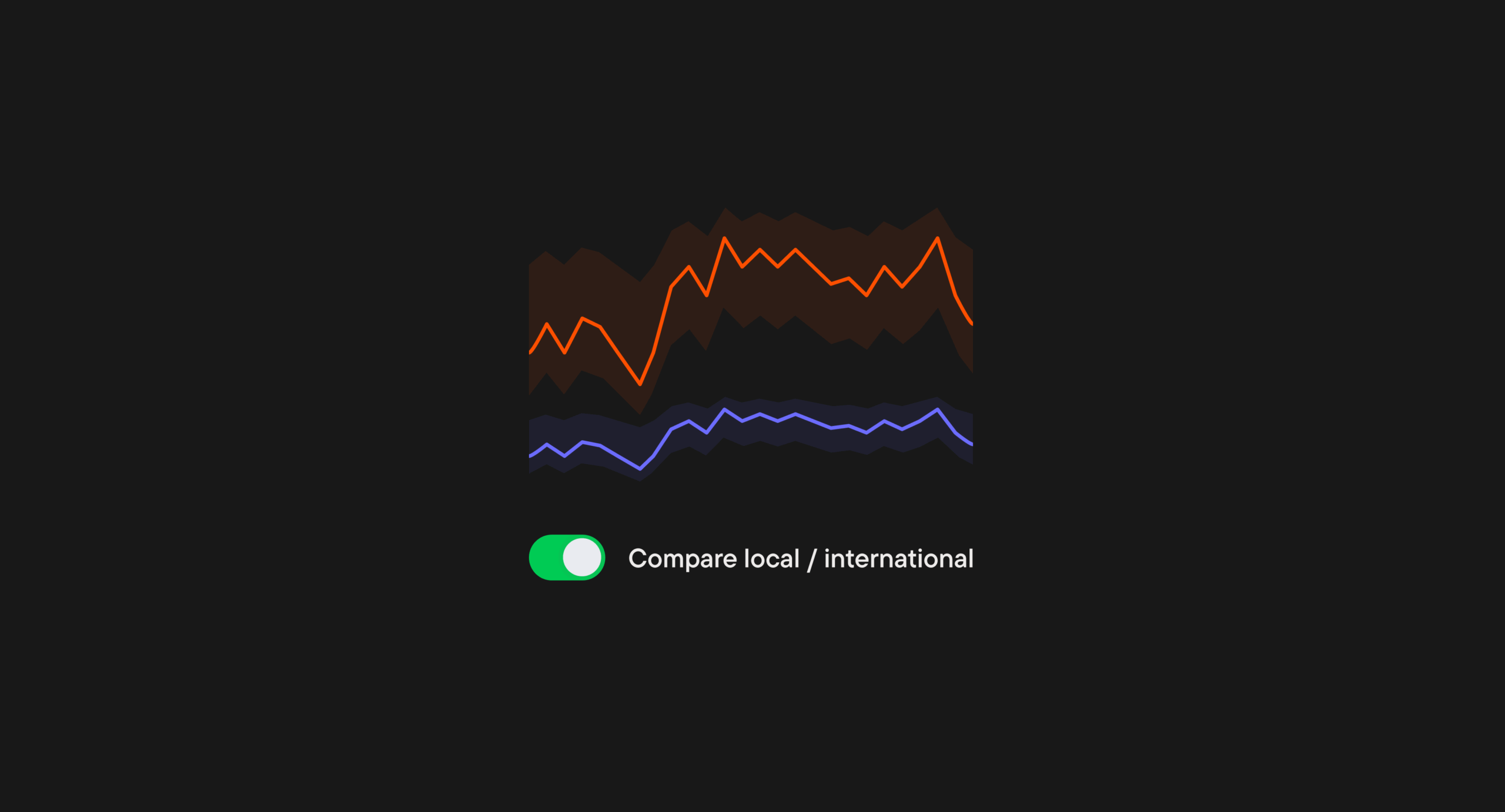
Compare local vs international brands by metric.
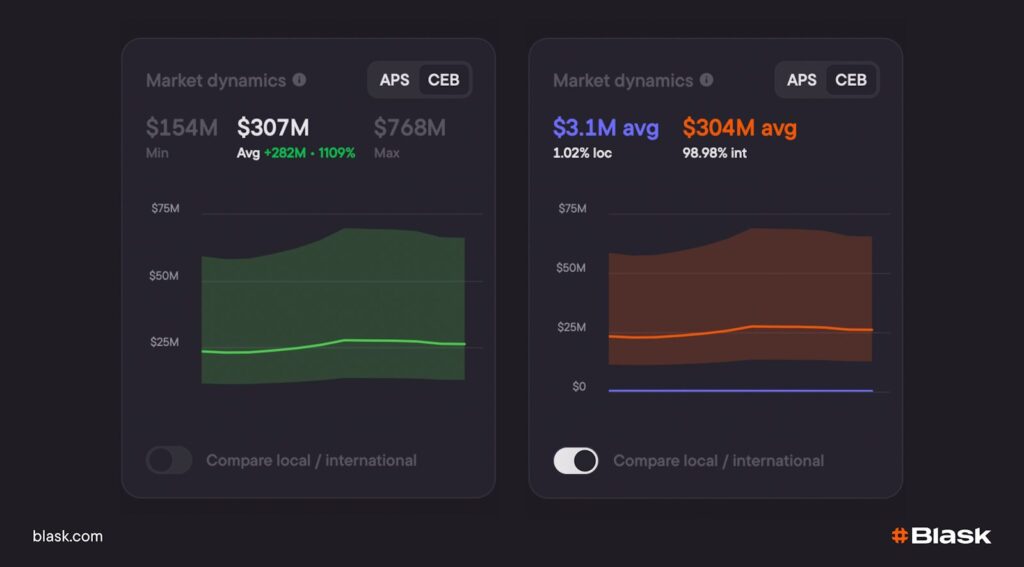
Still on the Market Overview page, you can toggle between APS and CEB charts.
Want to see the total market structure? Use the “local vs international” filter to compare how much player attention and revenue belong to licensed brands versus offshore ones.
Why choose Blask for CEB and APS insights.
Blask doesn’t just guess — it explains how your market actually works.
Our AI-driven platform blends verified regulatory data with player behavior, giving operators the most relevant, real-time view of their competitive environment.
Here’s what makes Blask different:
🔍 Market structure insights
See exactly how revenue splits between local and international brands.
🌍 Localized accuracy
We use real data from regulators, tax reports, and commissions — not estimates.
📈 Cross-market benchmarking
Compare brand performance across countries with a consistent, transparent framework.

What makes Blask unique?
- 🔍 Market structure analysis: Understand how revenue is divided between licensed local operators and unlicensed international brands.
- 🌍 Localized accuracy: Leverage verified data from regulatory reports, gambling commissions, and tax frameworks for precise calculations.
- 📈 Cross-market comparisons: Benchmark performance across jurisdictions to identify the most profitable opportunities.
Real-world applications:
- Strategic expansion: Identify high-potential markets for entry with country- and brand-level insights.
- Optimized marketing: Allocate budgets to campaigns delivering the highest CEB or APS growth.
- Investor transparency: Use reliable CEB and APS metrics to showcase brand performance and growth potential.
- Regulatory clarity: Visualize the role of licensed and unlicensed operators within regulated markets.
Don’t rely on outdated metrics. Blask equips you with the tools to understand your market, optimize strategy, and grow — whether local or global. 🚀