
- Updated:
- Published:
Football fever in casino lobbies: what the Blask data shows

Major football tournaments create a visible shift inside casino lobbies.
As attention grows, operators move themed content closer to the surface, but not every rise comes from a campaign push. For Blask, the useful question is which titles were already gaining space before the market peaked, and which appeared only once the event was in full swing.
This case study looks at that question through a set of football titles that grew in Blask’s data. It was not one game riding short-term placement. Several titles from the same franchise moved up together: they started before World Cup demand peaked, then accelerated during the event, a pattern more consistent with organic operator interest than with a single campaign.
How Blask reads football demand
Before major tournaments, Blask captures baseline visibility across the football games category. This helps separate what was already growing before the event from what moved only once tournament demand became active.
Promo-led growth usually appears around a campaign push and fades within 10-14 days after it ends. Organic visibility behaves differently: it starts earlier, builds more gradually, and is not tied to one short promotional window.
In this cycle, Blask detected several Penalty Shoot-Out titles gaining attention 8-10 weeks before the World Cup started. When the tournament began, the movement accelerated.
Before the World Cup: early movement across two markets
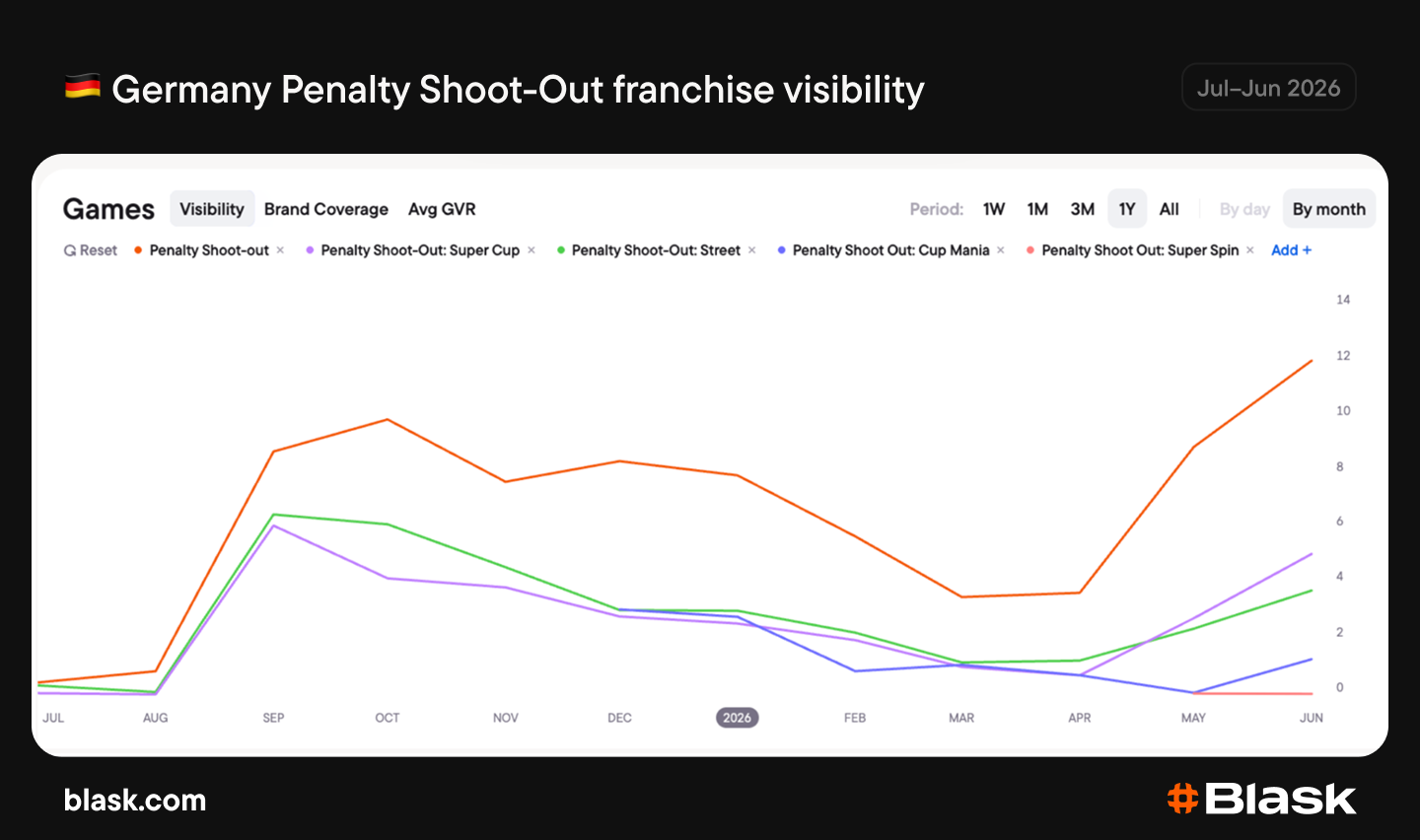
In Germany, the core Penalty Shoot-Out title moved from a winter low of 3-4% in visibility to around 12% by the tournament start. For Blask, this was not a typical lifecycle curve: the game did not simply decline after its earlier launch period, but recovered strongly before tournament demand became the main driver.
Brazil showed the franchise movement from a different angle. Since the market entered its regulated phase in January 2025, promotional activity has been stronger than the European norm, making organic visibility harder to separate from campaign-driven spikes.
Still, Blask detected several Penalty Shoot-Out titles holding lobby exposure at the same time, with no promo events in the data explaining the movement: Penalty Shoot-Out moved to 5%, Penalty Shoot-out: Street stabilised at 3.5-4%, and Penalty Shoot-Out: Super Cup held 0.8-1.2% instead of falling back to zero.
Together, Germany and Brazil showed that pre-tournament visibility was not limited to one game. Germany pointed to a rare recovery before the event, while Brazil showed a portfolio shelf effect, with several titles from the same football franchise earning lobby space before the World Cup became the main demand driver.
During the World Cup: tournament demand amplified the movement
Once the World Cup was active, the Penalty Shoot-Out franchise did not move as a single-game story. Blask’s data showed several titles reacting across different markets, but the shape of the growth depended on the local lobby context.
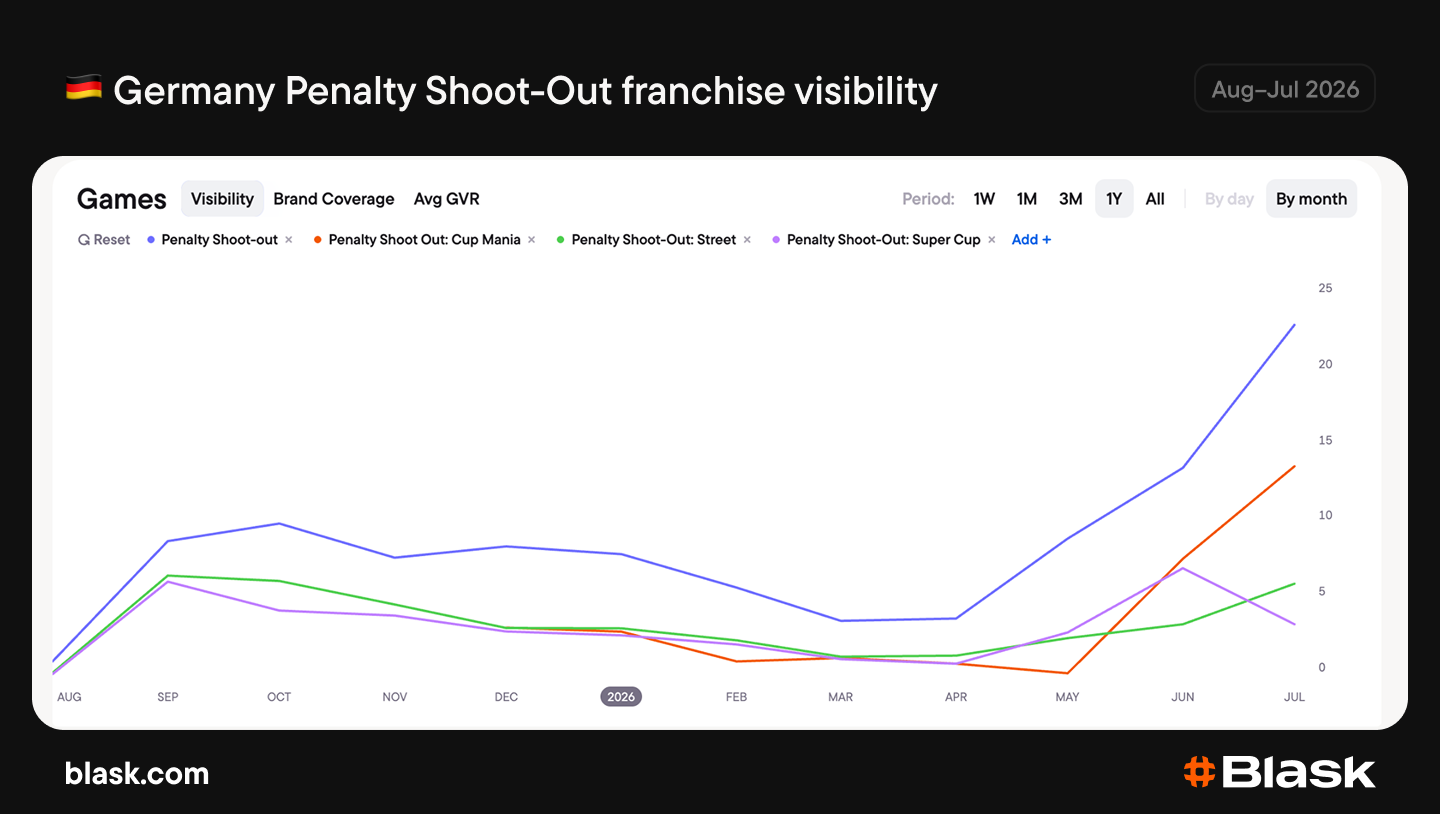
In Germany, the core Penalty Shoot-Out title continued its rise during the tournament, moving from around 12% at the start to roughly 22% by July. Penalty Shoot-Out: Cup Mania also accelerated sharply, reaching around 16-18% in visibility, while Penalty Shoot-Out: Street moved up to around 5%. Penalty Shoot-Out: Super Cup remained visible, although it eased after its June peak.
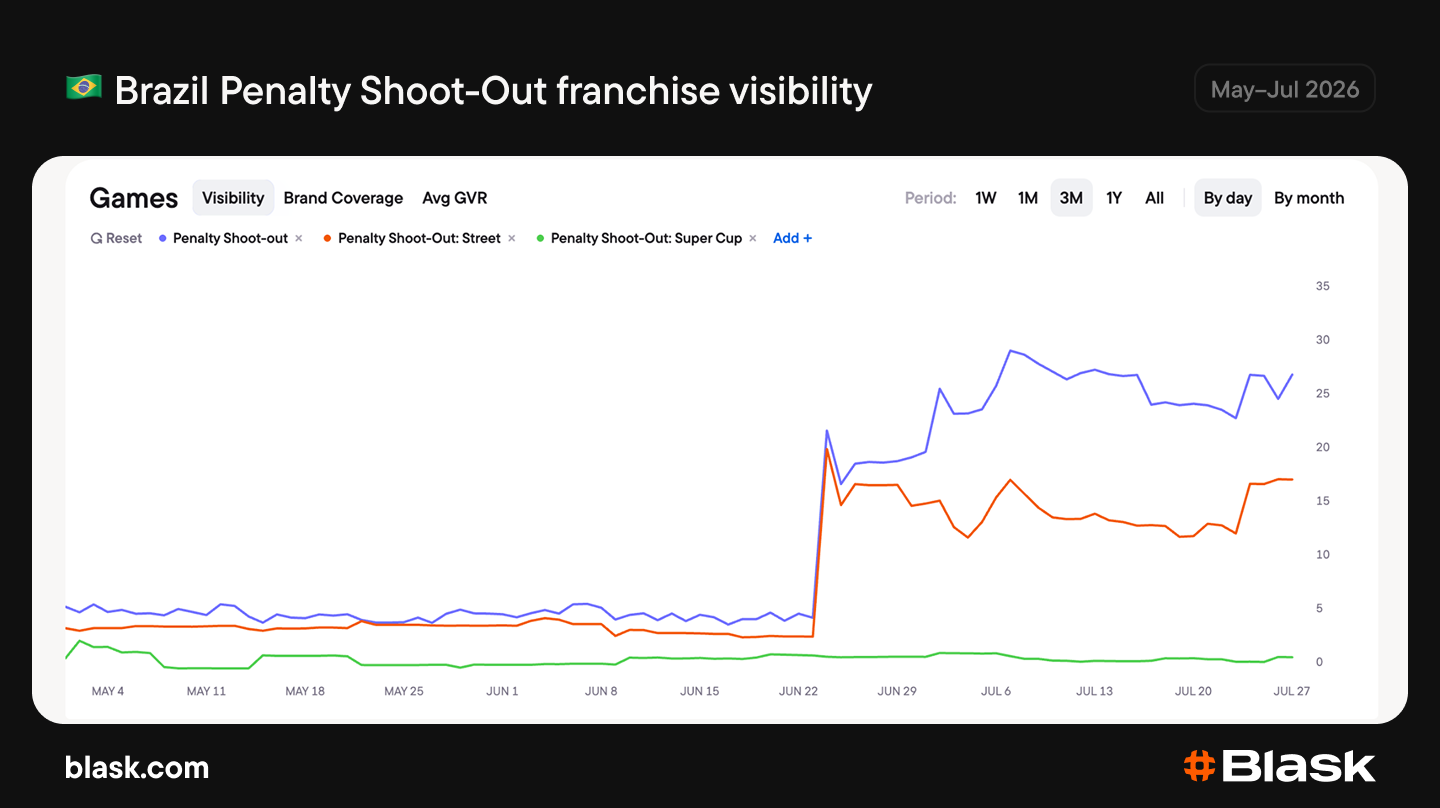
Brazil showed a stronger in-tournament jump. The core title and Penalty Shoot-Out: Street moved from low single-digit visibility into double-digit levels after late June, with the former reaching roughly 25-30% in July and the latter holding around 13-17%. This created one of the clearest examples of the franchise becoming a visible football shelf during the tournament itself.
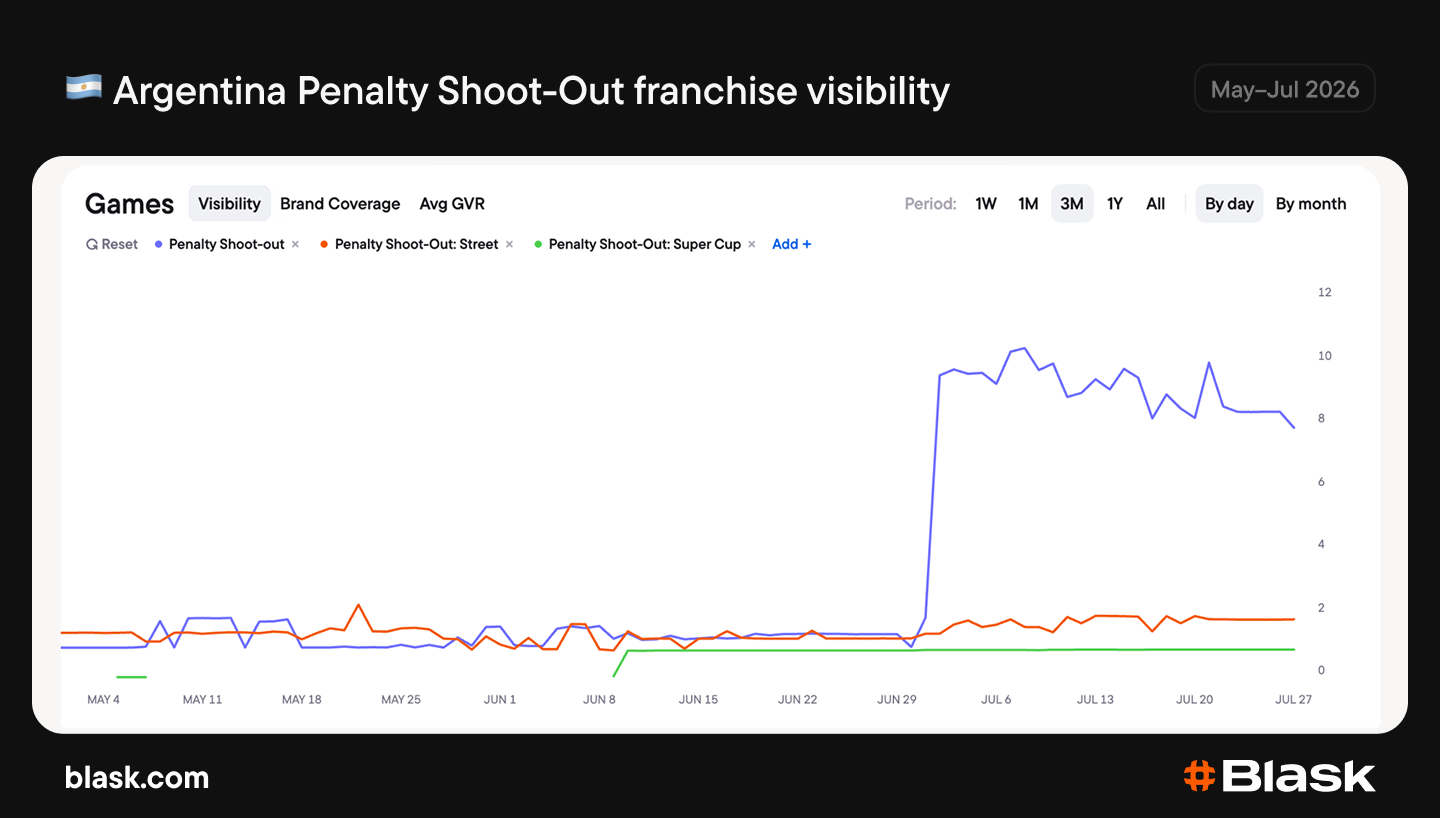
In Argentina, the movement was more concentrated around the core title. Around the start of July, Penalty Shoot-Out jumped from below 1% to around 9-10% in visibility and then held close to that level through mid-July.
Italy showed a smaller but still visible recovery, with the core title rising again in July after a lower May period.
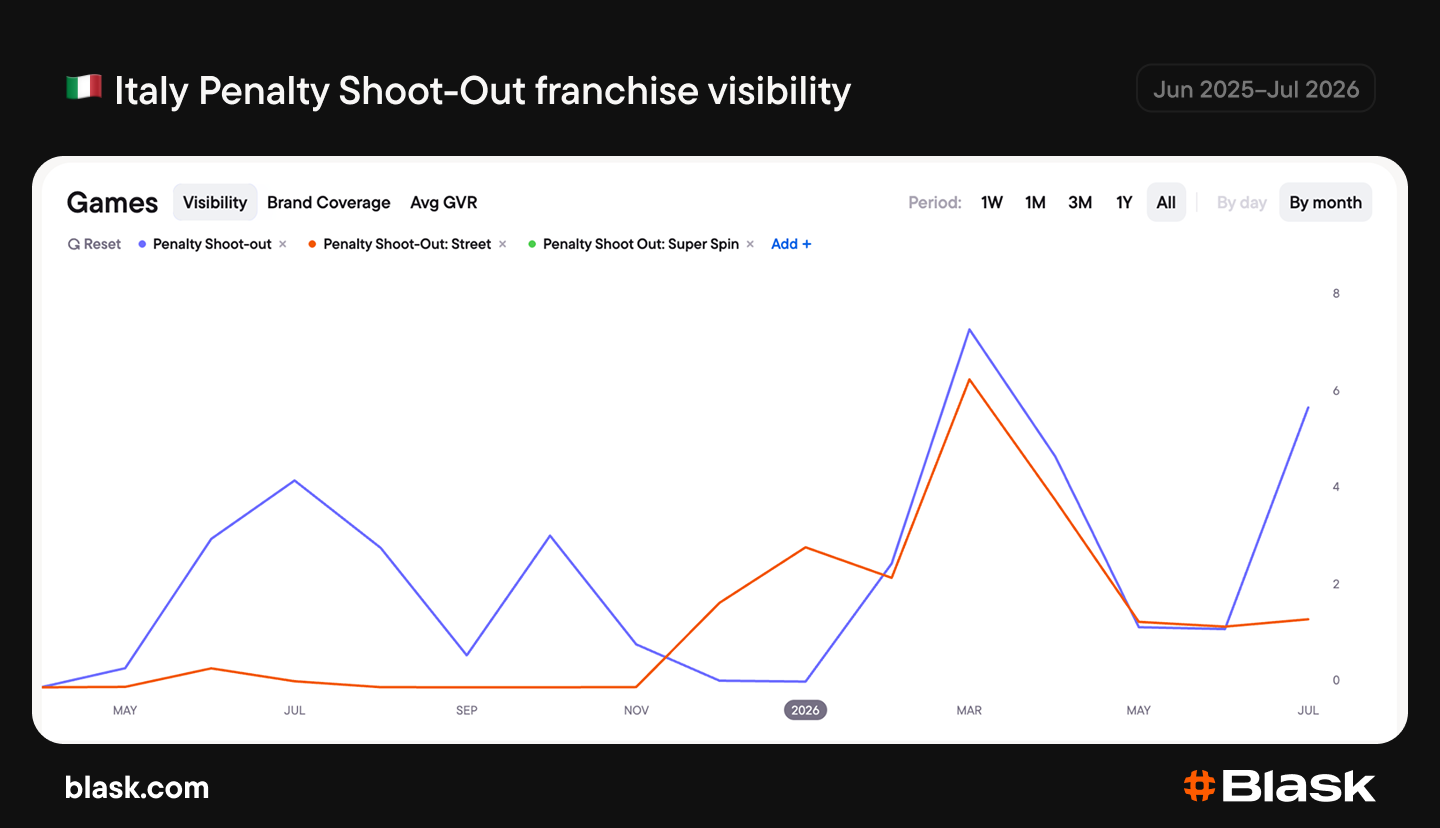
Across these markets, the World Cup did not create one identical curve. It amplified an existing franchise in different ways: a broader shelf in Germany and Brazil, a core-title breakout in Argentina, and a more selective recovery in Italy. The movement appeared across multiple geos and titles, with no special promo events detected in Blask data.
The first Penalty Shoot-Out title already proved the value of this format during the 2022 World Cup cycle. Activity grew by 6.5x, while rounds increased by around 300% during the tournament and by about 500% after the final. The data confirmed that the strongest opportunity can appear in the post-event window, while football emotions are still fresh.
Anastasiia Yakovykh, Product Marketing Lead at Evoplay
What operators can read from the curve
For operators, the value here is timing: when growth started, how it built, and whether it stayed in one title or spread across the franchise. A title that gains lobby space only during a tournament reads as a short seasonal response. When several games from the same franchise are visible before the event and then expand across markets during it, the pattern becomes something you can plan around.
The takeaway is that football-themed content does not need to wait for the tournament peak. Operators that placed the franchise earlier had more room to build visibility before demand intensified, then rode the wider attention once the World Cup was live.
The World Cup has ended, but football titles have not left the lobbies. That is the next point on the curve: the peak is over, but part of the attention is still live. Blask will keep tracking the coming months to see how much of this visibility holds.