- Updated:
- Published:
How February performs across global iGaming markets

February’s calendar disadvantage is obvious, but the weakness goes beyond the missing days.
In more than half of 126 markets Blask currently tracks, February ranks among the bottom three for player activity. The weakness is not regional, and it is not simply about brevity. The 2024 leap year produced the worst Blask Index performance of the period.
Consistent underperformance
Blask seasonality data for the past three years shows February as one of the most consistently underperforming months globally. On a 2023–2025 average, it sits in the bottom three in 65 markets spread across the globe. In 26 of them, it was the single weakest month.
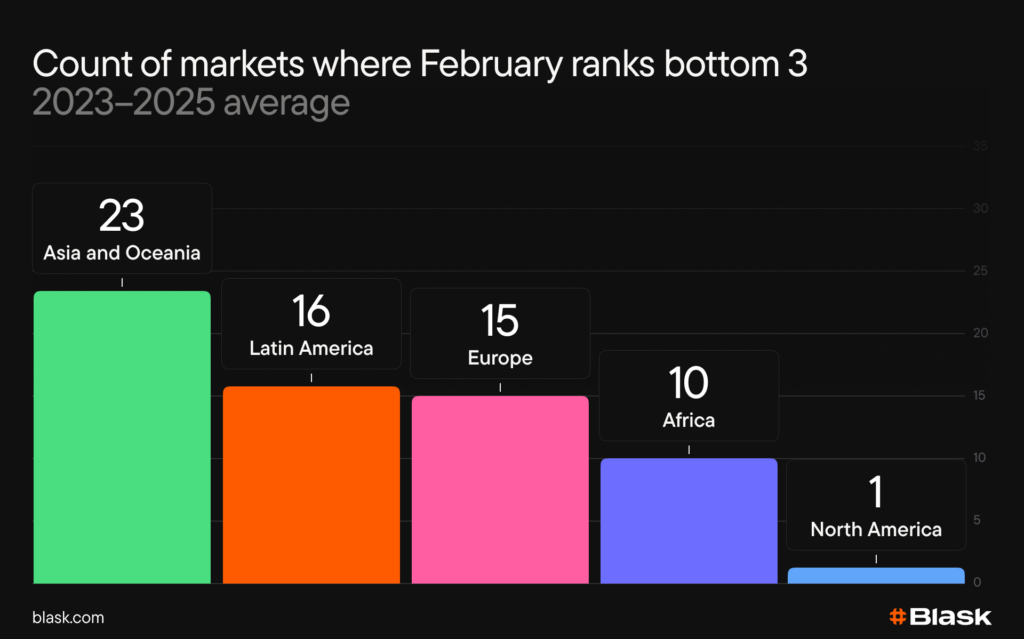
19 markets kept February in the bottom three every year from 2023 to 2025, mostly in Asia and Latin America. Only one of them was European (Sweden), and only one African (Algeria).
Extra day made it worse
If February’s weakness was purely a function of its brevity, the 2024 leap year should have softened the blow. The opposite happened.
That year, February ranked in the bottom three in 80 markets — nearly two-thirds of the total. In 43 of them, it was the weakest month outright. Both figures represent the sharpest decline in the three-year period.
Eight markets placed February last in both 2024 and 2025: Bangladesh, Bolivia, Bulgaria, Cambodia, Lithuania, New Zealand, Saudi Arabia, and Spain.
The handful of strong markets
Spain is a special case. In 2023, February was Spain’s strongest month. Then it became the weakest in both 2024 and 2025. Yet the three-year average still shows it as a top-three performer.
Besides Spain, there are five more markets where February ranks in the top three on a 2023–2025 average: Democratic Republic of the Congo, France, Japan, Singapore, and Tunisia. Only Tunisia keeps it there across all three years.
On a three-year average, February outperforms January in exactly half of all markets. But the pattern swings wildly by year. In 2023, the second month beats the first in 95 markets. In 2024, that number collapsed to just 30. In 2025, it rebounded to 89.
What the pattern reveals
February’s weakness is not about length — otherwise 2024 should have been better. The underperformance is structural, not calendar-driven. And where the month does perform well, consistency is rare. Collapse in Spain from first to last shows how quickly the exceptions can fall apart.