
How two days in February turned Norway into one of Europe’s most active iGaming markets — and what the brand data reveals about who actually benefits when a country goes all-in on sports.
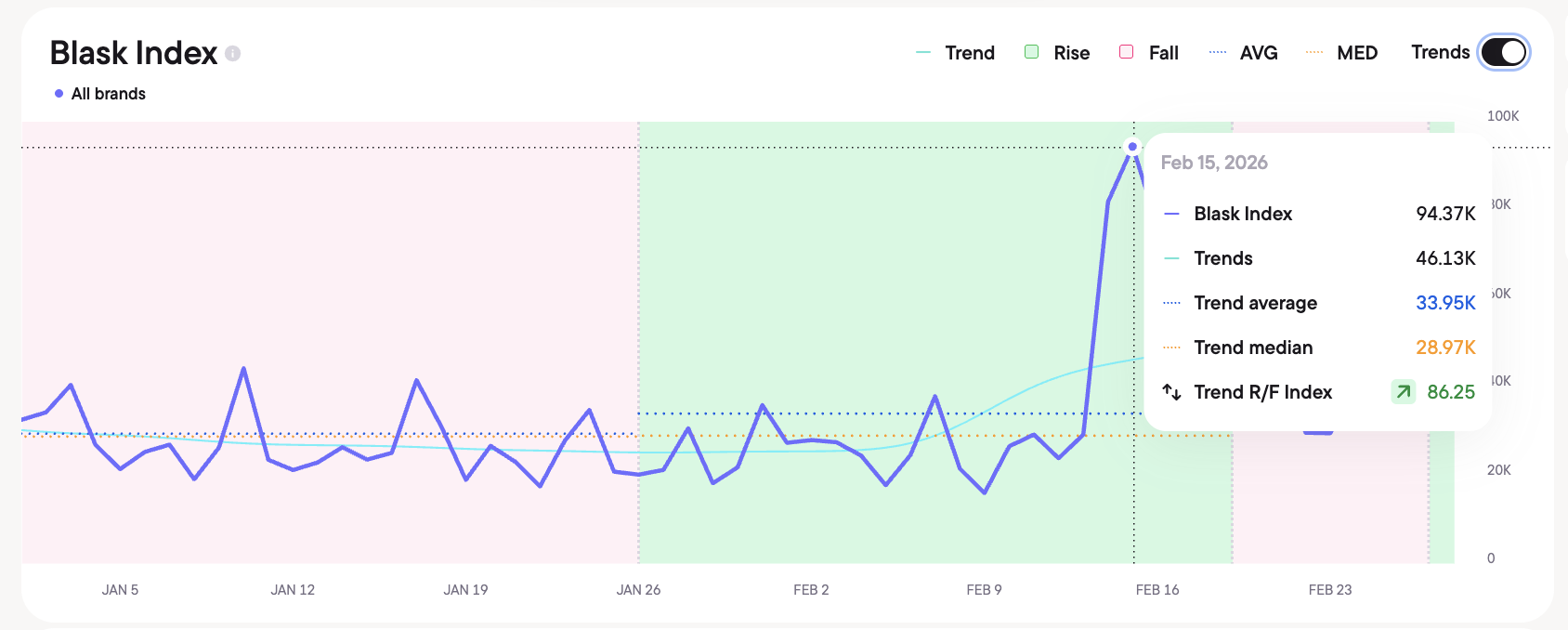
On most days in early 2026, Norway’s total iGaming demand — as measured by the Blask Index — runs around 34K. On February 15, it hit 94.37K.
That’s not a data anomaly. It’s what happens when a country of 5.5 million people watches its athletes dominate the Winter Olympics in real time and immediately goes looking for something to bet on.
The spike lasted two days. Both were directly tied to Norwegian gold medals in Italy. And the brand breakdown tells a story that goes well beyond sports betting volumes.
What the Blask Index measures
The Blask Index is a demand signal built from search activity across iGaming brands in a given market. It captures behavioral intent — people actively looking for operators, odds, games — before that activity converts to bets or revenue. When it spikes, it means players are actively searching, not that platforms reported higher deposits.
That distinction matters here. The Index tells us where Norwegian players looked, not just where they eventually landed.
February 15: Norway’s biggest Olympic day in decades
On February 15, 2026, Norway delivered its best single day of competition at the Milano-Cortina Winter Games.
Johannes Hoesflot Klaebo led Norway to gold in the men’s 4×7.5km cross-country relay, claiming his record ninth career Olympic gold and becoming the most decorated Winter Olympian in history. His teammates Emil Iversen, Martin Løwstrøm Nyenget, and Einar Hedegart completed the sweep. Hours later, Anna Odine Strøm won Norway’s second gold of the day in women’s large hill ski jumping — her second gold of the Games.
Norway led the total medal table with 22 medals and 11 golds at the close of play. On prediction markets, Polymarket had already assigned Norway a 79% probability of topping the gold medal leaderboard.
The Blask data captured what that national mood translated into. Total iGaming demand jumped to 94.37K — nearly three times the trend average of 33.95K and well above the trend median of 28.97K. The Blask Trend R/F Index, which measures how sharply a spike rises relative to what came before, registered 86.25. That’s a high-grade event signal.
Who captured the demand
The total volume is one story. The brand breakdown is a different one.
On February 15, two offshore operators — LiliBet and Gamdom — together took 76.8% of Norway’s iGaming demand. LiliBet held 42.54% of the market by BAP (Brand Accumulated Power, Blask’s measure of how much of a market’s total player attention each brand controls). Gamdom held 34.29%.
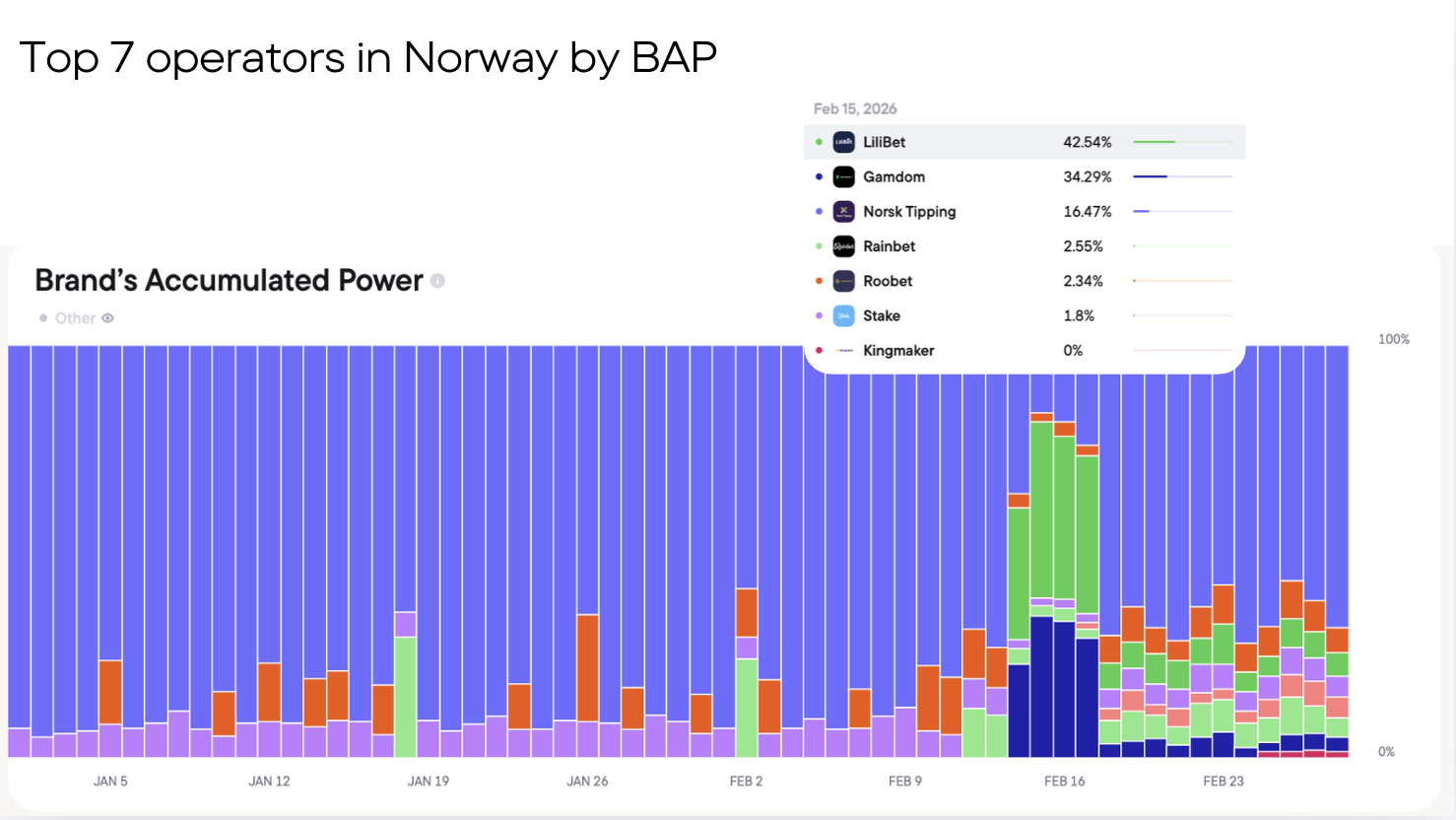
Those numbers are roughly double what each operator sees on a normal day. On February 14, the day before, LiliBet held 31.67% and Gamdom held 22.45%.
Both are offshore platforms operating under Curaçao licenses. Neither holds a Norwegian gambling license. Both offer full sportsbooks with live betting, competitive odds, and Norwegian-language interfaces.
LiliBet’s jump came first — the brand hit 40,144 in absolute Blask Index terms on February 15, up from 25,923 the previous day. Gamdom moved from 18,373 to 32,365 on the same date. Neither operator has a registered presence in Norway. Both drove most of the day’s incremental demand.
Norsk Tipping got left behind
Norway’s regulated gambling market runs on a monopoly model. Norsk Tipping is the only operator legally permitted to offer online casino and sports betting to Norwegian residents. It is state-owned, regulated by Lotteritilsynet (the Norwegian Gambling Authority), and cannot be displaced by commercial competitors under current law.
On February 15, Norsk Tipping held 16.47% of market demand — its lowest share of the month by a significant margin.
This requires context. Norsk Tipping’s absolute Blask Index value on February 15 was 15,546. That’s not a collapse — it’s roughly in line with its lower-activity days. The monopoly didn’t lose players it had. It failed to capture the surge.
The reason is structural. When Norwegian fans searched for odds on Klaebo’s relay, or wanted to bet on the ski jump podium before results were confirmed, Norsk Tipping had fewer tools to compete: limited markets, regulatory constraints on live-betting products, and a platform built for compliance rather than commercial competition. Offshore operators filled the gap.
The pattern held on February 16: LiliBet at 39.49%, Gamdom at 32.89%, Norsk Tipping at 18.74%. Three consecutive days where the regulated monopoly held less than a fifth of its own market.
February 17: the second wave
The second spike came two days later. On February 17, total demand hit 92.84K.
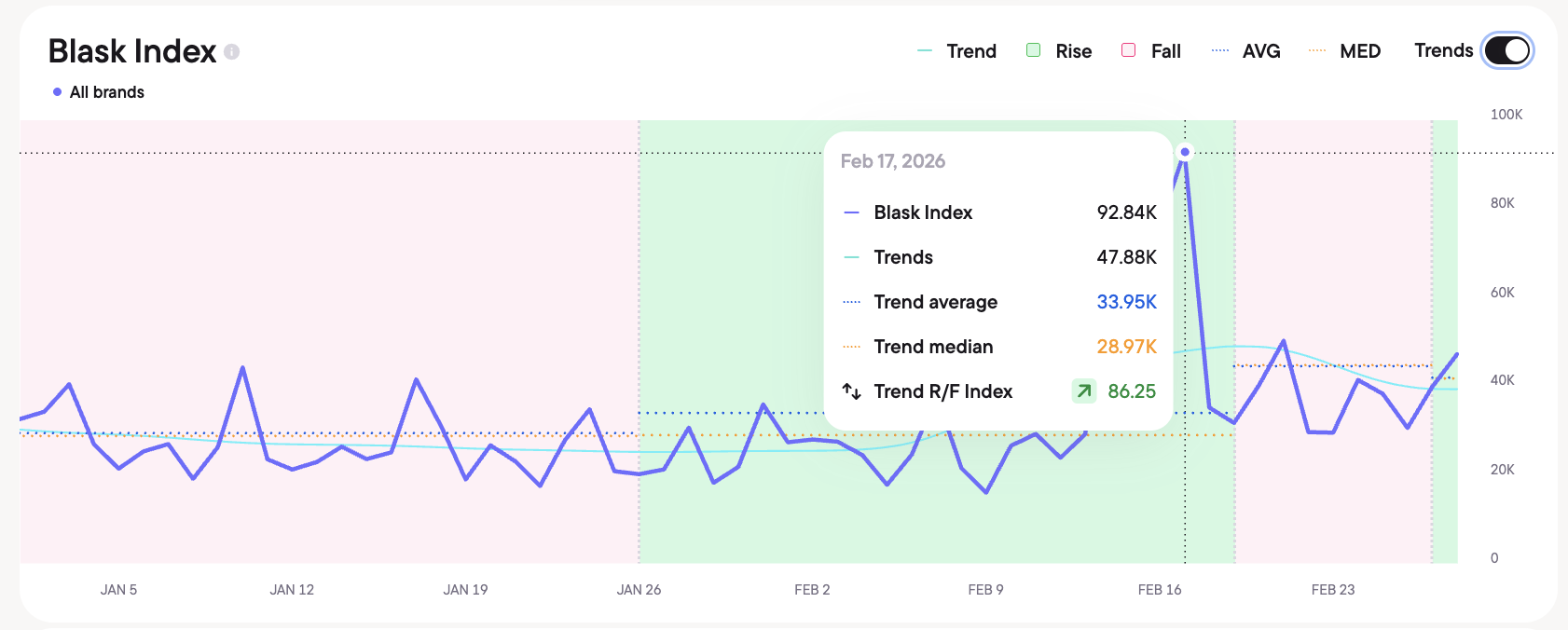
Two things drove it.
On the sports side, attention was building around the February 18 men’s team sprint — the event where Klaebo would go on to win his record 10th Olympic gold, joining Michael Phelps as the only Olympians in history with double-digit gold medals. Pre-event search interest is a reliable demand driver.
Separately, on February 17, Norwegian media was covering the “Crotchgate” controversy: ski jumpers Marcus Lindvik and Johann Andre Forfang had been found wearing illegal suits with an extra centimeter of fabric in the crotch area, violating FIS regulations. Their coaches received 18-month suspensions. The scandal generated significant search activity in Norway and may have contributed to the broader spike in iGaming searches — controversy and sports tend to amplify betting intent together.
On February 17, LiliBet held 38.26% of the market and Gamdom 28.91%. Norsk Tipping recovered slightly to 24.55%, but remained well below its non-event baseline.
| Brand | Feb 14 BAP | Feb 15 BAP | Feb 17 BAP |
|---|---|---|---|
| LiliBet | 31.67% | 42.54% | 38.26% |
| Gamdom | 22.45% | 34.29% | 28.91% |
| Norsk Tipping | 36.00% | 16.47% | 24.55% |
The offshore brands gained, in total, roughly 29 percentage points of market share over those two days. Almost all of it came at Norsk Tipping’s expense.
The offshore paradox
Norway’s gambling regulator began DNS blocking of unlicensed offshore gambling sites in early 2025. In February 2025, Lotteritilsynet notified ISPs of an order to block approximately 70 websites. By June 2025, formal blocking decisions had been issued against 47 of them. The list included major brands across the European grey market.
LiliBet and Gamdom were not among those initially blocked, or circumvented the blocks quickly enough to remain accessible during the Olympic period. Both platforms actively target Norwegian players — Norwegian-language interfaces, NOK support, Norwegian payment methods — despite operating without a Norwegian license.
The February data shows the practical limits of DNS blocking as a demand-suppression tool. When a major national sports event creates a surge in gambling intent, that intent finds available channels. Players motivated by Olympic results are not passive consumers waiting for the regulated option to catch up — they search, they find, and they bet.
Norway’s February market, for all its monopoly architecture, functioned like an unregulated one on its biggest sports days.
What the February data tells operators
Norway’s full-month market data for February 2026 puts the spike in broader context. Blask tracked 99 active brands across the country. Total Acquisition Power Score (APS) for the month — Blask’s benchmark for how many new customers a market’s demand level should support — averaged 59,805 new players (40,780–116,877 range). The range reflects how dramatically seasonal and event-driven peaks can shift acquisition capacity. The February Olympic period likely pushed the ceiling.
Total Competitive Earning Baseline (CEB) — Blask’s market-based revenue estimate, built from brand strength and competitive dynamics rather than operator-reported financials — sat at $35.09M for the month ($24.51M–$66.84M range). Both metrics point to a market that performs well above its structural size when Norwegian athletes are winning.
Three conclusions from the data:
- Sports events create temporary but genuine demand surges. Norway’s Blask Index doesn’t normally reach 90K+. Olympics gold medals do what no marketing campaign can replicate.
- Offshore operators are structurally better positioned to capture event-driven demand. Gamdom and LiliBet can offer live betting, wide odds markets, and rapid response to events that Norsk Tipping can’t match under the current regulatory framework.
- DNS blocking suppresses baseline activity, not peak-event behavior. The February numbers suggest that when demand spikes sharply, players bypass access restrictions. Regulatory tools built for everyday enforcement may not be calibrated for one-week Olympic surges.
For operators tracking Norway as a target market, the message is clear: Norway’s demand ceiling is higher than its regulatory model suggests, and it unlocks in a very specific way — national athletic success.