
- Updated:
- Published:
What is fantasy sports
Fantasy sports have become one of the most participatory entertainment formats in the history of sport — a $28 billion industry that now spans six continents, dozens of platforms, and over 200 million active players worldwide. Whether you are a first-time participant, a seasoned DFS grinder, or an operator evaluating a new vertical, this guide covers every dimension of the space: definitions, history, formats, platforms, legality, and market size.
What are fantasy sports?
| Fantasy sports betting is an activity where participants build virtual teams of real athletes and compete based on those athletes’ actual statistical performance in live professional games. |
The fantasy sports meaning, in formal terms, is a game of skill in which a manager assembles a roster subject to platform rules and accumulates points when their selected players produce real-world statistics. Touchdowns, home runs, rebounds, assists — every in-game action maps to a point value. At the end of each scoring period, totals are tallied, and the higher-scoring lineup wins the matchup.

This metaphorical AI image reflects the idea of FS when you collect your own sports dream team.
Fantasy sports betting is the most popular in the following countries:
- India is the world’s fastest-growing market and now rivals the United States in raw user volume. The Federation of Indian Fantasy Sports (FIFS) reported 130 million registered users as of 2023, with cricket — particularly the Indian Premier League — driving the overwhelming majority of activity.
| In 2025, FS was banned in India as the government claimed it to be gambling. |
- The United States. It is the largest market by revenue and the birthplace of the modern fantasy format. According to the FSGA 2023 Industry Survey, 62.5 million Americans participated in fantasy sports competitions that year (the US population is 350 million).
- The United Kingdom is the largest European market and home to the most played single fantasy game in the world. The English Premier League’s official Fantasy Premier League (FPL) game attracted over 11 million managers in the 2024/25 season.
A brief history of fantasy sports
The first documented fantasy competition traces to 1962, when sociologist William Gamson organized a rotisserie-style baseball league at Harvard. The concept remained niche until journalist Daniel Okrent formalized it as Rotisserie Baseball in 1980. An Inside Sports feature in 1981 spread the game to enthusiasts across the country.
For two decades, leagues ran by fax, phone, and spreadsheet. The internet changed the scale: Yahoo launched its free fantasy football product in 1999, attracting millions of participants overnight. ESPN and CBS Sports followed, turning draft parties into mainstream cultural events.
The next structural shift came in 2009 when FanDuel was founded, and in 2012 when DraftKings launched — both offering single-slate, cash-prize contests that compressed an entire season into one game day. This format attracted intense regulatory scrutiny and, ultimately, new legislation across dozens of US states.
How fantasy sports work
The best way to understand what is fantasy sports is to see its working mechanism.
Drafting your roster
The format varies by league type, but the core logic is identical: claim real athletes before competition begins.
- Snake Draft. Teams rotate selections in a reversing order. Draft position is typically randomized. First picks carry an advantage for elite players; later rounds reward depth scouting and breakout identification.
- Salary cap contest. No traditional draft. Each player is priced, and managers assemble a lineup without exceeding the total cap (typically $50,000). This turns roster construction into a constrained optimization problem: maximize projected output per dollar spent.
- Auction draft. Every team receives an identical budget (e.g., $260) and bids on nominated players. Any team may bid; the highest bidder wins the athlete. Auctions reward valuation accuracy over positional luck.
Scoring and real-world stats
Points are awarded after games conclude, calculated from box-score data ingested from official providers such as SportRadar, Stats Perform, Genius Sports. Scoring rules vary significantly by platform and league settings.
Managing your lineup
Winning requires active management throughout the season, not just a strong draft. Key decisions include:
- Waiver wire pickups;
- Trade negotiations;
- Start/sit decisions;
- Injury management.
Modern platforms have integrated AI-powered lineup recommendations, injury alert systems, and trade analyzers.
Daily fantasy sports vs season-long leagues
Season-long leagues are the traditional format. Users draft in late summer, compete weekly through the playoff, and invest in a roster across a full season.
Daily fantasy sports compress that commitment into a single slate. On DraftKings or FanDuel, a manager builds a lineup on Sunday morning, plays it through the night’s games, and knows the result by midnight.
| Dimension | Season-long | Daily fantasy sports |
| Time commitment | High (full season) | Low (per contest) |
| Entry fee structure | Flat buy-in or free | Per-contest, variable |
| Prize delivery | Season-end | Same day or next day |
| Skill expression | Roster management over time | Single-slate optimization |
Common fantasy league formats
Redraft and standard leagues
In a redraft league, rosters reset every season. Users draft from scratch each year with no carry-over from the previous campaign. This is the most accessible format — low commitment, broad appeal, minimal research required before the draft. “Standard” leagues pair redraft rules with default platform scoring and positional requirements.
Auction leagues
Auction leagues give every team an identical spending budget to bid on players as they are nominated one at a time. Because every manager has equal access to every player, draft position becomes irrelevant. Stars command premium prices; bargains emerge mid-auction when budgets dry up. Auction formats are widely considered a purer test of player valuation than snake drafts and attract more competitive, data-driven participants.
Keeper and dynasty leagues
Keeper leagues allow managers to retain a set number of players — typically one to five — from the previous season’s roster before the new draft begins. This rewards long-term investment in young, developing talent and adds a strategic layer to every in-season roster decision.
Dynasty leagues extend keeper logic to its extreme: full rosters carry over indefinitely, supplemented by a separate rookie draft each spring. Managing a dynasty team mirrors running a real franchise — rebuild cycles, aging cores, and multi-year blockbuster trades are all standard gameplay. Dynasty leagues attract highly dedicated participants willing to commit significant research time year-round.
Best ball leagues
Best ball eliminates weekly lineup decisions entirely. Managers draft a full roster at the season’s start; the platform automatically selects each week’s highest-scoring combination of eligible players. No waiver pickups, no trades, no decisions after draft day. Platforms such as Underdog Fantasy and DraftKings Best Ball have popularized large-field best ball tournaments with guaranteed prize pools reaching into six and seven figures.
Popular fantasy sports by type
There are several types of FS.
Fantasy football
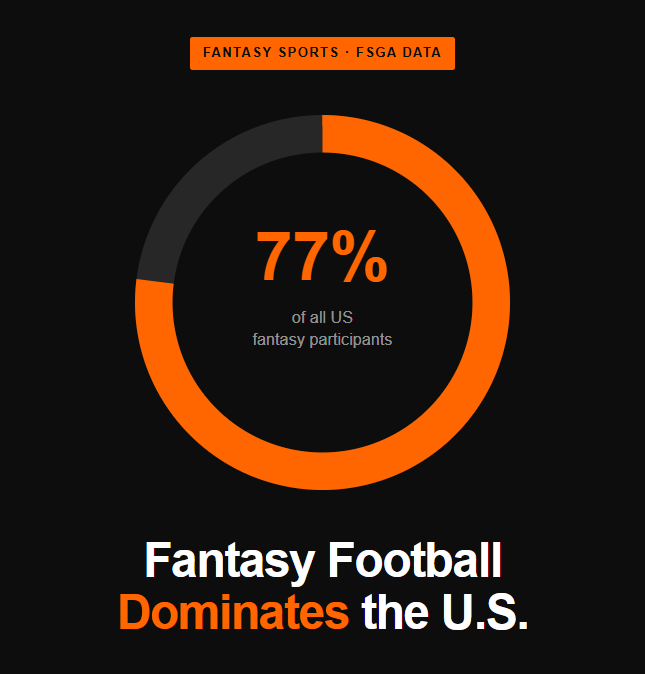
Fantasy football is the dominant format in the United States
The FSGA reports that NFL fantasy leagues account for over 77% of all US fantasy participants. The sport’s weekly cadence — one game per team per week — makes lineup decisions high-stakes and highly discussable, fueling a massive ecosystem of podcasts, analytics tools, start/sit columns, and injury news coverage.
Core format variants: single-QB vs. two-QB (Superflex) leagues, standard vs. PPR scoring, and standard 10-team vs. larger 12–16-team leagues. The NFL’s popularity ensures that target share, air yards, snap counts, and usage data are all publicly available, supporting sophisticated analytical approaches that are relatively accessible to new players.
Fantasy baseball
Baseball’s 162-game season and multi-category scoring make fantasy baseball the most statistically complex format. Rotisserie (roto) scoring ranks teams in each statistical category — hitting: batting average, home runs, RBI, runs, stolen bases; pitching: wins, ERA, WHIP, strikeouts, saves — and sums the rank points. Head-to-head points formats are an alternative popular with managers who prefer weekly results over season-long category positioning.
The long season demands consistent engagement but rewards patient roster management. Injured players occupy an IL slot, limiting the roster disruption common in other sports. Daily lineups — setting starters vs. pitchers with poor matchups — add a DFS-like decision layer to the season-long format.
Fantasy basketball
Fantasy basketball runs from October to April. Standard rotisserie formats track nine statistical categories: points, rebounds, assists, steals, blocks, turnovers, field-goal percentage, free-throw percentage, and three-pointers made. Deliberately “punting” one or two categories — building a roster that ignores turnovers, for example, in exchange for dominance elsewhere — is a recognized and effective strategy.
The NBA’s rapid pace and frequent load-management decisions make daily lineup settings critical. A star resting on a back-to-back can determine a weekly matchup. Fantasy basketball is well-suited to the DFS format given the nightly game slate throughout the season.
Fantasy hockey, soccer, and other sports
Fantasy hockey mirrors basketball’s structure — rotisserie or head-to-head, goalie and skater positional slots — within a shorter, more compressed season. Fantasy NASCAR assigns drivers to a virtual “garage” and scores finishes, laps led, fastest laps, and stage points.
Fantasy soccer is the dominant format outside North America. The English Premier League’s official Fantasy Premier League (FPL) game had over 11 million managers in the 2024/25 season, making it one of the largest single fantasy games in the world. In India, cricket fantasy — particularly IPL contests on Dream11 — draws tens of millions of entries per match, often exceeding the viewership of the game itself in terms of active engagement.
Top fantasy sports platforms in 2026
The landscape of fantasy sports sites spans US-focused and India-focused DFS giants, social season-long apps.
DraftKings and FanDuel (DFS)
DraftKings and FanDuel offer salary-cap contests across NFL, NBA, MLB, NHL, golf, MMA, and eSports slates.
DraftKings‘ flagship weekly NFL tournament — the Millionaire Maker — awards $1 million to the top entry from a field of hundreds of thousands..
FanDuel’s DFS product remains a primary entry point for new users, emphasizing showdown single-game contests alongside traditional multi-game slates.
| Feature | DraftKings | FanDuel |
| Flagship GPP prize | Millionaire Maker ($1M+) | Sunday Million ($1M) |
| States with DFS access | 43+ | 42+ |
| Unique contest types | Best ball, H2H, GPP, cash | Showdown, H2H, GPP, cash |
Pick’em Apps: PrizePicks, Underdog, Sleeper
A newer category — pick’em or player prop apps — has expanded rapidly. Users select over/under lines on individual player stat totals rather than assembling full rosters.
PrizePicks is the market leader, available in 35+ states. Users select 2–6 player props; correct predictions across all selections (with a one-miss “flex” option) pay multiplied cash prizes. PrizePicks was valued at over $800 million in a 2022 funding round.
Underdog Fantasy is best known for its best ball NFL tournaments — the Best Ball Mania series paid out $10 million in prizes in 2024. Underdog’s pick’em product has expanded into NBA, MLB, and college sports slates.
Sleeper began as a season-long social platform, praised for its modern UI, real-time injury alerts, and in-app group chat.
ESPN Fantasy
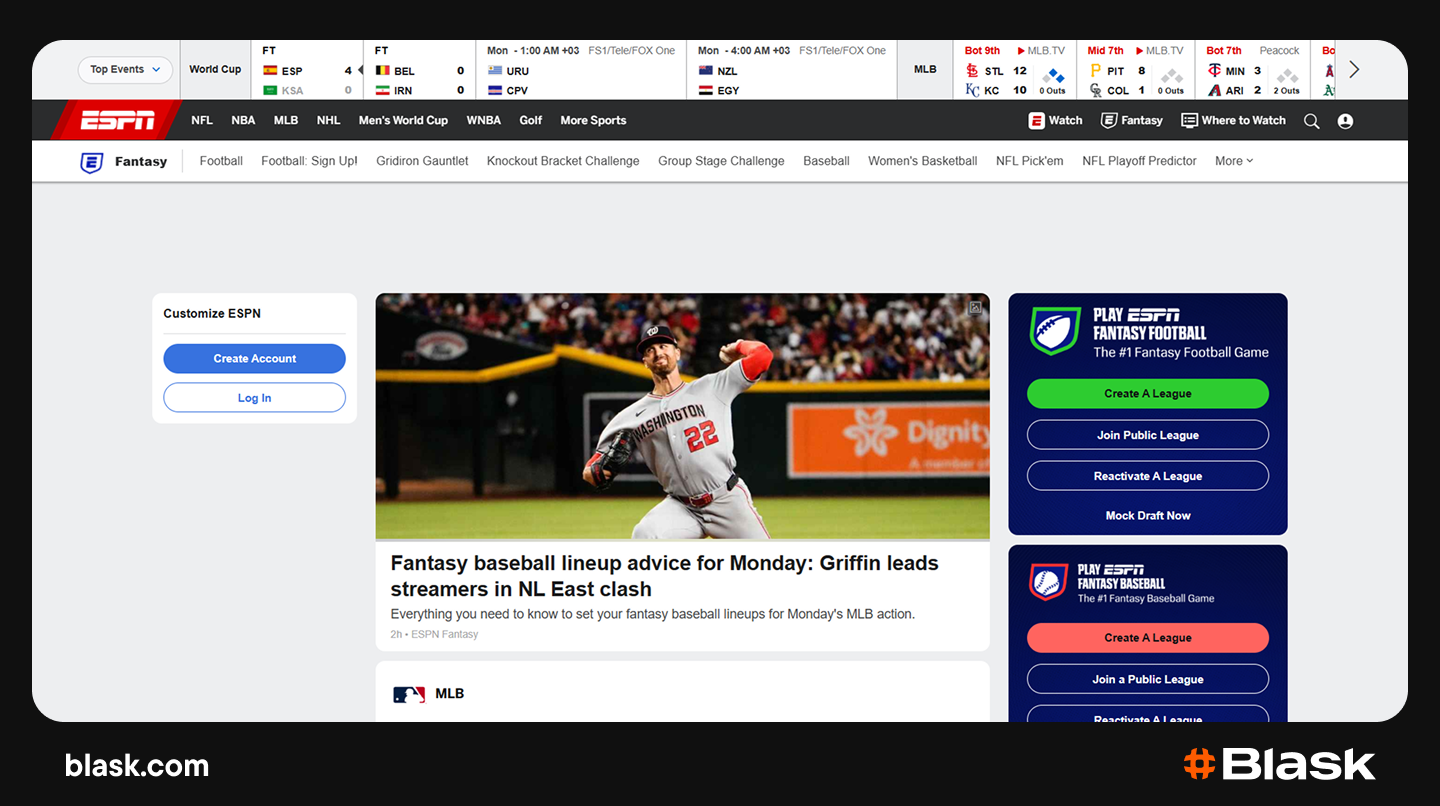
ESPN Fantasy is the most widely used platform for season-long football and baseball leagues in the United States. Free access, deep editorial integration, and brand familiarity across ESPN’s broadcast network give it unmatched reach among casual participants.
Yahoo Fantasy Sports
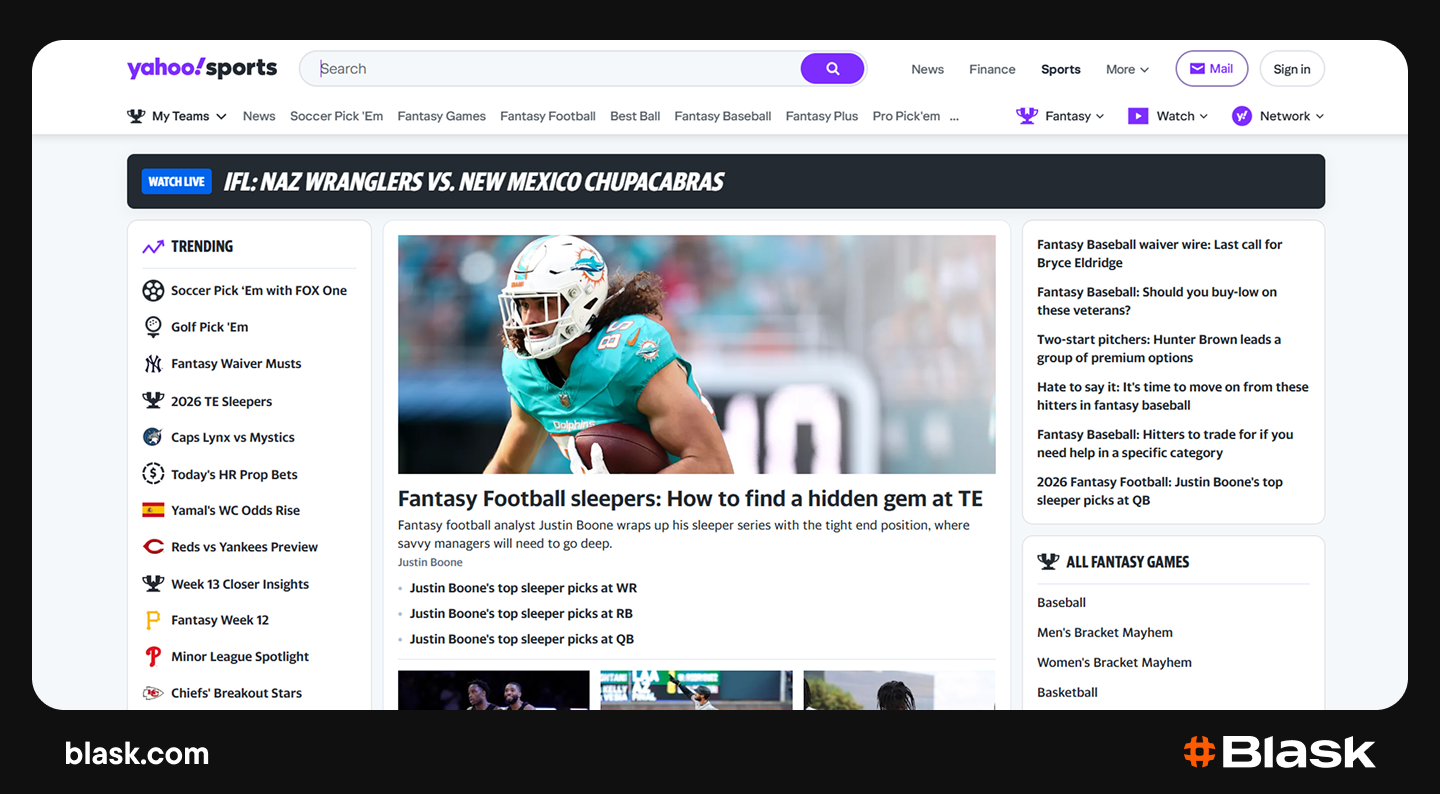
Yahoo Fantasy Sports is one of the oldest and most established season-long platforms. It launched in 1999 for football and extended to baseball, basketball, hockey, and golf over the following years.
Commissioner tools on Yahoo allow extensive customization: auction drafts, keeper and dynasty settings, custom scoring systems, and live draft audio rooms. The mobile app consistently receives high ratings for live scoring accuracy and real-time transaction management. Yahoo does not operate a cash-prize DFS product, maintaining its focus on free and private league play.
CBS Sports Fantasy
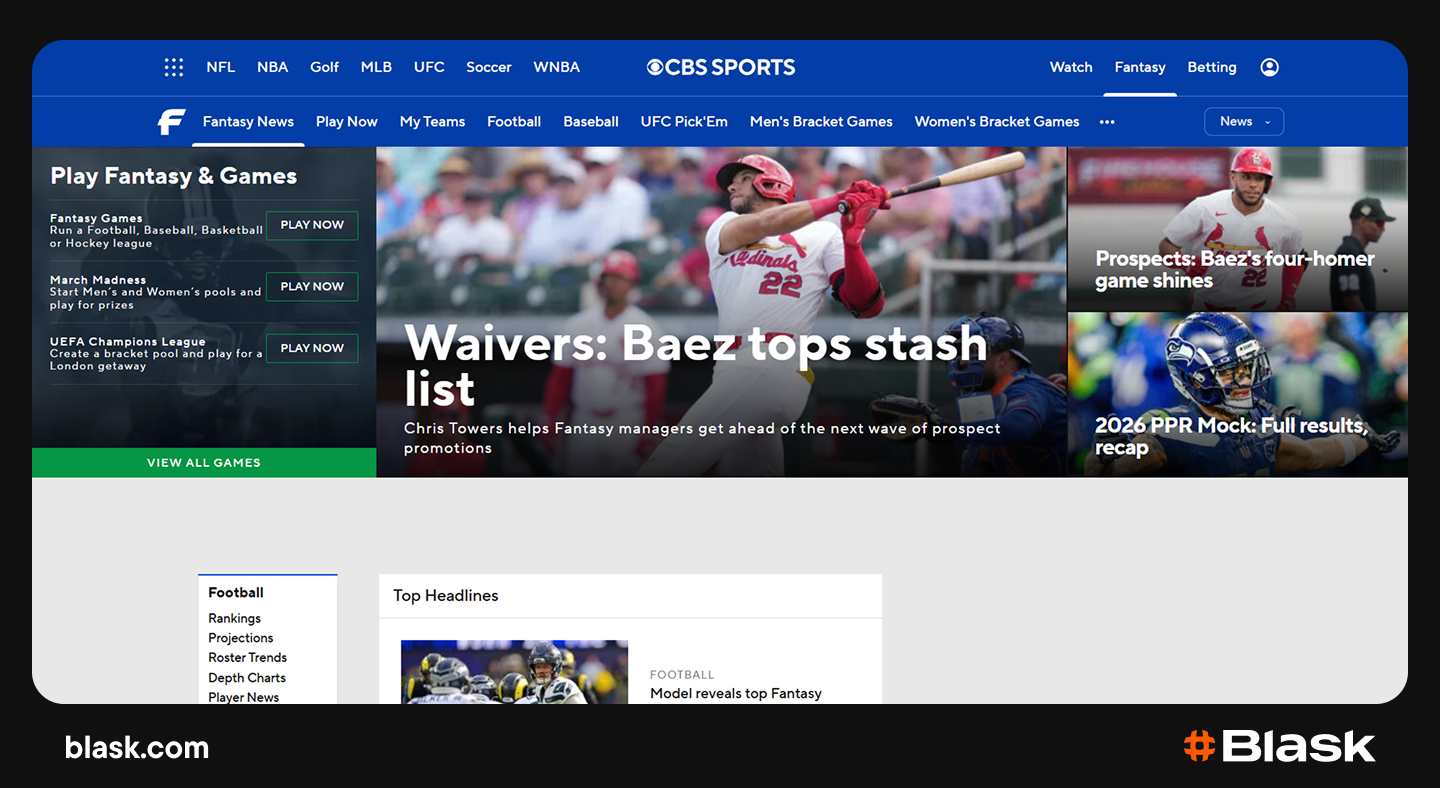
CBS Sports Fantasy offers season-long leagues with strong commissioner controls, deep historical projections, and highly customizable scoring. CBS is particularly strong in fantasy baseball, with tiered analysis tools and an active community of serious managers. Football and basketball leagues are also supported.
Indian fantasy sports platforms
Dream11 is the dominant global platform by registered users. It covers cricket, football (soccer), kabaddi, basketball, hockey, volleyball, and handball. Dream11 was the title sponsor of the Indian Premier League, a deal reportedly worth approximately ₹222 crore per season. The platform was valued at $8 billion in 2021 and is consistently profitable, a rarity among consumer gaming companies at its scale.
Mobile Premier League (MPL) is a multi-game platform combining sports contests with casual games and esports. MPL had over 90 million users across India and Southeast Asia as of its last public data (2022), with a sports fantasy vertical focused on cricket and football (soccer).
My11Circle (operated by Play Games24x7) is Dream11’s most direct cricket fantasy competitor. Backed by investments from Tiger Global and others, My11Circle has signed Indian cricket legends including Sourav Ganguly as brand ambassadors and is available in most Indian states where skill gaming is legally permitted.
WinZO targets Tier 2 and Tier 3 Indian cities with a regional-language gaming platform — supporting 12 languages — in which sports contests are one of several game verticals. WinZO has reported over 80 million registered users and emphasizes low-denomination contests accessible to first-time players on entry-level smartphones.
| Platform | Country | Primary Sport | Estimated Users |
| Dream11 | India | Cricket | 200M+ |
| MPL | India / SE Asia | Cricket, esports | 90M+ |
| My11Circle | India | Cricket | 50M+ |
| WinZO | India | Cricket, casual | 80M+ |
Is fantasy sports gambling? Legal status in the US
Fantasy sports gambling is a contested classification — one that sits differently under federal law, state regulation, and evolving enforcement frameworks.
UIGEA carve-out and the skill-game argument
The Unlawful Internet Gambling Enforcement Act of 2006 (UIGEA) explicitly exempted such contests from its definition of unlawful internet gambling, provided that:
- Prizes are established in advance and not determined by the number of participants or fees paid.
- Winning outcomes reflect the relative knowledge and skill of participants.
- No outcome is based solely on the performance of a single real-world athlete or the final score of a single game.
This federal carve-out gave DFS operators a safe harbor. The skill-game argument — that roster construction requires research, statistical reasoning, and strategic discipline — has been the industry’s legal cornerstone ever since. Multiple court decisions in New York, Massachusetts, and other states have upheld DFS as a game of skill rather than a form of gambling.
State-by-State DFS regulation
Despite UIGEA protection, states retain the authority to regulate or prohibit gambling activity within their borders. As of 2026, daily fantasy sports fall into three broad legal categories across US jurisdictions:
- Explicitly regulated. Approximately 22 states have enacted DFS-specific licensing laws with registration, tax, and consumer-protection requirements (New York, Colorado, Virginia, Tennessee, others).
- Legal but unregulated. Roughly 20 states allow DFS without specific enabling legislation, relying on pre-existing skill-game exceptions.
- Prohibited or legally uncertain. Approximately 8 states, including Washington and Montana, prohibit or restrict DFS activity.
Pick’em apps under scrutiny
Pick’em apps — PrizePicks, Underdog, and similar products — occupy a legal gray area. Unlike traditional DFS roster-building contests, pick’em products ask users to predict individual player stat over/under outcomes, which critics argue is structurally indistinguishable from sports betting prop markets.
New York, Michigan, and Massachusetts have each issued enforcement actions or cease-and-desist orders against pick’em operators in the 2023–2025 period, arguing these products constitute unregulated sports wagering. PrizePicks voluntarily withdrew from New York in 2023.
The concept of DFS gambling captures the core ambiguity: daily fantasy operators occupy a position between traditional skill gaming and sports wagering, and the precise legal boundary varies state by state, often depending on how broadly courts interpret “game of skill.”
Fantasy sports vs sports betting
| Dimension | Fantasy Sports | Sports Betting |
| Outcome basis | Aggregate player statistics | Single-game result or player prop |
| Opponent | Other players (peer-to-peer) | The house (bookmaker) |
| Skill component | High — research, lineup decisions | Mixed — handicapping, but house edge |
| Legal framework | Skill game in most jurisdictions | Gambling in all jurisdictions |
Contest types and salary cap mechanics
Head-to-head, double-ups, and GPPs
DFS contests fall into three broad categories determined by field size and payout structure:
- Head-to-head (H2H) matches two lineups directly. The higher-scoring entry takes the prize — typically ~1.8x the entry fee, with the platform retaining a cut. H2H is the lowest-variance format: beating a single randomly assigned opponent is more consistent than finishing in the top 20% of a 100,000-entry field.
- Double-ups are small-to-mid field contests where the top 45–50% of entries double their money. These favor chalk, high-floor lineups: selecting widely owned, highly projected players reduces downside risk relative to a GPP strategy.
- Guaranteed prize pools (GPPs) are large-field tournaments with top-heavy payout structures. The DraftKings Millionaire Maker pays $1 million to first place from a field of hundreds of thousands of entries. GPPs reward contrarian construction — identifying low-owned, high-upside plays creates the score separation needed to finish at the top. GPPs have the highest variance and the lowest expected value for most participants, but they are the aspirational product that drives platform marketing and new user acquisition.
Salary cap and player pricing
Every salary cap contest assigns each player a dollar value, updated by platform pricing algorithms based on projected usage, recent performance, matchup quality, and expected ownership.
Players group into rough tiers:
- Elite ($8,000–$10,000+);
- Mid-tier ($5,000–$7,900);
- Value ($3,000–$4,900).
Identifying pricing inefficiencies — players whose actual performance potential exceeds their salary valuation — is the primary alpha source for skilled DFS players. A $4,500 running back in a plus matchup with a lead role due to an injury upgrade is the foundational DFS opportunity.
Fantasy sports industry size and demographics
The industry has grown from a spreadsheet hobby into one of the largest participatory entertainment categories globally.
Key data points:
- 62.5 million Americans played fantasy sports in 2023.
- The global market was valued at $28.76 billion in 2023 and is forecast to reach $66.7 billion by 2030 at a 12.9% CAGR.
- The average US participant spends approximately $653 per year on contest fees, subscriptions, and related analytical tools.
- 79% of US participants are male; median player age is 37, per the FSGA 2023 demographic report.
- Fantasy players watch 40% more live sports and are 2.5x more likely to subscribe to a sports streaming service than non-players.
How operators run fantasy sports platforms (B2B angle)
Building a competitive platform in this space requires technical, data, legal, and operational infrastructure that most new operators source through white-label or B2B vendor partnerships.
Core platform components:
- Fantasy engine. Roster rules, positional limits, scoring calculation, contest management, and prize distribution logic.
- Sports data feed. Real-time stats from SportRadar, Stats Perform, or Genius Sports. Data licensing is a significant cost — NFL data, for example, is exclusive to official league data partners and commands premium pricing.
- Payment processing. Deposits, withdrawals, and prize payouts requiring PCI-DSS compliance and state-specific KYC/AML procedures.
- Responsible gambling tools. Deposit limits, session timers, reality checks, and self-exclusion — increasingly mandated by state DFS regulators and standard in B2B platform packages.
- Fraud and integrity systems. DFS platforms are high-value targets for bonus abuse, multi-accounting, and lineup scraping. Effective operators deploy device fingerprinting, velocity checks, and behavioral analytics.
Leading B2B fantasy solutions include SBTech (now part of DraftKings), Sportech, and several India-specific providers, for example RealSprint, FanClash.
Tips for beginners
Starting out can feel overwhelming given the volume of content, tools, and terminology. These principles apply regardless of sport or format.
- Master one sport and one format first. Depth of knowledge in a single sport outperforms broad familiarity across many. Complete a season of season-long football before exploring DFS baseball.
- Start with free tools. FantasyPros, Rotowire, and The Athletic’s fantasy coverage provide high-quality projections, rankings, and player news at no cost. Paid services add value at higher skill levels but are unnecessary for beginners.
- Read your league settings carefully. PPR vs. non-PPR, standard vs. custom scoring — these differences fundamentally change player values. A running back worth a third-round pick in PPR may be a fifth-round value in a standard league.
- Monitor the waiver wire actively. Most championships are determined by in-season adds, not draft-day picks. Injuries, usage changes, and breakout games create high-value pickups every single week.
- Manage your DFS bankroll. Set a weekly budget. No single slate should risk more than 5% of your total DFS bankroll. Variance is high — even skilled players lose money over short stretches.
- Adjust strategy by contest type. A contrarian, low-owned stack is correct in GPP tournaments. In head-to-head, consistency and floor matter more than upside ceiling. Never apply the same lineup construction logic across different contest formats.
- Review your decisions, not just outcomes. Losing on a player injury after lock is bad luck. Losing because you ignored a clear injury report is a correctable error. Use platform lineup history to distinguish the two.
Common mistakes to avoid
Even experienced managers fall into predictable traps.
Ignoring injury reports. Starting a player listed as questionable without checking the final injury report is the single most avoidable mistake in the game. Subscribe to beat reporter accounts on X (Twitter) and check the official NFL, NBA, or MLB injury designations each week.
Overvaluing name recognition. Aging veterans and players in declining roles are consistently drafted too early because managers trust reputation over current data. Check targets, snap counts, usage rates, and role clarity before drafting, not career highlight reels.
Chasing last week’s performance. One explosive game rarely signals a new role. Confirm whether a performance was matchup-specific, scheme-driven, or reflects a genuine opportunity change before rostering the player going forward.
Neglecting matchup quality. A strong receiver can underperform against a top cornerback. A mediocre quarterback can light up against the league’s worst pass defense. Matchup analysis is consistently the most underutilized skill among casual participants.
Going contrarian in the wrong format. Low-owned, high-upside constructions are GPP strategy — not H2H strategy. Forcing differentiation in a two-person contest reduces your win probability. Match construction approach to contest type.
Over-entering a single slate. Playing 200 entries at $10 each in one slate ($2,000 at risk) on a thin bankroll is a fast path to depletion. Volume entries require proportionally larger bankrolls and systematic lineup-building tools to justify the variance.
Forgetting to set your lineup. Every season, managers lose points because a player on bye, injured reserve, or a Monday game was left in the active slot. Check and confirm your lineup Saturday evening, before lock.