
- Updated:
- Published:
What is keno
Keno is one of the oldest forms of gambling — a lottery-style numbers game that has survived from ancient times. The core mechanics have barely shifted: pick numbers, watch a draw, collect on matches. What has changed is the speed, the variety, and the mathematics governing how much the house keeps. This guide covers every dimension of the keno game — from its grid mechanics and probability formulas to software providers, market trends, and where the format is heading next.
What is keno
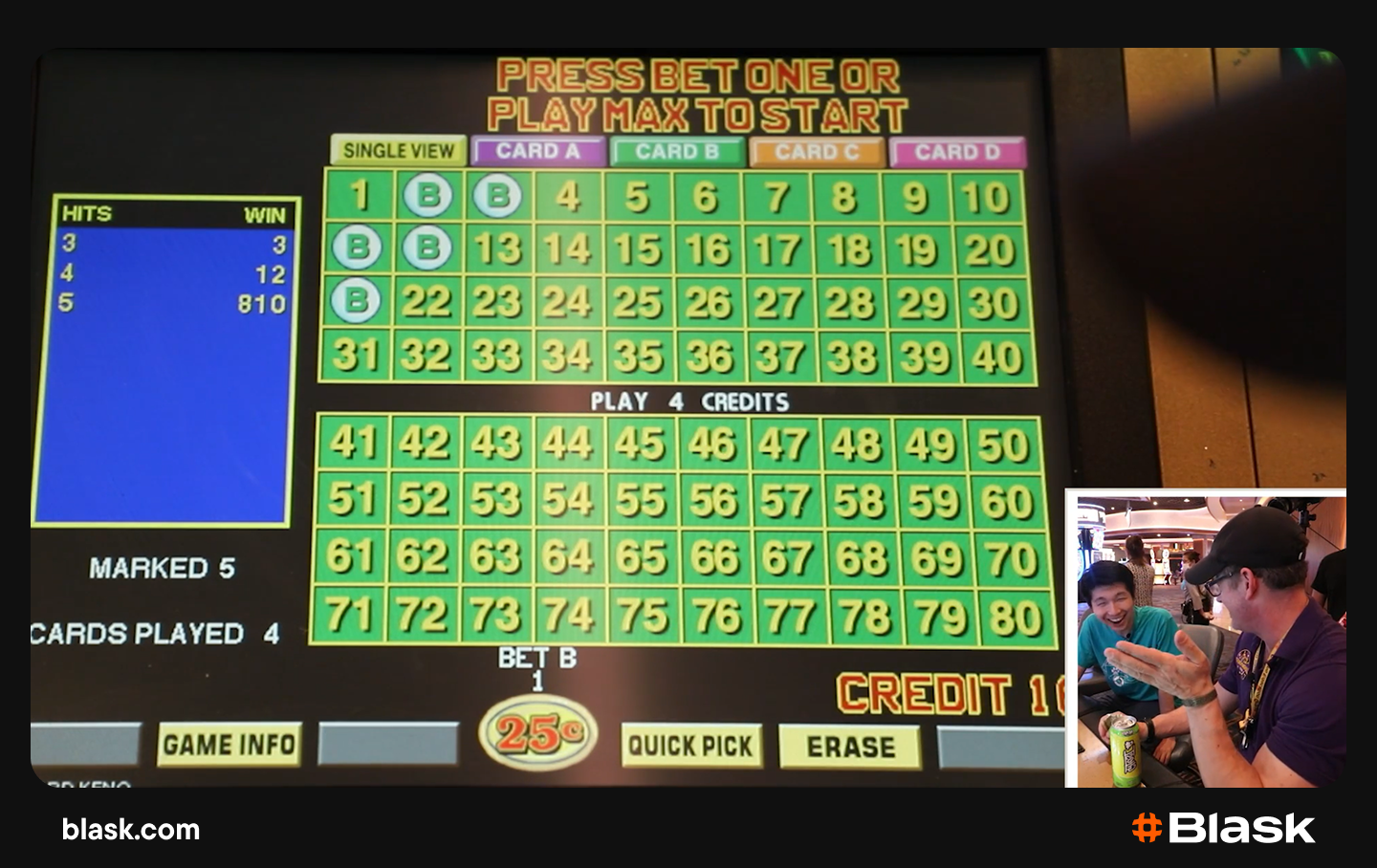
How Keno looks. The screenshot source: CEG Dealer School
What is keno, precisely?
| Keno is a fixed-odds gambling game in which a player selects between 1 and 20 numbers from a pool of 80, wagers a fixed stake, and receives a payout determined by how many of those numbers are matched in a random draw of 20 balls. The more numbers matched, the higher the payout multiplier. Online variation is slightly different: a user selects between 1 and 10 numbers from a pool of 40. |
Unlike poker or blackjack, keno involves no strategic decision once selections are made. It is closer to a lottery ticket than a table game: the only player input is number selection and bet size.
How keno works
The 80-number grid
Every standard keno game is built around a grid of 80 numbers, arranged in eight rows of ten (1–10, 11–20, 21–30 through 71–80). The online format offers a grid of 40 numbers.
The 80-number pool is identical across virtually all global variants, making keno one of the most structurally standardized casino games in operation. All probability calculations described in this article use this standard 80-number field.
Picking your numbers (spots)
Before any draw, the player selects a set of numbers — called spots — from the 80-number grid. Most casinos and online platforms allow picks of 1 through 10 spots; some extend to 15 or 20. The number of spots selected determines which pay table applies and directly controls the probability profile of the session.
Selecting fewer spots (1–4) produces more frequent, smaller wins. Selecting more spots (8–10) opens access to high-multiplier jackpot payouts but dramatically reduces the probability of winning anything. According to the GamblingCalc Keno Odds Calculator, the probability of missing all 10 picks in a 10-spot game is approximately 4.58% — meaning the most likely single outcome is a partial miss.
The draw (20 numbers)
Once all bets are placed, the casino draws 20 numbers from the 80-number pool — without replacement. In live keno lounges, this is done mechanically using numbered balls and a blower machine or a random number generator (RNG). In online and video keno, a certified RNG handles the draw digitally, and results are instantaneous. The draw is governed by the hypergeometric distribution: because numbers are not replaced between draws, the mathematical formula for any given catch probability is C(n,k) × C(80−n, 20−k) ÷ C(80,20), where n is the number of spots chosen and k is the number of catches being calculated.
Payouts based on matches
The number of player selections that appear among the 20 drawn numbers is called the catch count. Casinos publish a specific pay table mapping each possible catch count (relative to spot count) to a payout multiplier. These tables vary significantly between operators and game variants. Most land-based casinos award a “0 of 10 catch” consolation payout in a 10-spot game, acknowledging that missing all 20 drawn numbers is statistically rare enough to merit a small return. Payouts at the maximum catch tier — hitting all selected numbers — carry probabilities low enough to rival small lotteries.
Keno rules step-by-step
Keno rules are the same across land-based and online environments:
- Obtain a blank keno ticket (physical) or open the iGaming brand interface (digital).
- Choose how many spots to play (typically 1–10).
- Mark or click your chosen numbers on the 80-number grid.
- Declare your wager — the base bet per game.
- Submit the ticket or confirm the bet before the draw begins.
- The house draws 20 numbers (mechanically or via RNG).
- Catch count is tallied by matching drawn numbers against selected spots.
- Payout is issued according to the published pay table for that catch result.
- The next game begins independently — prior draws have no influence on future outcomes.
In land-based keno lounges, steps 1–5 occur during a designated betting window between draws, which can range from a few minutes (fast draw formats) to 20 minutes or longer. Online keno eliminates this waiting period entirely: how to play keno digitally reduces the cycle to under 30 seconds.
Types of keno games
Classic keno
The base format. Players pick up to 10 spots from the 80-number grid, a single draw of 20 numbers occurs, and payouts follow a fixed table.
Power keno (bonus on final number)
An Australian-originated variant in which the last number drawn acts as a multiplier. If any of the player’s picks matches the final drawn number, all winnings from that game are multiplied — typically by 4x. The bonus applies only to that single outcome, not to the total bet, and does not alter the base RTP of the underlying game structure.
Super keno (bonus on first number)
Structurally identical to power keno, but the multiplier triggers on the first number drawn rather than the last. Because players see the first number immediately, Super Keno creates a “lead-in” moment of anticipation before the remaining 19 draws are revealed — a minor but meaningful difference in session feel.
Way keno
Way keno allows a player to group their selections into multiple subsets on a single ticket, effectively wagering on several independent combinations simultaneously. A player marking 9 numbers can group them as three sets of 3, betting on all three groups as separate 3-spot games. This increases ticket cost proportionally but allows coverage of multiple pay tables in a single draw. Way Keno is predominantly a land-based format; online implementations are rare.
Combination keno
An extension of way keno in which different groupings are combined into additional wagers on the same ticket. Where Way Keno bets groups separately, Combination Keno also bets on their combinations. The complexity of the ticket multiplies quickly — a single physical ticket can contain dozens of separate wagers. High rollers in traditional keno lounges use this format to cover multiple probability scenarios in a single draw.
Progressive keno
A keno game in which a portion of each wager contributes to a shared jackpot that grows until a qualifying player hits it. The triggering condition varies: some progressives require matching all 10 spots in a 10-spot game; others require a specific catch count with a minimum bet. Progressive keno exists in both land-based lounge formats and online environments. Because the jackpot contribution comes from the base RTP pool, progressive keno typically carries a lower base RTP than non-progressive equivalents.
Video keno (slot-style)
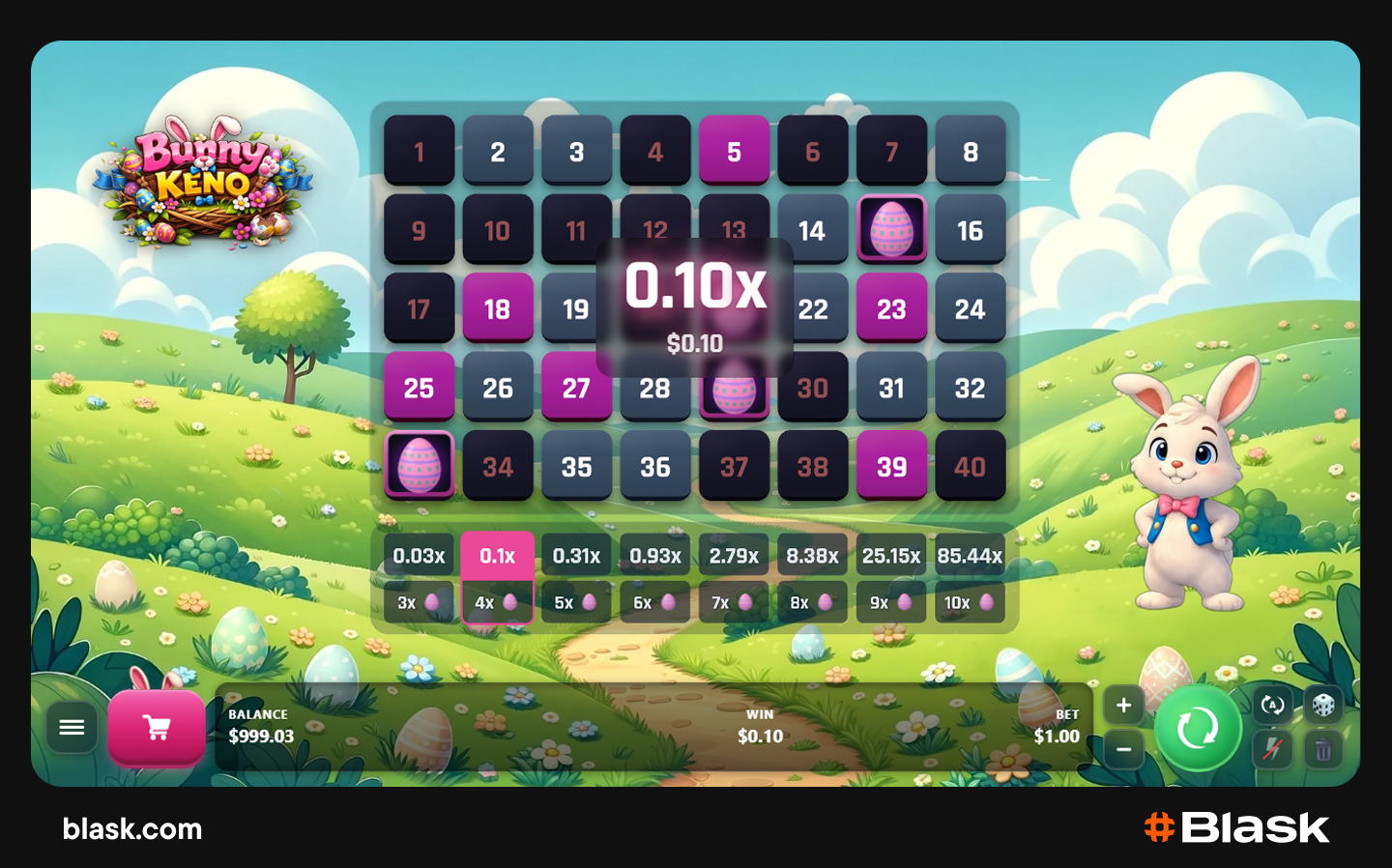
Bunny Keno on Stake
Video keno is a machine-based format in which a single player interacts with a dedicated terminal or video slot cabinet. Draws are generated by RNG and displayed instantly — no waiting for a live draw. The format is architecturally identical to a video poker terminal. According to WifiTalents’ 2026 Keno Statistics report, video keno machines typically carry a house edge of 5–15%, significantly lower than live lounge keno. Online keno in digital casinos is functionally equivalent to video keno.
Keno odds and payouts
House edge (25–40%)
Keno carries one of the highest house edges of any casino game. According to OnlineCasinos247, typical ranges by venue type are:
| Venue Type | Typical House Edge |
| Live keno lounge (land-based) | 25%–40% |
| Video keno machine | 10%–25% |
| State lottery keno | 30%–45% |
For context, European Roulette carries a house edge of 2.70%, and most slot machines run between 4% and 10%. A land-based keno lounge is among the worst expected-value bets available in any regulated casino environment. The GamblingCalc Keno Payout Analyzer models the relationship precisely: a typical live lounge paytable with standard payouts produces an RTP of approximately 73.6% — meaning the house retains $0.264 of every dollar wagered.
Probability of matching 0–10 numbers
The following probabilities, computed using the hypergeometric formula documented by Wizard of Odds, apply to a standard 10-spot game (player selects 10 numbers, house draws 20 from 80):
| Catch Count | Probability | Approximate Odds |
| 0 of 10 | 4.58% | 1 in 21.8 |
| 1 of 10 | 17.96% | 1 in 5.6 |
| 2 of 10 | 29.53% | 1 in 3.4 |
| 3 of 10 | 26.74% | 1 in 3.7 |
| 4 of 10 | 14.73% | 1 in 6.8 |
| 5 of 10 | 5.14% | 1 in 19.4 |
| 6 of 10 | 1.15% | 1 in 87 |
| 7 of 10 | 0.161% | 1 in 621 |
| 8 of 10 | 0.0135% | 1 in 7,384 |
| 9 of 10 | 0.0006% | 1 in 163,381 |
| 10 of 10 | 0.0000112% | 1 in 8,911,711 |
Hitting all 10 numbers in a 10-spot game — the top-tier jackpot outcome — has odds of approximately 1 in 8.9 million. As the GamblingCalc calculator notes, a player running one game per minute continuously for 17 years would statistically expect to hit this outcome once.
Sample payout tables
The following illustrates how dramatically paytables affect the value of a 10-spot game. These are representative examples, not universal standards — actual paytables vary by operator.
| Catch Count | Land-Based (Typical) | Online Keno (Better) |
| 0 of 10 | $5 | $0 |
| 5 of 10 | $2 | $3 |
| 6 of 10 | $50 | $75 |
| 7 of 10 | $100 | $200 |
| 8 of 10 | $500 | $1,000 |
| 9 of 10 | $2,000 | $5,000 |
| 10 of 10 | $10,000 | $25,000 |
(Assumes $1 base bet. Paytables are illustrative composites.)
The mid-range catches (5, 6, 7 of 10) are where most paytable value is concentrated, because they occur with meaningful frequency. The jackpot payout, despite its headline appeal, barely moves the RTP needle given its 1-in-8.9-million probability.
Keno RTP and variance
Return to Player (RTP) is the percentage of total wagered money that a game returns to players over a large sample. House edge and RTP are complementary: a 25% house edge = 75% RTP.
According to the GamblingCalc Payout Analyzer, keno RTP by format falls into three broad tiers:
| Format | RTP Range | Rating |
| Land-based lounge keno | 60%–75% | Poor |
| Video keno / online keno | 85%–95% | Fair to Good |
| Best online keno variants | 95%–96%+ | Good |
The WifiTalents 2026 Keno Statistics report documents specific state lottery examples: North Carolina Keno (10-spot) returns approximately 60%, Ontario Daily Keno approximately 59.5%, and Washington State Keno nearly 63% across all spots. These figures confirm that government-run keno consistently offers the worst player value in the category.
Variance in keno is extreme. The most likely outcomes — catching 2–4 numbers in a 10-spot game — pay little or nothing. Meaningful payouts occur only at 5+ catches, which happen less than 7% of the time collectively. This high-variance profile means that short sessions are highly unpredictable: a player can run significantly above or below expectation for dozens of games before results approach the theoretical RTP. Bankrolls deployed in keno should be treated as entertainment budgets rather than investment capital.
Online keno vs land-based keno
The core mechanics of the keno game are identical across digital and physical environments, but the player experience diverges meaningfully in several dimensions.
Speed of play
Land-based keno lounges draw every 4 to 20 minutes, depending on the property. Between draws, the player waits. Online keno is instant: the RNG resolves a draw in seconds. A player can run 200+ online keno games per hour versus 3–15 games per hour in a live lounge. This matters for bankroll management: the theoretical hourly cost scales directly with session speed.
Bet sizes and limits
| Parameter | Land-Based | Online Keno |
| Minimum bet | $1–$5 | $0.10–$1 |
| Maximum bet | $10–$20 | $100–$500 |
Online keno offers far lower minimums, making the keno casino experience more accessible. Land-based limits reflect the overhead of maintaining a physical lounge operation.
Variants available
Land-based casinos typically offer one to three keno variants, constrained by floor space and staffing. Online platforms carry a full library — Classic Keno, Power Keno, Progressive Keno, and video keno titles from multiple providers — all accessible from a single account. This variety is a meaningful advantage for players who want to compare paytables before committing funds.
Bonuses and promotions
Online operators frequently apply deposit bonuses, free rounds, and cashback promotions to keno, extending effective play time. Land-based keno lounges rarely offer comparable incentives. According to RealMoneyAction, online keno’s house edge rarely exceeds 12% and can be as low as 5% in optimized variants, versus approximately 30–35% for live lounge play. When bonus value is factored in, the effective return of online keno improves further.
Keno strategy
There is no keno strategy that changes the underlying mathematics. Every draw is independent, and no selection system, progression, or observation of prior draws affects the probability of the next game. The following guidance addresses how to play keno in a way that minimizes unnecessary losses, not how to gain an edge.
Choosing the right number of spots
Spot count controls the variance profile of the session, not the house edge. Fewer spots (4–6) produce more frequent small wins and a slightly higher RTP in some paytables; more spots (8–10) produce rarer, larger wins with longer losing streaks. The GamblingCalc odds data shows that 4-spot games often yield the best RTP in land-based environments at 72–74%. For online keno, paytable quality matters more than spot count — always read the pay table before committing.
Bankroll management
Given keno’s house edge of 25–40% in live formats, session budgeting is the most consequential decision a player makes. A bankroll divided into 50 or more individual bets at low denomination extends session time and smooths variance. Chasing losses by increasing bet size is particularly destructive in a high-edge game: each additional unit wagered compounds an already unfavorable expectation. Set a session loss limit before the first game.
Hot and cold numbers (myth or useful?)
Many land-based keno lounges display historical frequency boards showing which numbers have been drawn most and least often in recent sessions. These boards exist to fuel engagement — not to provide actionable data. Keno draws are statistically independent. A number that appeared in the last 10 draws has exactly the same probability in the next draw as a number that has not appeared in 100 draws. This fallacy — that past outcomes predict future ones — is called the gambler’s fallacy, and it is debunked directly by the hypergeometric model governing every keno draw. Tracking hot and cold numbers is not a strategy; it is a narrative imposed on random data.
Common keno mistakes
Playing state lottery keno for value. Government-run keno returns 59–63% in most documented jurisdictions. This is objectively poor value compared to online variants at 85–95%. If RTP matters to you, do not play state keno.
Choosing too many spots. A 10-spot game creates the illusion of more chances to win, but the probability of hitting enough catches to break even is extremely low. Most experienced players cap spot selection at 6–8.
Ignoring the paytable. Two keno games on the same platform can have entirely different RTPs due to paytable differences. Always compare paytables — specifically the payouts at catch counts of 5+ — before choosing which game to play.
Playing at unsustainable speed online. The convenience of online keno is also a risk factor. Running 300 games per hour at $1 per game with a 15% house edge costs $45/hour in expected losses. Set time limits alongside money limits.
Best online keno casinos in 2026
When evaluating a keno casino, four criteria drive the assessment: paytable quality (published RTP), licensing jurisdiction, software provider diversity, and availability of demo play before real-money wagering.
Operators licensed by the Malta Gaming Authority (MGA), UK Gambling Commission (UKGC), or Gibraltar Regulatory Authority are generally required to publish verified RTPs for each game, making paytable comparison possible. Operators in jurisdictions with less rigorous disclosure requirements should be approached cautiously.
Additional filters worth applying: minimum deposits below $10 (accessible for low-stakes play), instant withdrawal processing, and keno-specific bonus terms that do not exclude the game from wagering contribution. Several leading platforms — including bet365, LeoVegas, Unibet, and Casumo — carry keno portfolios from multiple providers under MGA and UKGC licenses, making them broadly suitable starting points for evaluating the category in regulated markets.
Top keno software providers
Spribe is leading across keno games by casino distribution. Top-10 leaderboard has even two Spribe’s titles: Keno and Keno 80, meaning this iGaming supplier succeeded not only in developing the legendary crash game.
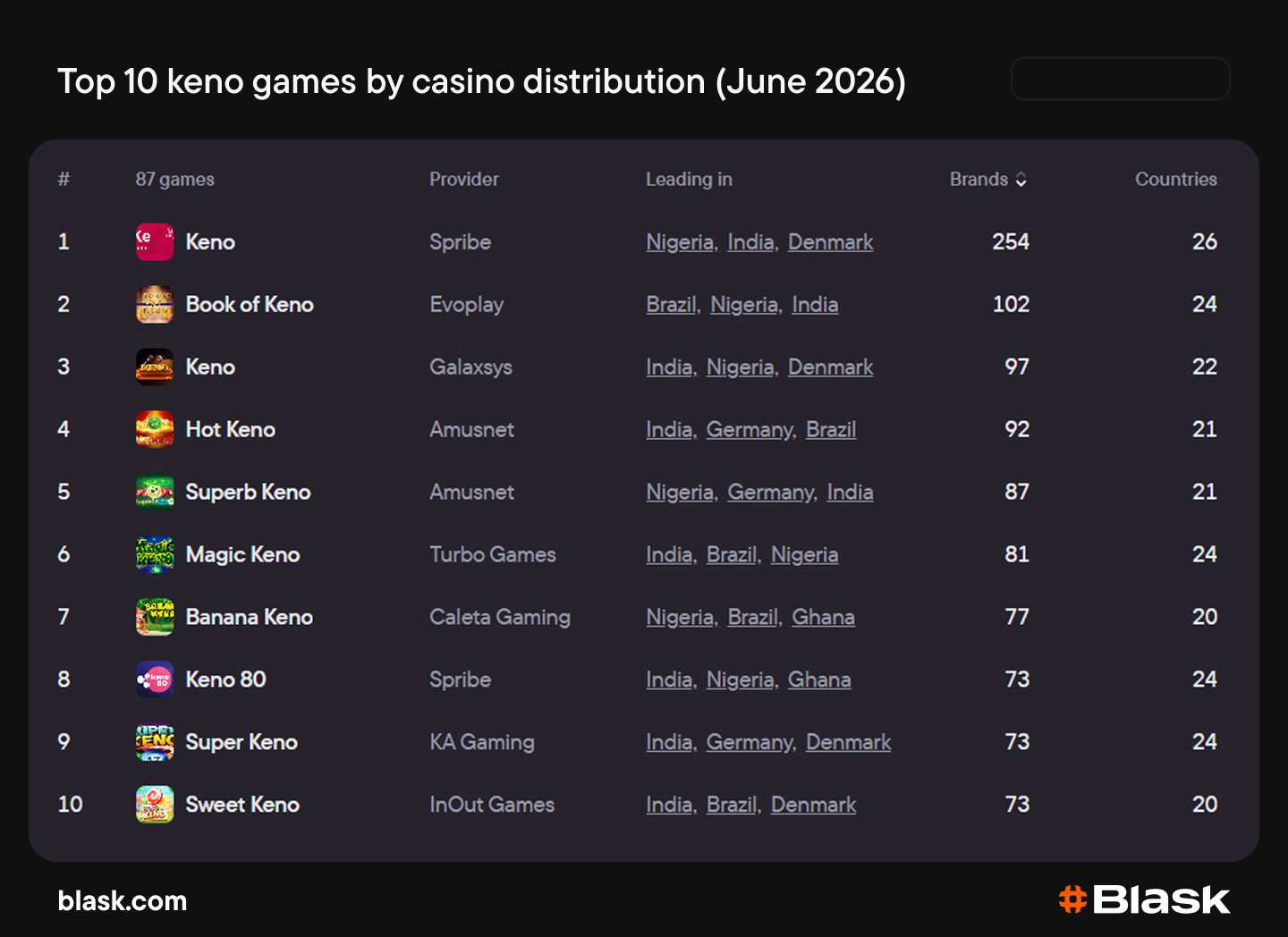
Like Spribe, Amusnet has two keno titles in the top-10 ranking — Hot Keno and Superb Keno.
Spribe
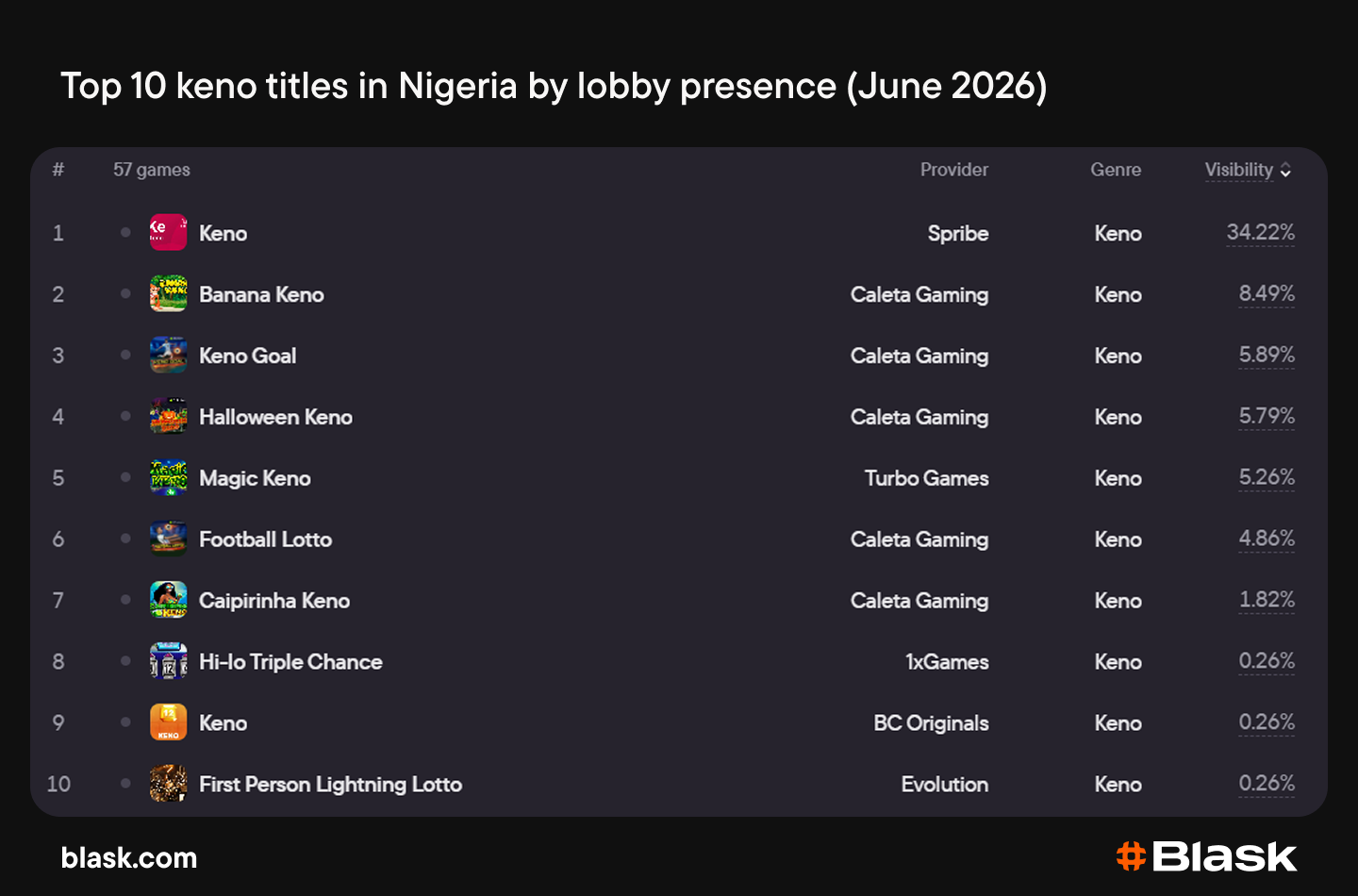
This iGaming supplier has two titles largely distributed across casinos, Keno and Keno 80. Keno is an undisputed leader in Nigeria: there is a big gap between this title and the second place taken by Banana Keno (Caleta Gaming).
Nigeria is the largest African market by CEB.
Caleta Gaming
Although Caleta Gaming isn’t a leader by casino distribution, it drew attention by the number of keno titles. For example, 5 out of 6 places in Nigeria are taken by Caleta Gaming’s titles.
Playtech
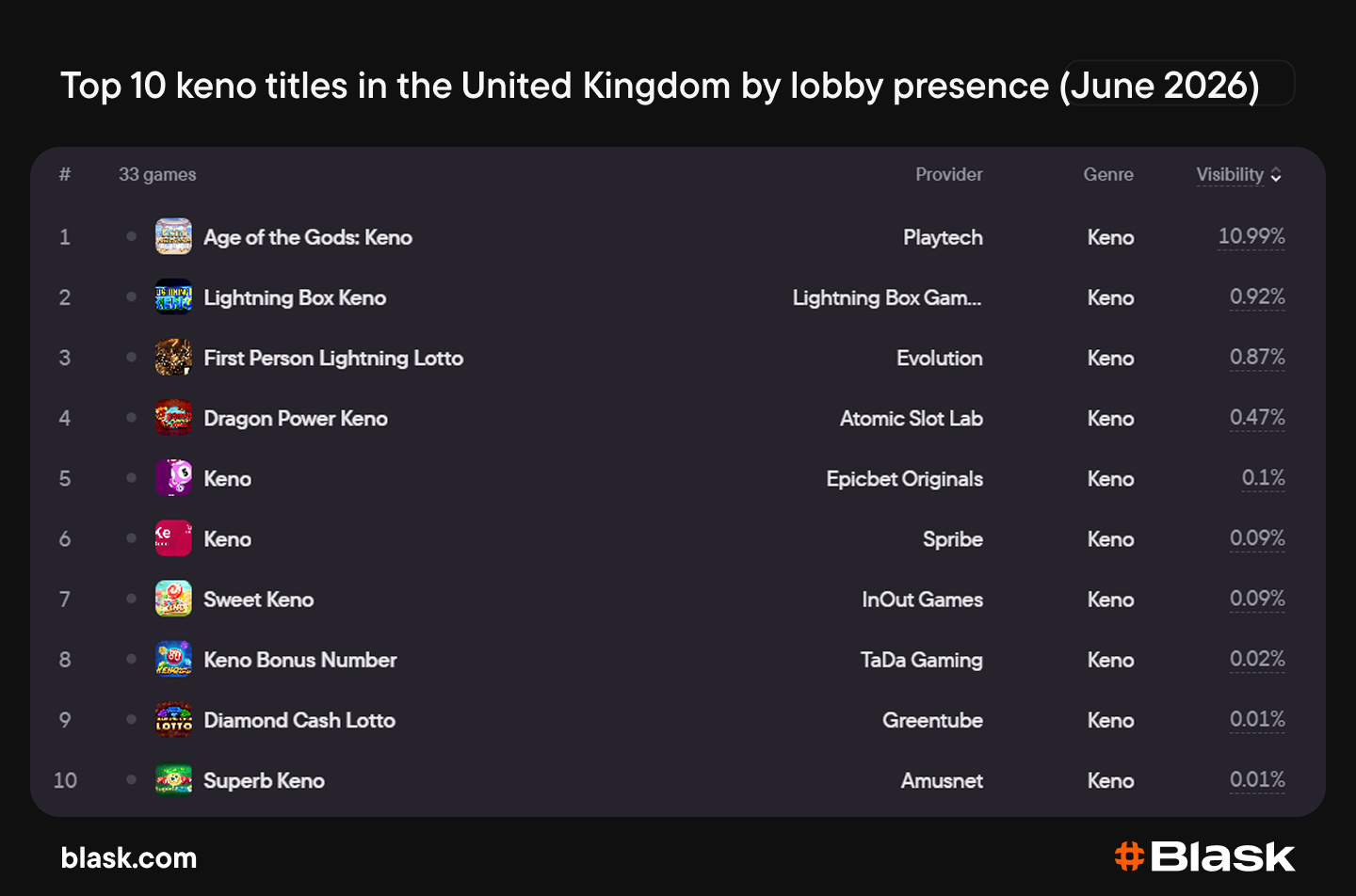
In the United Kingdom, Playtech is the leader by lobby visibility with its title Age of the Gods: Keno. With 10.99% of visibility it takes the first place why the second one has only 0.92%.
The UK is the largest European market by CEB.
Others
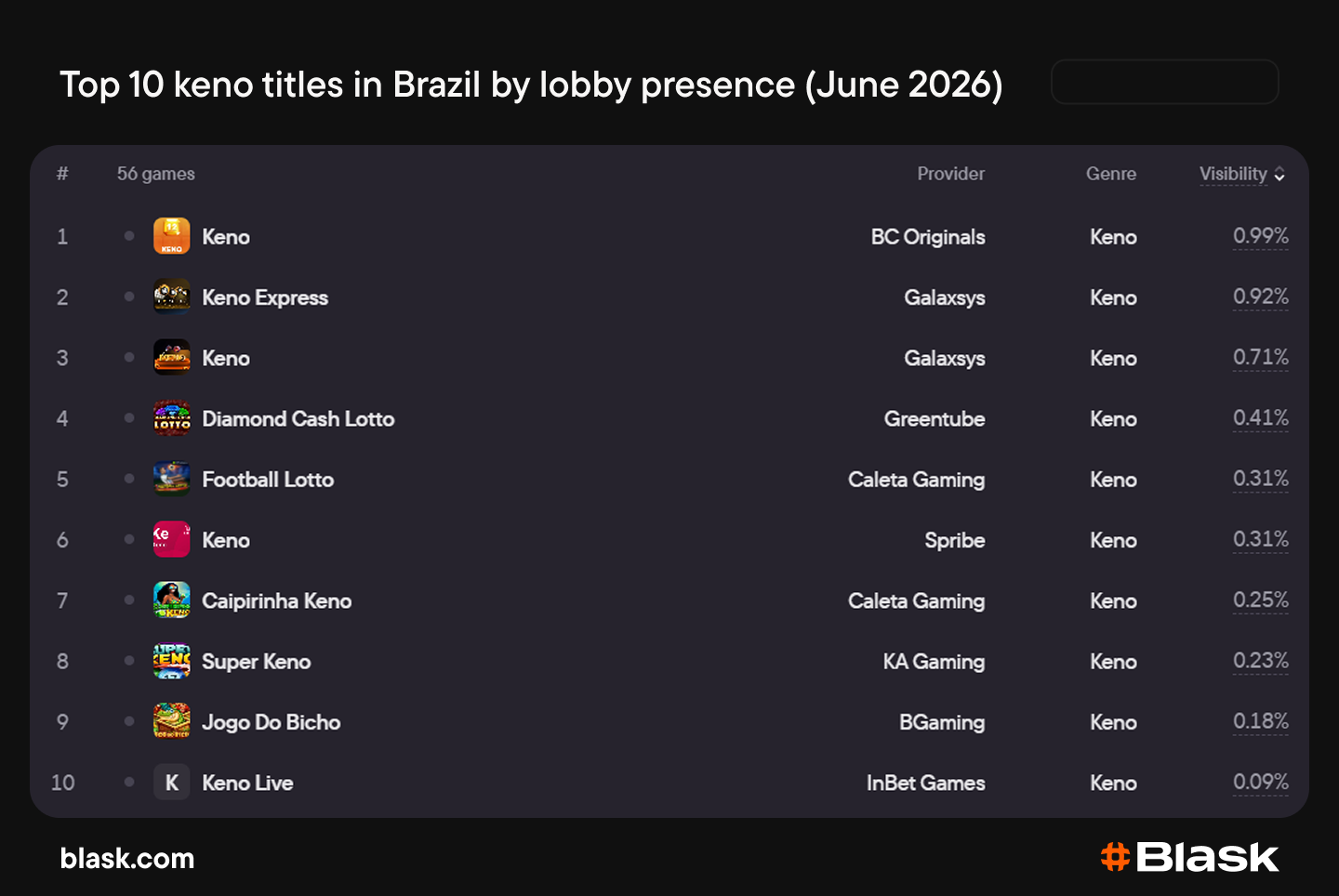
In Brazil, BC Originals’ title Keno and Galaxsys’ Keno Express have almost the same visibility share. However, Galaxsys has two titles in the top 10 ranking, while BC Originals — only the single.
Brazil is the biggest LATAM market by CEB.
Keno vs lottery vs bingo
All three formats involve number selection and random draws. The differences lie in structure, payout mechanics, and house edge.
| Feature | Keno | Lottery | Bingo |
| Draw frequency | Every 30 sec–20 min | Once or twice per week | Continuous (card speed) |
| Numbers in pool | 80 | 49–70 (varies) | 75 or 90 |
| Numbers drawn | 20 | 5–7 | Until winner |
| Player selections | 1–10 (typically) | 6 (typically) | Pre-set card |
| House edge | 20%–45% | 40%–50% | 25%–35% |
| Social element | None | None | High |
| Skill component | None | None | None |
Keno’s primary advantage over the lottery is draw frequency — how to play keno online means instant results rather than waiting days. Its advantage over bingo is individual play without dependence on other participants. Its disadvantage versus both formats is that its house edge, while often lower than the lottery, is still among the highest in the casino.
History of keno
Keno’s origins are rooted in a combination of historical fact and persistent legend. The most famous account attributes the game’s invention to Cheung Leung — or in alternative tellings, Zhang Liang — during the Chinese Han Dynasty, between approximately 205 and 187 BCE. According to legend, the game was devised as a lottery mechanism to fund military campaigns and, later, contributions toward the Great Wall of China. The Wikipedia entry on the Lottery notes that keno slips from this period represent the first recorded signs of organized lottery activity in human history — a claim that, while debated, has no older documented counterpart.
The verifiable ancestor of modern keno is the báigē piào (白鴿票), or “White Pigeon Game,” documented in late-19th-century southern China. As described by AncientGames.org, this game used sheets printed with the first 80 characters of the Thousand Character Classic — a classical Chinese text — from which a winning subset was drawn. Results from central drawing locations were relayed to outlying villages by carrier pigeons, giving the game its name. This 80-character pool and the subset-selection mechanic are the direct structural ancestors of the modern 80-number grid.
Chinese immigrants brought the game to the United States during the California Gold Rush in the mid-19th century, where it was adopted as the “Chinese Lottery” in communities along the transcontinental railroad. Over subsequent decades, Chinese characters were replaced with Arabic numerals, and the game migrated from immigrant social clubs into mainstream American casino culture. Nevada legalized the game under its current rules in 1951, establishing the format — 80 numbers, 20 drawn — that remains standard worldwide.
The word “keno” itself has debated etymology: the Wikipedia entry on Keno traces potential French roots (quine, meaning “five winning numbers”) and Latin roots (quini, “five each”), though both are disputed, and the game’s geographic origin is universally credited to China.
Future trends in keno for 2026
Several structural shifts are reshaping where and how keno is played as of mid-2026.
Massachusetts benchmark
In 2025, Massachusetts Keno set an all-time sales record of $1.3 billion — more than the combined sales of Powerball, MegaMillions, and all other draw games in the state combined. This figure confirms keno as the dominant lottery format in at least one major US market.
iGaming library diversification
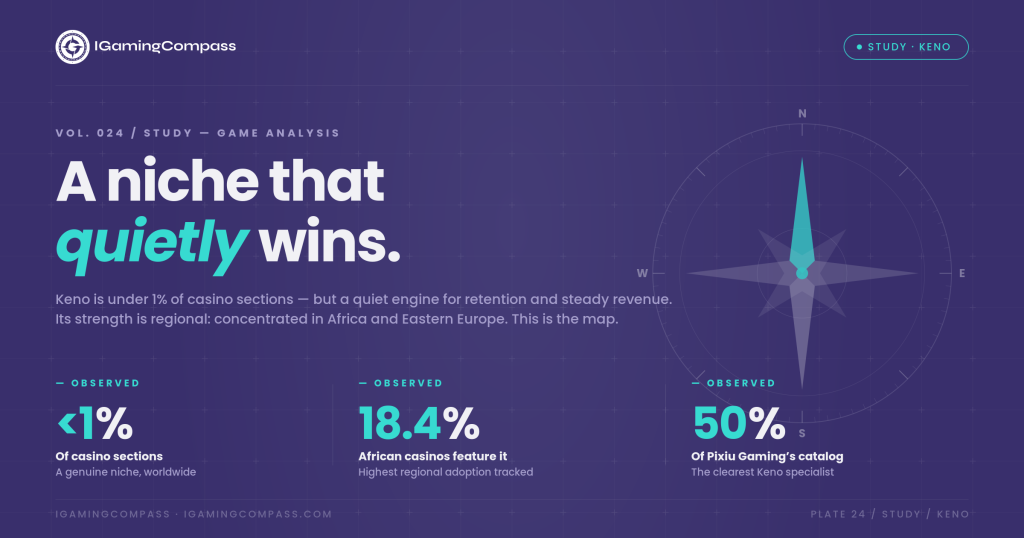
Image source: iGaming Compass
According to the iGaming Compass market report, keno represents less than 1% of dedicated casino game sections globally, but release activity peaked in 2023 and continues to be elevated. Africa leads with 22.1% of keno market share, followed by North America at 18.4% and Western Europe at 14.4%.
Live dealer keno
Several studios — primarily those already operating live casino environments — are testing live dealer keno formats with physical ball draws broadcast via video stream. These combine the provable authenticity of mechanical draws with the speed and accessibility of online play. Live keno carries more overhead than RNG variants, but addresses transparency concerns from players skeptical of software-generated outcomes.
AI-powered personalization
Operators are beginning to deploy machine learning tools that serve keno paytable variations and bet-size recommendations based on individual session history and deposit behavior. This is unlikely to improve player outcomes — the house edge is fixed by the paytable — but it increases engagement and session length metrics on the operator side.
Blockchain and provably fair keno
Following BGaming’s lead, studios are implementing cryptographic verification for keno draws, allowing players to audit outcomes independently. This addresses a persistent trust barrier and is particularly relevant in markets where licensing infrastructure is weaker and RNG skepticism is higher.