
- Updated:
- Published:
What Is RTP (Return to Player) in Slots
What RTP in slots is and how it works.
What Is RTP (Return to Player)
In plain language, what is RTP in slots comes down to one core number: the long-run share of wagered money a game is designed to give back over huge sample sizes, not over one lucky night or one rough session. A machine marked at 96 percent is built around a mathematical average, so the figure describes expectation, not a promise of balance stability or profit.
That distinction matters because short play can look chaotic. One session may burn through funds fast, while another may hit a feature almost immediately. The published figure still matters, but only as a long-horizon benchmark that helps explain how the game is built under the hood.

This AI image is a metaphor of RTP. Slots are icebergs because what players see is the surface excitement — but the real structure, vast and invisible, is pure mathematics below.
How RTP Is Calculated
This process is typically handled through mathematical modelling, large-scale simulation, and independent testing that checks base-game payouts, bonus features, and jackpot contributions. The published figure reflects a long-run statistical design, which is why short-term session results can look completely different from the theoretical average.
Theoretical RTP (Long-Run Average)
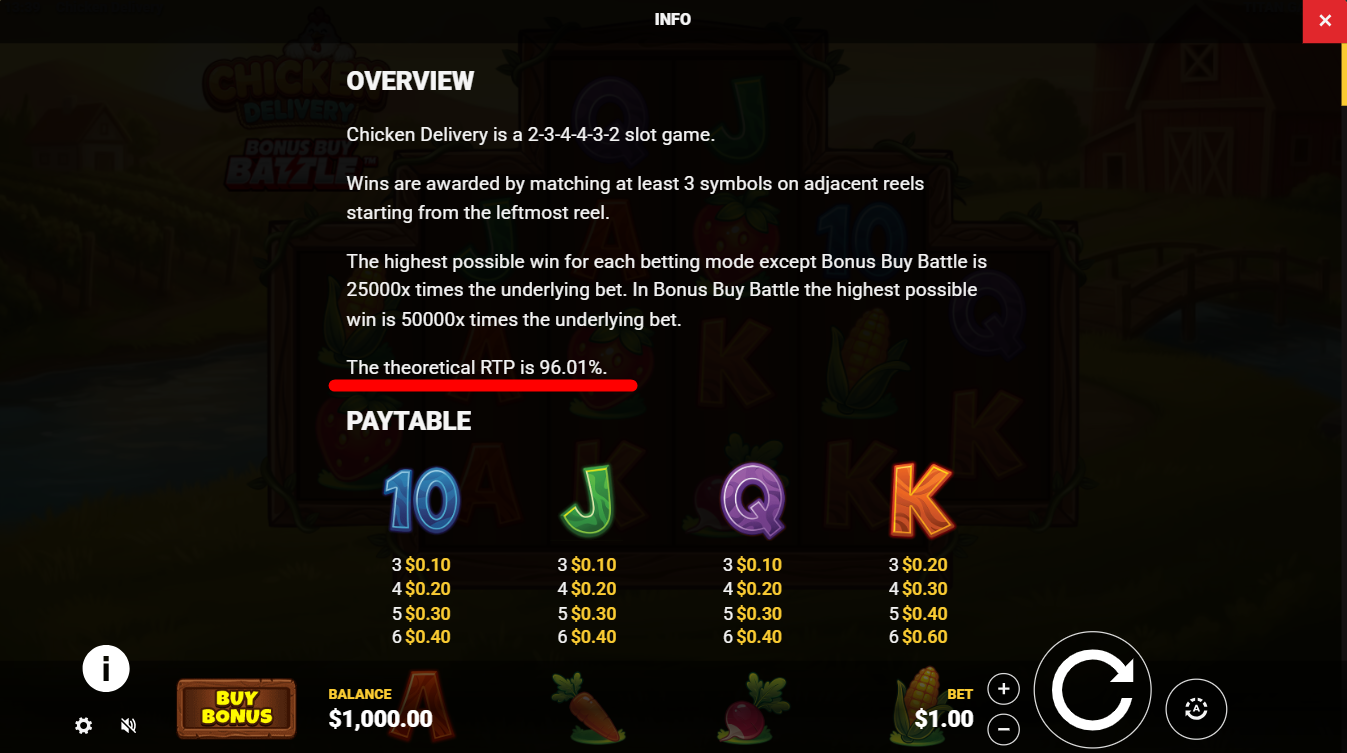
Theoretical RTP in Chicken Delivery by Titan Gaming
At the design stage, return to player is established through mathematical analysis of every meaningful pay combination or through very large simulations when the game structure is too wide for a simple closed-form model. Testing labs review the base game, feature rounds, jackpots, and the contribution of each part to the overall payback profile.
The point is not guesswork. Developers and labs are dealing with weighted symbols, reel strips, bonus states, and probability trees, then checking whether the final model lands inside a statistically acceptable range before the title goes live.
Actual RTP (Short-Term Variance)
Short-term performance is where confusion starts. The easiest way to explain RTP meaning is to separate design math from live outcomes: the first is the target, the second is the noisy real-world result produced by a finite sample of spins. A game can be perfectly healthy and still run above or below its target for quite a while.
That gap is not a flaw by default. Volatility stretches results, especially when big features and rare top symbols carry a large chunk of the payout model. The more uneven the prize map, the less smooth the short-run data will look.
Sample: 96% RTP Example
A practical benchmark helps. UK regulation guidance shows a game designed at 91.68 percent that records 1,200,000 in turnover and 1,085,000 in wins, producing an actual value of 90.42 percent for that measurement window. That does not automatically prove a defect, because tolerance depends on sample size and volatility.
In other words, a posted 96 percent game is not supposed to hand back exactly 96 from every 100 during one evening. Over enough volume the curve should move toward the theoretical target, but before that happens the ride can look messy, streaky, and honestly a bit wild.
RTP vs House Edge
House edge is simply the flip side of the same coin. If the game is built to return 96 percent over time, the operator edge is 4 percent. That is why RTP is useful as a framing tool: it presents the player-facing share, while house edge presents the operator-facing share. Same math, different angle.
The difference in wording is not trivial. Research cited in public explanations of the metric shows that many people understand warnings differently depending on whether the information is framed as money kept by the house or money returned by the game.
| RTP % | House Edge % | Typical Context |
| 99%+ | <1% | Best video poker, favorable blackjack rules |
| 97–98% | 2–3% | High-return slots, European roulette |
| 94–96% | 4–6% | Standard online slots |
| Below 94% | >6% | Weak slots, American roulette |
RTP vs Volatility: Key Differences
A slot can look generous on paper and still feel brutal in practice. Volatility explains how often wins arrive and how large they tend to be, while the payback figure explains only the long-run average. That is why chasing one number without reading the rest of the game sheet can lead to bad assumptions.
| RTP | Volatility | |
| What it measures | Long-run average payout percentage | Frequency and size distribution of wins |
| Useful for | Comparing game math across titles | Understanding session feel and risk level |
| Tells you | Expected return over millions of spins | How smooth or swingy short-term play will be |
What Each Metric Tells You
Two RTP slots with identical published returns may still produce totally different sessions because the hidden distribution is different. One can trickle small hits every few spins, the other can stay quiet for ages and then drop a chunky feature payout:
Long-run expectation: how much the model gives back over a very large play volume, Hit rhythm: how often balance movement happens, Payout shape: whether value is spread across small wins or concentrated in a few spikes, Top-end pressure: how much of the game’s value sits in rare premium outcomes.
Why Two 96% RTP Slots Play Differently
One 96 percent game may act like a slow drip, another like a dry desert with a few sudden storms. That is not a contradiction. Return to player says nothing about emotional pacing, balance swings, or the frequency of base-game relief between features.
A low-variance game often stretches playtime with smaller, steadier returns. A high-variance one may save much of its value for rare bonuses, jackpots, or premium symbol chains. Same average, completely different feel.
Typical RTP Ranges by Game Type
Across casino products, the average range changes with rules, skill, and house structure. Slots usually sit below the best table games and many video poker variants, while wheel games tend to reflect fixed mathematical edges tied to layout design.
| Game Type | Typical RTP Range | Notes |
| Slots | 94%–97% | Mid-90s most common; 97%+ considered strong |
| Blackjack | 99%+ | Skill-dependent; requires basic strategy |
| European Roulette | ~97.3% | Single-zero layout |
| American Roulette | ~94.7% | Double-zero layout |
| Video Poker | 99%+ | Full-pay tables with optimal play |
| Live Dealer | Inherits table game math | Same RTP divide as digital versions |
| Crash / Instant | ~95%–97% | Varies sharply by title and operator version |
Slots (94%-97%)
For online slots, what is return to player in practice usually means a band around the mid-90s, with many titles clustering near 96 percent and stronger examples moving above 97. Very high figures do exist, but they are exceptions rather than the standard market baseline.
Below 94 percent is typically viewed as weak, 96 percent is common, and anything at 97 percent or above usually gets tagged as notably strong for this product class.
Blackjack (99%+)
Blackjack under common rules and basic strategy can push close to 99.5 percent, which is far stronger than most slot math. The big catch is skill: wrong decisions drag the number down, so the headline value depends on disciplined play rather than passive spinning.
Roulette (97.3% European / 94.7% American)
Roulette is cleaner because the wheel decides everything. European single-zero tables produce an RTP percentage of about 97.30, while American double-zero tables fall to roughly 94.74 because the extra zero widens the house edge.
That gap is one of the clearest examples of how a tiny rule change can move the long-run math in a visible way.
Video Poker (99%+)
Video poker often sits above slots because player decisions matter and some full-pay tables are extremely strong. Full-pay Jacks or Better is commonly cited at 99.54 percent with optimal play, while certain Deuces Wild schedules can even edge above 100 in theory.
Live Dealer Games
Live dealer titles usually inherit the mathematics of the table game behind them. That means blackjack can remain near the top under favorable rules, baccarat generally stays efficient, and roulette keeps the same single-zero versus double-zero divide seen in digital versions. The studio feed changes presentation, not the basic arithmetic.
Crash and Instant Games
Crash and instant-win products are less uniform. Published examples commonly land in the mid-90s, often around 95 to 97 percent, but the category is broad and exact figures can vary sharply by title and operator version. That makes individual rule screens far more important than category labels.
Highest RTP Slots in 2026
The phrase highest RTP slots usually points to a small group of older but still mathematically famous releases. They are not always the loudest games in the lobby, yet they keep showing up in comparison pieces because their long-run numbers still stand out.
| Slot | Provider | RTP |
| Ugga Bugga | Playtech | 99.07% |
| Mega Joker | NetEnt | 99% |
| Blood Suckers | NetEnt | 98% |
| Starmania | NextGen | ~97%+ |
| White Rabbit Megaways | Big Time Gaming | ~97%+ |
| Golden Chief | Pulse 8 | ~97%+ |
Mega Joker (NetEnt) — 99%
Mega Joker remains the classic benchmark. Multiple current comparison sources continue to place it at 99 percent, which is rare territory for a slot and one reason the title still gets mentioned long after its release cycle stopped being new.
Ugga Bugga (Playtech) — 99.07%
Ugga Bugga is usually cited a touch above Mega Joker, with published figures up to 99.07 percent depending on version and source. That places it in genuinely elite territory, though availability can be patchy and version control matters.
Blood Suckers (NetEnt) — 98%
Blood Suckers stays relevant because 98 percent is still excellent for a mainstream five-reel slot. It is not the flashiest title around, but mathematically it remains one of the best-known examples of a player-friendly payback model.
Other 97%+ RTP Slots
Beyond the headline trio, strong RTP slots in current comparison tables include Starmania, White Rabbit Megaways, Golden Chief, Wolfpack Pays, Medusa Megaways, and Texas Tea, all listed around or above the 97 percent zone by recent guides.
A short reality check helps here. High payback alone does not guarantee modern visuals, deep bonus design, or low risk. Some of the strongest mathematical titles are old-school, blunt, and mechanically simple.
How to Find a Slot’s RTP
Finding the figure is easier online than in physical venues, but consistency still varies. In a transparent RTP casino environment, the number is usually visible somewhere in the help file, the provider page, or a verified game listing.
Check the Pay Table or Info Screen
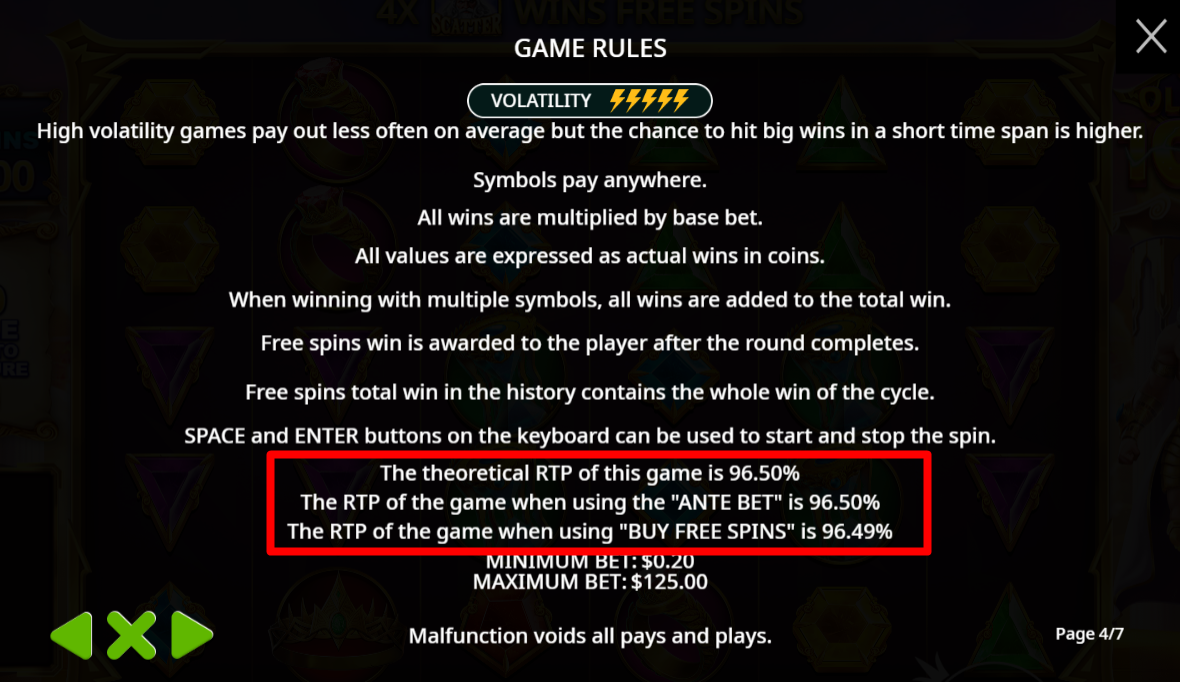
This is an RTP of Gates of Olympus (Pragmatic Play) on Stake
The first stop is the in-game information panel. Many regulated titles publish the number near rules, paytable notes, or bonus explanations, often alongside volatility language and minimum bet data:
Screen help: rules and feature notes, Paytable page: symbol values and base mechanics, Game info tab: version details and limits.
Provider Website
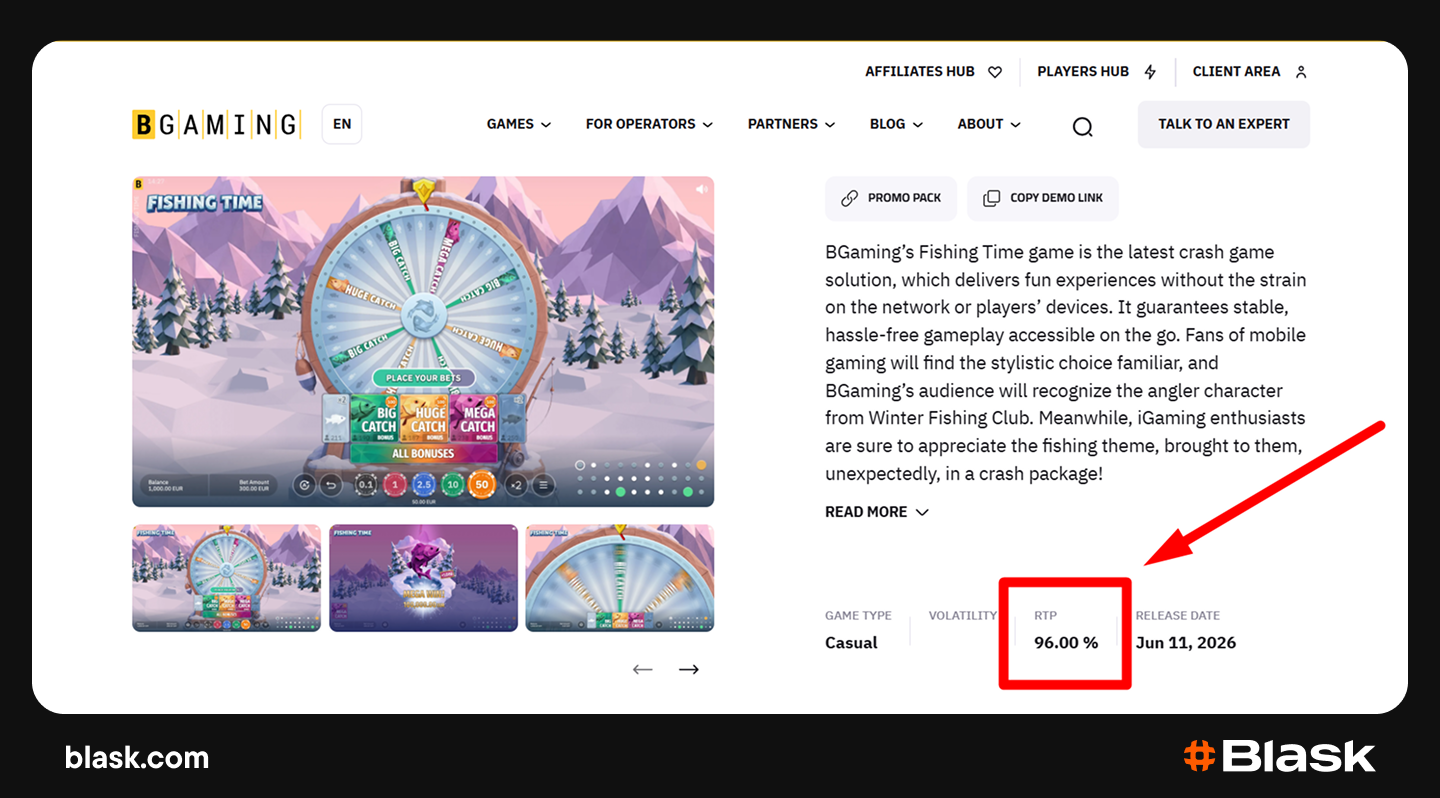
For example, this is Fishing Time’s RTP on the BGaming’s website.
Provider pages can be cleaner than casino lobby cards. When the developer publishes official stats, that version is usually the better reference point for default game math and feature structure.
Casino RTP Listings
Third-party listings are useful for comparisons, especially when checking several titles side by side, but they can go stale or mix regional versions. Good comparison pages are handy, yet a direct rules screen still carries more weight if there is any mismatch.
Why Some Casinos Offer Different RTPs for the Same Slot
This is one of the least understood parts of the market, and the second big piece of RTP meaning. A slot name is not always tied to one immutable configuration. Some titles are released in several approved settings, allowing one operator to run a tighter build and another to choose a more generous one.
The practical result is simple: the same branded game can feel different across sites because it may literally be running different math. That is why comparing the title alone is not enough; the version matters.
How Operators Configure RTP (Operator Side)
Historically, changing the setting could require physical intervention, but in some markets newer systems have made network-based configuration possible. As a result, one slot may be available in several approved RTP versions, sometimes ranging from 85 percent to 98 percent.
Configuration logic: choose an approved build, deploy it to the platform, monitor field results, then compare live performance with statistical tolerance bands. Labs and regulators care less about vibes and more about whether the actual data stays inside acceptable boundaries.
RTP and Bonus Buy Features
Bonus buys complicate the conversation because a feature round can carry its own return profile. In some games, RTP for the purchased feature is slightly better than the base mode; in others it is simply a faster route into the same volatility package rather than a mathematical upgrade.
That is why bonus buttons should never be treated as automatic value. They change pacing, risk concentration, and balance burn rate, and sometimes they change the underlying payback figure as well.
Common RTP Misconceptions
Most confusion comes from mixing long-run theory with short-run emotion. A clean fact check clears up the usual myths fast.
RTP Does Not Guarantee Wins
The first myth is the easiest to kill. If someone asks what is RTP and expects a session guarantee, the concept has already been misunderstood. A strong number can still produce long losing stretches, because random distribution does not care about short-term fairness.
Higher RTP ≠ Better Experience
A stronger payback model does not automatically mean more fun. Some high-return games are dry, repetitive, or light on feature depth, while a slightly lower-return title may feel livelier because the action is distributed more often.
RTP Is Long-Term, Not Per Session
This point cannot be skipped: return to player is a population-level expectation over massive play volume, not a personal contract for one bankroll, one hour, or one weekend. The math works over time, but time in gambling is much longer than most people instinctively assume:
Misread idea: one session should reflect the posted number. Correct idea: short samples swing hard. Misread idea: higher figure means frequent wins. Correct idea: volatility controls the feel.
RTP Regulation and Certification
Public trust depends on oversight. Return to player is not just a marketing label when a regulated market requires testing, documentation, and tolerance monitoring against the designed model.
UKGC and How to Calculate RTP
The UK approach is unusually concrete. Guidance explains how actual performance is measured from turnover and wins, why standard deviation matters, and why acceptable deviation narrows as the sample grows from tens of thousands of games toward a million.
MGA Requirements
Maltese policy documents show that minimum thresholds can also shift over time. A published paper discussed streamlining the minimum from 92 percent to 85 percent for remote operators, aligning remote and land-based standards under the same authority.
Independent Testing Labs (GLI, eCOGRA)
Independent labs are where certification turns technical. GLI describes theoretical and simulated analysis across base play, feature rounds, and jackpots, while eCOGRA describes large-sample simulation work to confirm that theoretical outcomes are actually achievable within statistical limits.
Future Trends in RTP for 2026
The next phase is less about inventing a new metric and more about making math visibility harder to ignore. What is RTP in 2026 is increasingly tied to version transparency, bonus-mode disclosure, and more explicit separation between base-game and feature-game returns. Players are seeing more comparison content, while regulators and labs are pushing clearer measurement language.
The sharpest trend is practical, not flashy: better-informed users are no longer satisfied with one headline number alone. They want the real picture, including configuration differences, volatility context, and the gap between theoretical design and live performance. That shift is healthy for the market, and frankly long overdue.