
- Updated:
- Published:
Armenia targets gambling payments as offshore demand triples
Armenia is moving to block offshore gambling payments, but the market has already run ahead of regulation: Blask Index for offshore brands tripled in two years.
Armenia’s parliament passed a package of amendments to the gambling law in the first reading. The official goal is to cut off revenue for unlicensed operators and leave payment infrastructure only for the licensed sector.
The amendments have not entered into force yet, and Armenia’s centralized monitoring system is still stuck at the tender stage. While the SRC (State Revenue Committee of Armenia) prepares to hand it to a private operator for 15 years, offshore gambling demand has already moved ahead.
What exactly was adopted
The amendments were initiated by Civil Contract MP Hayk Sargsyan. His package includes:
- Payment blocking. Commercial banks must reject transactions related to unlicensed gambling, including MCC 7995. Technical directives have already been sent to the financial sector.
- Website blocking. Providers must block access to unlicensed platforms.
- Advertising. Offshore promotion is banned. Licensed operators must pre-approve every creative.
- Player protection. Mandatory self-exclusion, a loss limit of 20% of income, and restrictions for pensioners and social aid recipients. All these rules apply only to the licensed sector.
The amendments come on top of the reform that started on January 1, 2025: geoblocking, mandatory .am domains, a 10% turnover tax from July 2025, and rising licence fees through 2028.
The National Association of Gambling Operators (NAGO) warned that players affected by the new restrictions would move to unlicensed platforms. The association estimates that the black market share grew from 10% to 20% in one year.
Local brands still dominate, but demand is weakening
Armenia’s gambling market remains almost fully local and highly concentrated. Adjarabet, totogaming and VBET together hold 92.8% BAP. However, only the leader is growing: Adjarabet added 13.1% year-on-year, while totogaming lost 22.1% and VBET lost 20.9%.
At the same time, 1win, an offshore operator without an Armenian licence, already ranks 5th by BAP. Its share is still small at 0.78%, but its Blask Index grew 134.5% YoY, the strongest rate in the top-5.
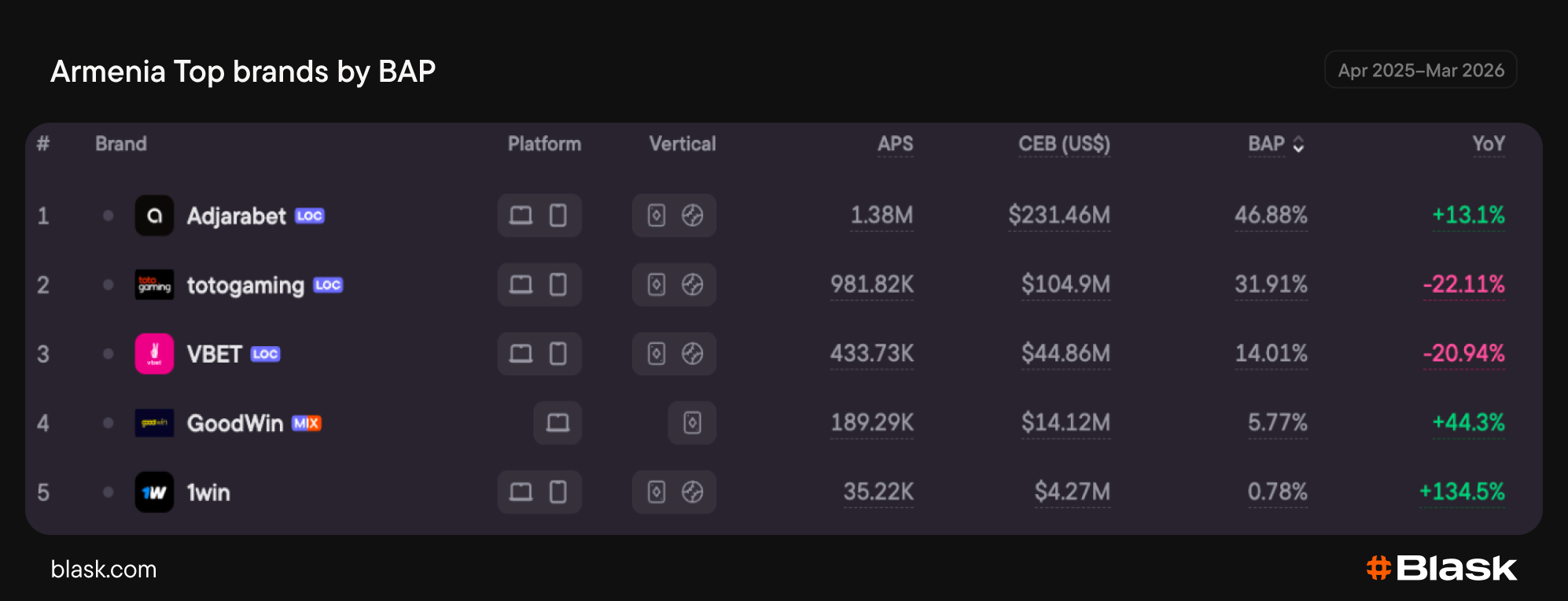
Together, the two declining brands control 45.9% BAP, almost as much as Adjarabet alone, so the leader’s growth does not offset weakness across the rest of the market’s top tier.
Euro 2024 lifted demand before enforcement pulled it down
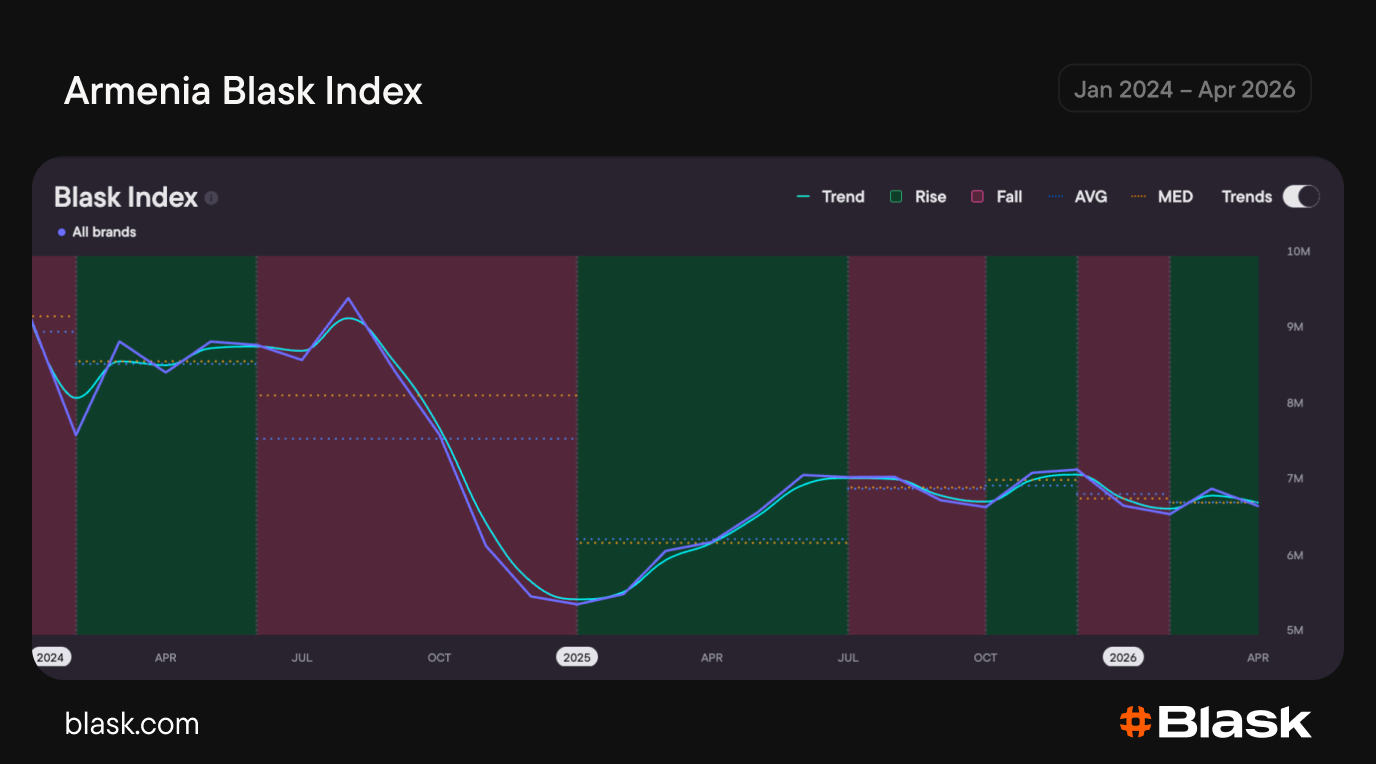
Blask Index shows a sharp reversal in the second half of 2024. After the summer peak driven by Euro 2024, demand started to decline, and the fall accelerated after October 10, when Armenia introduced measures to block foreign gambling sites and restrict advertising. By December, the index was already about 43% below its July peak.
Problem is structural, not just regulatory
Armenia’s licensed perimeter mostly rests on three brands. Two of them have been losing demand for two years in a row, while the third is growing but cannot carry the whole segment.
Parliament is adopting amendments that will increase the compliance burden for the licensed sector, while offshore platforms remain outside those rules. For now, the market is still overwhelmingly local: the top three licensed brands hold about 90% of BAP but 1win’s growth shows where the pressure is building.
Its share is still much smaller than the leaders’, yet it is already above 1.5% BAP in April and growing faster than any top local brand. Blask data shows an early offshore shift forming before payment blocking and centralized monitoring come into force.