

- Updated:
- Published:
Austria’s July gambling law deadline puts operators with 50% of demand at risk
Austria’s new gambling law is approaching its July deadline, but the proposed multi-year licensing ban for grey-market operators remains unresolved.
Austria’s three governing parties — ÖVP, SPÖ and NEOS — are finalising the new online gambling law. The draft is expected to be presented before July, and after a three-month EU approval process it could come into force as early as autumn. That timeline would allow the licence tender to start before Win2day’s monopoly expires in 2027.
Under the proposal, operators that violated Austrian law in the past five years would be barred from submitting licence applications for 24–36 months. The measure targets offshore brands with European licences that have been operating in Austria without a local one.
Offshore brands hold half the demand but only 40% of CEB
Blask data shows Austria’s iGaming market split in two: offshore brands capture roughly half of user search demand, while Win2day — the only licensed operator — takes around 60% CEB. The financial structure of the market has barely changed since Blask’s previous overview, even as demand has shifted slightly back toward the legal sector.
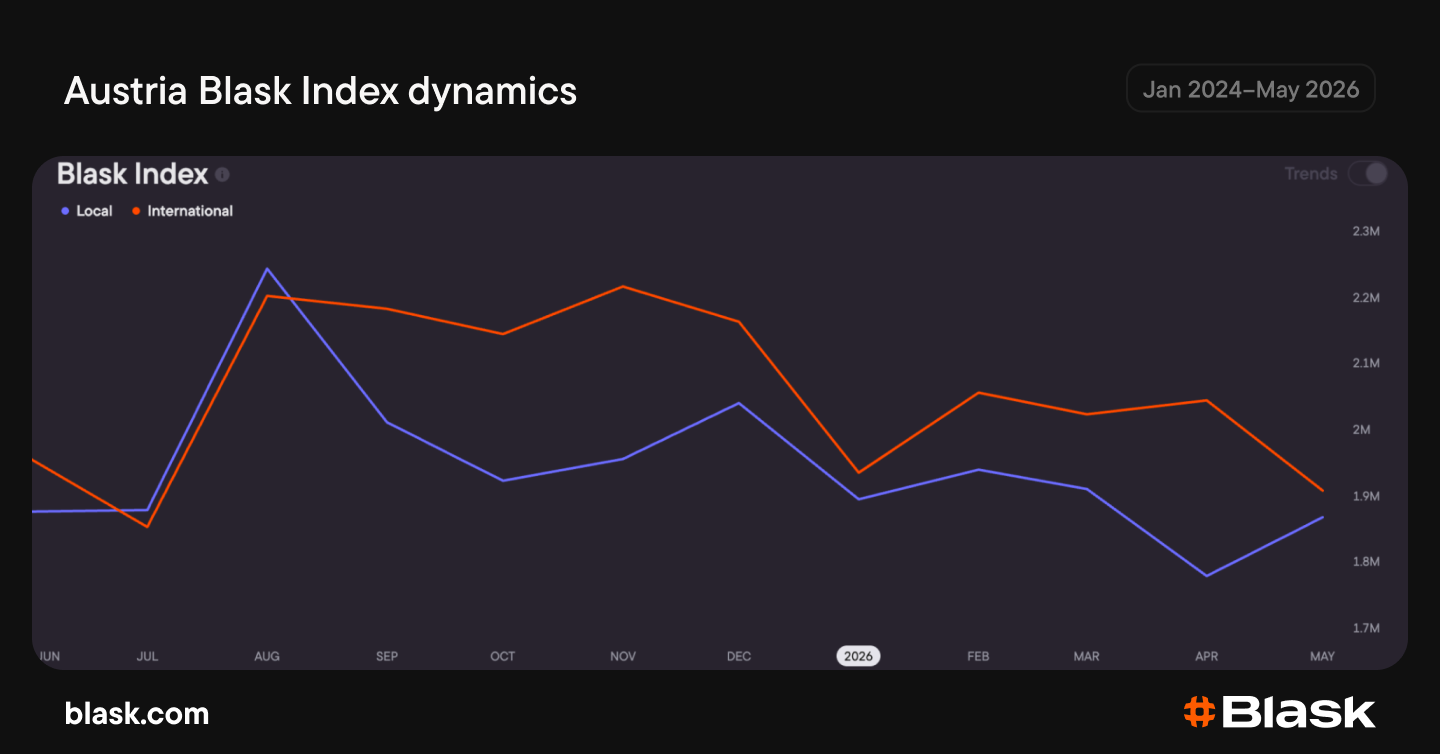
By May 2026, offshore demand share had fallen from its April peak of 53.5% to 50.5%, while the onshore segment grew from 46.5% to 49.5%. CEB remained stable throughout: offshore operators stayed within the $41M–43M per month range, while Win2day held at $62M–64M. The gap between attention and projected revenue is structural — offshore brands attract players, but Win2day’s monopoly converts that into a dominant spending share.
The cooling-off period traps offshore demand outside the licensed market
The cooling-off period creates a direct contradiction at the heart of Austria’s reform: it leaves offshore demand in the market while closing the path to licences for the operators that already hold a significant share of it.
Despite that offshore share having slipped slightly, the brands at risk of a licensing ban still represent roughly 50% of the search demand Austrian players generate. If those brands are excluded for 24–36 months — and the first new licences are not expected before 2029 — a three-year ban could push the real transition of offshore operators into the legal sector well into the 2030s.
For a reform designed to channel players into the licensed system, the risk is clear: Austria may open the market on paper while many high-demand brands remain outside the new framework.