

- Updated:
- Published:
Germany’s gambling rules come under pressure as offshore demand outpaces local market growth
Germany’s ruling party has questioned whether the current framework can hold back offshore demand — and Blask data confirms the gap is already widening.
The debate over gambling reform in Germany escalated after the Economic Council linked to the Christian Democratic Union (CDU), Germany’s ruling conservative party, called for a revision of the 2021 State Treaty on Gambling (GlüStV). The party argues the current model has failed to achieve its primary goal — channeling players from offshore platforms to licensed operators.
Among the key criticisms: a 5.3% turnover tax on online slots, a €1-per-spin stake limit, and a licensing procedure operators have repeatedly described as excessively rigid. The CDU proposes to strengthen enforcement against unlicensed operators, ease the approval process, and move to continuous regulatory evaluation rather than infrequent scheduled reviews.
Offshore demand accelerates again
According to the industry association DSWV, unlicensed operators outnumber licensed ones by roughly 11 to 1, and the real channelization rate stands at just 22–25%.
Blask data confirms that offshore competition remains significant: international brands account for approximately one-third of total betting demand even outside major sporting event peaks. From February to June, their share of the German market grew from 20.2% to 46.1%.
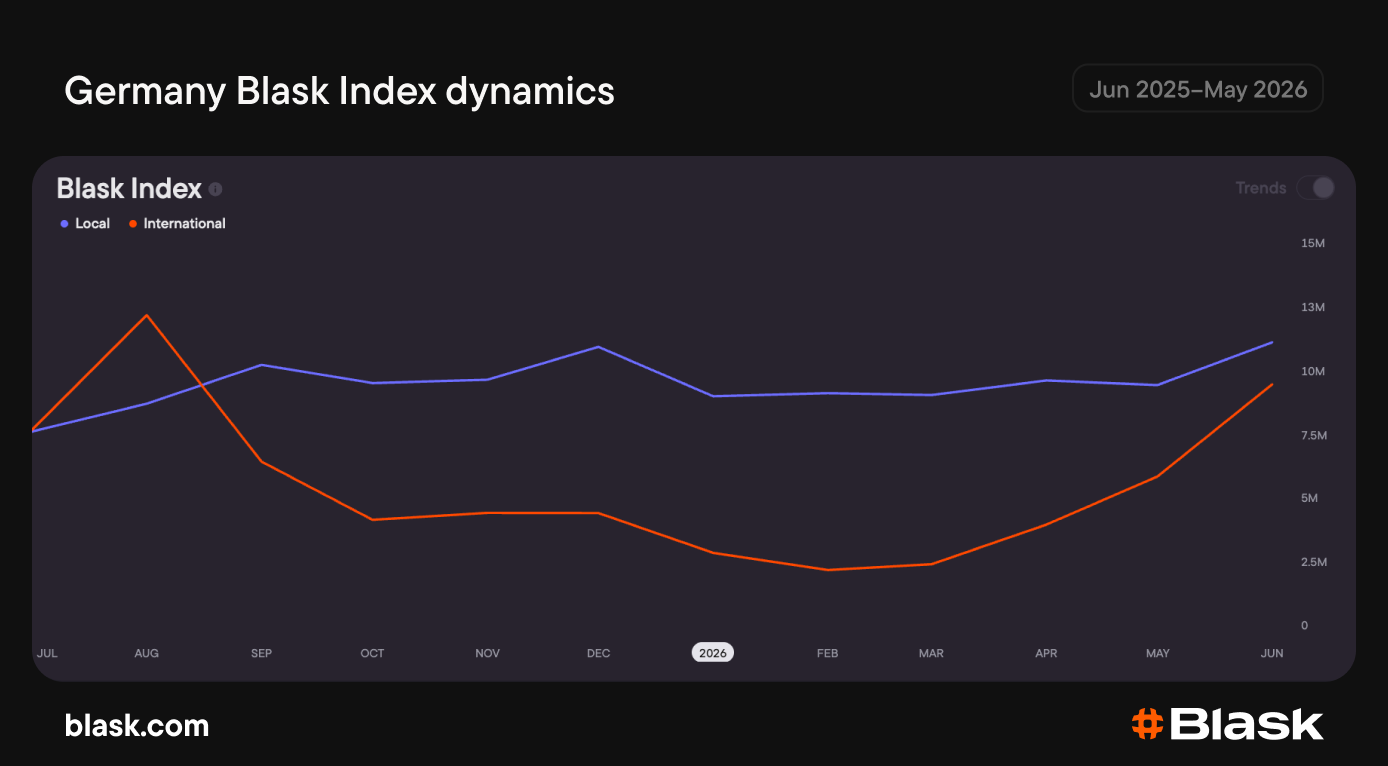
Onshore demand remained relatively stable throughout the period; offshore brands posted the strongest growth — particularly in May and June. The additional betting interest driven by the FIFA World Cup flowed largely to offshore rather than licensed brands.
It is consistent with an earlier Blask analysis of the World Cup that identified Germany as one of the markets where the unregulated segment stood to gain most from tournament demand. DSWV estimated that up to $463M in World Cup wagers could flow to unlicensed bookmakers, thanks to a broader product offering, fewer restrictions, and simpler onboarding.
Pressure on the regulator is mounting
The CDU’s statement shifts the GlüStV 2021 debate from taxes and licensing to market survival. Political pressure is running ahead of the law’s scheduled end-of-2026 review, and Germany’s central question has become whether the legal sector can compete with offshore operators for consumer demand at all.