

In May 2026, an Italian report showed record growth in illegal gambling traffic, while Blask Index showed a decline in offshore demand. Both sources can be right. The difference lies in what each one measures and what that means for operators.
In May 2026, the Data Room Nexus Observatory published its first systematic report on illegal online gambling in Italy. Data for Q1 2026 showed 4.5M active users and more than 13M sessions on unlicensed platforms. The annual size of the illegal market is estimated at around €20B.
In 2025, Italy’s Customs and Monopolies Agency blocked more than 1,000 illegal websites. Many returned within hours as mirror sites with the same platforms and user databases.
How regulation created the asymmetry
In 2018, Italy introduced the Decreto Dignità, one of the strictest gambling advertising bans in Europe. The law prohibits “any form of advertising, including indirect advertising” for gambling businesses. The ban hit licensed operators only, while unlicensed platforms continued to advertise.
The European Gaming and Betting Association estimated the impact in 2023: around €1B in online GGR flows to illegal operators every year.
In November 2025, Italy relaunched its licensing system: 52 new licences for 46 operators at €7M each. At the same time, the Senate is advancing an amendment that would allow sports clubs to accept betting sponsorships.
Blask shows offshore demand losing search visibility
A previous Blask market overview of Italy showed the longer trend: Italy remained a mature and steadily growing iGaming market, while offshore brands’ share by Blask’s market signal fell from over 20% to 2%.
April 2026 data shows the same split through CEB. Offshore brands fell 27% over 12 months to $12.9M, while their share of total market CEB dropped from 3% to 2%. Licensed brands continued to grow, increasing 17% to $544.1M.
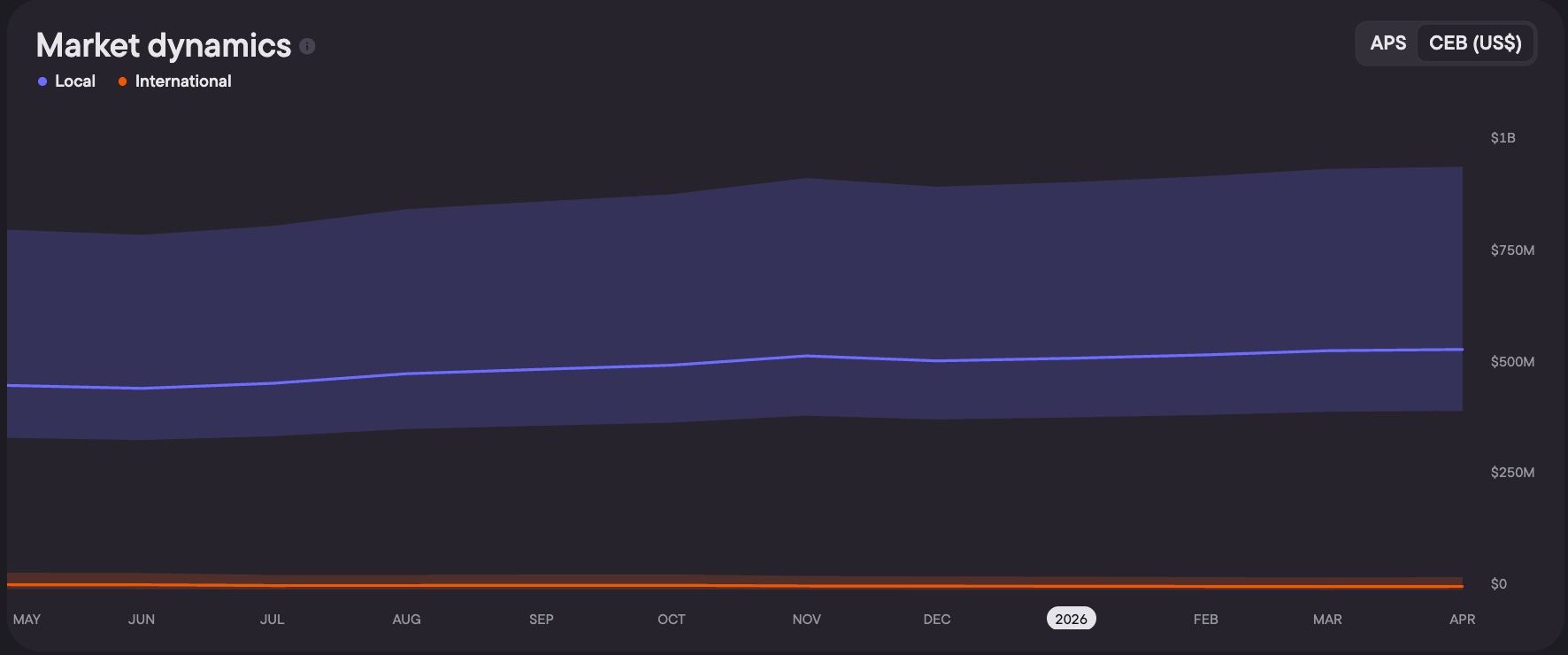
Visits are rising, search visibility is falling
The difference between The Observatory on Illegal Online Gambling and Blask is methodological: the former measures actual visits to illegal websites, while Blask measures brand direct demand. Since Italy’s advertising ban, illegal operators have moved deeper into channels that do not require public search: closed Telegram channels, private WhatsApp groups, social media posts, YouTube referral links, saved links and direct visits. As a result, this traffic appears in Observatory data, but does not create a signal for Blask.
Together, these signals show that offshore gambling has not disappeared from Italy. It has moved deeper into closed acquisition channels, where users no longer search for a brand but arrive through a ready-made link.
Blocking sites does not block demand
Italy’s data shows that a strict advertising ban without symmetrical control over the illegal space does not reduce gambling, but changes its infrastructure instead.
Illegal gambling in Italy is becoming less visible in public search and more embedded in closed channels that are much harder to track and block.