
By any measure, Europe’s battle against offshore gambling has intensified. Regulators are coordinating across borders, enforcement budgets are rising, and political rhetoric increasingly frames illegal operators as both a fiscal and consumer-protection threat. Yet despite years of effort, unlicensed platforms still dominate large parts of the continent’s online gambling economy.
A new joint article by Blask and NEXT.io attempts to move the debate beyond intention and into evidence. Drawing on Blask’s market intelligence data, the study compares seven European jurisdictions to answer a deceptively simple question: which enforcement approaches actually work and which quietly push players offshore?
What the data actually shows
The timing is deliberate. In November 2025, gambling authorities from Germany, Austria, France, the United Kingdom, Italy, Portugal, and Spain formalised a rare cross-border coordination agreement aimed at tackling illegal gambling. The pact promises shared intelligence, joint complaints to digital platforms, and aligned investigative methods.
What it does not guarantee, however, is effectiveness.
Blask’s data paints a stark picture of Europe’s online gambling reality.
Despite regulatory frameworks across all seven countries, unlicensed operators still account for the majority of total market value. The offshore sector, according to the analysis, generates more than twice the revenue of licensed operators across Europe — an imbalance with profound implications for taxation, consumer protection, and regulatory credibility.
Rather than treating Europe as a single regulatory bloc, the report dissects how different enforcement philosophies shape market outcomes. Some countries have all but eliminated offshore competition. Others appear locked in a fragile equilibrium.
One, notably, has seen illegal operators gain the upper hand.
Country analysis
The contrast is most visible in markets where enforcement is both aggressive and operationally mature. In the United Kingdom and Italy, offshore operators have been reduced to statistical noise.
The study attributes this not to regulation alone, but to the systematic pairing of domain blocking, payment interdiction, and sustained monitoring. Visibility disappears, transactions fail, and offshore platforms wither.
Elsewhere, the picture is more complicated.
France
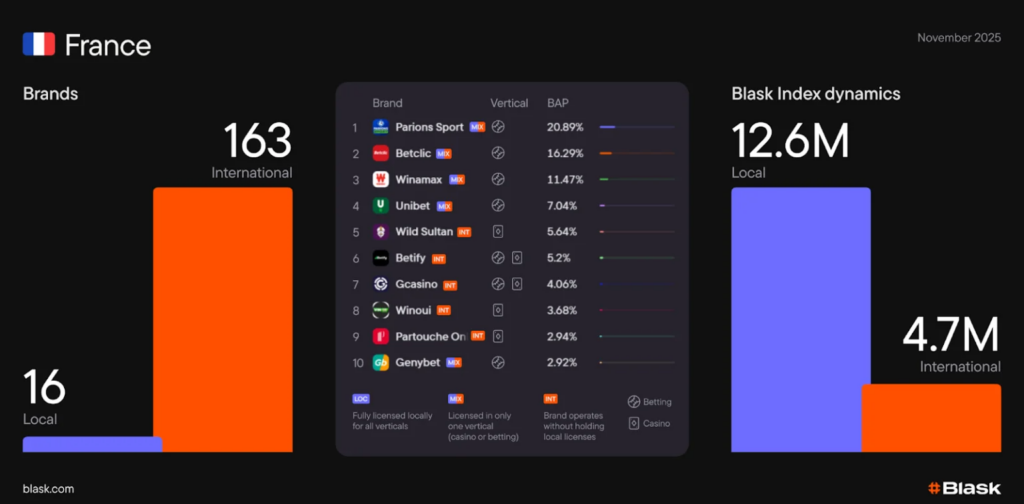
France, for example, enforces its laws vigorously — but only within a limited regulatory scope. Online casino gaming remains prohibited, creating a legal vacuum that enforcement cannot fill.
Players seeking casino products inevitably turn to offshore alternatives, not because regulation is weak, but because it is incomplete.
Germany
Germany illustrates a different tension. Courts have curtailed key enforcement tools, while strict product restrictions — low betting limits, forced delays, capped deposits — have made the licensed offering less attractive.
The result, according to the data, is not reduced gambling, but displacement: players migrate to offshore platforms that provide fewer frictions and broader choice.
Austria
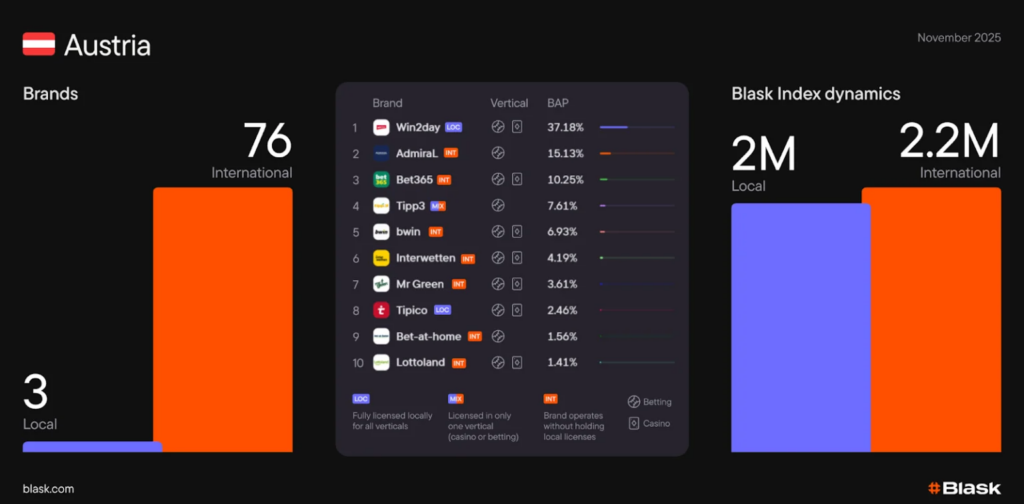
Austria’s case is the most striking. Operating under a monopoly model for online casinos, the country has combined limited consumer choice with minimal enforcement mechanisms.
The outcome, the report shows, is a market where offshore operators now command the majority share — an inversion of regulatory intent.
What emerges from the Blask–NEXT.io analysis is not a moral argument, but a structural one. Enforcement succeeds when it is enforceable, coordinated, and paired with competitive legal products.
It falters when regulation restricts supply without neutralising alternatives, or when political frameworks outrun technical capability.
The full report goes further: quantifying market shares, detailing enforcement tools country by country, and drawing uncomfortable comparisons between regulatory ambition and real-world impact.
It does not prescribe a single European model, but it does make one conclusion difficult to avoid: offshore gambling is not defeated by laws on paper, but by systems that work in practice.
The complete analysis, including country-by-country breakdowns and supporting data, is available in the original NEXT.io feature.
Read the full report: Which enforcement approaches actually curb offshore gambling?