

- Updated:
- Published:
Pennsylvania moves to limit online casinos after $2.77B in annual losses
Pennsylvania lawmakers have introduced a three-bill package against aggressive online gambling. The bipartisan initiative targets three risk areas: deposit frequency, payment methods, and marketing to vulnerable players.
The three-bill package frames gambling harm as a public health issue and gives lawmakers a clearer route to act before player losses turn into another annual record.
Three restrictions in the bills:
- Deposit limits: limits on deposits into online gambling accounts within a 24-hour period, along with a ban on push notifications and text messages encouraging users to gamble.
- Credit card ban: a ban on using credit cards to fund gambling accounts.
- Self-exclusion marketing ban: a ban on marketing to users who have voluntarily added themselves to the self-exclusion register.
One of the initiative’s sponsors, Representative Tarik Khan, argues that gambling addiction should be treated as a public health issue, rather than only as a reason to fine operators.
The trigger was record data from legal online casinos. In 2025, Pennsylvania residents lost $2.77B on these products, up 27% YoY.
Online gambling has already become mainstream behaviour in Pennsylvania: around 30% of adults in the state have gambled online at least once. Against that backdrop, the rise in calls to the problem gambling helpline, especially among younger players, gave lawmakers a direct argument for tightening the rules.
Pennsylvania’s demand is cooling, but the money is still there
Blask data shows why Pennsylvania is proposing restrictions specifically on deposits, credit cards, and player reactivation.
Over the last 12 months, market CEB reached $5.73B, while demand declined: Blask Index fell 8.83% YoY, despite a 21.97% MoM rebound in May 2026. The pattern points to a shift in how regulators read the market: the problem is no longer growth, but how operators monetise existing players.
Pennsylvania’s online casino market is not dominated by a single operator. Blask data shows a distributed structure: 19 brands hold more than 1% BAP, while only three brands cross the 10% threshold — FanDuel, DraftKings, and Hollywood Casino.
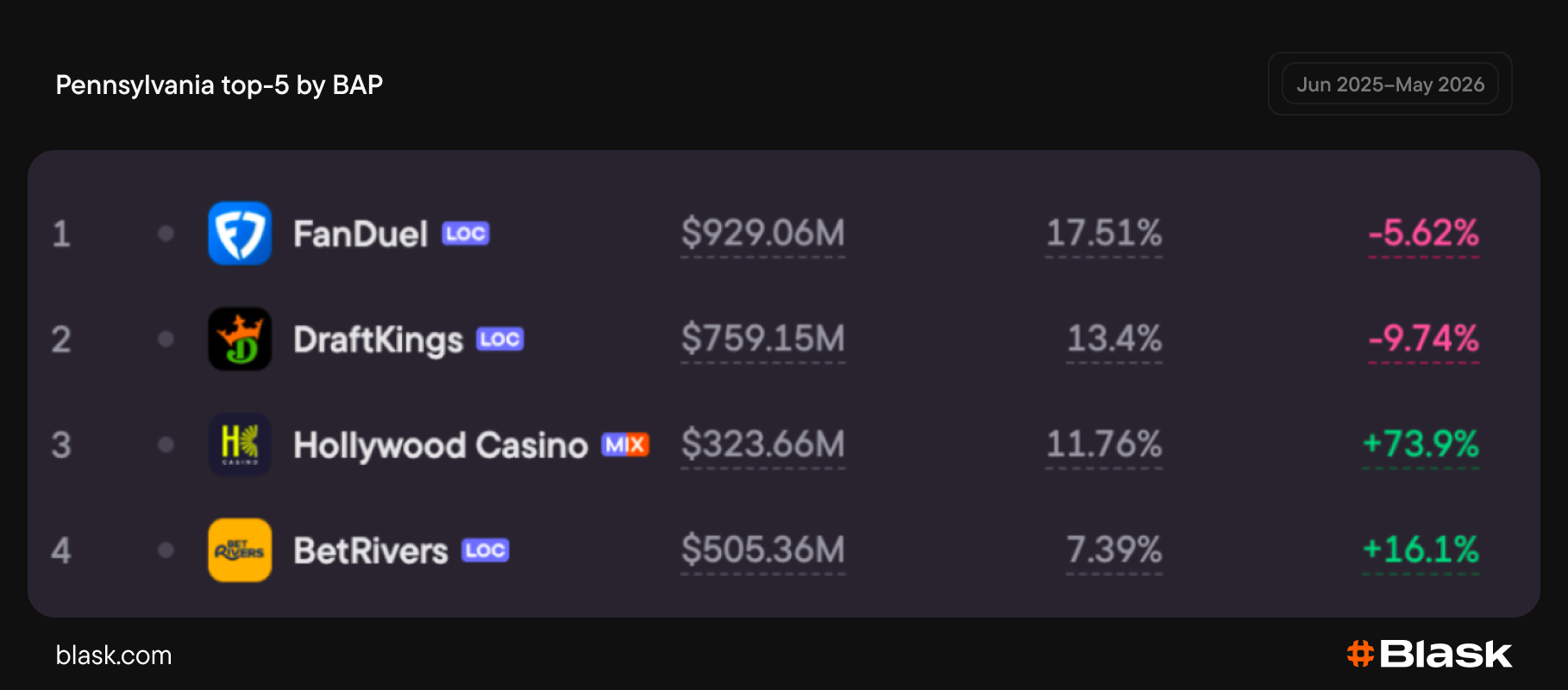
That structure matters for the proposed bills. Restrictions on deposits, credit cards, push notifications, text messages, and marketing to self-excluded players would not hit one dominant brand alone. They would change the retention mechanics across a broad competitive market, where operators rely on repeated engagement.
What the bills would change
If the bills pass, Pennsylvania would restrict online casinos not only through licensing and advertising rules, but at the level of user behaviour. Deposit limits would reduce the frequency of top-ups, the credit card ban would remove a higher-risk payment method, and restrictions on push notifications, text messages, and marketing to self-excluded players would narrow reactivation channels.
For operators, this means fewer tools for retention and player reactivation in one of the largest iGaming markets in the US.