In just two years, two platforms have captured nearly 80% of U.S. demand — turning a fast-growing experiment in wagering into something closer to a financial market structure.
Prediction markets were barely visible in the American gambling economy a few years ago. By the end of 2025, they had become one of its fastest-growing segments — and one of its most concentrated.
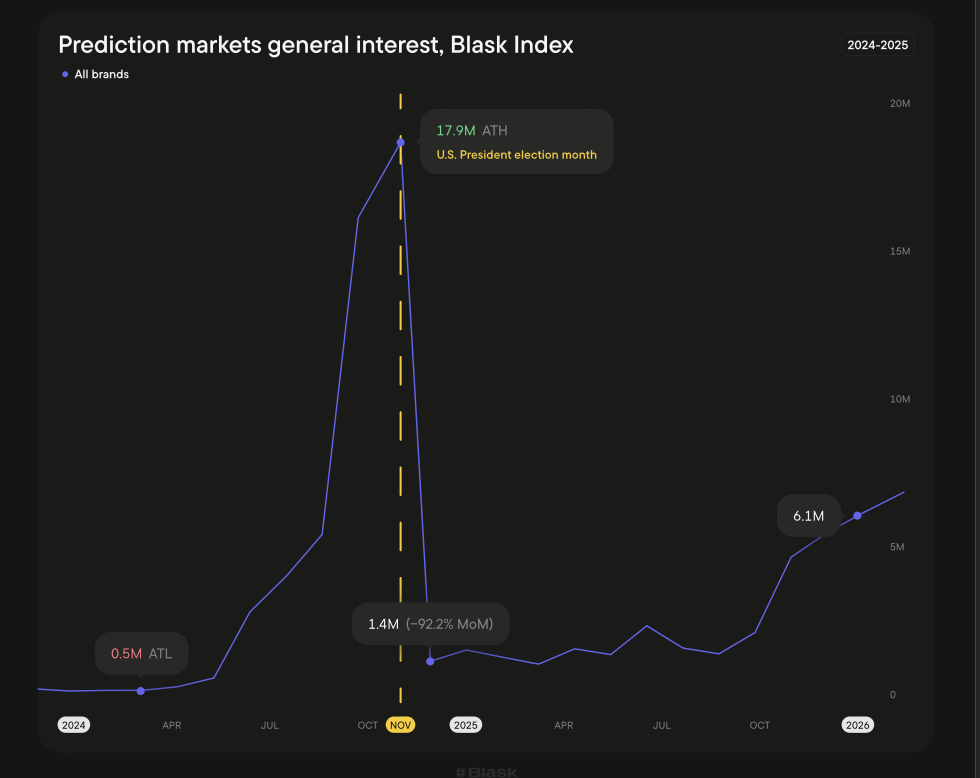
Two platforms now dominate the space. Polymarket, a crypto-native trading venue, and Kalshi, a federally regulated exchange, together controlled about 79% of U.S. Blask Index by the end of the year, according to Blask data.
The surprising part is not just the scale of their lead. It is how quickly the market around them has consolidated. Even as 10 new brands entered the sector in 2025, the overall ecosystem has become less competitive, not more.
How a duopoly formed in a market that barely existed
The rise of Polymarket and Kalshi reflects a pattern common in financial exchanges and online marketplaces: liquidity attracts liquidity.
Prediction markets work best when large numbers of traders are active at the same time. More users mean tighter spreads, faster price discovery and deeper markets. Those conditions attract still more traders.
Once a platform reaches critical mass, that cycle becomes difficult for competitors to break.
In prediction markets, that dynamic has produced a structure that resembles a classic duopoly. The two largest platforms continue to pull activity away from the long tail of smaller entrants.
Polymarket grew despite regulatory turbulence
Polymarket’s dominance is notable partly because of the obstacles the company has faced.
The Commodity Futures Trading Commission forced the platform to shut down its original U.S. operations in 2022. In November 2024, the apartment of the company’s chief executive was raided by the FBI during an investigation related to the platform’s regulatory status. Events like that might have undermined confidence in many financial platforms. Polymarket, however, continued to expand.
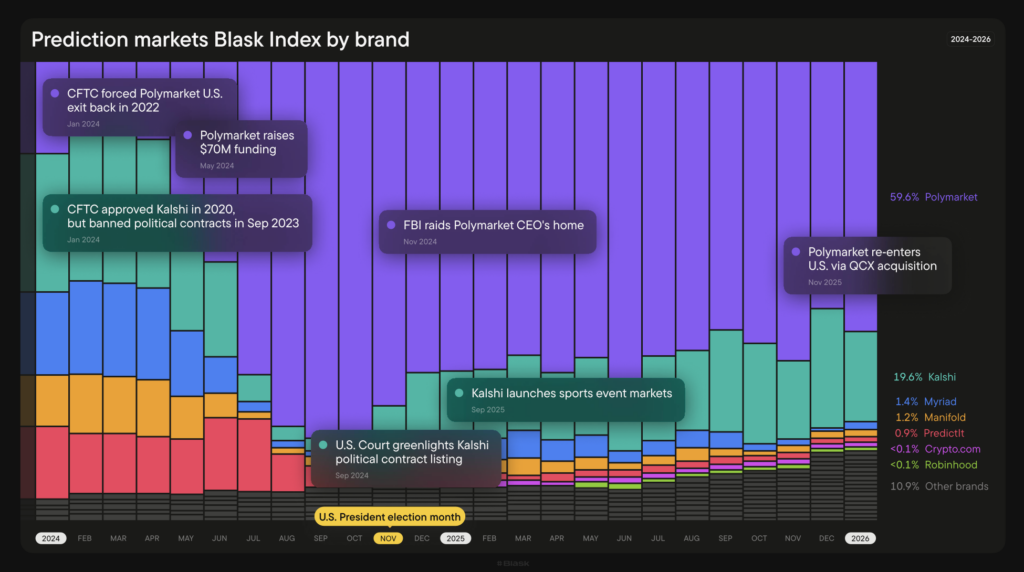
The company raised $70M in May 2024, attracted a large user base during the presidential election cycle and eventually re-entered the U.S. market through a regulated acquisition in November 2025.
By the end of that year, Polymarket accounted for about 59.6% of prediction market demand, according to Blask’s demand signals.
Its users — many drawn from crypto trading communities — appear relatively comfortable operating in environments where regulation remains unsettled.
Kalshi built a different advantage: regulatory legitimacy
Kalshi’s rise followed a more traditional regulatory pathway.
The company became the first prediction market platform approved by the Commodity Futures Trading Commission as a Designated Contract Market in 2020. That approval allowed Kalshi to operate within a federally supervised framework, something no crypto-native competitor had achieved.
But its growth was initially constrained.
In September 2023, regulators blocked the platform from offering political contracts. Kalshi challenged that decision in court and won in September 2024, reopening the door for election markets and expanding the range of contracts the platform could list.
The ruling, combined with Kalshi’s later expansion into sports event markets, accelerated its growth through the second half of 2025.
By the end of the year, Kalshi held roughly 19.6% of prediction market demand.
Smaller platforms are struggling to find scale
Beyond the two leaders, the rest of the prediction market ecosystem remains fragmented and comparatively small.
Platforms such as Myriad, Manifold and PredictIt together account for less than 4% of Blask Index. Even companies connected to major crypto exchanges — including Crypto.com and Robinhood, which both experimented with prediction-style markets — hold shares too small to register meaningfully in the data.
The underlying obstacle is liquidity. Traders tend to gravitate toward the platforms where they can easily find counterparties. Once most activity concentrates in a few venues, competing platforms struggle to attract enough volume to become viable alternatives.
Regulation may reshape the competitive landscape
The structure of the prediction markets industry could still change as regulation evolves.
Several companies are currently seeking CFTC approval to operate as Designated Contract Markets, which would allow them to compete with Kalshi within the same regulatory framework while trying to capture some of the user base that Polymarket has built through crypto-native channels.
At the same time, ongoing court cases may determine how broadly prediction markets are allowed to operate.
Key questions remain unresolved: whether election contracts will remain legal and how regulators will distinguish sports prediction markets from traditional sports betting. Those decisions could either open the industry to broader competition or reinforce the dominance of its current leaders.
The bigger opportunity may extend far beyond sports
Prediction markets remain small compared with the overall U.S. gambling economy. In the $79.8B American online gambling market, they still represent only about 0.1% of total demand.
But their growth has been striking. According to the Blask report, prediction markets expanded 256% in 2025, making them the fastest-growing vertical tracked in the analysis.
And their potential reach may extend beyond sports and elections.
“The underlying mechanism — pricing probability in real time — extends far beyond sports. Sport may be the entry point, but the broader opportunity lies anywhere uncertainty exists.”
Will Martin Chief executive of the prediction markets technology company VANT.