

- Updated:
- Published:
Portugal warns of illegal gambling risks as Blask notes falling offshore demand
Portugal is preparing summer reforms against illegal betting — just as search demand suggests offshore is losing ground.
At the launch of the “Nem tudo o que vês é jogo seguro” campaign, Economy Minister Manuel Castro Almeida put illegal gambling at the centre of the debate. He estimated legal online gambling at around $27,8B, with the illegal segment accounting for “just as much,” and warned that this shadow market is “growing very fast,” destroying families and hitting the economy. After Parliament rejected Livre’s proposal to tighten the regime, the government promised a new rule package this summer — featuring stronger oversight, blocking, and prevention of digital fraud.
Blask data does not confirm rapid offshore growth in Portugal. Since the end of 2025, international demand has remained roughly on a plateau, with a slight decline after December. In May 2026, local brands held 92% of the market CEB.
Regulator’s rhetoric and search demand diverge
Portugal is a mature regulated market where online casinos and sports betting are licensed by SRIJ (Serviço de Regulação e Inspeção de Jogos). Blask data shows no surge in offshore demand, despite the minister’s warnings about shadow-market growth.
- Falling offshore share: Over the past 12 months, the share of international operators in Blask Index decreased by 5 percentage points — from 17.1% to 12.17%. Since the end of 2025, this demand has hit a plateau, showing a slight decline after the winter peak.
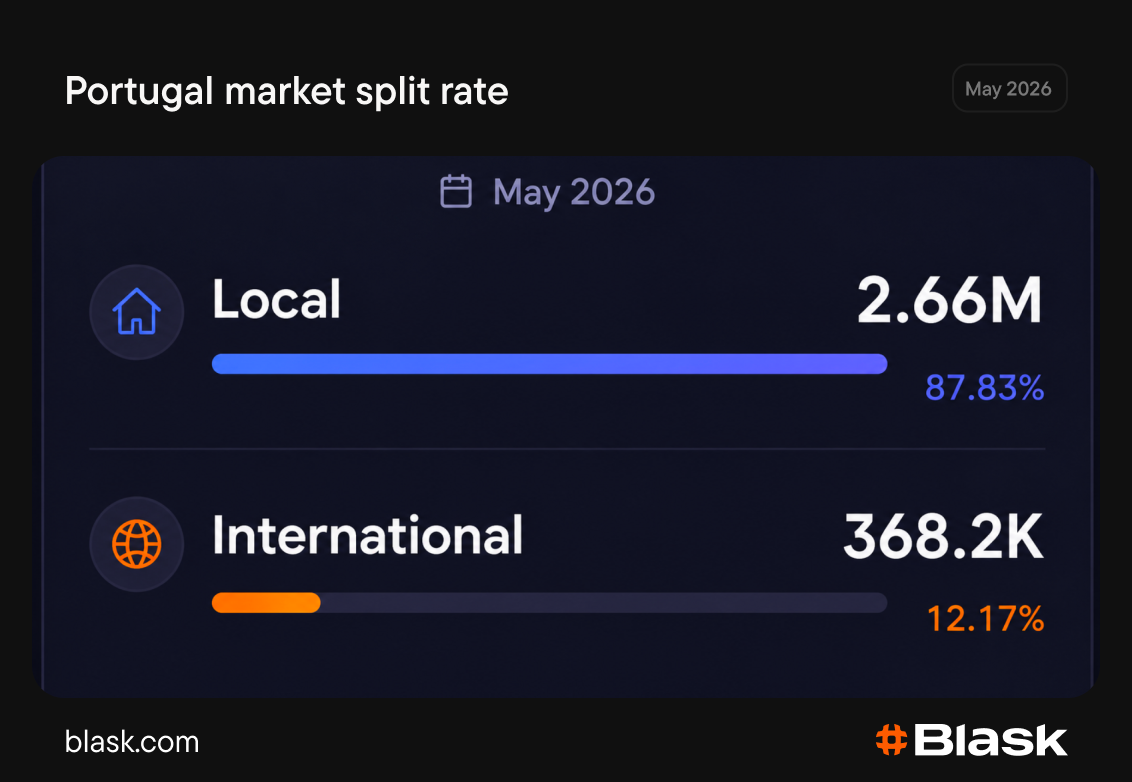
- Projected revenue breakdown: Licensed operators generate around $103.7M–$111.3M of monthly CEB (approximately 92% of the market in May 2026). International offshore brands account for just $8.5M–$9.08M, which refutes the minister’s words about an equal market split.
Native shift to the legal segment
Although a grey segment persists in Portugal, user intent is already firmly concentrated around licensed operators. The summer enforcement package may sharpen blocking and oversight, but with licensed brands holding the vast majority of CEB, most branded demand in the country is already channelled through legal channels.