Prediction markets in U.S. — platforms where users trade contracts on the probability of future events, from election outcomes to sports results — expanded sharply in 2025. A boom that many expected to collapse after the 2024 presidential vote instead evolved into one of the fastest-growing segments of the online gambling economy.
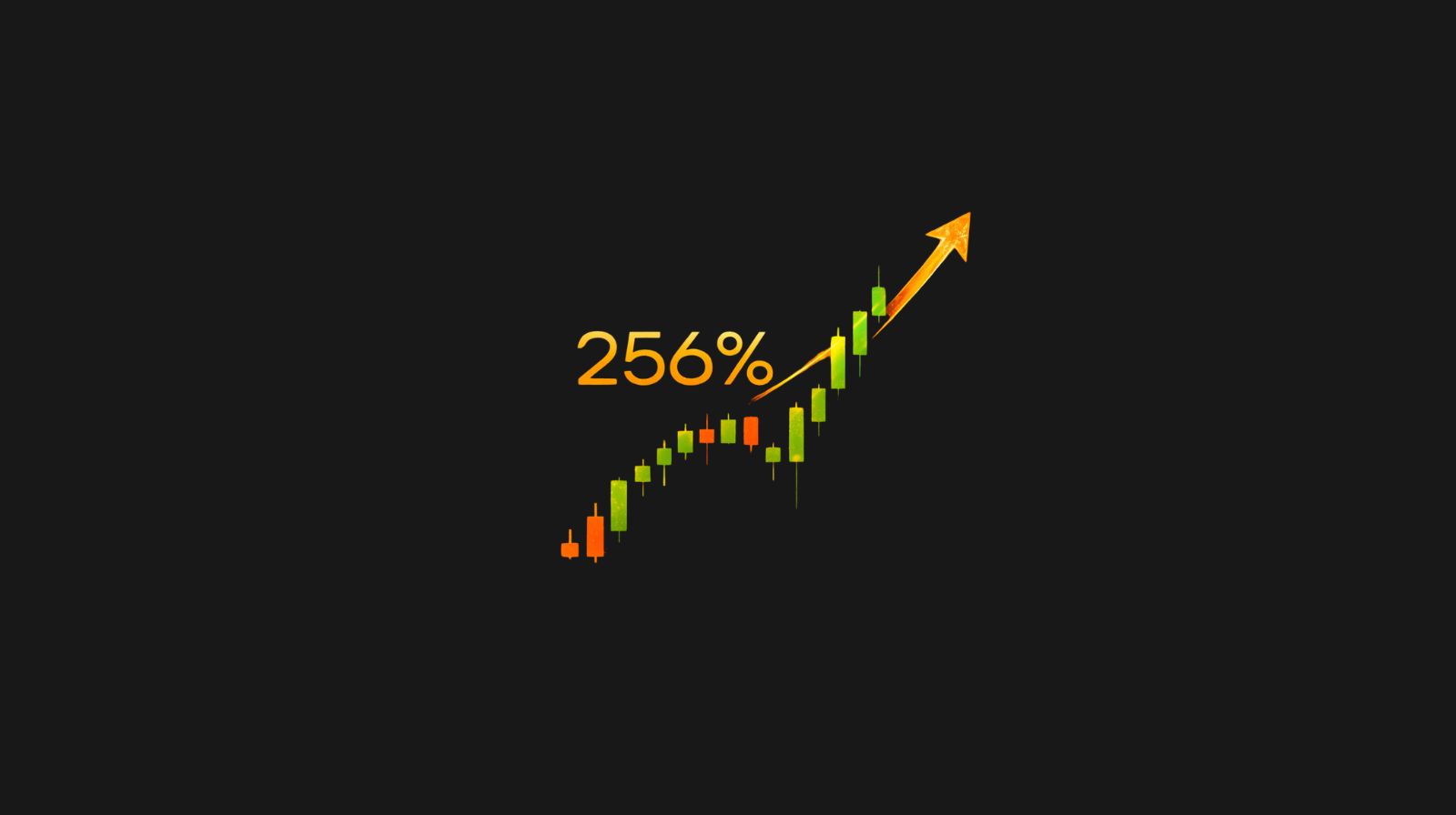
According to data from Blask, demand for prediction markets grew 256% between January and December 2025 on the company’s Blask Index. What once appeared to be a niche driven by election speculation is now developing into a broader wagering ecosystem that increasingly overlaps with sports betting.
The shift suggests that prediction markets may be moving beyond political cycles — and toward becoming a permanent feature of how Americans bet on uncertainty.
The election that put prediction markets on the map
The modern surge in prediction markets began with the 2024 U.S. presidential election.
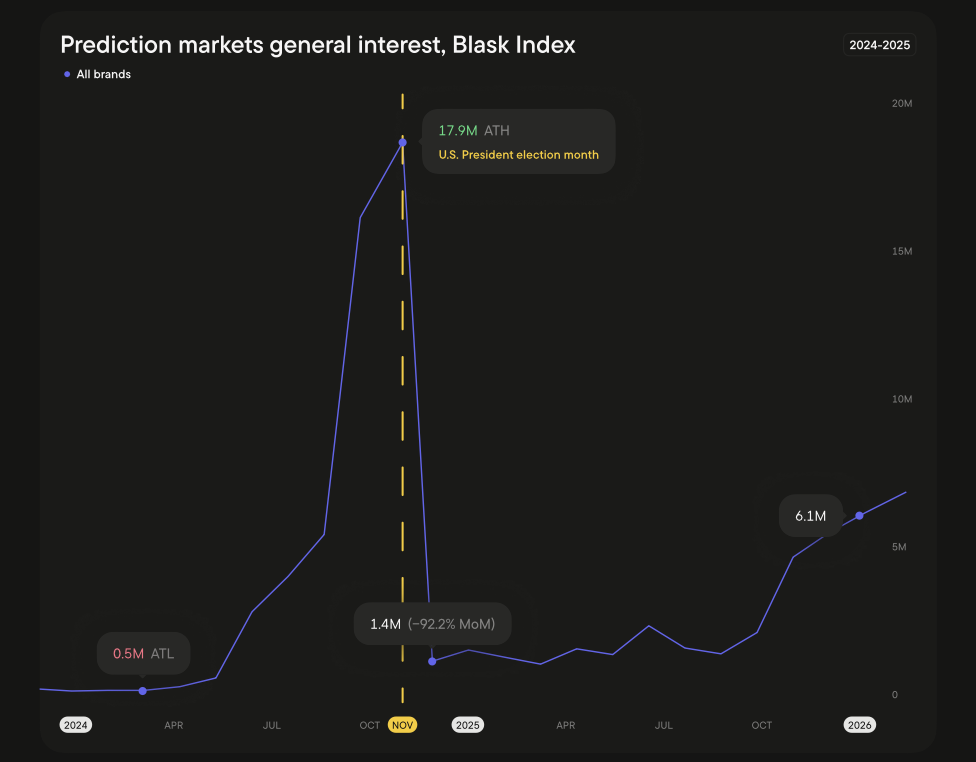
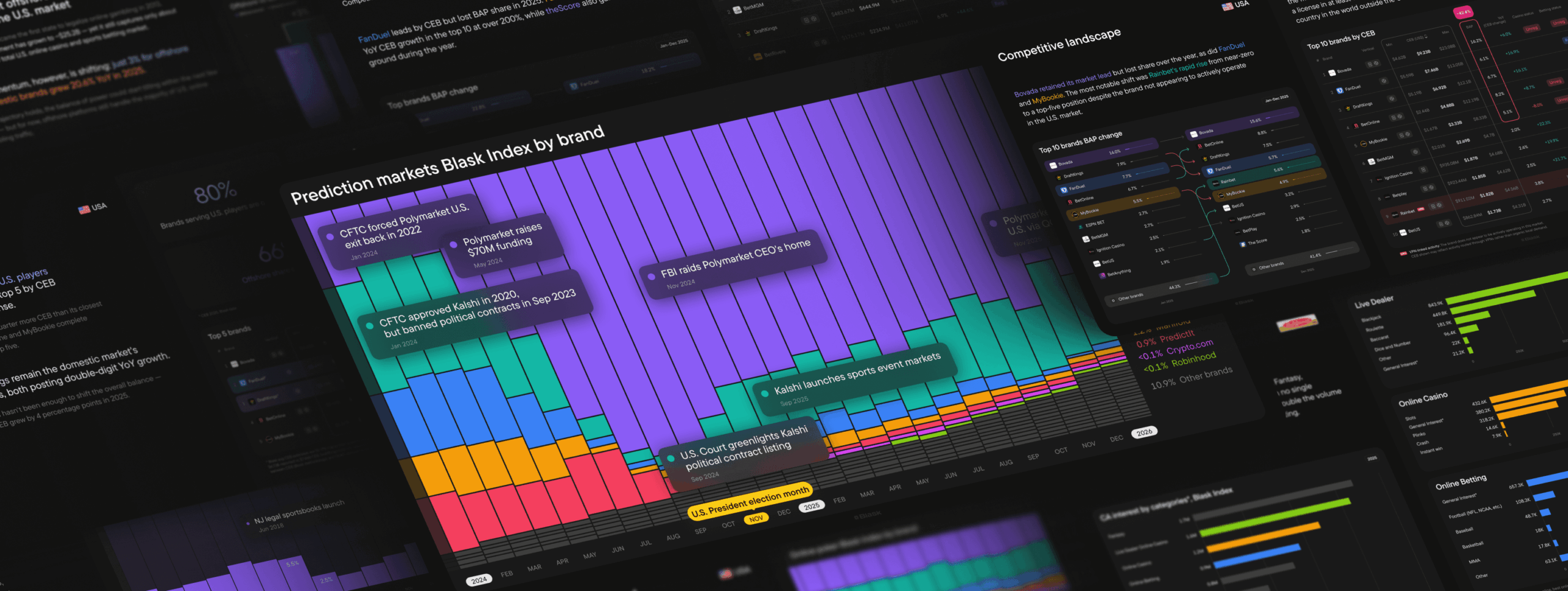
Interest on the Blask Index metric reached 17.9M in November 2024, the highest level ever recorded for the vertical, as users flocked to platforms such as Polymarket and Kalshi to trade contracts on electoral outcomes.
The spike was dramatic but unsurprising. Major political events have historically driven short-term speculation on prediction platforms.
What came next seemed equally predictable.
By December 2024, demand collapsed by more than 92% MoM, falling to 1.4 million units. The decline appeared to confirm what many analysts believed: that prediction markets were largely an election-driven phenomenon.
But the collapse did not last.
Sports turned a political tool into a year-round product
The next phase of growth arrived through sports.
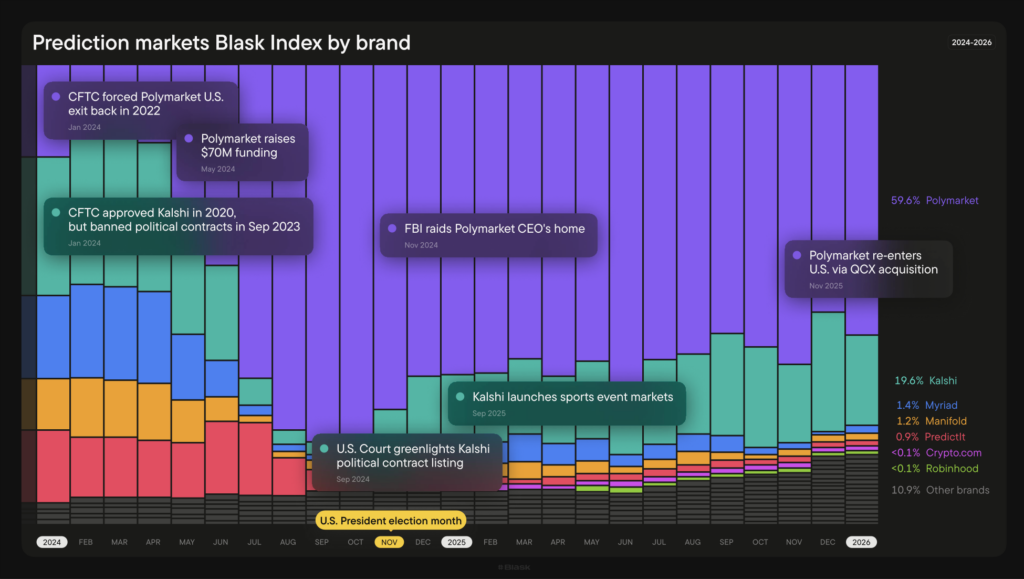
In September 2025, Kalshi expanded its markets to include sports-related contracts following a legal victory that cleared the path for broader contract types. That shift introduced prediction markets to a much larger audience: sports bettors.
By December 2025, Blask Index had climbed back to 6.1M. The number remained far below the election peak, but it was more than four times higher than the post-election trough a year earlier.
Prediction markets Blask Index by brand
In other words, the vertical had stabilized at a much higher baseline. What once looked like a political novelty had begun to resemble a permanent betting format.
A different way to bet on outcomes
Prediction markets differ from traditional sportsbooks in one important way: they treat odds as continuously tradable probabilities.
In a conventional sportsbook, bettors place wagers at fixed odds before the event begins.
Prediction markets operate more like financial exchanges. Prices move constantly as traders buy and sell contracts reflecting the probability of an outcome.
For experienced bettors — and for users accustomed to financial trading — that structure can be appealing.
“When price is expressed directly as probability, markets become more than a wagering mechanic — they become a real-time signal of collective belief,”
Will Martin
chief executive of the prediction markets technology company VANT.
The model allows users to adjust positions during an event rather than simply betting on a fixed outcome before it begins.
A market already consolidating around two platforms
Despite a growing number of entrants, prediction markets are consolidating quickly around a handful of major platforms. According to Blask data:
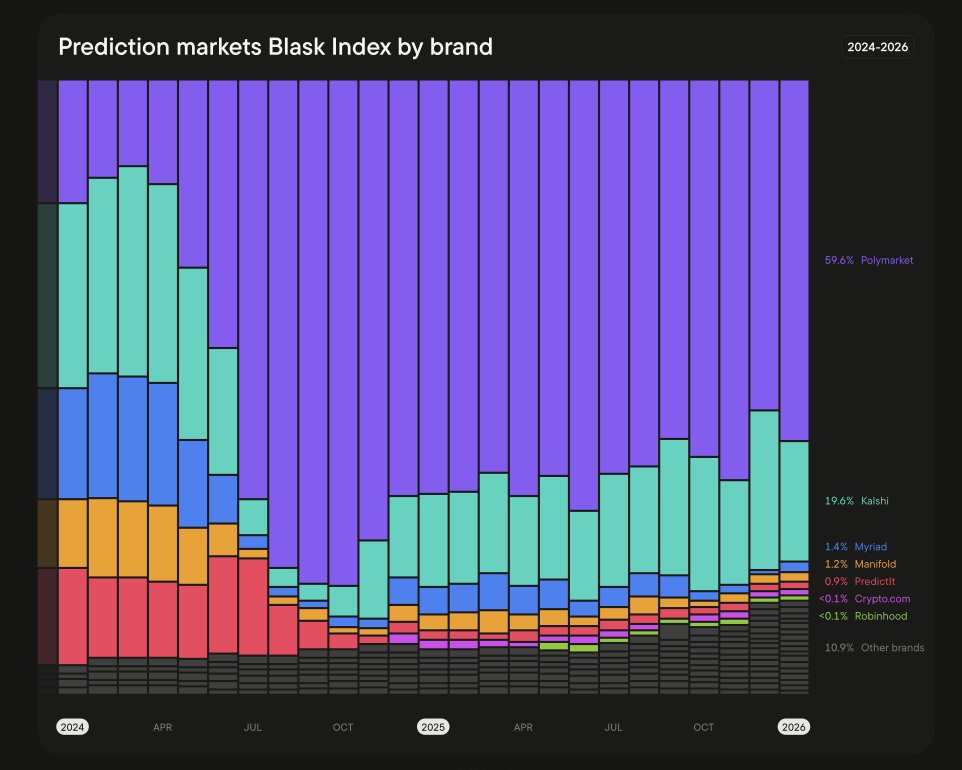
Polymarket accounts for approximately 59.6% of total prediction market demand
Kalshi holds roughly 19.6%
Together, the two platforms control nearly 80% of the vertical. The dynamic resembles other financial marketplaces, where liquidity tends to concentrate around a small number of dominant exchanges.
Even though 10 new brands entered the space in 2025, smaller platforms have struggled to capture meaningful share.
Regulation is still catching up
The legal status of prediction markets remains complex.
Kalshi first received approval from the Commodity Futures Trading Commission (CFTC) in 2020 but was later restricted from offering political contracts. That restriction was overturned in September 2024, allowing the company to expand its offerings.
The broader regulatory environment remains unsettled. Several jurisdictions are exploring compatible frameworks, and ongoing litigation continues to shape how prediction markets will be governed.
By early 2026, at least 17 platforms were operating actively, with roughly 20 additional platforms reportedly preparing launches.
“There is a lot of litigation ongoing and it will take time for the dust to settle”
Evan Fisher
Сhief operating officer of the prediction markets technology company Sparket.
Still, he noted that the regulated sector is beginning to explore how elements of the model could be integrated into traditional gambling products.
A new audience for online wagering
Prediction markets may also attract a slightly different audience than traditional sportsbooks.
Because the format resembles financial trading — with probabilities expressed as prices and positions traded over time — it appeals not only to bettors but also to users comfortable with speculative markets.
That hybrid structure could expand the overall online wagering audience rather than simply shifting users from sportsbooks to prediction platforms.
If that happens, prediction markets may not replace traditional betting. They may instead represent a new layer of the gambling economy — one built around trading the future itself.
Over the past two months, Blask released two reports, launched state-level drill-downs for the United States, Canada, and Australia, surpassed 5,000 tracked operators, launched a new podcast, and won an award. New reports Blask released two major reports during February and March. The first, USA & Canada iGaming Landscape 2025: The Offshore Reality, breaks down […]
Bolivia’s 2–1 win over Suriname in the FIFA World Cup qualifying playoffs triggered a 15.2% spike in iGaming demand across the country. It’s the clearest example yet of how football moments move betting interest in unregulated LATAM markets — and the final against Congo is today.
As armed conflict escalated across the Middle East in late February 2026, iGaming search demand in Qatar and the UAE dropped sharply. Blask data shows the decline deepening week over week — and spreading toward Azerbaijan. This is what macro risk looks like in iGaming data.