

South Korea will pay citizens up to KRW 600K ($436) to report illegal betting sites before the 2026 World Cup. Blask data shows offshore brands already hold 83% of search demand.
The payment and data collection program will run until July 31. During this period, citizens and industry participants can report illegal sites through the monitoring portal or a special hotline. After verification, all reports will be forwarded to the National Police Agency and the Korea Communications Standards Commission (KCSC) for the immediate blocking of resources.
Terms and reward amounts:
- 10,000 KRW ($7) — for a report that leads to the blocking of a site.
- 50,000 KRW ($36) — if the report includes the operator’s bank details.
- Limit: one person can receive no more than 600,000 KRW ($436) per month.
To qualify for a payment, applicants must attach solid evidence: screenshots of bets, deposits or withdrawals, as well as login details for the site. All money for blockings carried out before the end of August will be paid in one payment in September or October.
Commission head Choi Byung-hwan described the campaign as protection of “public health”, intended to preserve the 2026 World Cup as a “healthy sports festival.”
Offshore operators already dominate Korean demand
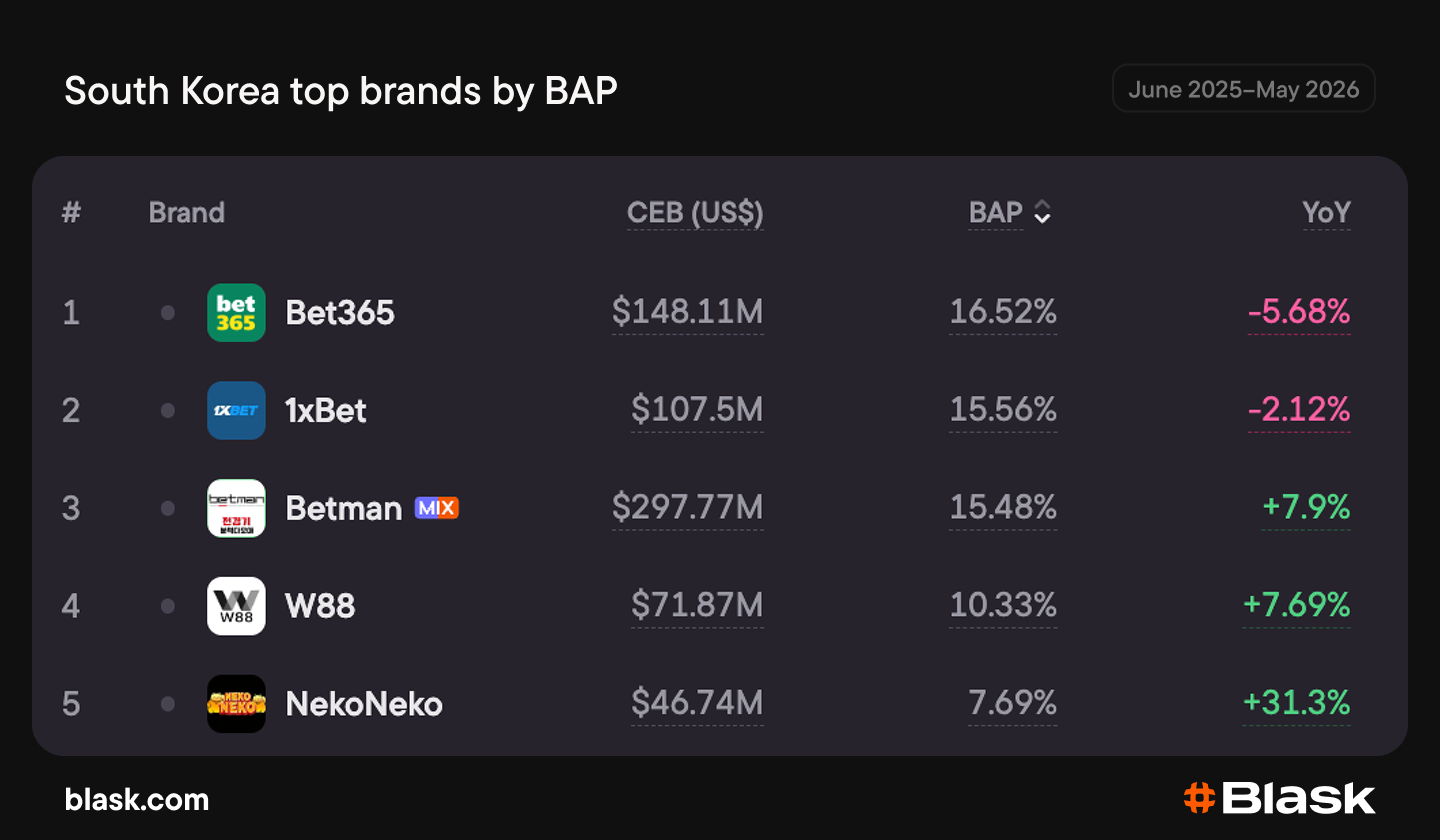
South Korea’s tight gambling rules have left the legal market struggling to compete: Sports Toto caps individual bets at KRW 100K ($72), while online casinos remain fully banned. Betman is still the largest individual brand by CEB, with $298M over the past year, but the broader market has already shifted offshore — international operators account for more than 80% of branded search demand, according to Blask Index data, and around 70% of total CEB.
Blask tracks 85 brands in the country, and over the past year their combined CEB reached $1B. In May, the licensed segment accounted for roughly 17% of branded search demand and $24M in monthly CEB, compared with $53M for offshore operators.
The top five confirm the offshore shift. International brands hold four of the five largest positions by BAP, led by Bet365 and 1xBet, while Betman is the only local operator in the group. It remains the strongest domestic brand by CEB, but demand leadership has already moved offshore.
Site blocks add reporting capacity but leave the product gap open
Domain blocks can take down individual sites, but they do not change the structure of demand. Offshore brands still control more than 80% of BAP in Korea, and mirror domains typically return within weeks.
With the World Cup set to drive a surge in iGaming interest across July and August, Sports Toto’s KRW 100K cap and absent online casino product leave the legal sector structurally unable to absorb that demand. International platforms offer sports betting and casino under a single account, typically without any betting limits; the GCC program adds a reporting channel, but does not close the gap.