
- Updated:
- Published:
Tanzania’s new betting tax risks widening the offshore gap
Starting July 1, Tanzania will introduce a 5% excise duty on all gambling stakes, increasing the tax burden on licensed operators and sharpening an already existing imbalance in favour of the offshore segment.
In Tanzania’s 2026/27 budget, presented to parliament on June 11 by Finance Minister Hamis Musa Omar, a new 5% excise duty on the value of all gambling stakes is included. The tax covers all formats: land-based and online sports betting, casinos, gaming machines, forty-machine operations, and virtual games. The measure takes effect on July 1.
The government expects to collect an additional $28.4M in the first year. Ten percent of this sum goes to the Gaming Board of Tanzania (GBT) — to strengthen regulatory capacity and fund problem gambling programms.
Tanzania’s market is growing, while offshore is gaining weight
Tanzania remains a predominantly local and regulated gambling market. According to Blask data for the 12 months to May 2026, 50 active brands generated a combined CEB of $329M, with BetPawa accounting for around 62.7% of the market. SportyBet and Betway ranked second and third, consolidating the licensed core.
Offshore demand remains modest — below 1% of the total market — but is growing faster than the licensed segment. From June 2025 to May 2026, the offshore Blask Index rose by 108%, while licensed operators expanded by just 53%. The clearest example is 1win, which entered the market without a local licence in April 2024 and by May 2026 had reached 15th place by BAP and 10th by CEB.
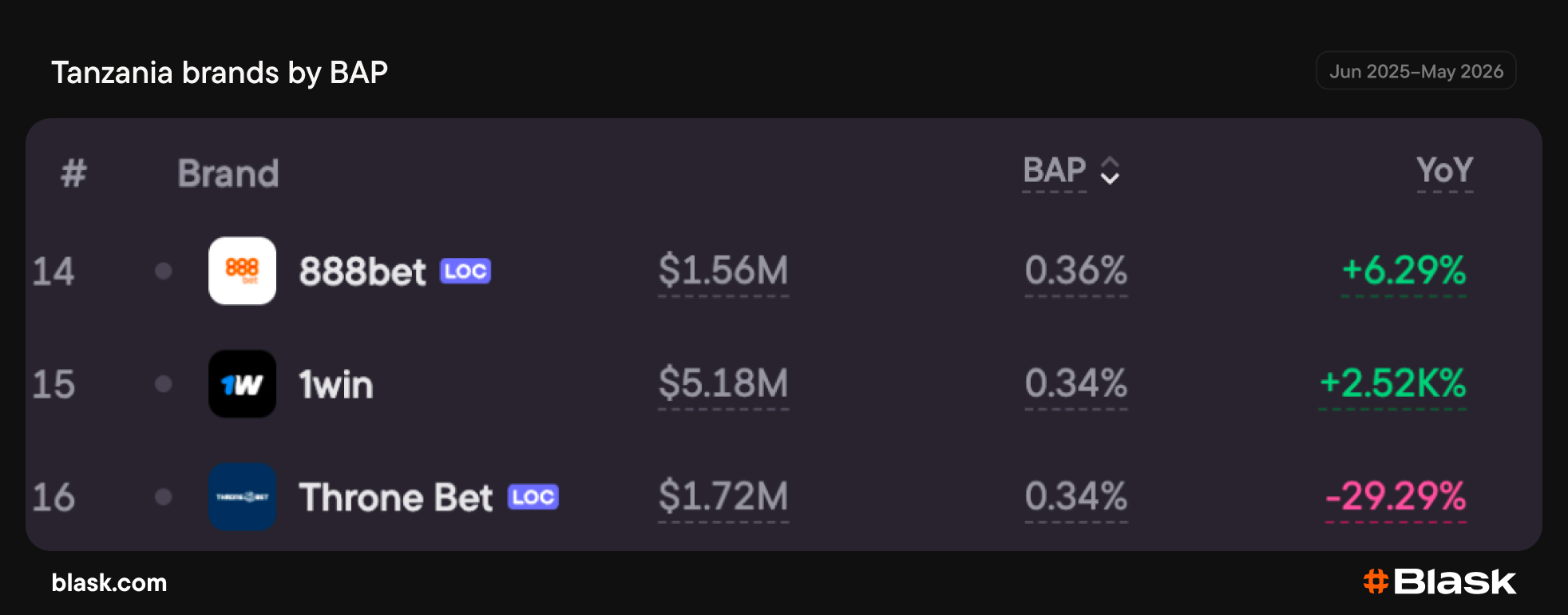
The new 5% excise arrives in a market where offshore pressure remains limited but is already accelerating. Unlike a GGR tax, a stake-based levy is visible to the player on every single bet — it can widen the cost gap between licensed platforms and offshore alternatives.
Kenya has already demonstrated the risk of this model: after a similar tax was introduced and subsequently raised, several licensed operators exited the market and betting tax revenues fell as activity shifted out of the regulated sector. The rate in Tanzania is lower, but the mechanism is the same.