Six years of Blask Index data show the UK market follows a repeating schedule: one spike the day before Cheltenham Festival, one spike five days before the Grand National. The pattern holds across pandemic years, regulatory cycles, and shifting competitive landscapes.
Open Blask Index for the United Kingdom and set the timeline to any year between 2020 and 2025. Two peaks appear somewhere between late February and mid-April. They are the largest demand spikes of the year for most iGaming operators in the market.
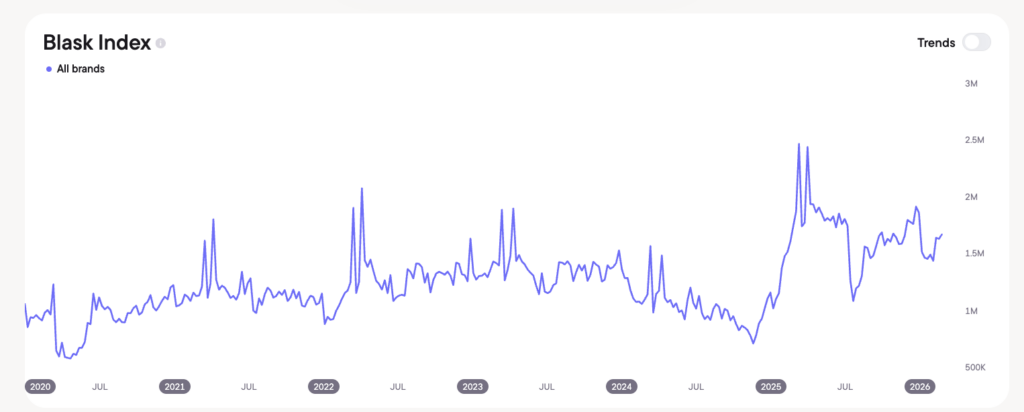
The peaks are not random. They are not correlated with legislative changes, bonus regulation cycles, or Premier League results. They correspond, with remarkable consistency, to two events in the British horse racing calendar: the Cheltenham Festival and the Grand National at Aintree.
What makes the pattern useful is its precision. The first spike does not land during Cheltenham — it lands the day before it opens. The second spike does not land on Grand National Saturday — it lands five days earlier. The same lag, year after year.
The pattern
Cheltenham Festival is a four-day National Hunt meeting held in Gloucestershire each March. It is the sport’s biggest event by attendance: 250,000 visitors over four days, with online viewership that dwarfs those numbers. Grand National follows three to four weeks later at Aintree — the most watched horse race in the UK, with an audience that extends well beyond regular racing followers.
Both events generate the largest single-event betting volumes in the British calendar. Cheltenham attracted more than £450 million in wagers in 2026; Flutter’s network alone processed 34 million bets across the four days. Grand National week follows the same trajectory.
The Blask Index picks this up not as an event signal, but as a demand-behavior signal. The spikes do not represent what happens during the races — they represent what happens before them, when millions of users open accounts, place early bets, and interact with brands they will not touch again until the following year.
Spike 1: the Cheltenham eve effect
Every year from 2021 through 2025, Blask Index demand in the UK reached its seasonal peak on the day before Cheltenham’s opening Tuesday:
| Year | UK Blask Index spike | Cheltenham opens | Gap |
|---|---|---|---|
| 2025 | March 10 | March 11 | −1 day |
| 2024 | March 11 | March 12 | −1 day |
| 2023 | March 13 | March 14 | −1 day |
| 2022 | March 14 | March 15 | −1 day |
| 2021 | March 15 | March 16 | −1 day |
The mechanics behind this are consistent across the industry. Cheltenham is the single biggest acquisition window in UK racing. Optimove’s data shows the festival drives a fourfold surge in new bettor acquisition compared to a normal day.
Operators run their most aggressive acquisition campaigns in the week leading up to the opening day. Users who haven’t placed a bet in months register, verify, and deposit in the 24 hours before racing begins. The demand peak is a registration event as much as a betting event.
By Tuesday morning, when the first race runs, most of that user activity has already happened. The spike is the preparation, not the race.
Spike 2: the Grand National declaration window
The Grand National pattern follows a different mechanism, but the consistency is just as clear:
| Year | UK Blask Index spike | Grand National | Gap |
|---|---|---|---|
| 2025 | March 31 | April 5 | −5 days |
| 2024 | April 8 | April 13 | −5 days |
| 2023 | April 10 | April 15 | −5 days |
| 2022 | April 4 | April 9 | −5 days |
| 2021 | April 5 | April 10 | −5 days |
Aintree publishes the final race declarations — the confirmed list of horses entered to run — six days before Grand National Saturday. One day after that announcement, media coverage accelerates, odds shorten, and casual bettors enter the market. The declaration triggers the demand spike.
This matters for campaign planning. By the time Grand National Saturday arrives, the window for acquisition is largely closed.
Operators who time bonuses and registration incentives to the race itself are competing for an audience that committed its bets five days earlier.
2020: the exception that confirms the pattern
The 2020 data looks different on the chart. Two peaks, but shifted — March 16 and March 30 — with no obvious event alignment.
Cheltenham ran that year on schedule: March 10–13, with crowds attending despite early pandemic warnings. The spike on March 16 does not sit before the festival — it arrives three days after it closed. That date is when the UK government issued COVID guidance against large gatherings, and when the Grand National was officially cancelled. The cancellation generated its own news cycle, driving unusual search behavior toward online alternatives on the same day.
The March 30 spike followed the first week of national lockdown, announced March 23. With physical betting shops closed and sports cancelled, UK gambling audiences shifted online. The Gambling Commission was already tracking the effect by month end. By May, search interest in online casinos had hit an all-time high in the UK. The spike pattern held, but its cause was a structural redistribution of attention rather than a pre-event buildup.
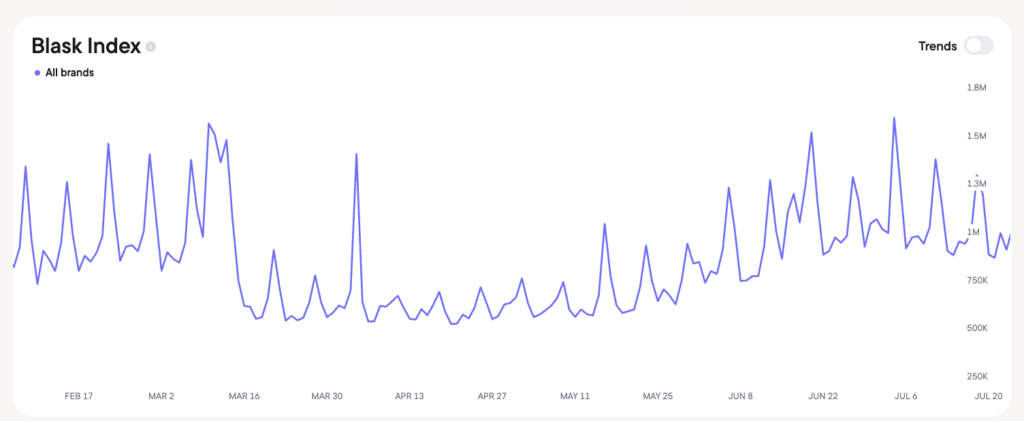
2020 is not a failure of the pattern — it is a stress test that shows what displaces it: a once-in-a-generation closure of the physical betting economy.
What this tells operators about UK campaign timing
The consistent lag between spikes and events is a planning input, not just an observation.
- For Cheltenham: the effective acquisition window opens around 10 days before the festival and closes on the opening Tuesday morning. Campaigns launched after Monday evening are competing for users who already have accounts. Operators who run registration incentives during the festival week — while the racing is live — are spending against an audience that made its decisions in the preceding week.
- For Grand National: the declaration window is the trigger. Declarations drop six days before the race. The demand spike follows within 24 hours. Operators who want to capture that peak need campaigns ready to go live the moment the horse list is published — not the following Monday.
This does not mean the races themselves are irrelevant to commercial performance. Retention campaigns, bonus mechanics for existing customers, and in-play products all perform during the events. But acquisition — new registrations, first deposits, first bets from lapsed users — concentrates in the windows the Blask Index identifies.
What the Blask Index is measuring here
The UK spikes are a demonstration of what the Blask Index captures at the market level: behavioral demand from real users, aggregated across brands, before internal operator data is available.
An operator watching their own registration numbers sees the spike when it arrives. The Blask Index shows the market-level signal — across all tracked brands simultaneously — which means the pre-event build-up is visible before any single operator has confirmed it in their own data.
For a market intelligence tool, the value of that lead time is in planning: aligning creative, budget, and capacity to the window where the market is actually moving.
Read more: What is the Blask Index — and what does it actually measure?
The UK calendar, year after year
Two events. One pattern. The Blask Index maps both with enough precision to put dates on a planning calendar twelve months in advance.
Cheltenham 2026 ran March 10–13. The spike landed on March 9. Grand National follows on April 11, 2026. Based on six years of data, the Blask Index spike for the Grand National window should arrive around April 6.
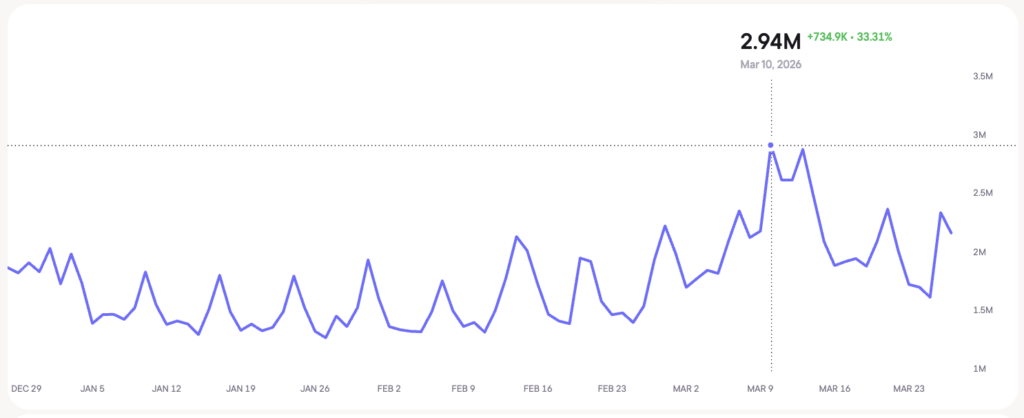
The UK iGaming market is not predictable in general — competitive intensity, regulatory pressure, and product cycles all introduce variance. But for two weeks each spring, the demand pattern is about as foreseeable as it gets.