
The UK Blask Index dropped sharply between December 1, 2025 and February 1, 2026. Mean daily market interest fell from 51.48 million to 43.50 million — a 15.5% contraction in six weeks. Median interest moved from 51.64 million to 46.92 million.
That’s not seasonal noise. Three distinct forces converged at once: a structural regulatory reset, a tax shock that changed operator behaviour immediately, and an Atlantic storm that knocked out power across the country for three days.
Here is what actually happened — and what it means for anyone competing in the UK right now.
The Numbers First
Blask Index tracks real-time player search interest across every licensed brand in a market, updated hourly. It’s the closest live proxy for where player attention — and acquisition spend — is going.
In the UK, the December–January period normally holds relatively steady before the spring Premier League phase lifts the market again. This cycle was different.
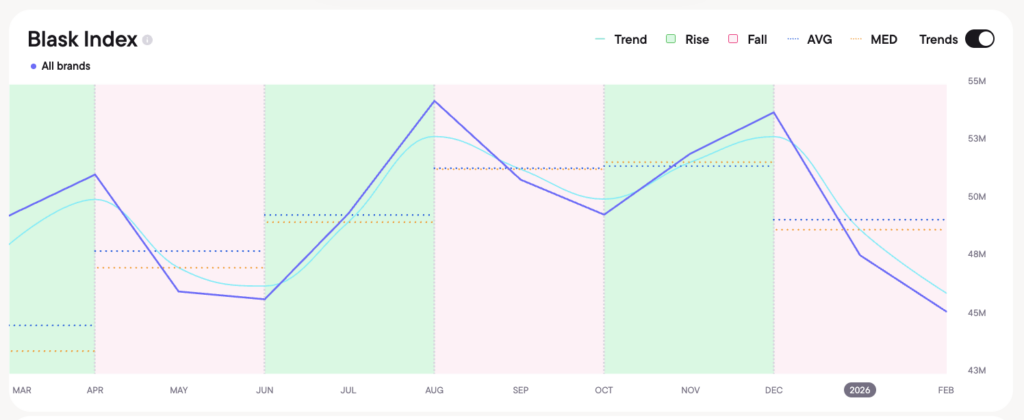
The mean-median gap — a useful signal of distribution skew — narrowed sharply. When the mean falls faster than the median, it means the high-intensity days are disappearing. That is exactly what happened: the strong spikes that normally accompany big sporting weekends and promotional surges simply weren’t there.
January 19, 2026 is the single most notable date in the data. The index dropped visibly on that day. It was not a coincidence.
Force 1: The Regulatory Reset
On January 19, 2026, the UK Gambling Commission’s revised License Conditions and Codes of Practice took effect. The changes were extensive. Two had immediate measurable impact on market interest.
The 10x wagering cap.
Every bonus — free spins, free bets, matched deposits — now carries a maximum 10x playthrough requirement before withdrawal. The previous industry norm was 30x to 50x. For context: a 35x requirement keeps a player engaged for an average of 14 days; a 10x requirement brings that to two. Bonuses now expire in seven days instead of thirty.
The commercial arithmetic changed overnight. Operators could no longer use deep wagering requirements to extend session length and maximise retention from a single promotional cycle.
According to H2 Gambling Capital, UK online GGR in February 2026 fell 4.2% year-on-year — slots down 7%, sports up 2% — with bonuses now representing 22% of acquisition spend, down from 35%.
The mixed-product incentive ban.
Operators can no longer bundle cross-vertical offers: no casino-with-sports free bet, no slots voucher tied to a bingo deposit. Each vertical now stands alone. The cross-sell mechanics that drove a meaningful share of multi-product player journeys were turned off in a single administrative update.
The UKGC did not act in isolation. Two months earlier, on November 26, 2025, the UK’s Autumn Budget announced that Remote Gaming Duty — the primary online gambling tax — would rise from 21% to 40%, effective April 2026. A further increase in General Betting Duty to 25% for remote wagers follows in 2027.
The industry’s reaction was immediate and specific.
- Evoke plc (William Hill, 888) pulled its full-year financial forecasts, warned of thousands of UK job cuts, and exited online operations in 13 non-UK markets within a week of the Budget announcement. Its incremental annual tax burden: £125–135 million.
- Flutter Entertainment (Paddy Power, Betfair, Sky Bet) announced a “significant reduction in investment into the UK” and projected £650 million in additional costs over two years. Sky Bet’s headquarters relocated to Malta before the Budget — a decision that saved Flutter an estimated £55 million in UK exposure.
- Entain (Ladbrokes, Coral, bwin) faced approximately £200 million in additional annual costs. Its share price fell 12% on announcement day. Shares across the sector fell so sharply that analysts called it a “stock market bloodbath”: Evoke dropped 18% the day of the announcement, then 10% more the day after.
Force 2: The Sports Calendar Gap
The UK betting market runs on sports. The Premier League provides its backbone, but the December–January window traditionally benefits from three additional scaffolding events: the PDC World Darts Championship, AFCON, and the Boxing Day football slate.
In the 2025–2026 cycle, all three underperformed their historical norms.
PDC World Darts Championship concluded on January 3, 2026. The tournament is a significant betting catalyst — played across the Christmas and New Year period, it drives consistent daily wagering from a highly engaged niche audience. Its conclusion removed that driver just three days into January.
Boxing Day Premier League. In a normal year, multiple Premier League fixtures are scheduled on December 26, creating one of the highest-volume betting days of the calendar. In 2025, broadcast deals and scheduling left only a single match: Manchester United versus Newcastle United. United won 1–0. The usual multi-fixture bonanza that drives a late-December index spike did not materialise.
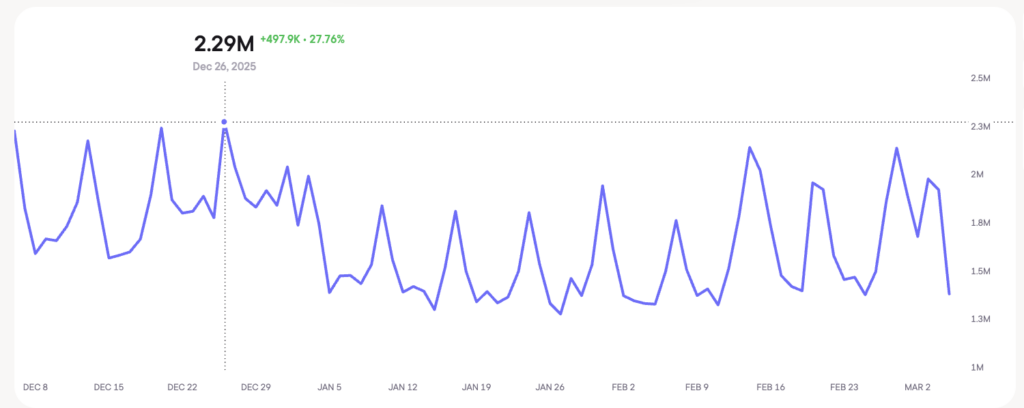
The UEFA Champions League group stage had concluded before December; the Carabao Cup was past its high-attention rounds. The sport content available to drive player acquisition and re-engagement was thin.
Force 3: Storm Goretti
Between January 8 and 10, 2026, Storm Goretti tracked across the British Isles. Power outages were widespread. Transport networks were disrupted. Retail betting was effectively suspended in affected areas for key weekend hours — a period that normally generates consistent wagering activity.
The storm’s direct effect on online behaviour is harder to isolate than a regulatory change or a sports blackout, but it compressed already-weak market interest during a window that should have been recovering. January 8–10 fell in the middle of the sports calendar gap described above, amplifying the dip.
One Click to the Explanation
The analysis above is exactly what Blask’s Market Explanation surfaces inside the platform — automatically, for every trend segment, across every market Blask tracks.
Click any trend segment on the Blask Index chart and the system returns a structured brief: an overview of the cycle, categorised drivers (sports, regulation, payments, macro), a table of specific events with dates, and numbered citations. It regenerates four times daily. No research required.
The UK decline of December–January 2026 is the kind of pattern that looks like noise until you understand what was happening with tax policy, promotional economics, and the sports calendar at the same time. Market Explanation connects those threads in one click.
That is the difference between knowing the market moved and understanding why.